“Indian Food” Is a Useful Label—and a Misleading One
Outside India, a restaurant menu may place butter chicken, dosa, biryani, samosa and vindaloo under one heading: Indian food.
The label is understandable. But as a description of how more than a billion people actually eat, it is far too broad.
India’s cuisines developed across deserts, Himalayan valleys, river plains, tropical coasts, forested hills and large cities. Communities grow different grains, speak different languages, follow different religious traditions and inherit different histories of trade and migration.
The result is not one cuisine with regional variations. It is better understood as a network of overlapping food worlds.
Geography Creates the First Layer of Difference
Food begins with what an environment can produce.
Rice dominates many wetter regions. Wheat is central across large parts of the north and northwest. Millets are historically important in drier areas and are now receiving renewed attention for climate resilience and nutrition. Coastal regions draw heavily on fish and coconut. Mountain cuisines use preserved, fermented and hardy local ingredients shaped by altitude and seasonality.
Even within one state, geography can create multiple cuisines.
Karnataka’s official Incredible India material, for example, distinguishes coastal food traditions, North Karnataka preparations and dishes associated with other parts of the state. Coastal fish curry and neer dosa belong to a different ecological context from the sorghum-based jolada rotti of North Karnataka.
That internal variation is typical rather than exceptional.
Climate Shapes Technique
Regional cuisine is not just about ingredients. Climate influences preservation and cooking.
Hot, humid regions historically required ways to manage perishability. Dry regions developed other preservation strategies. Fermentation, pickling, sun-drying, smoking and the use of souring agents vary according to local conditions and available foods.
Kerala’s cuisine shows the relationship particularly clearly: coconut, rice, seafood and spices reflect a humid tropical and coastal environment, while local souring ingredients such as kudampuli appear in specific preparations.
In Rajasthan, by contrast, aridity historically favoured foods and techniques suited to limited water availability and storage.
Crops Become Cultural Identity
Agriculture does more than supply calories. It shapes the foods people regard as normal.
Punjab’s agricultural abundance is reflected in wheat, dairy products, mustard greens and maize preparations associated with seasonal eating. Incredible India describes sarson da saag with makki di roti as a dish tied to winter crops.
In parts of Karnataka, sorghum supports breads such as jolada rotti. Rice underpins countless forms across the east, south and northeast. Millets have long supported communities in semi-arid and tribal regions.
When a crop declines, therefore, a cuisine can change even if recipes survive on paper.
Religion Creates Overlapping Culinary Systems
India’s religious diversity strongly shapes food practices.
Hindu, Muslim, Sikh, Jain, Buddhist, Christian, Jewish and other communities have developed distinctive approaches to fasting, meat, ritual purity, festival foods and commensality.
But these traditions are not isolated from region.
A Muslim cuisine in Kerala differs from one in Lucknow or Hyderabad because local ingredients and historical networks differ. Christian food traditions in Goa differ from those in Kerala or the northeast. Vegetarianism itself takes many forms depending on region, caste, sect and household practice.
Religion therefore intersects with geography rather than replacing it.
Courtly Traditions Added Another Layer
Royal and aristocratic courts supported specialised cooks, elaborate techniques and ingredient networks.
Mughal and successor-state courts contributed to prestigious culinary traditions across parts of northern and central India. Regional kingdoms developed their own elite cuisines. Courtly kitchens had access to resources, labour and long-distance ingredients unavailable to many ordinary households.
Over time, some elite dishes moved outward into restaurants and urban middle-class cooking.
This is one reason dishes now presented as broadly regional may have originated in much narrower courtly settings.
Trade Made Coastal Cuisines Cosmopolitan
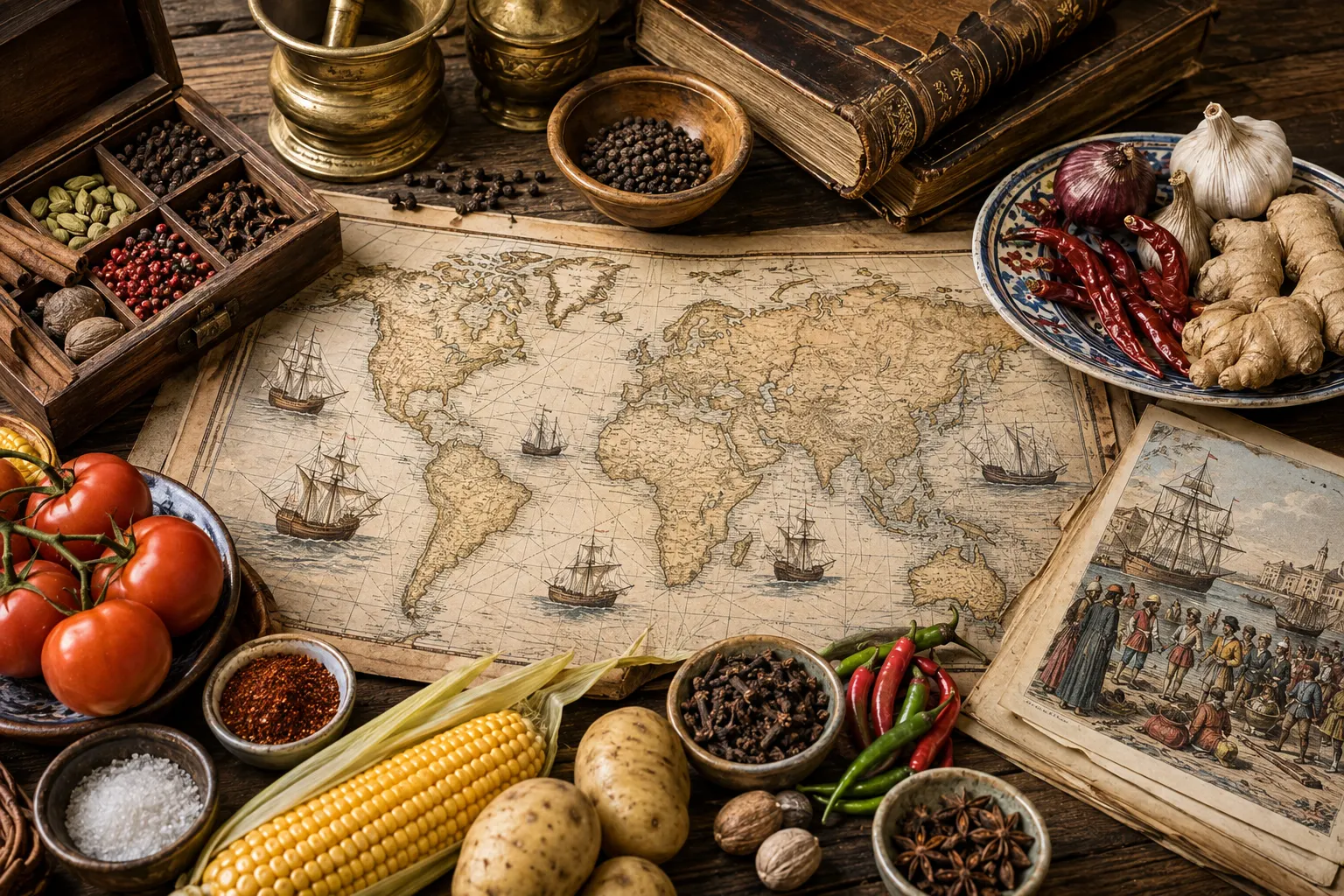
India’s long coastline connected it to the Arabian Sea, Persian Gulf, East Africa and Southeast Asia for centuries.
Ports brought merchants, religious communities and ingredients. Kerala’s spice trade linked the Malabar coast to wider Indian Ocean networks. Goa’s food history reflects Portuguese colonial influence. Coastal cities absorbed new breads, vinegars, meats, sweets and techniques while retaining local staples.
This mixing was not a modern phenomenon.
Indian cuisine has been global for a very long time.
The Northeast Challenges Simplified Ideas of Indian Food
Mainstream representations of Indian cuisine often centre wheat breads, paneer-rich gravies, biryani or dosa. The northeastern states demonstrate how incomplete that picture is.
Food traditions across Assam, Nagaland, Manipur, Mizoram, Meghalaya, Tripura, Arunachal Pradesh and Sikkim include wide use of rice, fermented foods, bamboo shoots, local greens, smoked meats, fish and region-specific herbs.
Even this description is too general because the northeast contains many ethnic communities with distinct culinary practices.
Incredible India’s Delhi food guide, while describing northeastern restaurants in the capital, lists Assamese fish tenga, Manipuri singju, Naga pork with fermented bamboo shoot, Tripuri preparations and other distinct dishes—an accidental reminder that “northeastern cuisine” is itself an umbrella term.
Bengal Shows the Importance of River and Delta Ecology
Bengal’s riverine and delta environment helped make fish central to many food traditions. Rice, mustard, freshwater fish, vegetables and sweets form important parts of Bengali culinary identity.
Yet Bengal is also divided by history, religion and modern borders. Food traditions overlap between West Bengal and Bangladesh while differing across communities and districts.
This demonstrates a recurring principle: culinary regions do not always fit neatly inside political boundaries.
Kerala Is More Than “Coconut and Seafood”
Kerala is often summarised through coconut, curry leaves, spices and fish. Those ingredients matter, but they do not capture the full landscape.
The state contains Hindu, Muslim and Christian food traditions, regional differences between Malabar and Travancore, vegetarian temple and festival cuisines, seafood-rich coastal cooking and dishes shaped by long-distance trade.
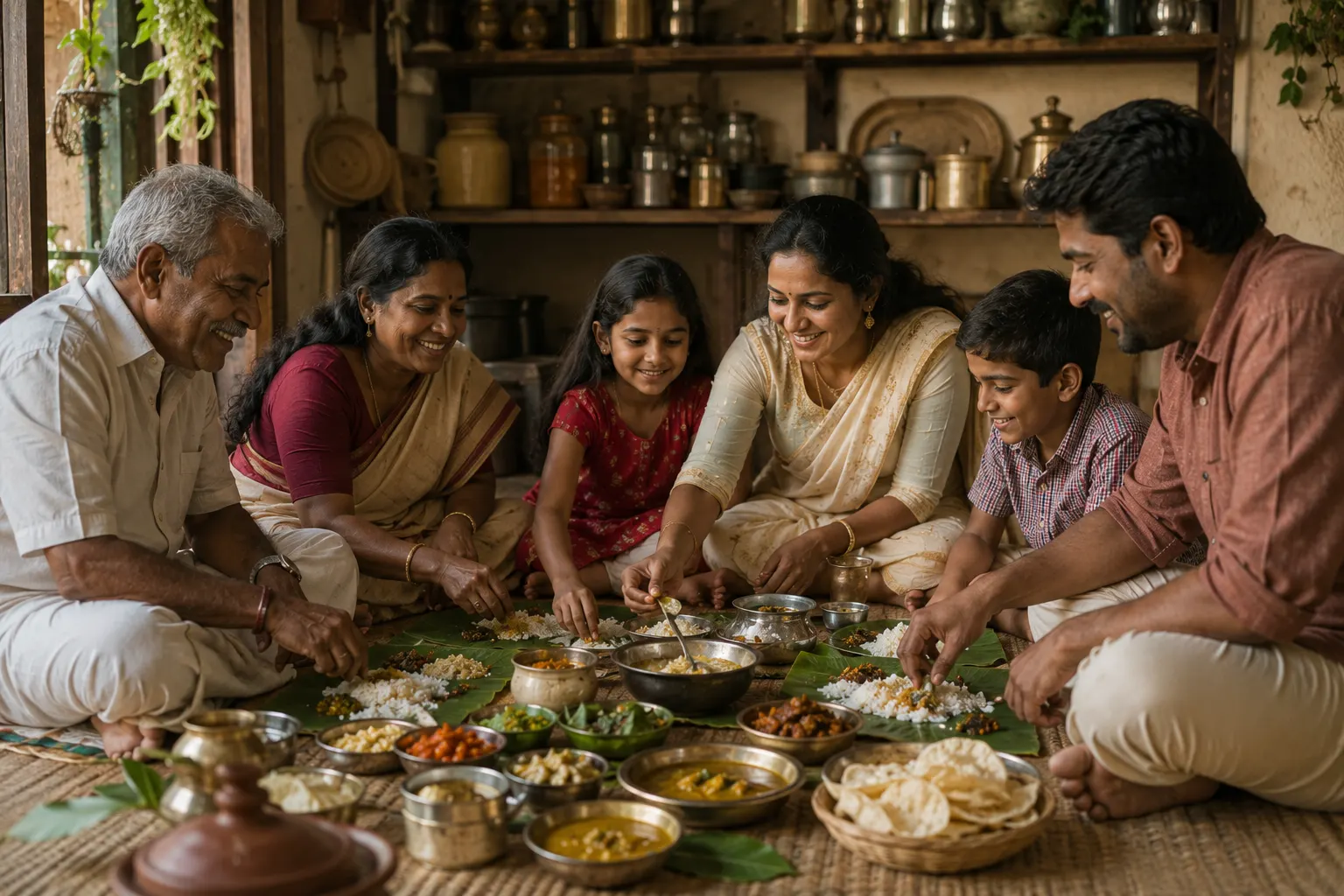
The sadya—a vegetarian feast served on a banana leaf—is associated especially with festivals and celebrations. Malabar biryani traditions reflect a different social and historical setting.
Both are Kerala cuisines.
Punjab Is More Than Restaurant “North Indian” Food
Internationally, rich Punjabi-derived restaurant dishes have strongly influenced the image of Indian food.
But Punjabi cuisine cannot be reduced to butter, cream and tandoori restaurant classics.
Seasonal greens, wheat breads, pulses, yoghurt, lassi, pickles and agricultural rhythms are central to everyday foodways. Sarson da saag and makki di roti express winter agriculture more clearly than a generic restaurant curry does.
The global success of Punjabi restaurant food is historically important precisely because it has come to stand for a much larger and more diverse region than Punjab itself.
Rajasthan Shows How Scarcity Shapes Cuisine
Rajasthan’s dry climate influenced food storage, water use and ingredient choices.
Gram flour, pulses, grains, ghee, dried ingredients and intensely seasoned preparations became important in many areas. Dal baati churma and gatte ki sabzi are among widely recognised examples.
But even Rajasthan contains subregional and community differences, including royal meat traditions alongside strong vegetarian food cultures.
Again, ecology sets conditions; society creates multiple responses.
Karnataka Demonstrates Diversity Inside a State
Karnataka is especially useful for challenging the idea that states possess one cuisine.
The coast has rice, coconut and seafood traditions. North Karnataka uses jowar extensively. Mysuru and Bengaluru have different urban and courtly histories. Kodagu has its own food identity. Udupi cuisine developed through specific religious and institutional contexts.
Incredible India’s Karnataka overview itself moves between Mangaluru fish curry, neer dosa, Dharwad peda, jolada rotti, bisi bele bath and filter coffee.
The list looks eclectic only if we expect one state to taste the same everywhere.
Cities Create Their Own Cuisines
Urban India produces another layer of culinary geography.
Delhi combines Mughlai, Punjabi, migrant and street-food traditions. Mumbai reflects Maharashtrian, Gujarati, Parsi, coastal, migrant-worker and cosmopolitan influences. Kolkata carries Bengali, colonial, Chinese-Indian and other histories. Hyderabad is shaped by Deccani courtly traditions and later urban change.
Cities concentrate migration, so they often create dishes that become iconic despite having relatively recent histories.
Street food is especially dynamic because vendors respond quickly to price, mobility and changing tastes.
Partition and Migration Reshaped Regional Food
The Partition of 1947 moved millions of people across new borders. Migrants carried recipes, businesses and preferences into new cities.
Punjabi refugee communities influenced post-Partition food landscapes in Delhi and elsewhere. Restaurants transformed domestic preparations into commercial forms. Foods associated with displaced communities entered wider urban culture.
This is a reminder that regional cuisine is not always produced by people staying in one region. Sometimes displacement spreads it.
Modern Media Standardises Some Dishes
Cookbooks, television, restaurant chains, packaged masalas and social media make certain versions of regional dishes nationally recognisable.
This can preserve awareness while also flattening difference.
A recipe marketed as “South Indian sambar” may conceal major regional variations. “Biryani” can refer to distinct traditions with different rice, meat, spice, layering and cooking methods. “Dal” describes an enormous family of pulse preparations.
The more nationally familiar a label becomes, the more important it is to ask what local diversity sits underneath it.
India’s Spice Economy Still Reflects Regional Ecology
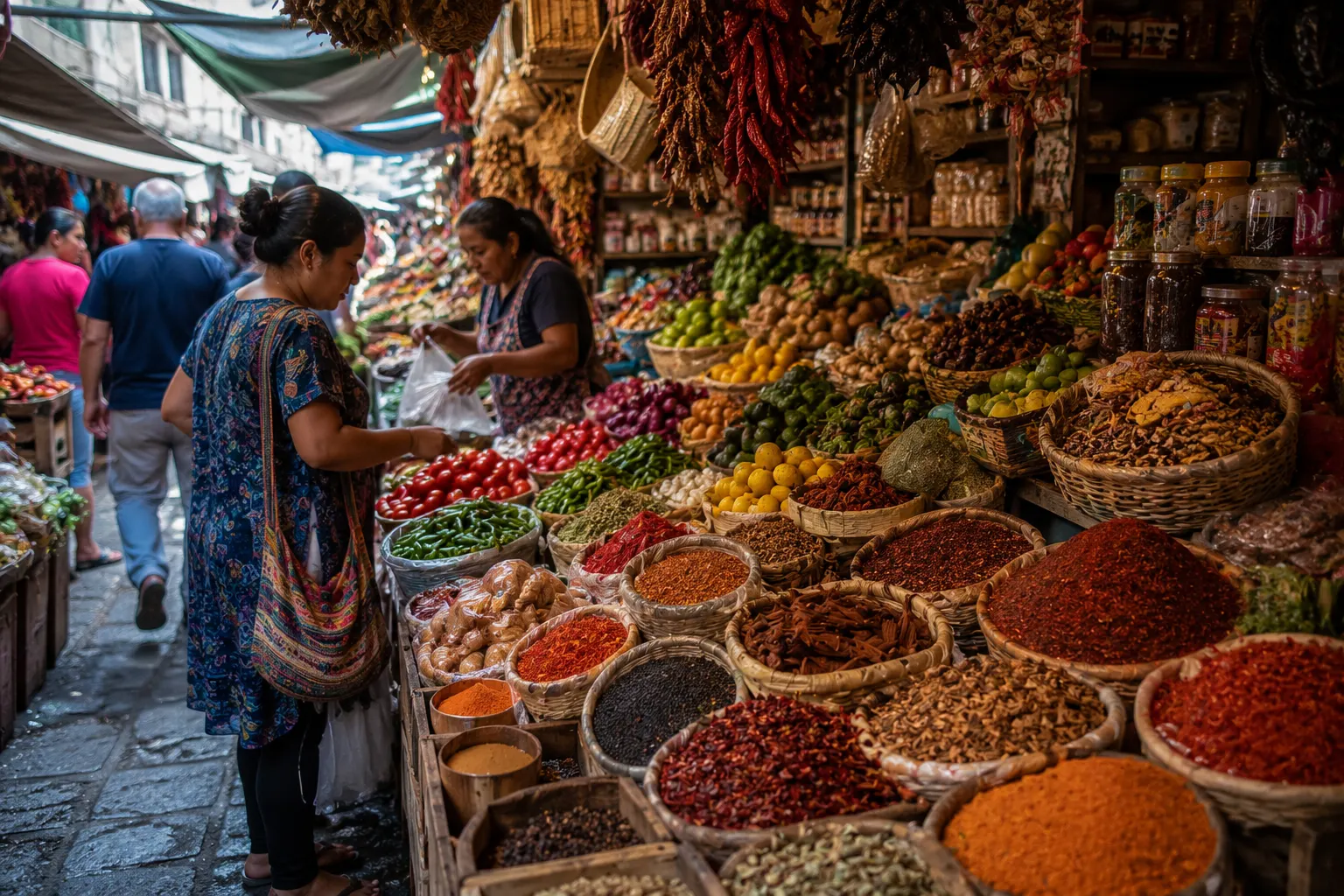
The Spices Board notes that varied climatic zones allow India to grow a broad range of spices across states and union territories. Its catalogue and GI-linked products show strong regional associations between place and spice varieties.
These agricultural geographies feed directly into local food traditions.
Spice use is not uniform across India. The same cumin, mustard, pepper, chilli, cardamom or turmeric may be used in different combinations, quantities and cooking stages from one region to another.
The difference lies not merely in the spice itself, but in culinary grammar.
There Is No Need to Choose Between Diversity and National Identity
Saying India has no single cuisine does not mean the phrase “Indian food” is meaningless.
Shared techniques, ingredients, religious practices, trade histories and national circulation create connections between regions. People across India recognise many dishes from outside their own home regions. Restaurants and migration have built a shared culinary vocabulary.
But unity should not be mistaken for uniformity.
Indian food is best understood as a federation of culinary traditions: connected, constantly exchanging, sometimes overlapping, yet rooted in different ecologies and histories.
The Better Question
Instead of asking, “What is Indian cuisine?” it is more useful to ask:
Which region?
Which community?
Which season?
Which class or household?
Which historical period?
Which migration story?
Those questions do not make Indian food harder to understand.
They make it visible.
Sources / Further Reading
• Ministry of Tourism, Government of India — National culinary platform press release — https://tourism.gov.in/sites/default/files/2025-12/Press%20Release_23_12_2025.pdf
• Incredible India — Kerala cuisine in Thiruvananthapuram — https://www.incredibleindia.gov.in/en/kerala/thiruvananthapuram/what-to-eat-and-where-to-eat-in-thiruvananthapuram
• Incredible India — Karnataka regional dishes — https://www.incredibleindia.gov.in/en/karnataka/bengaluru/the-delectable-cuisine-of-karnataka-13-must-try-local-dishes-in-bengaluru
• Incredible India — Punjabi cuisine — https://www.incredibleindia.gov.in/en/chandigarh/chandigarh/a-gastronomic-journey-through-must-try-local
• Spices Board India — Spice Catalogue — https://www.indianspices.com/spices-development/spice-catalogue.html
Suggested Internal Links
Food Is Never Just Food: How Eating Becomes Culture — Article 5
Cuisine as a Historical Record: How Food Reveals the Past — Article 6
How Food Crosses Borders—and Becomes Local Again — Article 8
Spices and Culture: How Flavour Helped Shape Trade, Identity and Empire — Article 9
What Is the Cultural Role of Tea — Planned internal link
Approximate article body word count: 1,711