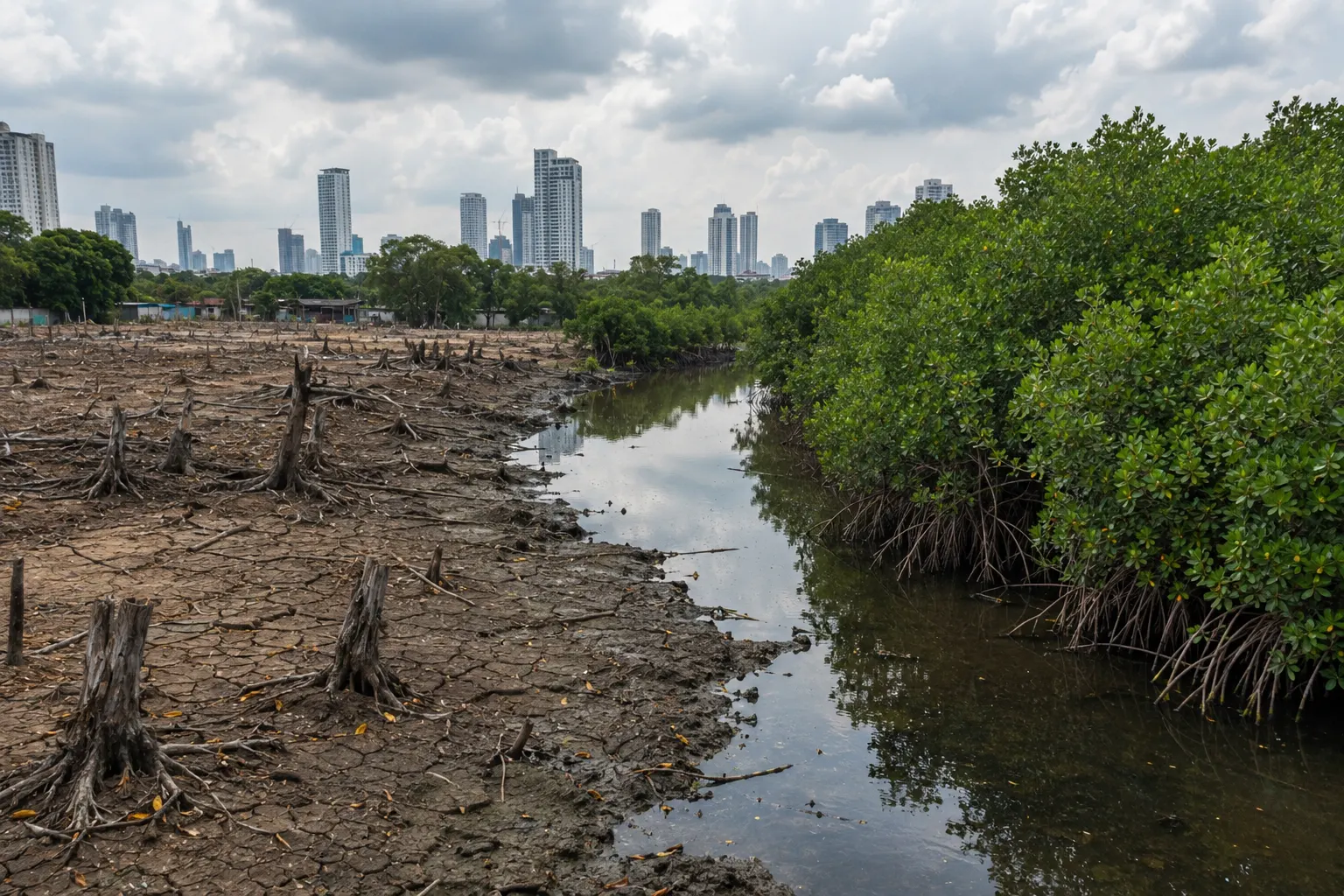
An ecosystem is an interaction, not just a location
A forest, pond or coral reef is often called an ecosystem, but the word means more than a type of scenery. The Convention on Biological Diversity defines an ecosystem as a dynamic complex of plant, animal and microorganism communities and their non-living environment interacting as a functional unit. The key word is interacting. Organisms depend on water, temperature, soil, light and chemistry, while living organisms also modify those physical conditions. An ecosystem therefore exists through relationships and processes, not merely because several species happen to occupy the same place.
The living components are called biotic factors
Plants, animals, fungi, bacteria and other organisms make up the biotic component of an ecosystem. They interact through predation, competition, pollination, parasitism, decomposition and many other relationships. A tree may provide food and nesting space; fungi may form symbioses with its roots; insects may pollinate its flowers; herbivores may consume leaves; decomposers eventually break down dead tissue. These interactions determine which species can persist and how energy and nutrients move through the system. Biodiversity describes variation among these living components at genetic, species and ecosystem levels.
The non-living environment is equally important
Abiotic factors include sunlight, temperature, water, air, salinity, nutrients, soil structure, pH, wind and physical disturbance. These factors place limits on life. A mangrove tolerates salt and tidal flooding that many terrestrial trees cannot; a cold mountain lake supports different communities from a warm tropical pond. Abiotic conditions also change through seasons, weather and long-term climate trends. Because organisms respond to these conditions, a shift in rainfall or temperature can reorganise ecological relationships even without direct habitat destruction.
Energy enters, moves and leaves
Most ecosystems ultimately depend on energy captured from sunlight by photosynthetic organisms such as plants and algae. Producers convert light energy into chemical energy stored in organic matter. Herbivores obtain some of that energy by eating producers, predators obtain some by eating consumers, and decomposers use dead organic material. At each transfer, organisms use energy for metabolism and much is released as heat. Energy therefore flows through an ecosystem rather than cycling endlessly. This helps explain why food webs require a continuing energy input.
Matter behaves differently from energy
Atoms such as carbon, nitrogen and phosphorus are repeatedly reused. Plants take nutrients from soil or water; animals obtain them through food; wastes and dead organisms are broken down; microbes transform compounds into forms that can re-enter biological cycles. Water also moves among organisms, soils, rivers and the atmosphere. These biogeochemical cycles connect living and non-living components of ecosystems. If nutrient inputs become excessive - for example through fertiliser runoff - the cycle can be disrupted, producing algal blooms or oxygen depletion.
Producers, consumers and decomposers are useful functional groups
Ecology often groups organisms by what they do. Producers make organic matter from inorganic sources, usually through photosynthesis. Consumers obtain energy by eating other organisms. Decomposers and detritivores process dead material and waste, returning nutrients to forms that can be used again. These categories simplify a much more complicated reality: many organisms are omnivores, fungi form mutualisms as well as decompose material, and microbes perform chemical transformations that do not fit ordinary food-chain diagrams. Still, the functional groups help explain ecosystem processes.
An ecosystem has no universally fixed size
The CBD ecosystem approach explicitly notes that an ecosystem can be defined at many scales. A pond can be treated as an ecosystem, but so can a forest, a watershed or a much smaller functional unit. Boundaries are chosen according to the ecological question. A researcher studying soil microbes may define an ecosystem at the scale of a patch of soil, while a conservation planner may work at landscape or river-basin scale. Nature does not draw administrative lines around ecological systems; water, nutrients, animals and seeds often cross the boundaries people select.
Ecosystems are open systems
Because boundaries are porous, ecosystems exchange energy, matter and organisms with surrounding areas. Migratory animals carry nutrients between habitats. Rivers transport sediment and dissolved material downstream. Wind moves pollen, seeds and dust. Salmon returning from the ocean can transfer marine-derived nutrients into freshwater and terrestrial food webs. Human trade can move invasive species across continents. This openness is one reason ecological management cannot always succeed by protecting a small site in isolation; processes outside the boundary may determine what happens inside it.
Food webs describe one set of ecosystem connections
Who eats whom is central to ecosystem structure, but feeding relationships are only part of the network. Food webs link producers, herbivores, predators and decomposers through energy transfer. Other relationships - pollination, seed dispersal, competition, mutualism and habitat engineering - can be equally important. A bee and a flowering plant interact without one eating the other. A beaver changes water flow by building a dam. An ecosystem is therefore broader than its food web, although food webs provide an important map of trophic relationships.
Disturbance is normal, not automatically ecological failure
Fires, floods, storms, droughts, grazing and disease can disrupt ecosystems, but disturbance is part of the history of many environments. Some species are adapted to periodic fire; floodplains depend on changing water levels; fallen trees create gaps that allow new growth. The ecological issue is not whether disturbance occurs but its frequency, intensity, scale and interaction with other pressures. Human activity can suppress natural disturbances in some places and greatly intensify them in others, pushing systems beyond conditions to which their species are adapted.
Resilience means more than returning to exactly the same state
Ecological resilience refers broadly to the capacity of a system to absorb disturbance while retaining important functions, structures or feedbacks. Recovery does not always mean recreating an identical pre-disturbance species composition. Ecosystems are dynamic, and climate change can make historical conditions impossible to restore precisely. Managers therefore increasingly ask which functions and relationships need to persist, what thresholds might trigger a major shift and whether the system can adapt without losing its essential character.
Humans are part of ecosystems
The ecosystem concept does not require pretending that people stand outside nature. The CBD ecosystem approach explicitly recognises humans, with their cultural diversity, as an integral component of many ecosystems. Farms, cities, managed forests and fisheries all contain ecological processes, although human decisions strongly shape them. This matters because environmental policy is not simply about separating people from nature. It is about managing interactions so that resource use, infrastructure and livelihoods do not destroy the ecological processes on which they ultimately depend.
Ecosystem services connect ecology to human well-being
People receive food, freshwater, fibres, climate regulation, pollination, flood moderation, recreation and many other benefits from functioning ecosystems. The concept of ecosystem services makes these connections visible, but ecosystems are not valuable only when a service can be priced. They also contain intrinsic, cultural and relational values that vary among societies. Understanding the underlying ecosystem first is therefore important: services are consequences of ecological structure and processes, not products supplied independently of biodiversity, soils, water and physical conditions.
The ecosystem idea changes how environmental problems are understood
A polluted river is not only contaminated water. Pollution can alter microbes, invertebrates, fish, plants, oxygen levels and nutrient cycling. Deforestation is not only tree loss; it can change soils, hydrology, habitat, carbon storage and food webs. The ecosystem perspective forces analysis across interactions rather than isolated objects. That makes environmental management harder, because causes and effects spread through networks, but it also makes it more realistic. An ecosystem is the functional conversation between life and its physical environment - and environmental change rewrites many parts of that conversation at once.
Feedbacks make ecosystems dynamic
Ecosystem components influence one another in feedback loops. More vegetation may improve soil structure and water retention, which can then support more vegetation. Heavy grazing can reduce plant cover, increase erosion and make recovery harder. Predator decline can alter herbivore pressure, while vegetation change can alter habitat for predators. Feedbacks help explain why ecosystems sometimes respond gradually and then shift abruptly once thresholds are crossed. They also make prediction difficult: changing one component can alter the conditions controlling several others.
Ecologists measure processes as well as species
A species list tells us who is present, but ecosystem function also depends on rates: primary production, decomposition, nutrient cycling, respiration, water flow and disturbance. Two forests could contain similar numbers of species yet differ greatly in carbon storage or nutrient turnover. Scientists therefore combine biodiversity surveys with measurements of physical and chemical processes. This is especially important when assessing restoration, because planting vegetation can make a site look recovered before soils, hydrology or food webs have regained their former function.
Sources / Further Reading
Convention on Biological Diversity - Ecosystem Approach
Convention on Biological Diversity - Description of the Ecosystem Approach
Convention on Biological Diversity - Convention Text
U.S. National Park Service - Food Webs
Suggested Internal Links
Understanding Food Chains and Food Webs - Planned internal link
Understanding Ecosystem Services - Planned internal link
Understanding Biodiversity Loss - Planned internal link
Understanding the Role of Predators in Ecosystems - Planned internal link
What Are Keystone Species - Planned internal link
What Are Wetlands and Why They Matter - Planned internal link