The ozone layer is recovering. That statement is scientifically defensible, but it can be misunderstood in two opposite ways.
One interpretation is too pessimistic: because a large Antarctic ozone hole still appears each spring, the Montreal Protocol must have failed. The other is too optimistic: because the trend has turned, the problem is essentially solved.
Neither is accurate.
The strongest evidence points to a slow, policy-driven recovery of stratospheric ozone as concentrations of ozone-depleting chlorine and bromine decline. Yet the Antarctic ozone hole remains enormous in some years, and full recovery is expected to take decades because the chemicals responsible are long-lived and polar weather strongly influences each season.
The story is therefore not one of instant repair. It is one of atmospheric damage being gradually reversed after the source of that damage was brought under international control.
What changed after the Montreal Protocol
The Montreal Protocol on Substances that Deplete the Ozone Layer was agreed in 1987 and progressively strengthened. It targeted chlorofluorocarbons, halons and other substances that release chlorine or bromine in the stratosphere.
This mattered because the ozone problem was fundamentally a stock-and-flow problem. Each year of continued production added more long-lived ozone-depleting substances to the atmosphere. Stopping most production reduced the flow, but the accumulated stock did not vanish.
CFC molecules can survive for decades. Some ozone-depleting compounds or their halogen atoms remain in the atmospheric system even longer. Equipment, foams and other old products can also contain "banks" of controlled substances that may leak during use or disposal.
So the Protocol did not operate like switching off a dirty chimney. It changed the future trajectory of a global chemical reservoir.
The atmospheric burden has begun to fall
UNEP's Ozone Secretariat reports that emissions of ozone-depleting substances, weighted by their ability to damage ozone, peaked in the late 1980s and subsequently fell substantially under the Montreal Protocol. Total stratospheric halogen content peaked later, in the late 1990s, because it takes time for surface emissions to be transported into and through the stratosphere.
By the end of 2022, the Ozone Secretariat's scientific summary reported stratospheric halogen content about 18% below its peak. NASA and NOAA have also observed a long-term decline in ozone-depleting chlorine and bromine over Antarctica.
That chemical decline is the foundation of recovery. The atmosphere now contains less of the material that drives catalytic ozone destruction than it did around the turn of the century.
But "less" does not yet mean "back to normal."
What the 2025 Antarctic ozone hole showed
The 2025 season provided a useful snapshot of both progress and persistence.
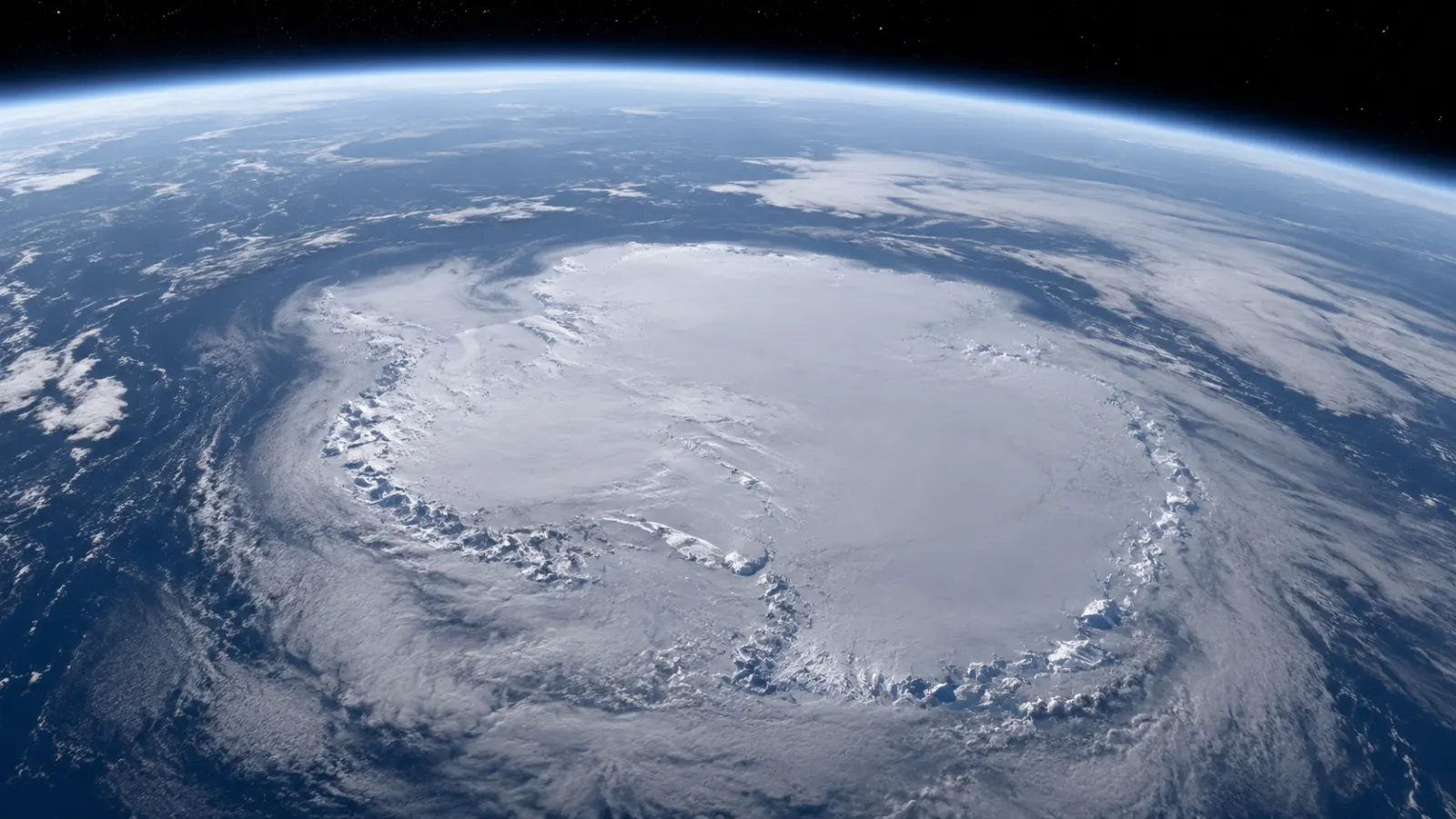
NASA and NOAA reported that the Antarctic ozone hole reached a maximum one-day extent of about 22.86 million square kilometres on 9 September 2025. Averaged over the main depletion period from 7 September to 13 October, its area was the fifth-smallest since 1992, the period when the Montreal Protocol's controls had begun to take effect.
That was encouraging. NASA scientists noted that ozone holes have been trending smaller than those seen in the early 2000s, tending to form later and break up earlier.
Yet the same event remained continental in scale. A smaller ozone hole is not a small phenomenon.
The 2025 observations illustrate why recovery should be judged over decades rather than by asking whether one year's hole looked unusually large or unusually small.
Why ozone-hole size still jumps around
Antarctic ozone chemistry is highly sensitive to temperature and circulation in the stratosphere.
A cold, strong polar vortex favours polar stratospheric clouds and can maintain the isolated conditions in which chlorine-driven depletion intensifies. A warmer or more disturbed vortex can reduce those conditions and mix ozone-rich air into the polar region sooner.
NASA and NOAA attributed part of the relatively smaller 2025 hole to meteorological conditions, including a weaker-than-normal polar vortex during part of the season. That does not weaken the evidence for chemical recovery. It means the observed hole is the product of both the long-term decline in ozone-depleting substances and short-term atmospheric variability.
Imagine a steadily receding tide with waves moving on top of it. The waves can temporarily move water higher or lower, but the background direction is still visible over time.
Ozone recovery has a similar statistical character.
What "recovery" actually means
Scientists usually compare future ozone levels with a historical baseline, often 1980 values, because that predates the full development of severe Antarctic depletion.
The most recent completed WMO-UNEP Scientific Assessment of Ozone Depletion, published for 2022, projected that if current policies remain in place, ozone should return to 1980 levels around 2040 for most of the world, around 2045 over the Arctic, and around 2066 over Antarctica.
These are projections, not appointment dates. Atmospheric chemistry, climate interactions, unexpected emissions and future policy compliance can influence the trajectory.
It is also important to be precise about the status of the next assessment. In July 2026, WMO hosted a meeting to finalise the 2026 quadrennial scientific assessment, but the Montreal Protocol's formal terms require the assessment reports to be submitted by the end of 2026. Until that process is complete, the 2022 assessment remains the latest completed global benchmark for published recovery dates.
Why Antarctica recovers last
The Antarctic ozone hole is the most chemically extreme manifestation of depletion because the polar winter creates especially cold and isolated stratospheric conditions.
Even as total chlorine and bromine decline, enough remains to drive major springtime depletion when those meteorological conditions occur. The Antarctic atmosphere therefore needs a larger reduction in ozone-depleting halogens before seasonal chemistry resembles the pre-hole era.
This is why global mid-latitude ozone can approach historical levels earlier while the Antarctic hole persists.
Recovery is geographically uneven because ozone depletion was geographically uneven.
The Montreal Protocol did more than ban CFCs
The agreement is sometimes described too simply as "the treaty that banned CFCs." Its strength came from repeated adjustment.
Scientific assessments periodically updated knowledge about ozone chemistry. Governments then tightened controls, added substances and changed schedules. The system also included financial and technical mechanisms to help countries transition away from controlled chemicals.
That feedback between measurement, scientific assessment and policy is central to the Protocol's success.
The Kigali Amendment later added a climate dimension by establishing a phasedown of hydrofluorocarbons, or HFCs. HFCs generally do not destroy stratospheric ozone in the way CFCs do, but many are powerful greenhouse gases. WMO has said implementation of the Kigali Amendment could avoid up to about 0.5 degrees Celsius of warming by the end of the century.
The ozone regime therefore evolved from solving one atmospheric chemistry problem toward reducing part of another.
Why continued monitoring still matters
A treaty does not make atmospheric chemistry self-enforcing.
Scientists continue measuring ozone and ozone-depleting substances because unexpected emissions can occur, old chemical banks can leak, and new or short-lived compounds may raise questions that earlier regulatory frameworks did not anticipate.
The discovery of unexpectedly high CFC-11 emissions in the 2010s demonstrated why global atmospheric monitoring remains essential. Concentrations in the air can reveal inconsistencies that production and consumption statistics alone may miss.
NASA's satellites, NOAA's balloon observations, WMO's Global Atmosphere Watch network, British Antarctic Survey records and other international measurements provide overlapping ways to detect change.
The 2026 scientific-assessment process itself reflects that continuing need. Recovery is not a reason to stop observing; it is a hypothesis that must keep being tested.
Climate change complicates the picture
Stratospheric ozone and climate are connected.
Greenhouse gases can cool parts of the stratosphere even while warming the lower atmosphere. Changes in circulation can alter the transport of ozone. Major volcanic eruptions, unusual wildfire smoke injections and other events can affect stratospheric particles and chemistry.
These interactions do not erase the dominant role of ozone-depleting substances in the historical Antarctic hole. They do mean that the path of future ozone recovery will not be perfectly smooth.
That is another reason recovery dates are best understood as modelled milestones under specified assumptions rather than guarantees.
A rare case of environmental repair at planetary scale
The ozone layer is often cited as proof that international environmental cooperation can work. That conclusion is justified, but the deeper lesson is more demanding than a slogan.
The success depended on detecting a problem through long-term observation, identifying a specific causal mechanism, creating substitutes and transition pathways, building a global treaty, strengthening that treaty as evidence improved, helping countries implement it, and monitoring whether the atmosphere responded as expected.
The response also benefited from one unusually favourable feature: governments could target a relatively defined set of manufactured chemicals. Problems such as climate change, biodiversity loss or water stress involve broader economic systems and therefore cannot simply copy the Montreal Protocol.
Still, the recovery is scientifically important.
The world changed the chemical composition of the stratosphere in a dangerous direction. Then policy changed emissions enough to bend the trajectory back.
The Antarctic ozone hole has not disappeared, and in some years it will still look alarming. But the long-term system is no longer moving toward ever greater chlorine-driven destruction.
That is what recovery means: not that the atmosphere has already healed, but that the processes responsible for healing now outweigh the processes that created the crisis - slowly, measurably and only as long as international controls continue to hold.
Sources / Further Reading
WMO - Ozone and UV Bulletin / recovery projections from the 2022 assessment
NASA Science - NASA and NOAA rank the 2025 ozone hole as fifth-smallest since 1992
NASA Ozone Watch - latest Antarctic ozone monitoring
UNEP Ozone Secretariat - Twenty Questions and Answers About the Ozone Layer
WMO - 2026 Ozone Assessment Panel meeting
Suggested Internal Links
What Caused the Ozone Hole? The Chemistry Behind a Global Environmental Crisis - Article 61
Understanding International Climate Cooperation - Planned internal link
What Is the Role of Governments in Climate Action - Planned internal link
Understanding Climate Modelling - Planned internal link