Illegal HTBt Cotton Now Covers Up to 30% of India’s Cotton Area
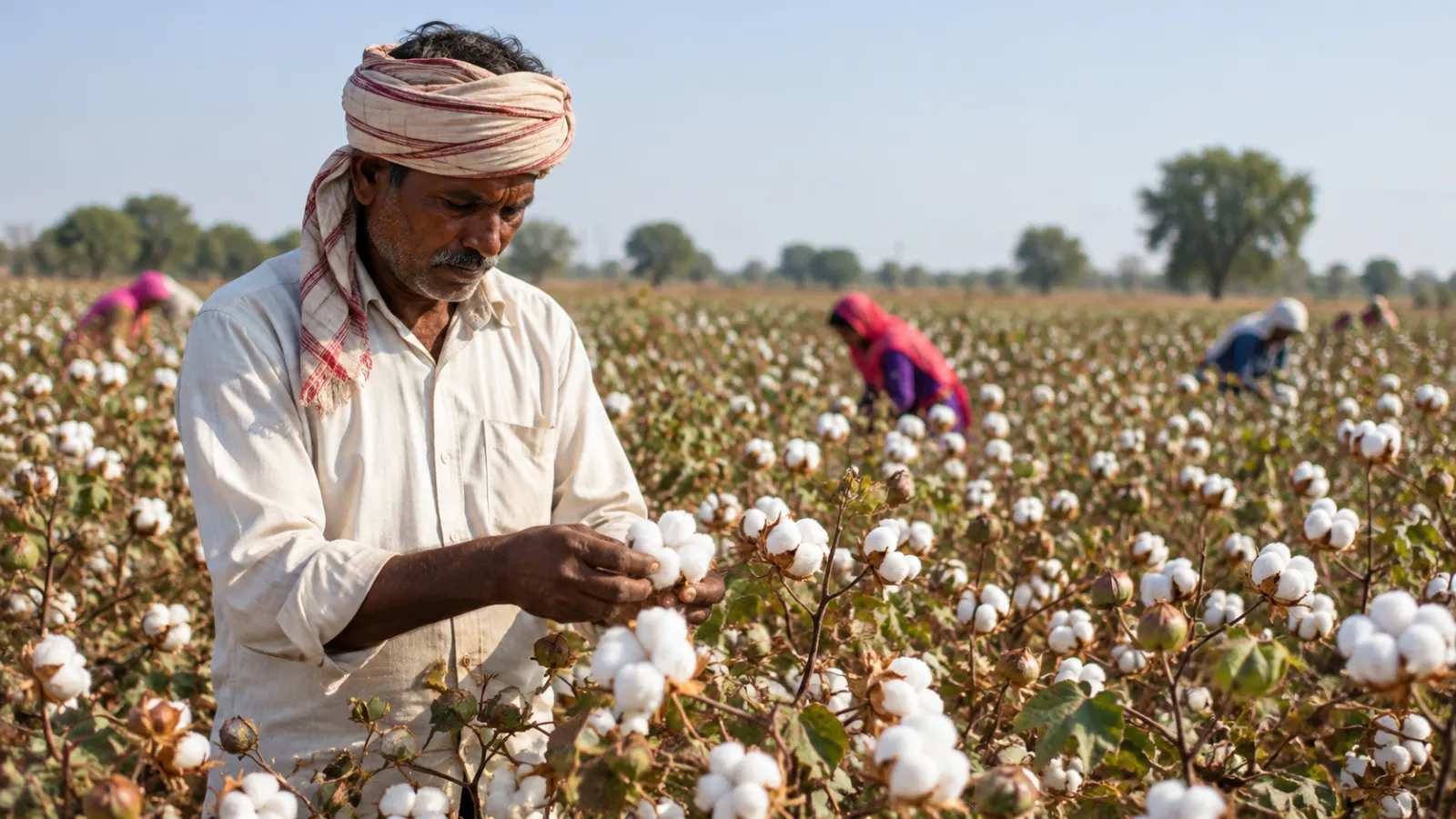
Unauthorised herbicide-tolerant Bt cotton, or HTBt cotton, may now cover as much as 30% of India’s total cotton acreage, according to a new field study that highlights how rapidly unapproved genetically modified seeds are spreading across major cotton-growing states.
The study estimates that HTBt cotton was planted on roughly 65–72 lakh acres during the 2025-26 kharif season, accounting for about 24% to 30% of India’s cotton area. Adoption has been particularly high in Maharashtra, Telangana and Andhra Pradesh, where farmers are increasingly using the technology to reduce the cost and labour involved in weed control.
The findings expose a major regulatory contradiction. India has not approved HTBt cotton for commercial cultivation, yet farmers appear to be using it at scale because it offers a cheaper alternative to manual weeding. The result is a large informal seed market operating outside the country’s formal biosafety, quality-control and licensing framework.
Why farmers are shifting to HTBt cotton
The biggest reason is cost.
HTBt cotton contains a herbicide-tolerance trait that allows farmers to spray glyphosate on fields to kill weeds without damaging the cotton crop. This can sharply reduce the need for labour-intensive manual weeding.
According to the study, glyphosate-based weed control costs approximately ₹750–₹850 per acre, while manual weeding can cost around ₹12,000–₹15,000 per acre.
That difference is significant for cotton farmers already facing volatile crop prices, higher input costs, labour shortages and uncertain weather.
In areas where agricultural labour is difficult to find or expensive during peak periods, HTBt cotton offers a clear economic incentive despite its unapproved status.
This helps explain why the technology has spread even without formal regulatory clearance.
Adoption is highest in Maharashtra, Telangana and Andhra Pradesh
The study found particularly high levels of HTBt adoption in several major cotton-growing regions.
Telangana recorded adoption of around 66%, while Maharashtra was estimated at about 58% and Andhra Pradesh at around 49%.
Some individual districts showed even higher usage. Adoption reportedly reached around 82% in Mahabubabad, 76% in Yavatmal and 75% in Kurnool.
Rajasthan currently has lower HTBt adoption, but researchers found growing demand for other unapproved genetically modified cotton seeds as farmers attempt to manage pink bollworm and other pest pressures.
The geographic concentration suggests that farmers are making decisions based largely on local labour availability, weed pressure and crop economics rather than regulatory status alone.
India has not approved HTBt cotton
India currently permits commercial cultivation of approved Bt cotton varieties containing specific insect-resistant genes.
HTBt cotton goes a step further by adding herbicide tolerance, allowing the crop to survive glyphosate application while surrounding weeds are killed.
That trait has not received commercial approval in India.
As a result, HTBt seeds are sold through informal and illegal channels rather than through the regulated seed market.
This creates several problems.
Farmers buying unapproved seeds do not receive the same quality assurance available with certified seeds. They may have limited legal recourse if germination fails, traits do not perform as advertised or seeds contain unexpected genetic material.
Regulators also lose visibility over which genetic traits are being planted and how they are spreading.
Study finds unapproved genes beyond herbicide tolerance
The problem may be broader than HTBt alone.
The study reported that 98.2% of field samples contained at least one genetically modified trait, while a significant proportion contained combinations of several transgenes.
Some samples reportedly contained four genetic traits, including Vip3A, an insect-resistance gene that has not been approved for commercial cotton cultivation in India.
This raises additional biosafety and regulatory concerns.
Unmonitored use of multiple genetic traits can make it harder to track resistance patterns, maintain seed purity and assess long-term environmental effects.
It can also undermine formal approval systems if untested or unregistered combinations spread widely before regulators evaluate them.
A large black market has emerged
The rapid spread of HTBt cotton has created a substantial informal seed economy.
Industry-backed estimates place the value of the illegal HTBt seed market at as much as ₹1,500 crore.
At the same time, sales of legal Bollgard-II cotton seeds reportedly fell by more than 22% nationally between 2022 and 2026.
This shift affects legitimate seed companies that invest in regulatory approvals, breeding programmes, testing and distribution networks.
It also creates an uneven market in which unapproved seeds can command a premium because farmers are willing to pay for traits they believe reduce production costs.
The scale of the informal market suggests that enforcement alone may not be enough to address the problem.
Glyphosate use is also rising sharply
The spread of HTBt cotton has been accompanied by a significant increase in glyphosate use.
According to the study, glyphosate consumption rose by about 26% in one year, from roughly 27,721 kilolitres in 2024-25 to 35,642 kilolitres in 2025-26.
Researchers also found that glyphosate is increasingly being distributed through informal channels, including bulk containers.
This creates environmental and agronomic concerns.
Repeated use of the same herbicide can encourage the development of herbicide-resistant weeds. Once resistance spreads, farmers may need higher doses or additional chemicals, increasing both costs and environmental pressure.
Improper application can also damage neighbouring crops if spray drifts beyond the intended field.
Cotton production is already under pressure
The HTBt debate is unfolding while India’s cotton sector faces broader productivity challenges.
Cotton production has fallen from around 35.2 million bales in 2020-21 to an estimated 29.1 million bales in 2025-26, a decline of roughly 17.5%.
Productivity has also weakened.
Government assessments have attributed the decline to several factors, including lower acreage, erratic rainfall, extreme temperatures, pest attacks, crop diseases and farmers switching to more profitable alternatives.
The government has responded with a ₹5,659-crore Mission for Cotton Productivity, aimed at improving yields, seed quality and farmer incomes.
The spread of unapproved HTBt seeds shows that many farmers are already attempting to solve productivity and cost problems independently.
Seed industry calls for legalisation
Industry groups supporting the study argue that the scale of HTBt cultivation demonstrates that the existing regulatory framework is no longer aligned with farmer demand.
Their argument is that legalisation would allow authorities to regulate seed quality, monitor glyphosate use and provide proper stewardship rather than allowing the technology to spread through black-market channels.
They also argue that farmers are adopting HTBt primarily because of economic pressure rather than a deliberate desire to break regulations.
However, legalisation would require a formal biosafety assessment and regulatory approval process.
Any decision would need to consider environmental risks, weed resistance, herbicide use, farmer economics and the interests of seed companies.
The debate is therefore not simply about whether HTBt works. It is about how India should regulate a technology that farmers are already using at substantial scale.
Why the issue matters beyond cotton
The HTBt controversy raises a broader question about agricultural regulation in India.
When a technology remains unapproved but is nevertheless adopted by millions of farmers, authorities face a difficult choice.
Strict enforcement may be politically and practically difficult if farmers believe the technology provides clear economic benefits.
Ignoring the spread, however, can weaken biosafety regulation and encourage further growth of unregulated seed markets.
Formal approval without sufficient testing could create environmental risks, while continued delay may push even more cultivation underground.
For policymakers, the challenge is to separate genuine farmer demand from the risks associated with uncontrolled adoption.
The latest study suggests that this decision can no longer be postponed indefinitely.
If up to 30% of India’s cotton acreage is already planted with unapproved HTBt varieties, the issue has moved well beyond isolated illegal seed sales. It has become a structural problem affecting farmers, seed companies, regulators and the future of India’s cotton sector.