The account that tells whether a nation earns enough abroad
A country can grow quickly and still face external pressure if it spends more abroad than it earns. It can have busy factories, rising consumption and strong domestic demand, yet still depend on foreign capital to pay for oil, machinery, electronics, travel and investment income. The current account is the economic statement that captures this relationship.
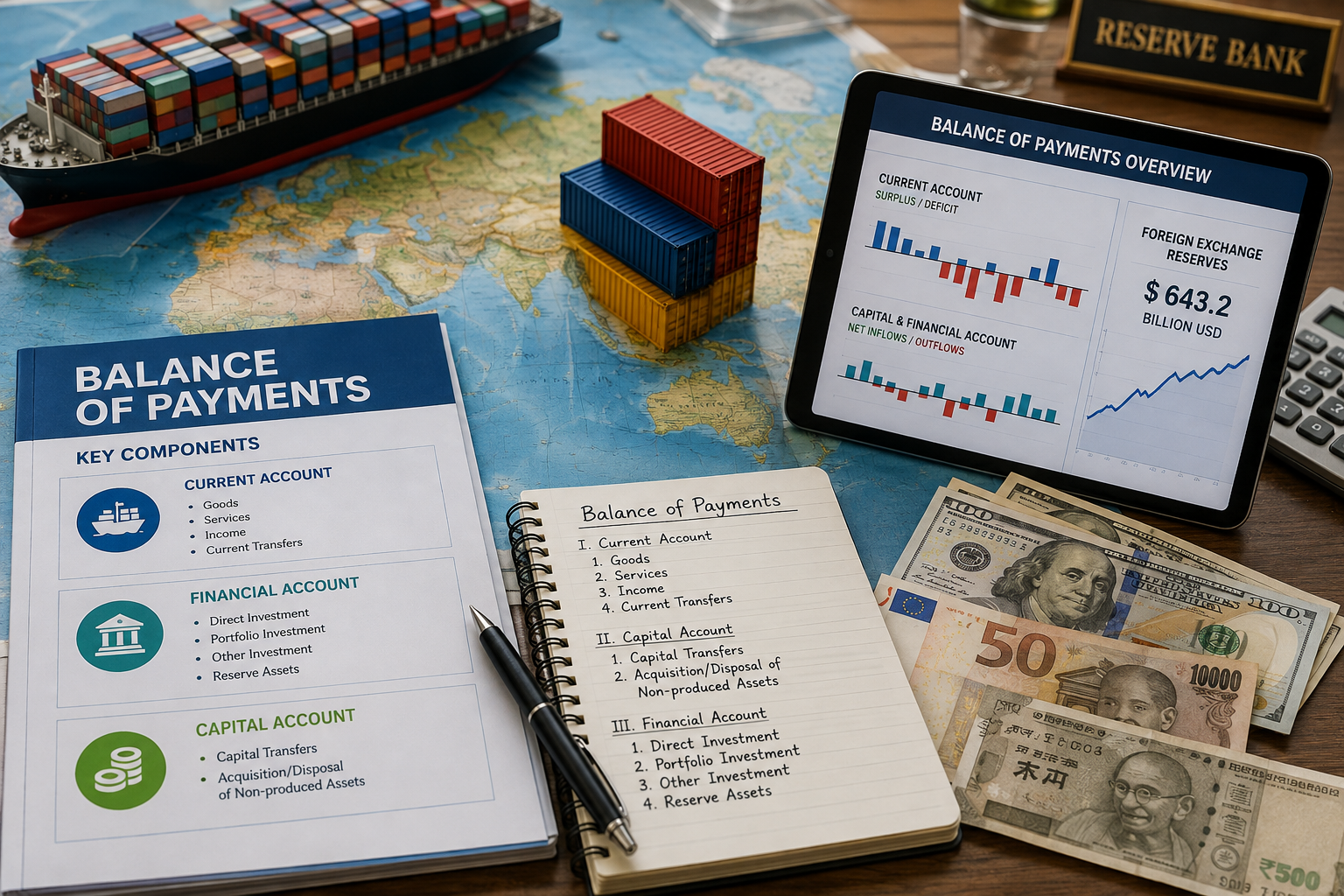
The current account is one of the most important parts of the balance of payments. It records the flow of goods, services, income and transfers between a country and the rest of the world. In simple terms, it asks whether the country’s regular international earnings are enough to cover its regular international payments.
This is why the current account attracts attention during currency pressure, oil-price shocks, export slowdowns and global financial uncertainty. It is not merely a statistic for economists. It is a signal of how comfortably an economy is living within its external means.
What the current account includes
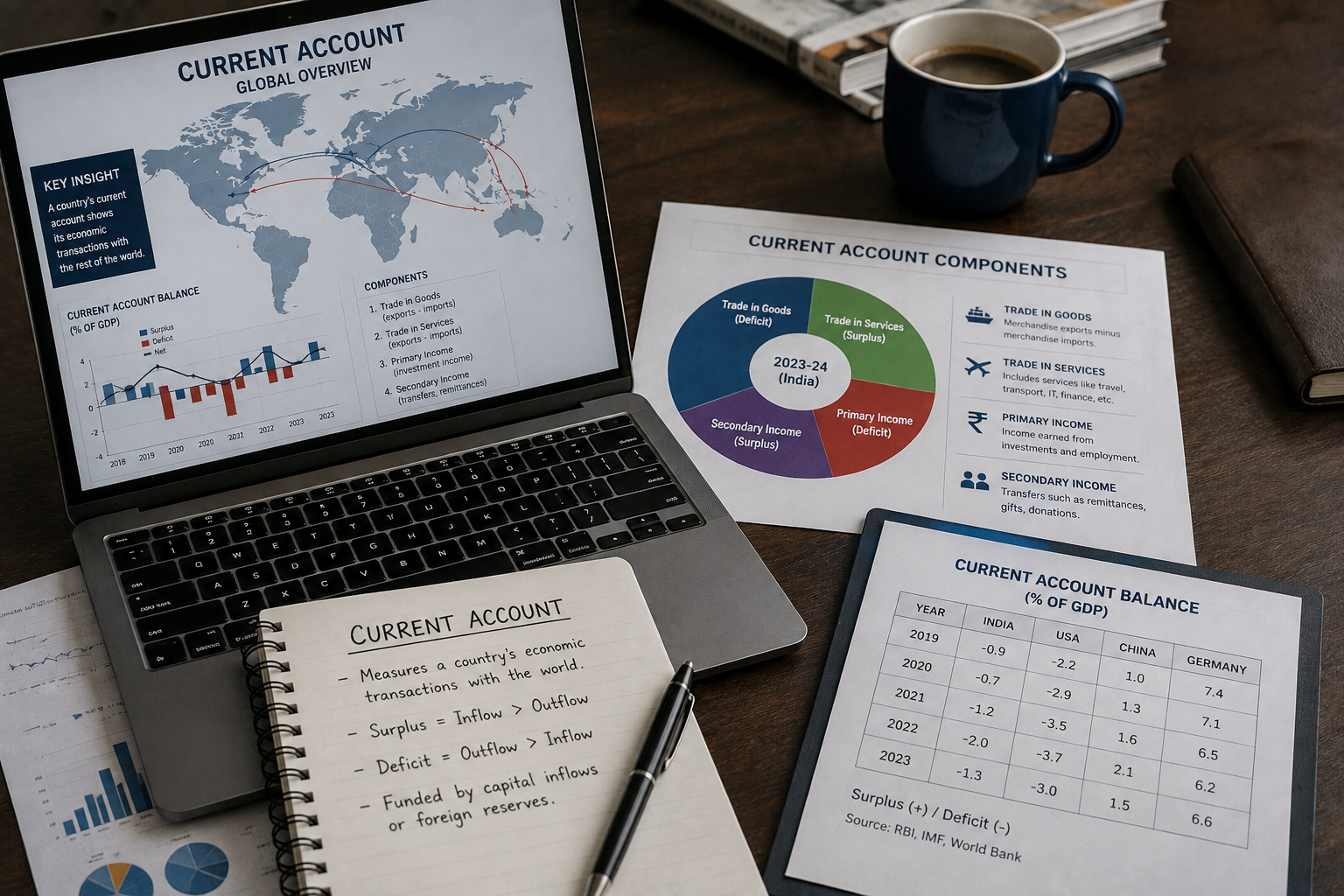
The current account has four broad components: goods, services, primary income and secondary income. The goods balance records exports and imports of physical goods such as crude oil, electronics, medicines, textiles, machinery, food items and automobiles. This is the part most people associate with the trade deficit.
The services balance records exports and imports of services. These include software services, business process services, consulting, tourism, transport, financial services, education-related payments and other intangible transactions. In a modern economy, services can be as important as goods, sometimes even more important for external resilience.
Primary income records income earned from work and investment across borders. This includes interest, dividends, profits and compensation of employees. If foreign investors earn returns from assets in the domestic economy, payments may flow outward. If domestic residents earn income from assets abroad, money may flow inward.
Secondary income covers transfers where no direct economic good or service is exchanged in return. Remittances are the most familiar example. Money sent home by workers abroad can be a powerful support for household consumption and national external accounts. Grants and other transfers may also appear here.
Current account deficit and surplus
A current account deficit occurs when payments on goods, services, income and transfers exceed receipts. In ordinary language, the country is spending more abroad on current transactions than it is earning from abroad. The gap must be financed through capital inflows, borrowing, asset sales or reserve drawdown.
A current account surplus occurs when receipts exceed payments. The country earns more from the rest of the world than it spends on current transactions. This can allow the country to accumulate foreign assets, strengthen reserves or lend capital abroad. Surplus countries often have strong export sectors or high savings relative to investment.
Neither condition is automatically good or bad. A deficit may reflect productive investment in a fast-growing economy. A surplus may reflect competitiveness, but it may also reflect weak domestic consumption. The quality and context of the current account matter more than the label.
Why a deficit is not always a crisis
A current account deficit becomes dangerous when it is large, persistent, poorly financed and disconnected from future productive capacity. If a country borrows abroad mainly to finance luxury imports, fuel inefficient consumption or cover structural weaknesses, the deficit can become a vulnerability.
But a deficit can be economically rational if it finances investment that raises future income. Developing economies often need to import capital goods, technology, energy and intermediate inputs before they can expand production. The question is whether those imports help create future exports, productivity and growth.
The financing source is crucial. A deficit financed by stable foreign direct investment is less risky than one financed by short-term portfolio flows that can leave quickly. A country with strong reserves, credible institutions and competitive exports can handle deficits better than a country with weak confidence and fragile financing.
How the current account differs from other deficits
The current account deficit is often confused with the fiscal deficit. The fiscal deficit is the gap between government expenditure and government revenue. The current account deficit is the gap in regular external transactions between the country and the rest of the world. They are connected but not identical.
A large fiscal deficit can contribute to a current account deficit if government spending boosts demand for imports without raising productive capacity. But a country can also run a current account deficit because of private consumption, energy imports, commodity shocks or weak export competitiveness.
The current account should also not be confused with the trade deficit. The trade deficit usually refers to goods trade, or sometimes goods and services. The current account is wider because it includes income and transfers. A country may have a large goods deficit but offset part of it through services exports and remittances.
The India angle
India’s current account story is shaped by a distinctive combination. The country often imports more goods than it exports, particularly because of energy, gold, electronics and capital goods. But India also earns substantially through services exports and receives large remittance inflows from workers abroad.
This means India’s current account cannot be understood by looking only at merchandise trade. The services sector, especially technology and business services, plays a stabilising role. Remittances also support the external account and household incomes. These strengths help reduce the pressure created by goods imports.
However, the vulnerability remains real. When crude oil prices rise sharply, import bills can increase. When global demand slows, export earnings may weaken. When financial markets become risk-averse, financing conditions can tighten. The current account then becomes central to discussions about the rupee, inflation and macroeconomic stability.
For India, the policy goal is not necessarily to eliminate the current account deficit permanently. A moderate, sustainable deficit can coexist with growth. The larger goal is to ensure that external payments are financed safely, exports become more competitive, services remain strong, and import dependence in strategic sectors is managed wisely.
What a reader should watch
When reading current account data, the headline number is only the beginning. Readers should ask what caused the change. Did the deficit widen because of oil prices, weak exports, strong domestic demand, higher profit repatriation or lower remittances? Different causes require different policy responses.
Readers should also examine how the deficit is financed. Strong foreign direct investment, stable long-term borrowing and adequate reserves provide more comfort than short-term speculative flows. A country’s external risk rises when it depends heavily on capital that can exit during panic.
Finally, readers should separate temporary shocks from structural weaknesses. A one-year widening caused by global oil prices may be manageable. A long-term inability to export competitively is more serious. Good analysis distinguishes between weather and climate.
Final reader takeaway
The current account is the part of the balance of payments that shows whether a country earns enough from trade, services, income and transfers to pay for its regular external obligations. It is one of the clearest indicators of external economic sustainability.
A deficit is not automatically a sign of failure, and a surplus is not automatically a sign of success. The meaning depends on why the balance exists, how it is financed, and whether it supports future growth.
For India, the current account is a crucial bridge between global energy prices, services exports, remittances, foreign investment, the rupee and household inflation. Understanding it helps citizens read the economy with more depth than headlines about trade deficits alone can provide.
Editorial Disclaimer
This article is for general financial and economic education. It does not constitute investment, tax, currency, legal or policy advice. Current account data and interpretations should be verified with official releases for the relevant period before publication or analysis.