A country also has a financial mirror
Every country trades with the rest of the world. It sells goods, buys energy, receives remittances, attracts investors, pays interest, sends tourists abroad, borrows money, repays old loans and holds foreign currency reserves. These movements look scattered when viewed separately. The balance of payments brings them together into one disciplined accounting framework.
The phrase sounds technical, but the idea is simple: the balance of payments records the economic transactions between residents of one country and the rest of the world over a period of time. It is the external report card of an economy. It tells us whether a country is earning enough foreign exchange, whether it is relying on foreign capital, whether its currency may face pressure, and whether its growth model is externally sustainable.
For serious readers, the balance of payments matters because many economic crises begin outside the visible budget. A country may appear to be growing, consuming and investing, while silently importing more than it earns, depending on volatile foreign money, or draining its reserves. BoP analysis helps identify these pressures before they become panic.
What the balance of payments means
The balance of payments, often shortened to BoP, is a systematic record of all economic transactions between a country’s residents and non-residents. Residents include individuals, firms, banks, governments and institutions based in the domestic economy. Non-residents include foreign buyers, investors, lenders, workers and governments.
The accounting period can be a quarter or a year. The transactions include trade in goods and services, income from investments and work, remittances, grants, foreign direct investment, portfolio flows, loans, banking capital, and changes in reserves. In this sense, the BoP is broader than a trade deficit. Trade is only one part of the external relationship.
A useful way to understand the BoP is to imagine a national foreign-currency diary. Every dollar, euro, yen, dirham or rupee-equivalent that comes in through exports, investment or transfers is recorded. Every payment going out through imports, interest, dividends, travel or capital outflow is also recorded. The final picture shows how the country pays for its external life.
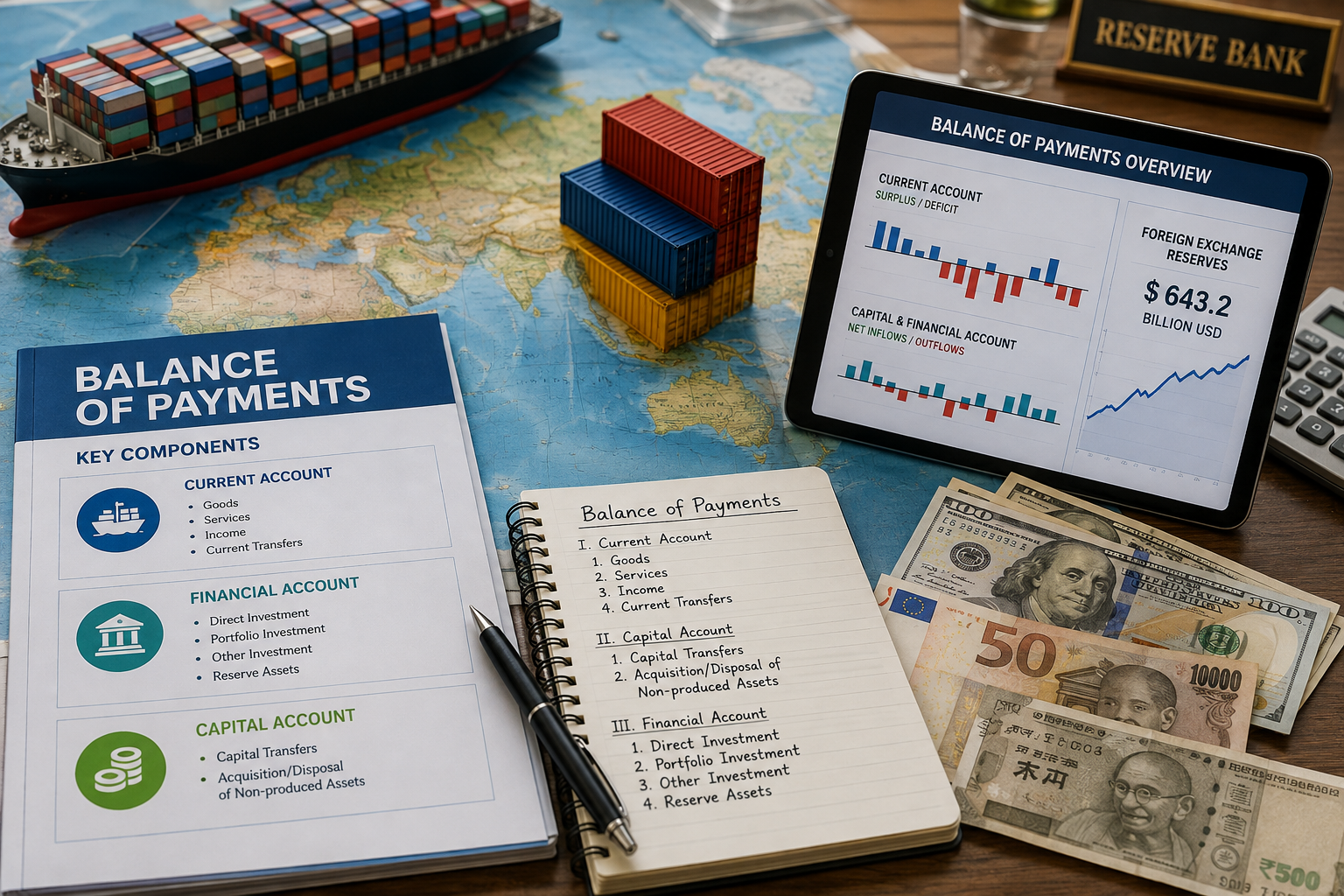
The main accounts inside the BoP
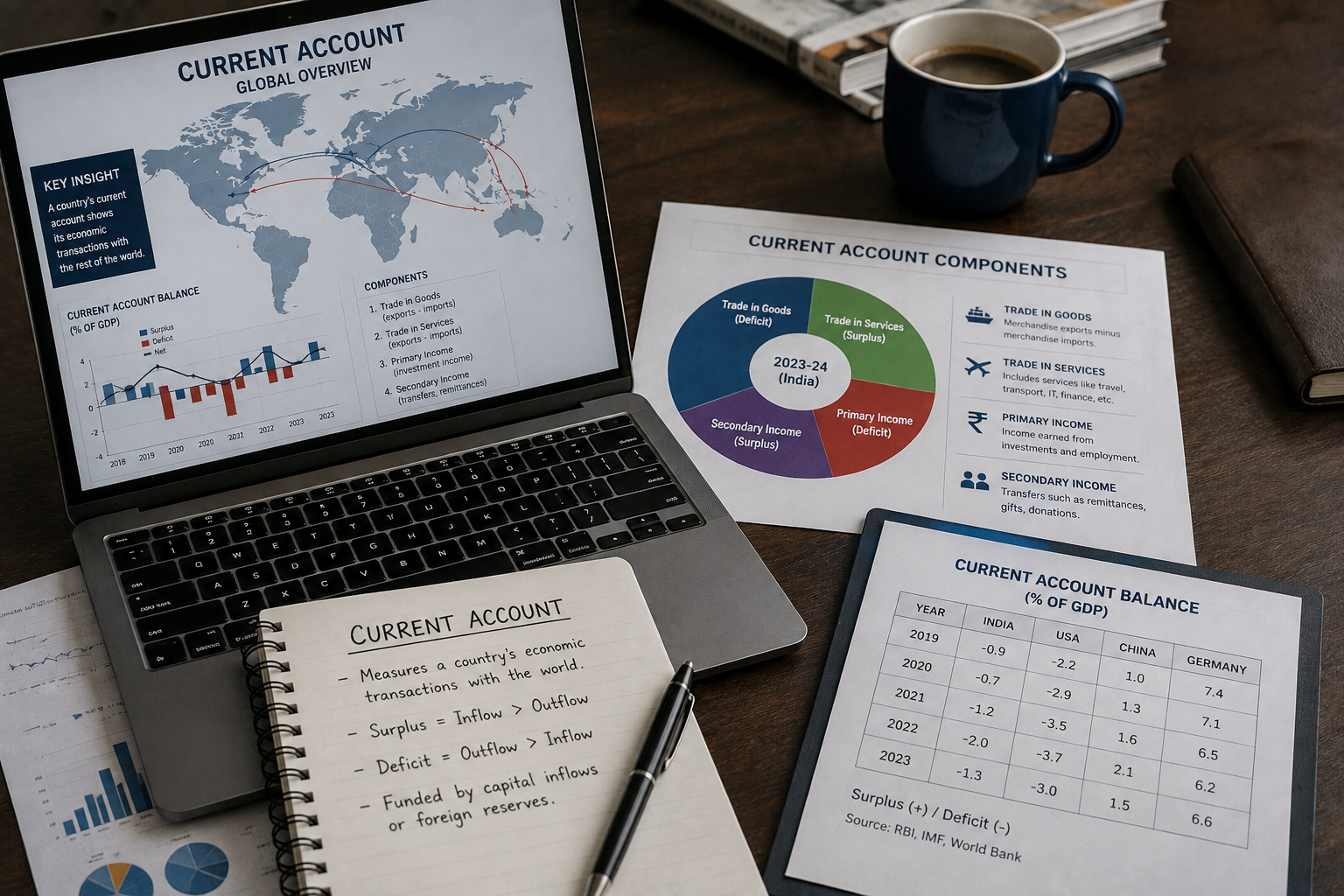
The current account records transactions that are linked to the present flow of goods, services, income and transfers. It includes exports and imports of goods, exports and imports of services, investment income, compensation income and transfers such as remittances. When people discuss a current account deficit, they are referring to this account.
The capital account, in the modern statistical framework, is usually a smaller account. It records capital transfers and transactions in non-produced, non-financial assets. In public debate, people sometimes use “capital account” loosely to describe all financial flows. But technically, the larger investment and borrowing flows are usually recorded in the financial account.
The financial account records changes in ownership of financial assets and liabilities. Foreign direct investment, foreign portfolio investment, external commercial borrowing, banking capital, deposits and reserve assets are part of this wider external financing picture. If the current account shows how a country earns and spends abroad, the financial account shows how it finances the gap or invests the surplus.
There is also an errors and omissions entry. This is not a scandal by itself. It exists because real-world data are collected from many sources, and timing, valuation and reporting differences can occur. In a large economy, perfect measurement is difficult. The errors and omissions item helps reconcile the accounts.
Why the BoP “balances” but still signals stress
A common confusion is this: if it is called the balance of payments, does it always balance? In accounting terms, yes. Every international transaction has two sides. If a country imports more goods than it exports, the payment must be financed by some form of capital inflow, reserve drawdown, borrowing or asset sale. The books must add up.
But accounting balance does not mean economic comfort. A household’s books can also balance if it spends more than it earns by borrowing every month. The arithmetic may balance, but the financial position may weaken. The same logic applies to countries. A current account deficit can be manageable if financed by stable long-term investment, but risky if financed by short-term speculative flows.
This is why economists do not merely ask whether the BoP balances. They ask how it balances. Is the country paying for imports through strong services exports and remittances? Is it attracting durable foreign direct investment? Is it depending on hot money? Is it drawing down reserves? Is external debt rising faster than export capacity? The quality of financing matters as much as the number itself.
Current account surplus and deficit
A current account surplus means a country earns more from its current external transactions than it spends. This may come from strong exports, large services income, investment income or remittances. A surplus can strengthen reserves and give policy flexibility, but it can also reflect weak domestic demand or excessive dependence on foreign markets.
A current account deficit means the country spends more abroad than it earns through current transactions. This is not automatically bad. A developing economy may run a deficit while importing machinery, technology and energy needed for future growth. The problem begins when deficits finance consumption rather than productive capacity, or when they are too large for too long.
The sustainability of a deficit depends on the growth of exports, the stability of capital inflows, the level of reserves, external debt maturity, exchange-rate flexibility and investor confidence. A small deficit in a credible economy may be harmless. A similar deficit in a fragile economy can become dangerous if foreign investors suddenly withdraw.
The India angle
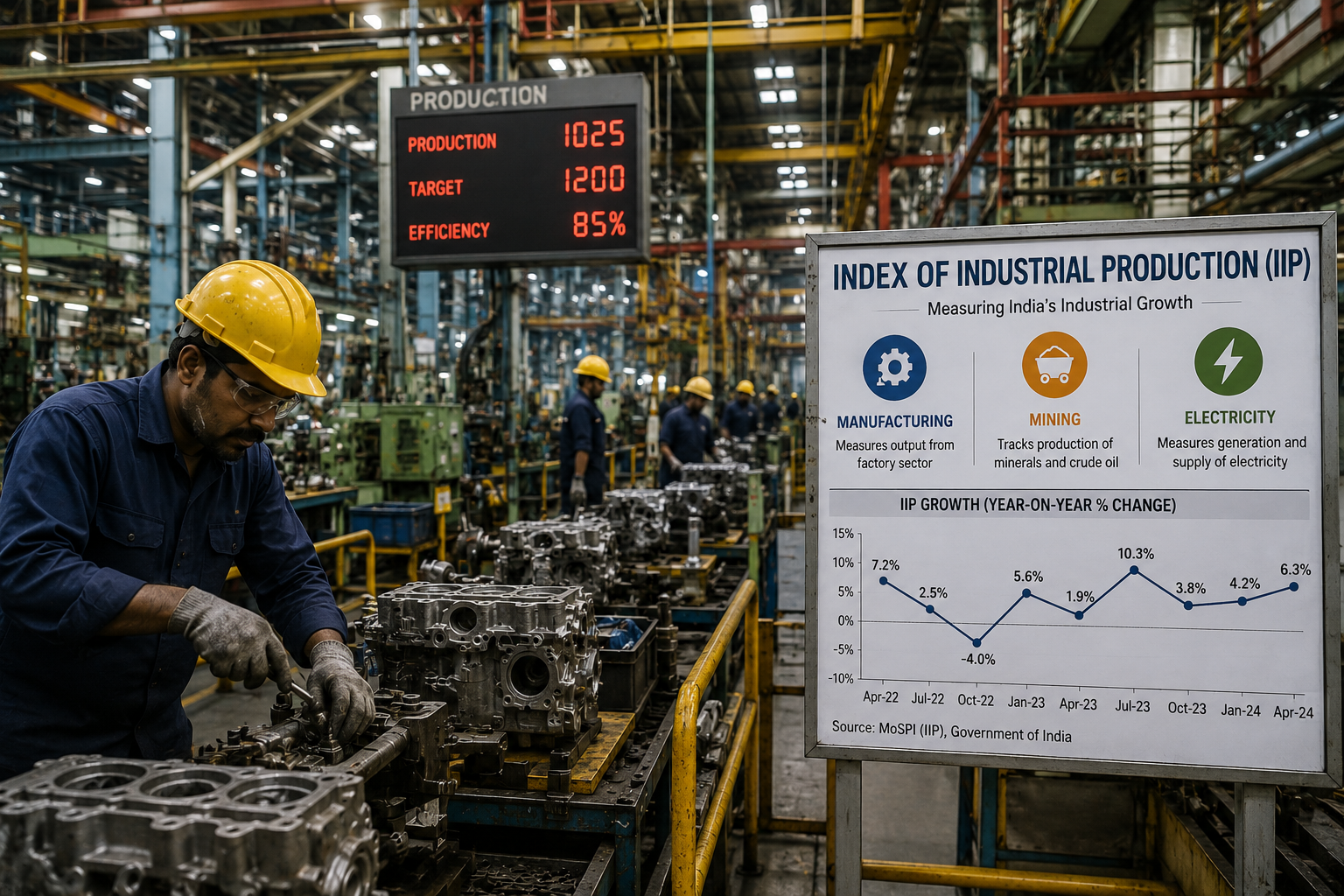
For India, the balance of payments is especially important because the country is deeply connected to the world through oil imports, gold demand, services exports, remittances, foreign investment, technology imports and global financial markets. India’s external account is not a narrow trade statistic; it is linked to household consumption, corporate borrowing, inflation, the rupee and macroeconomic stability.
India has historically faced pressure from merchandise trade deficits, especially because of energy imports. Services exports, particularly software and business services, have helped offset some of this pressure. Remittances from Indians working abroad have also provided a major external cushion. This combination makes India’s BoP story more complex than a simple import-export comparison.
Foreign exchange reserves are another key part of the Indian discussion. Reserves do not eliminate external vulnerability, but they provide insurance. They help the central bank manage disorderly market conditions, meet external payment needs and maintain confidence. The stronger the reserve buffer, the less likely short-term volatility becomes a full-blown external crisis.
At the same time, a country should not treat reserves as a substitute for competitiveness. The deeper solution is to build stronger exports, improve manufacturing capability, deepen services, attract stable investment and reduce avoidable import dependence. Reserves buy time; productive strength solves the problem.
Why citizens should care
The balance of payments may sound distant from daily life, but it affects citizens through the exchange rate, fuel prices, imported goods, inflation, interest rates and employment. If external pressure weakens the currency sharply, imported crude oil, electronics, machinery and education abroad can become costlier. That pressure can eventually move into household budgets.
Businesses also feel BoP pressure. Importers face higher costs when the currency weakens. Exporters may gain price competitiveness, but they also suffer if imported inputs become expensive. Borrowers with foreign-currency debt face repayment risk. Investors reassess markets when external accounts deteriorate. The BoP therefore becomes part of business strategy, not only government statistics.
For policymakers, the BoP is a warning dashboard. It forces them to look beyond domestic growth numbers and ask whether growth is externally balanced. A boom driven by imported consumption and short-term capital can look impressive until financing dries up. Sustainable growth requires the external account to remain credible.
Final reader takeaway
The balance of payments is the story of how a country deals with the rest of the world financially. It records trade, income, transfers, investment and financing. More importantly, it reveals whether an economy’s external position is resilient or fragile.
The key lesson is that BoP analysis should not be reduced to fear of deficits or celebration of surpluses. A deficit can be healthy if it supports future productive capacity and is financed by stable capital. A surplus can be useful but may also hide weak domestic absorption. The real question is sustainability.
For India, the balance of payments is a strategic economic indicator. It connects oil, exports, services, remittances, investment, reserves and the rupee into one framework. Anyone who wants to understand the Indian economy must learn to read this external mirror.
Editorial Disclaimer
This article is for general financial and economic education. It does not constitute investment, currency, tax, legal or policy advice. Readers should verify current BoP data, exchange-rate movements and policy updates from official sources before using them for analysis or decision-making.