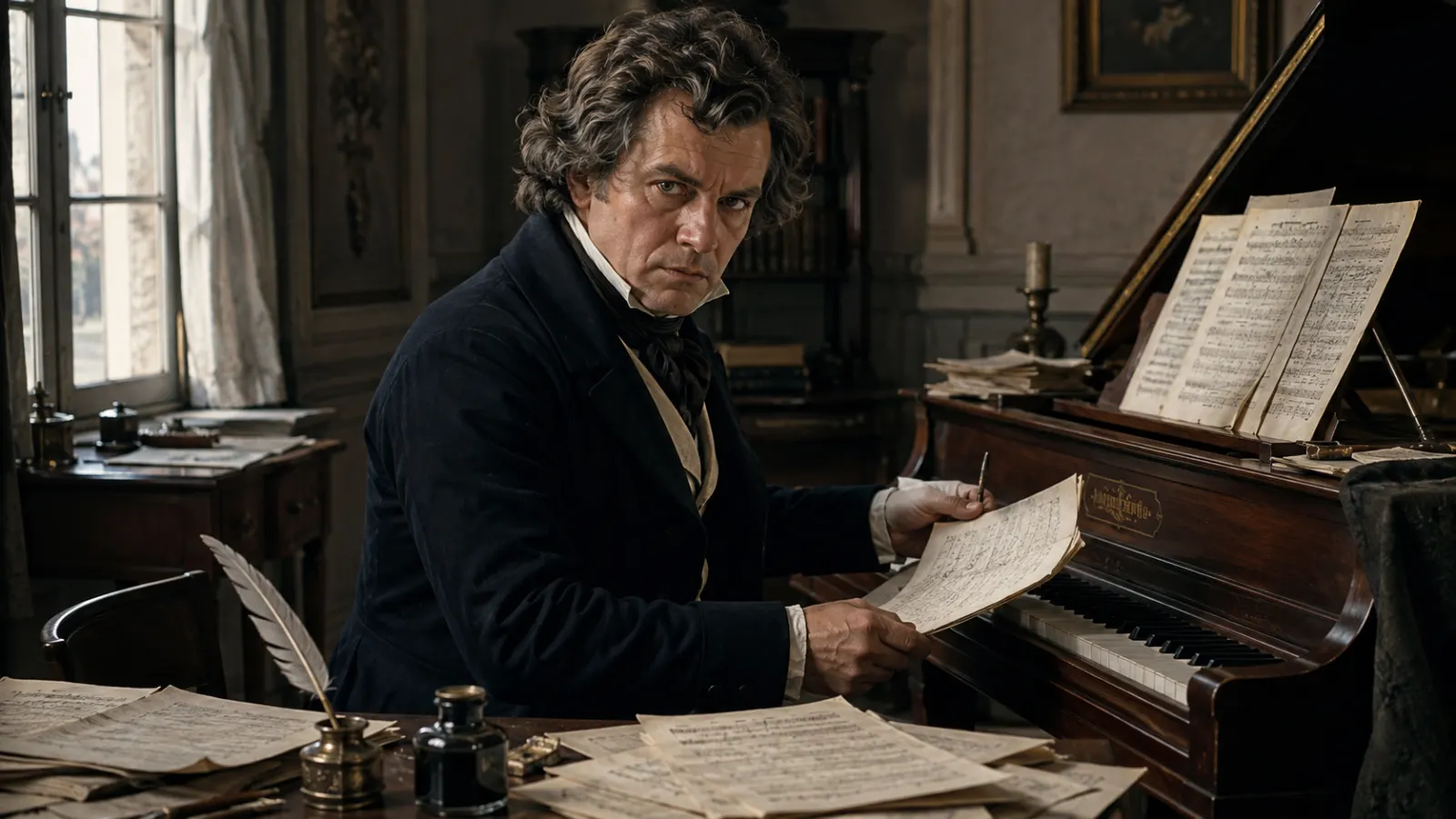
Wolfgang Amadeus Mozart has been made to carry one of the most persistent myths in cultural history: the effortless genius. In that version, music poured from him complete, childhood brilliance made training almost irrelevant, masterpieces appeared without revision, money disappeared through irresponsibility, and a mysterious Requiem seemed to announce his own death. The legend is powerful because the documented talent was genuinely extraordinary. Mozart was composing as a child, performing before European courts and writing at a level that astonished experienced musicians.
But genius without work is the wrong explanation. Mozart’s abilities developed inside a highly organised family project. His father Leopold was a professional musician, teacher and manager who understood how talent could be trained, displayed and marketed. His sister Maria Anna — Nannerl — was also a gifted keyboard performer whose early career formed part of the same touring enterprise. Years of travel exposed Wolfgang to musicians, styles, theatres, instruments and audiences across Europe. By adulthood, he possessed not only unusual facility but an immense working knowledge of musical systems.
Mozart’s life is therefore more interesting when treated as professional history rather than miracle. He moved from court-dependent childhood celebrity to a difficult attempt at freelance independence in Vienna. He wrote for patrons and public concerts, for opera companies and private households, for churches and theatres. He negotiated reputation, family obligations, debt and changing public taste. His death at thirty-five froze that career into legend, but the surviving manuscripts and letters reveal a working composer rather than a supernatural one.
Salzburg: a musical household
Mozart was born in Salzburg on 27 January 1756 and baptised Johannes Chrysostomus Wolfgangus Theophilus Mozart. He later used different forms of his names, including Wolfgang Amadé. He was the seventh child of Leopold Mozart and Anna Maria Pertl, though only Wolfgang and his older sister Maria Anna survived infancy.
Leopold served as a musician at the Salzburg court and published an important violin treatise in the year of Wolfgang’s birth. He was therefore unusually well equipped to recognise and cultivate musical ability. Nannerl, five years older than Wolfgang, received keyboard instruction, and Wolfgang learned in the same environment. Family accounts and early manuscripts document precocious musical activity at a very young age.
The child-prodigy label is accurate but incomplete. Precocity did not remove the need for education; it accelerated it. Wolfgang absorbed keyboard technique, composition, violin playing and the social discipline of performance. His father corrected manuscripts and guided his development. Scholars continue to examine early compositions to distinguish Wolfgang’s own work from Leopold’s assistance. That question does not diminish the child’s talent. It shows how talent develops through instruction.
Nannerl’s place in the story is equally important. She toured as a performer and was praised alongside her brother. As she reached marriageable age, social expectations sharply restricted the possibility of a comparable public career. The contrast is a reminder that “genius” is never recognised in a social vacuum. Wolfgang’s sex, family strategy and professional opportunities allowed his talent to be converted into a lifelong career in ways Nannerl’s could not.
Touring Europe: education through performance
From childhood, the Mozart family undertook extensive journeys to major European courts and cities. Munich, Vienna, Paris, London, the Netherlands and Italian centres became part of Wolfgang’s practical education. These trips were physically demanding and financially uncertain. Travel in the eighteenth century involved poor roads, illness, delays and expensive logistics. The family was not taking a modern concert tour with predictable infrastructure.
The performances had multiple purposes. They demonstrated the children’s virtuosity, created patronage connections and enhanced Leopold’s social standing. Wolfgang performed prepared music, improvised and took part in tests designed to prove unusual ability. European aristocratic culture had a strong appetite for prodigies, and the Mozarts understood that market.
The tours also exposed Wolfgang to different compositional styles. In London he encountered the music and influence of Johann Christian Bach. In Italy he absorbed opera seria traditions, met musicians and pursued commissions. Such encounters mattered because eighteenth-century musical culture was highly regional. A composer who travelled widely could hear styles that did not circulate as easily in printed form as music does today.
The mythology of the child who simply “knew music” obscures this cosmopolitan apprenticeship. By adolescence Mozart had acquired professional experience that many musicians would need decades to accumulate. The tours were a form of education conducted through courts, theatres, churches and social networks.
Italy, opera and the young professional
Opera became central to Mozart’s ambitions. It required him to work with librettos, singers, orchestras and theatrical conventions. Italian journeys brought opportunities to write stage works and sacred music, but they also exposed the difficulty of securing permanent employment.
Mozart’s early successes did not automatically produce a major European post. Patronage systems remained competitive, and courts balanced artistic prestige against budgets and hierarchy. Leopold repeatedly sought favourable positions for his son. The failure to secure the kind of appointment he wanted would shape Mozart’s later frustration with Salzburg.
This tension is important because modern fame can distort how precarious Mozart’s status once was. We know that many works became canonical; patrons at the time did not know they were dealing with a future monument of Western music. They evaluated a young composer within immediate institutional needs.
Back in Salzburg, Mozart held positions under the prince-archbishop. Court employment provided income and performance opportunities, but he experienced the role as constraining. The clash was not simply “genius versus philistine authority.” Salzburg’s court expected service from an employee; Mozart increasingly expected the freedom and status of an artist whose reputation extended beyond local duties.
The break with Salzburg and the decision for Vienna
The decisive conflict came in 1781 during service under Archbishop Hieronymus Colloredo. Mozart’s relationship with the Salzburg court deteriorated and he chose to establish himself in Vienna. The break has often been dramatised as an artistic declaration of independence. In practical terms, it meant giving up institutional security for a mixed economy of teaching, composing, performing, publishing and private patronage.
Vienna offered opportunity because it was an imperial capital with aristocratic households, public concerts and a strong opera culture. It also exposed Mozart to competition and fluctuating demand. His success would depend on maintaining a network rather than receiving a single reliable court salary.
This move places Mozart within a broader transformation in European cultural life. Court patronage remained powerful, but commercial publishing and public performance were expanding. A composer could attempt to earn money from multiple sources. The model was not fully modern freelancing, yet it allowed greater artistic mobility than traditional household service.
Mozart’s Vienna years became the most concentrated period of his mature career.
Constanze Weber and the household behind the composer
Mozart married Constanze Weber in 1782. Leopold opposed or worried about the match, and relations between father, son and daughter-in-law became complicated. Later mythology often reduces Constanze either to a careless wife who failed the genius or to a heroic guardian of his memory. Both caricatures are inadequate.
The marriage produced six children, only two of whom survived infancy. The emotional and practical effects of repeated child loss belonged to ordinary eighteenth-century life but are easy to overlook in composer biography. Constanze managed household matters under variable financial conditions and, after Mozart’s death, played a major role in preserving, publishing and promoting his music.
That later work also influenced the Mozart legend. Widows and heirs had strong reasons to shape public memory. Stories about the Requiem and Mozart’s final days circulated through networks in which reputation had financial as well as emotional value. This does not mean the stories were fabricated wholesale; it means they must be evaluated as remembered narratives rather than treated automatically as verbatim documentation.
The piano concertos and Mozart as performer-composer
During the early Vienna years Mozart enjoyed substantial success as a pianist and composer of piano concertos. These works were linked to his public appearances, subscription concerts and reputation among elite audiences. They demonstrate how directly composition and performance were connected in his career.
The concertos allowed him to create a dialogue between soloist and orchestra that was both technically demanding and dramatically responsive. The piano could dominate, converse, withdraw and re-enter. For audiences who knew Mozart as a performer, the works also carried his personal presence.
This period complicates the later image of permanent poverty. Mozart could earn significant sums and maintained a lifestyle consistent with social aspirations in Vienna. The problem was volatility. Income from concerts, commissions and lessons could rise and fall. War, changing fashion, illness, household costs and debt all affected stability.
Letters requesting loans from his friend and fellow Freemason Michael Puchberg show genuine financial strain in the late 1780s. But “Mozart died a penniless pauper because he wasted everything” is too crude. His finances changed over time, and the final year included renewed professional activity and important commissions.
Haydn, chamber music and artistic dialogue
Mozart admired Joseph Haydn and dedicated a set of six string quartets to him. The relationship is frequently sentimentalised, but the musical exchange is more important than anecdote. Haydn’s quartet writing posed a compositional challenge, and Mozart responded with works that demanded unusually close interaction among the instruments.
The quartets illustrate Mozart’s capacity to absorb another composer’s achievements without merely imitating them. Counterpoint, thematic development and conversational textures become part of his own language. This ability to synthesize styles is one reason Mozart’s music can seem effortless. The surface clarity often conceals dense technical organisation.
It also undermines the cliché that genius requires absolute originality. Mozart’s art was relational. He learned from Bach, Handel, Haydn, Italian opera, Salzburg church music and countless performers. Individuality emerged through recombination, judgment and craft.
The Marriage of Figaro: comedy inside a political society
The Marriage of Figaro premiered in Vienna in 1786, with a libretto by Lorenzo Da Ponte based on Beaumarchais. The source play had been politically controversial because of its treatment of aristocratic privilege. The opera was adapted to fit imperial censorship and theatrical conditions.
Figaro is often presented as a musical declaration of revolution. That is too direct. Mozart was not writing a party manifesto. Yet the drama depends on hierarchy: masters and servants, male privilege, sexual power and the vulnerability of women inside household structures. Music allows characters across social ranks to claim emotional depth.
Ensemble writing is central to the achievement. Multiple characters can pursue conflicting intentions simultaneously, and the music creates order without erasing confusion. Social comedy becomes musical architecture.
The opera’s initial Vienna run was respectable but not the triumphant cultural takeover later memory might suggest. Its stronger reception in Prague helped reinforce Mozart’s connection with that city.
Don Giovanni and the instability of genre
Don Giovanni premiered in Prague in 1787. Again working with Da Ponte, Mozart combined comic, serious and supernatural elements around the Don Juan story. Attempts to classify the work neatly as comedy or tragedy miss its deliberate instability.
The protagonist’s charisma, violence and refusal of repentance produce a drama in which pleasure and moral danger coexist. Modern productions debate how to stage sexual coercion and social power without romanticising them. That continuing debate is part of the opera’s afterlife, not evidence that eighteenth-century audiences understood every issue in modern terms.
Musically, the score moves between social worlds and dramatic registers with remarkable speed. The final supernatural confrontation with the stone guest has become iconic, but the opera’s power depends equally on the differentiated musical identities of its ensemble characters.
Don Giovanni demonstrates Mozart’s theatrical intelligence. He wrote not simply attractive melodies but music that makes character relationships audible.
Later Vienna: changing conditions, Masonic networks and mature style
Mozart joined the Freemasons in Vienna in 1784. Freemasonry provided social networks and exposed him to Enlightenment-inflected ideas of fraternity, morality and ritual. Masonic associations appear in discussions of several works, especially The Magic Flute, though symbolic interpretations can become speculative if every musical number is treated as a coded message.
The later 1780s were financially and professionally uneven. Public concert opportunities declined. Austria’s war with the Ottoman Empire affected aristocratic life and spending. Mozart moved residences and borrowed money. At the same time, he continued to compose at a high level.
Così fan tutte premiered in 1790. The opera’s treatment of fidelity, disguise and gender has generated intense modern debate. Its beauty can sit uneasily beside a plot built around manipulation. That tension is worth preserving rather than resolving through moral simplification.
Mozart’s mature art repeatedly combines elegance with instability. Comic surfaces can reveal cruelty; simple themes can sustain elaborate structures; entertainment can become psychological experiment.
1791: The Magic Flute, La clemenza di Tito and the Requiem
Mozart’s final year was exceptionally productive. The Magic Flute, written for Emanuel Schikaneder’s popular theatre, combined spoken dialogue, comedy, fairy-tale elements, Masonic resonances and serious moral aspiration. Its accessibility helped make it one of Mozart’s most durable stage works.
He also composed La clemenza di Tito for festivities connected with the coronation of Leopold II as King of Bohemia. The speed of production illustrates Mozart’s professional flexibility. He could work for court ceremony and popular theatre almost simultaneously.
The Requiem commission arrived anonymously through an intermediary acting for Count Franz von Walsegg, who had a history of commissioning music privately. The circumstances later generated the famous legend of a mysterious grey messenger and Mozart’s belief that he was writing his own funeral mass.
Some recollections come from Constanze and later witnesses, but the story accumulated dramatic embellishment. What is securely known is that Mozart received the commission, worked on the Requiem while completing other obligations, became seriously ill and died before finishing it. Constanze, needing the commission completed and paid, arranged for other composers to finish the score, most importantly Franz Xaver Süssmayr.
The familiar Requiem is therefore both Mozart’s work and a posthumously completed composition. Different modern editions attempt to distinguish or revise the completion.
Death: uncertainty instead of poisoning legend
Mozart died in Vienna on 5 December 1791 at the age of thirty-five. The precise cause of death remains uncertain. Contemporary descriptions of illness do not support a confident modern diagnosis, and retrospective medical speculation has produced many competing theories.
The most famous myth is that Antonio Salieri poisoned Mozart. There is no credible evidence that Salieri murdered him. The idea grew through later rumours and artistic works that found dramatic value in rivalry. Salieri and Mozart did compete within Vienna’s musical world, but competition is not evidence of homicide.
Another myth concerns burial. Mozart was not thrown into a pauper’s grave because Vienna had rejected him. He received burial according to contemporary regulations for a person of his social category, in a common grave rather than an individually marked elite tomb. The exact location was later lost.
The absence of a grand funeral fits poorly with modern expectations for a canonical genius, which is precisely why later culture transformed it into tragedy.
Constanze, publishing and the posthumous Mozart
After Mozart’s death, Constanze faced financial and family responsibilities. She organised memorial concerts, managed manuscripts and worked with publishers. Along with later biographers, collectors and Mozart’s sons, she helped turn the composer’s papers into a cultural archive.
This posthumous work matters because canons are built, not merely inherited. Mozart’s reputation depended on performance, publication, biography, collecting and institutional preservation. The International Mozarteum Foundation and later critical editions continued that process on a scholarly scale.
The Köchel catalogue, first developed in the nineteenth century and repeatedly revised, attempted to organise Mozart’s works chronologically. Its famous “K” numbers demonstrate how scholarship creates navigational systems around a prolific historical figure.
What Mozart’s “genius” actually consisted of
Mozart’s genius is sometimes described as speed. He could indeed compose rapidly, and his surviving manuscripts can be cleaner than Beethoven’s heavily revised pages. But manuscript neatness does not prove that music arrived fully formed without mental revision. Compositional work can occur before ink reaches paper.
His deeper strength was fluency across genres. Opera, symphony, concerto, chamber music, sacred music, dances and songs all occupied his working world. He could adapt to different performers and institutions while maintaining a recognisable musical intelligence.
He also had an extraordinary capacity to give distinct characters musical presence. In opera, aristocrats and servants, comic figures and tragic figures can inhabit the same ensemble without becoming musically interchangeable. In instrumental music, contrasting ideas can be balanced without losing tension.
The word “genius” is useful only if it does not erase the infrastructure behind that achievement: Leopold’s training, Nannerl’s shared childhood environment, European travel, patronage, instruments, performers, librettists, theatres, copyists and publishers.
Legacy: the unfinished life behind perfect surfaces
Mozart’s death at thirty-five encourages endless speculation about what he might have written. That question has no answer. The more historically grounded fact is that he left an enormous body of work produced in a short life under changing professional conditions.
Nineteenth-century Romanticism helped turn him into an emblem of natural inspiration. Twentieth- and twenty-first-century performance practice has complicated that image by reconstructing period instruments, tempi, ornamentation and theatre conditions. Scholarship on letters and manuscripts has made the working composer more visible.
Mozart endures because clarity in his music is rarely simplicity in the weak sense. The surfaces can sound balanced while emotional structures remain unstable. Comedy can become painful; formal symmetry can hold conflict; a melody that seems inevitable can sit inside intricate counterpoint.
The miracle-child legend is therefore unnecessary. The documented story is stronger. A highly trained child was taken through Europe, learned rapidly, struggled for professional autonomy, built a precarious career in Vienna, collaborated with exceptional artists, experienced debt and family loss, and produced music that remains difficult to exhaust. Mozart’s achievement was not that he escaped labour. It was that labour became almost invisible inside the music.
Sources / Further Reading
International Mozarteum Foundation, Salzburg — official Wolfgang Amadé Mozart biography and family documentation.
International Mozarteum Foundation — Digital Mozart Edition, family correspondence and manuscript resources.
International Mozarteum Foundation — Mozart museums and Bibliotheca Mozartiana collections.
International Mozarteum Foundation — research on Mozart’s death and the later Requiem legend.
Primary sources: Mozart family letters, surviving autograph manuscripts, early editions and performance documents.
Modern critical biographies and Neue Mozart-Ausgabe / Digital Mozart Edition scholarship for chronology and attribution.
Suggested Internal Links
Planned internal link: The Music of Ludwig van Beethoven
Planned internal link: The History of Opera
Planned internal link: How the Classical Concerto Works
Planned internal link: Music and Patronage in Eighteenth-Century Europe
Planned internal link: The Requiem in Western Music
Planned internal link: Child Prodigies, Training and the Myth of Effortless Genius