A forest is more than a collection of planted trees
When a forest disappears, the most visible loss is the trees. That makes the apparent solution seem simple: plant trees again.
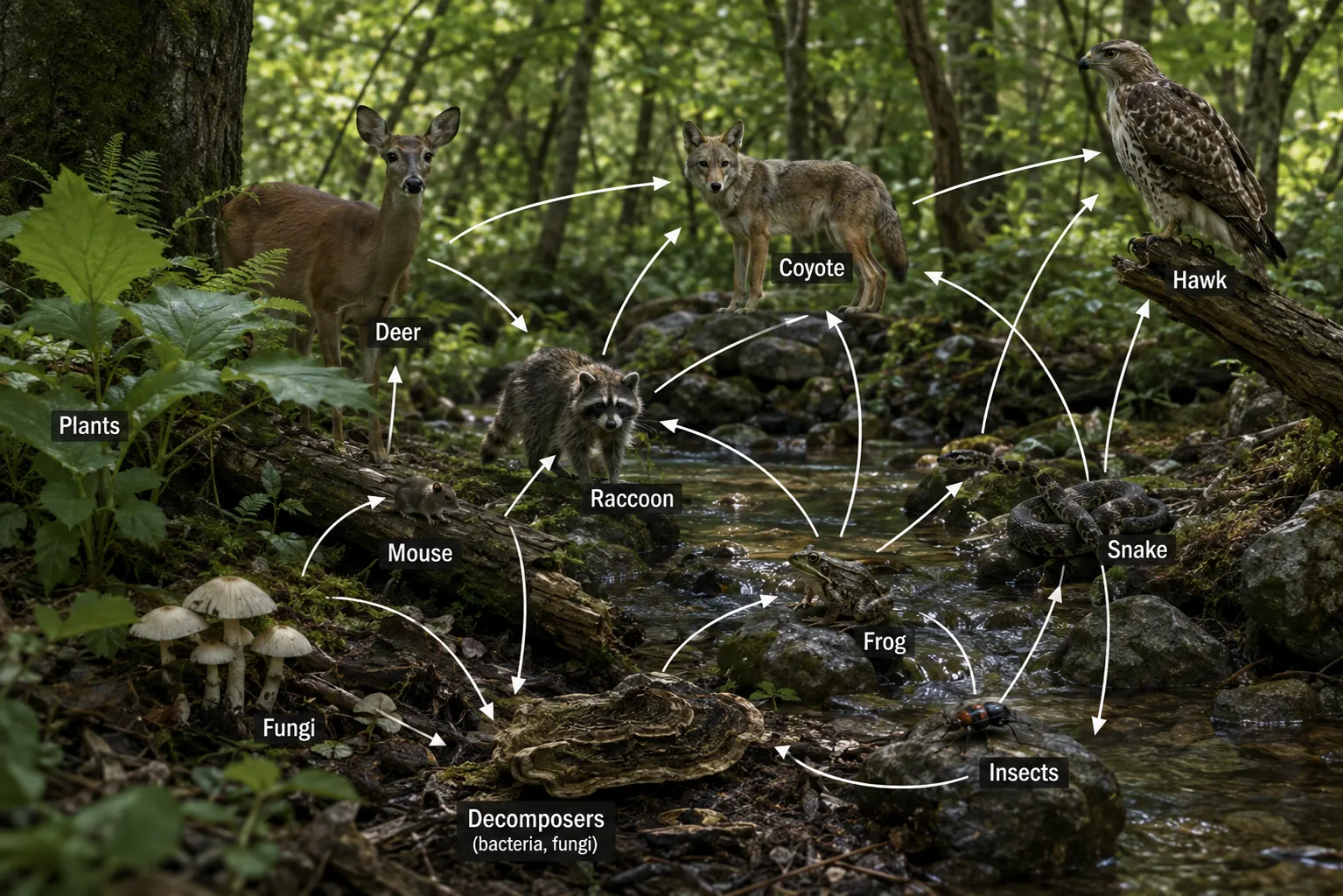
But a functioning forest is not merely an inventory of trunks. It is a living system of soils, fungi, insects, birds, mammals, understory plants, dead wood, water flows and relationships built over time. Bringing that system back may involve planting, but it may also involve doing less—removing the pressure that prevents a damaged forest from recovering on its own.
That is the central idea behind reforestation and modern forest restoration.
In everyday use, reforestation means restoring tree cover where forest has been lost or severely reduced. Technical definitions vary. FAO forest reporting has at times used “reforestation” for the re-establishment of forest on land still classified as forest but temporarily without sufficient tree cover. In its forest-and-landscape restoration guidance, FAO also uses the term more broadly for re-establishing tree cover on land deforested by other activities. The important practical distinction is that reforestation is about bringing forest back to a place with a forest history; afforestation establishes forest on land that was not previously forest, or has not been forest for a long period.
Why forests are restored
The reasons for reforestation differ from place to place.
One project may aim to reconnect habitat for wildlife. Another may be designed to reduce erosion in a damaged watershed. A government may want to increase forest carbon stocks. A community may want fuelwood, shade, food, medicines or more reliable water. A timber company may re-establish production forest after disturbance.
These objectives can overlap, but they are not identical. A forest designed mainly for timber can look and function very differently from a forest restored primarily for biodiversity. A project that maximises rapid carbon accumulation may favour different species or planting densities from one intended to restore a native ecosystem.
FAO’s forest and landscape restoration approach reflects this complexity. It emphasises restoring ecological functions across a landscape while balancing environmental services with agriculture, forestry and local livelihoods. The objective is not simply to maximise the number of trees.
Reforestation can happen without planting
One of the most important misconceptions is that reforestation always requires people to plant seedlings.
Many landscapes contain a biological memory of the former forest. Seeds remain in the soil. Nearby trees supply seed. Roots and stumps resprout. Birds and mammals carry seeds into open areas. If grazing, repeated burning, clearing or other pressures are reduced, trees may return naturally.
This is natural regeneration.
Where natural recovery is possible, it can be cheaper and ecologically richer than planting every tree by hand. The species that return are more likely to reflect local conditions, and the resulting forest can develop a varied structure rather than a uniform plantation.
Natural regeneration is not always sufficient. Seed sources may be too distant. Soils may be severely degraded. Invasive plants may dominate. Fire may recur too frequently. Large wildlife may be absent, disrupting seed dispersal. In such cases, restoration managers can use assisted natural regeneration: protecting useful regrowth, controlling competing vegetation, reducing grazing pressure, preventing fire or enriching the site with selected native species.
At the most degraded sites, active planting may be necessary.
Planting trees is a tool, not the definition of success
Tree-planting campaigns are visually powerful because progress can be counted: one thousand seedlings, one million seedlings, one billion seedlings.
Survival is harder to photograph.
A seedling planted today is not automatically a forest tomorrow. It must survive heat, drought, browsing, fire, pests and competition. It must be suited to the soil and future climate. The site must have enough water. Local people must have a reason to protect it. If the project uses only one or two fast-growing species, it may add tree cover while providing much less biodiversity than the ecosystem it is supposed to restore.
IPCC assessments therefore distinguish between simple forest expansion and ecological restoration. Well-planned reforestation and forest restoration can improve biodiversity, water regulation, soil protection, climate resilience and livelihoods. Poorly planned projects can create trade-offs, particularly when they use non-native monocultures, consume scarce water or compete with food production.
The relevant question is not “How many trees were planted?” but “What kind of forest is developing, and what functions is it recovering?”
Native forest, plantation and restored forest are not interchangeable
A plantation can be useful. It may supply timber, fibre, fuelwood or other products, potentially reducing pressure on natural forests when managed sustainably.
But a plantation is not automatically an ecological substitute for the forest that existed before it.
Natural forests generally contain more structural complexity: trees of different ages, dead wood, canopy gaps, multiple plant layers and many interacting species. A restored forest may gradually recover some of these qualities, but the process takes time. A young plantation composed of one fast-growing species should not be described as equivalent to an old natural forest simply because both satisfy a minimum definition of “forest”.
This distinction matters in climate policy as well as biodiversity policy. Carbon can be stored in many kinds of tree cover, but ecological outcomes depend on species choice, management and location.
What reforestation can do for climate
Trees remove carbon dioxide from the atmosphere through photosynthesis and store carbon in wood, roots, litter and soils. Reforestation can therefore increase carbon stocks on land that has lost forest.
The IPCC identifies reforestation and forest ecosystem restoration among land-based mitigation options with substantial potential. Yet climate benefit is not a licence to plant indiscriminately. The amount and durability of carbon storage depend on forest type, disturbance risk, management and what would have happened to the land without the project.
A forest destroyed by fire, drought or renewed clearing can release part of the carbon it accumulated. Climate mitigation therefore depends on keeping restored forests functioning over decades, not merely recording initial planting.
Preventing the destruction of intact forests is also generally more certain than attempting to recreate their carbon and ecological functions after loss. Restoration is essential, but it should complement conservation rather than become an excuse for continued deforestation.
Water benefits—and water trade-offs
Forests interact with water in several ways. Their roots can stabilise soil, reduce erosion and influence infiltration. Forest cover can reduce sediment reaching rivers and reservoirs. Tree canopies and soils affect evapotranspiration, streamflow and groundwater recharge.
These effects are context-dependent.
FAO’s Forest and Water Programme stresses that reforestation and afforestation can improve water quality and regulation, but changes in tree cover can also alter the amount and timing of water available downstream. Trees use water. In some catchments, particularly dry ones, increased tree cover can reduce annual water yield even while improving erosion control or water quality.
That is why watershed restoration requires hydrological planning rather than the assumption that more trees always produce more water.
Reforestation and biodiversity
A well-designed restoration project can reconnect fragmented habitat, increase native plant diversity and create space for wildlife to return. This is especially valuable when surviving forest patches are isolated by farms, roads or settlements.
Location matters. Restoring a corridor between two forest fragments may provide more ecological value than planting the same area of trees far away from remaining habitat. Species mix matters too. Native trees and shrubs can support insects, birds and other organisms that may not use exotic plantation species in the same way.
Restoration also depends on processes beyond trees. Pollinators, seed dispersers, predators, soil organisms and natural disturbance patterns all influence whether the recovering ecosystem becomes resilient.
The human landscape cannot be ignored
Many degraded landscapes are not empty.
They may be farmland, grazing land, customary territory or a source of fuel and food. People may hold formal or informal rights to use them. Large restoration commitments can therefore fail when they are designed on maps without understanding local land tenure, livelihoods and incentives.
FAO’s landscape-restoration guidance emphasises stakeholder participation because restoration changes who can use land and for what purpose. If local communities bear the costs while outsiders receive the benefits, planted areas may be neglected, cleared or contested.
Successful reforestation is therefore partly an ecological project and partly a governance project.
How do we know whether restoration worked?
Counting seedlings is an activity measure, not an outcome measure.
A serious evaluation asks whether trees survived, whether native species increased, whether invasive species declined, whether soil and water conditions improved, whether habitat became more connected and whether local people received intended benefits.
The appropriate indicators depend on the project’s original goals.
A carbon project should monitor carbon stocks and permanence. A watershed project should measure erosion, sediment and water outcomes. A biodiversity project should track species composition and habitat structure. A livelihood project needs socioeconomic indicators as well as ecological ones.
Monitoring may need to continue for years because forests develop slowly.
Reforestation is recovery, not instant replacement
The attraction of reforestation is understandable. Forest loss is visible, and trees provide a tangible symbol of repair.
But restoration cannot compress centuries of ecological development into a planting season.
A restored forest may take decades to accumulate the structure, soils and species relationships associated with mature ecosystems. Some losses cannot be fully reversed. Others can be substantially repaired if the underlying causes of degradation are removed and recovery is given enough time.
The strongest reforestation strategy therefore begins before the first seedling is planted. It asks what ecosystem belonged on the site, why it disappeared, what local people need, how water and biodiversity will respond, and whether natural recovery can do part of the work.
Planting trees can be valuable.
Restoring a forest is the larger task.
Sources / Further Reading
FAO — Forest and landscape restoration, Sustainable Forest Management Toolbox — https://www.fao.org/sustainable-forest-management-toolbox/modules/forest-and-landscape-restoration/
FAO — Forest restoration, Sustainable Forest Management Toolbox — https://www.fao.org/sustainable-forest-management-toolbox/modules/forest-restoration/en
FAO — Forest and Water Programme: The Forest-Water Nexus — https://www.fao.org/in-action/forest-and-water-programme/overview/en/
IPCC AR6 WGIII — Chapter 7: Agriculture, Forestry and Other Land Uses — https://www.ipcc.ch/report/ar6/wg3/chapter/chapter-7/
IPCC AR6 Synthesis Report — Longer Report — https://www.ipcc.ch/report/ar6/syr/longer-report/
Suggested Internal Links
What Is Afforestation — Planned internal link
Understanding Deforestation and Its Causes — Planned internal link
Understanding the Importance of Trees — Planned internal link
Understanding Biodiversity Loss — Planned internal link
Understanding the Role of Forests in Climate — Planned internal link
What Is Carbon Sequestration — Planned internal link