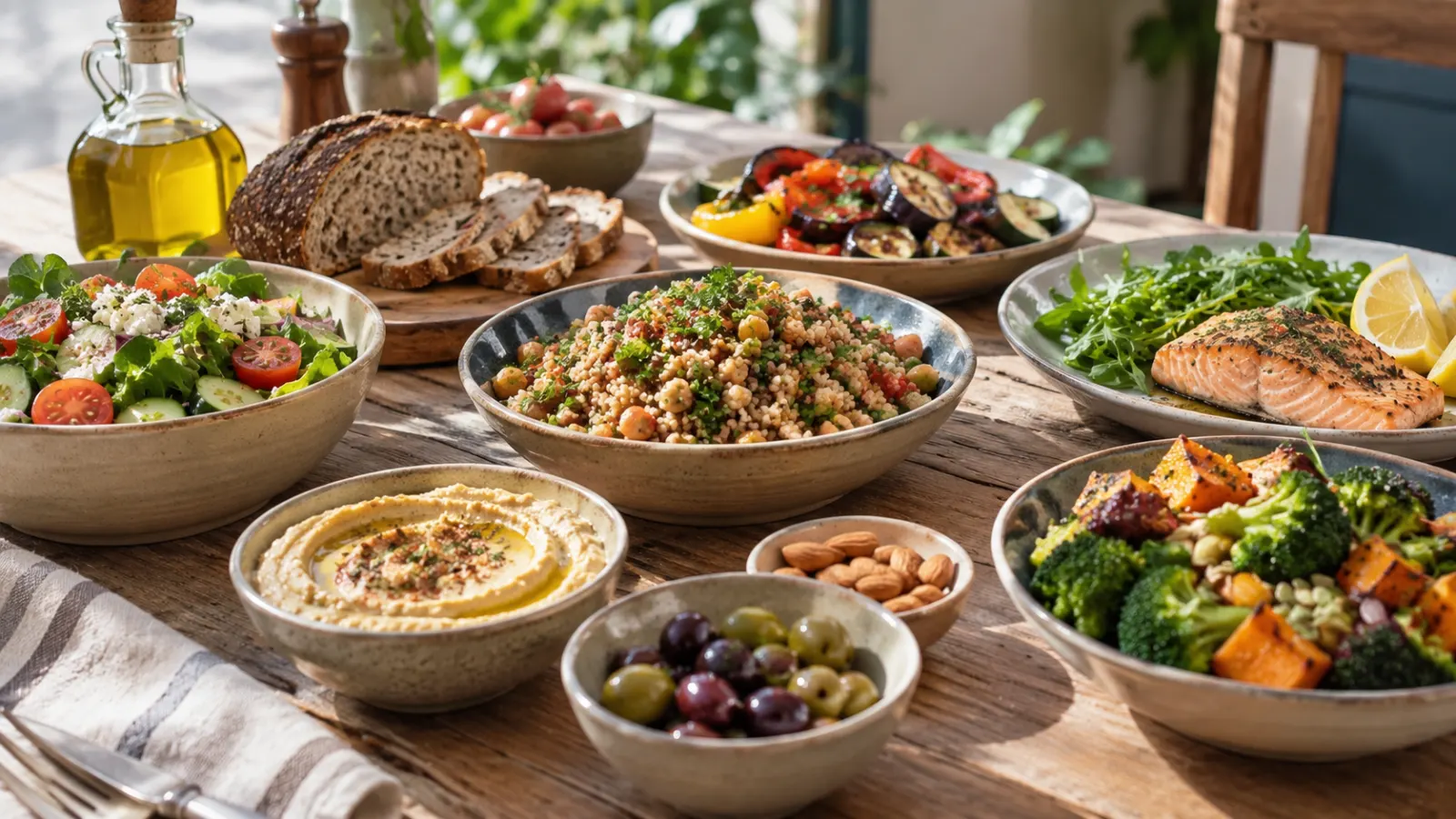
Mediterranean Diet: Benefits, Foods and How to Adapt It
The Mediterranean diet is often presented as though it were a fixed menu of olive oil, fish, tomatoes and European food. Historically, however, there was never one identical Mediterranean diet. Greece, southern Italy, Spain and other communities around the Mediterranean developed different food traditions based on local agriculture, religion, income and culture. Modern nutrition guidance therefore treats the Mediterranean diet as a dietary pattern, not a requirement to reproduce one region's cuisine.
The common principles are more important than the exact dishes. Mediterranean-style eating generally emphasises vegetables, fruits, legumes, whole grains, nuts and seeds; uses olive oil or other unsaturated fats in place of more saturated fats; includes fish where appropriate; and limits red and processed meat, sweets and heavily processed foods. The American Heart Association similarly describes the Mediterranean diet as a flexible pattern rather than one standard diet and notes that its central features align closely with heart-healthy dietary guidance.
This makes the Mediterranean diet unusually adaptable. Someone in India does not need imported olives, Mediterranean cheese or expensive European ingredients to use its nutritional logic. Dal, rajma, chana, vegetables, fruit, nuts, seeds, whole grains, suitable plant oils and fish where eaten can build a pattern with many of the same characteristics. The important question is not whether a meal looks Mediterranean. It is whether the overall diet moves toward more minimally processed plant foods, higher fibre, healthier fat sources and less reliance on highly processed foods.
The strongest evidence is cardiovascular, not cosmetic
The Mediterranean diet is frequently marketed for weight loss, “anti-ageing”, better skin or general wellness. Its strongest clinical evidence, however, concerns cardiovascular health.
The best-known trial is PREDIMED, which included 7,447 adults in Spain who were at high cardiovascular risk but did not have cardiovascular disease at enrolment. Participants were assigned to a Mediterranean diet supplemented with extra-virgin olive oil, a Mediterranean diet supplemented with mixed nuts, or a comparison diet advising reduced fat intake. The corrected and republished analysis reported fewer major cardiovascular events among participants assigned to the Mediterranean-diet groups.
That evidence should be reported carefully. The original PREDIMED paper was retracted and republished after irregularities in randomisation were identified at some study sites. The 2018 reanalysis attempted to account for those problems and continued to report a cardiovascular benefit, but the methodological history is part of the evidence and should not be hidden.
The broader evidence base is also consistent with the idea that Mediterranean-style eating can support cardiovascular health. The American Heart Association continues to recommend dietary patterns that closely overlap with Mediterranean principles: plenty of vegetables and fruits, mostly whole grains, healthy protein sources, unsaturated fats in place of saturated fats, fewer ultraprocessed foods, less added sugar and lower sodium. Its March 2026 cardiovascular dietary guidance continues to emphasise the quality of the whole pattern rather than individual foods or nutrients.
This distinction prevents the evidence from becoming a marketing slogan. The lesson from Mediterranean research is not that olive oil is a medicine or that nuts independently prevent heart attacks. It is that a dietary pattern built around these foods can replace less favourable foods and improve the overall nutritional structure of the diet.
Olive oil, nuts, legumes and whole grains work as part of a system
Olive oil is probably the food most strongly associated with Mediterranean eating. Extra-virgin olive oil contains predominantly monounsaturated fat and also contains polyphenol compounds, but its usefulness depends partly on what it replaces. Using an unsaturated plant oil instead of butter or other foods high in saturated fat changes the fatty-acid profile of the diet. Current American Heart Association guidance likewise recommends replacing sources of saturated fat with sources of unsaturated fat.
That does not mean drinking olive oil or adding unlimited quantities to every meal. Oil remains energy dense. Adding large amounts of olive oil to a diet dominated by refined foods does not reproduce the dietary pattern studied in Mediterranean research. The substitution is more important than the symbolism.
Nuts and seeds play a similar role. They provide unsaturated fats, fibre, plant protein and minerals. Their energy density sometimes makes people assume they automatically cause weight gain, but moderate portions can fit comfortably into healthy diets, particularly when they replace less nutritious snack foods or foods rich in saturated fat. People with nut allergies can use other appropriate sources of unsaturated fats and plant protein; Mediterranean eating does not depend on one mandatory ingredient.
Legumes may be among the most transferable components of the pattern. Beans, lentils, chickpeas and peas combine carbohydrate with fibre and plant protein while providing minerals such as potassium and magnesium. They can replace part of the refined starch or meat in a meal and are relatively affordable in many countries.
This is where Mediterranean principles translate particularly easily into Indian food. Dal, chana and rajma already perform the nutritional function that Mediterranean recipes may obtain from lentils, chickpeas or beans. A dietary pattern does not become less evidence-based simply because the ingredients have different cultural names.
Whole grains, vegetables and fruits provide much of the fibre-rich structure of the diet. Mediterranean-style eating does not require the permanent elimination of white rice or bread, but it shifts the average diet toward more whole or minimally processed carbohydrate sources and more plant foods. This is more realistic than creating a list of forbidden ingredients.
Fish can contribute protein and, in fatty species, long-chain omega-3 fats. Traditional Mediterranean diets often include fish more frequently than red meat, but fish is not the definition of the diet. People who do not eat seafood can still build a strongly Mediterranean-style plant-forward pattern, although their overall nutrient intake—including omega-3 sources—should still be considered.
The broader principle is substitution. Adding olive oil, nuts or fish while leaving the rest of an unhealthy dietary pattern unchanged misses much of the point. Mediterranean-style eating gains nutritional value because healthier foods increasingly displace processed meat, refined sweets, sugary drinks and other less favourable choices. The source draft correctly identifies this substitution mechanism as central to the pattern.
Wine is optional, and people should not start drinking for health
Traditional descriptions of Mediterranean eating sometimes include wine with meals. This has occasionally been interpreted as evidence that alcohol is necessary for cardiovascular health.
It is not.
The American Heart Association's 2026 dietary guidance states that people who do not drink alcohol should not start, while people who do drink should limit their intake.
A modern Mediterranean dietary pattern can therefore be completely alcohol-free. Water, unsweetened beverages and culturally appropriate alternatives fit easily within it. Removing wine does not remove vegetables, legumes, whole grains, nuts, unsaturated fats or the food substitutions responsible for most of the diet's nutritional structure.
This is a useful example of why a traditional regional pattern should not be copied uncritically. Some historical behaviours may have accompanied Mediterranean eating without being necessary components of its health benefits.
Mediterranean principles can be adapted to Indian and other cuisines
One of the biggest misconceptions about the Mediterranean diet is that following it requires buying imported foods.
An Indian version might include dal, chana, rajma, vegetables, fruit, peanuts or other nuts, sesame or other seeds, whole-grain or higher-fibre staple choices, curd where appropriate, and fish in communities where seafood is already part of the cuisine. Appropriate unsaturated plant oils can be used instead of assuming that every meal must be cooked with imported extra-virgin olive oil.
Spices, herbs, garlic, onions, tomatoes and traditional preparations can remain. The nutritional objective is to improve the proportions of plant foods, fibre-rich staples and healthier fats while reducing dependence on processed meat, sugary drinks, heavily refined snacks and high-sodium packaged foods.
This approach also protects cultural identity. A diet becomes harder to maintain when it requires people to abandon foods they know, family meals they share and cooking techniques they enjoy. Mediterranean-style eating is valuable partly because its underlying principles can survive cultural translation.
The source draft correctly identifies legumes as particularly transferable and notes that Indian staples such as dal, chana and rajma already fit the logic of a plant-forward Mediterranean-style pattern.
The same idea applies beyond India. Latin American diets can use beans, maize-based whole-food preparations, vegetables, avocado, nuts and fish where appropriate. Asian cuisines can emphasise vegetables, legumes, whole grains or minimally refined staples, soy foods, seafood and unsaturated oils. The geographical label is less important than the nutritional direction.
Preparation methods matter too. Herbs, spices, garlic, citrus, onions and other flavour-building ingredients can make plant-rich meals enjoyable without depending entirely on salt, sugar or heavy sauces. A sustainable dietary pattern is not only a nutrient profile; it is also a way of cooking food that people want to repeat.
Mediterranean eating does not guarantee weight loss
Mediterranean diets can support weight management, particularly because vegetables, legumes, fruits and whole grains can provide fibre and volume while reducing reliance on highly processed foods. But the pattern is not an unlimited-food diet.
Olive oil, nuts and seeds are nutrient dense but also energy dense. A person can follow a high-quality Mediterranean-style diet and still consume more energy than required for weight loss.
This distinction is important because the diet's cardiovascular value should not be reduced to the number on a scale. Blood pressure, blood lipids, glucose regulation and overall diet quality can improve even when weight change is modest. The purpose of the eating pattern may therefore differ between individuals.
When weight loss is the goal, portions and total energy intake still matter. Mediterranean principles can make an energy deficit easier for some people because fibre-rich foods can support fullness, but no dietary label suspends energy balance.
The diet's flexibility may nevertheless help with adherence. Unlike highly restrictive plans, Mediterranean-style eating does not require eliminating entire macronutrient categories. It permits different grains, vegetables, legumes, protein sources and cooking traditions. It can include fish or be largely vegetarian.
That flexibility is not scientific weakness. It may be one reason the pattern is practical in ordinary life.
Cost and food access determine how practical the diet becomes
Mediterranean eating is sometimes marketed through premium extra-virgin olive oil, imported nuts, specialty cheeses and restaurant seafood. Constructed that way, it can look expensive.
The underlying pattern does not require those products.
Beans, lentils, seasonal vegetables, fruit, whole grains and modest portions of nuts or seeds can be inexpensive staples. Frozen vegetables and canned beans can also make the pattern more convenient where fresh foods are costly, seasonal or likely to spoil.
Affordability still matters. Nutrition advice should not pretend that food prices, kitchen facilities, time and local availability are irrelevant. A theoretically ideal diet that a household cannot purchase or prepare is not a useful recommendation.
This is another reason adaptation matters more than authenticity. The best Mediterranean-style pattern for a household is usually one built from foods that are locally available, culturally familiar and affordable enough to be purchased repeatedly.
The pattern also works through routines. Keeping useful staples available, knowing several satisfying vegetable and legume dishes and making healthier meals normal within the household can matter as much for long-term adherence as understanding individual nutrients.
The Mediterranean diet is strong because the principles are broader than the label
Mediterranean-style eating has one of the strongest cardiovascular evidence bases among widely discussed dietary patterns, but its usefulness can be distorted when individual ingredients become health products.
Olive oil is not a medicine. Nuts are not a longevity supplement. Fish is not mandatory for every person. Wine is not required. Imported foods are unnecessary.
The stronger evidence supports a direction: eat more vegetables, fruits, legumes, nuts and whole grains; choose healthier protein sources; favour unsaturated over saturated fat; minimise highly processed foods, excess sodium and added sugars; and build the pattern from foods that can realistically be sustained. This direction closely overlaps with the American Heart Association's updated 2026 cardiovascular dietary guidance.
The Mediterranean diet is therefore useful precisely because it does not have to remain Mediterranean in a geographical sense.
Its principles can appear in dal and vegetables as easily as in lentil soup and olive oil. What matters is the nutritional pattern created across meals and weeks.
That is also why arguments over the single “most important Mediterranean food” miss the point.
The evidence supports the combination and substitution: more minimally processed plant foods and unsaturated fats, less dependence on heavily processed foods and less favourable fat sources, and a pattern flexible enough to become ordinary eating rather than a temporary diet.
Medical Note
This article provides general nutrition and health information and is not a substitute for individual medical or dietetic advice. People with diabetes, kidney disease, pregnancy-related nutritional needs, eating disorders, significant gastrointestinal conditions, frailty, food allergies or medication-related dietary requirements may need personalised guidance from an appropriately qualified healthcare professional.