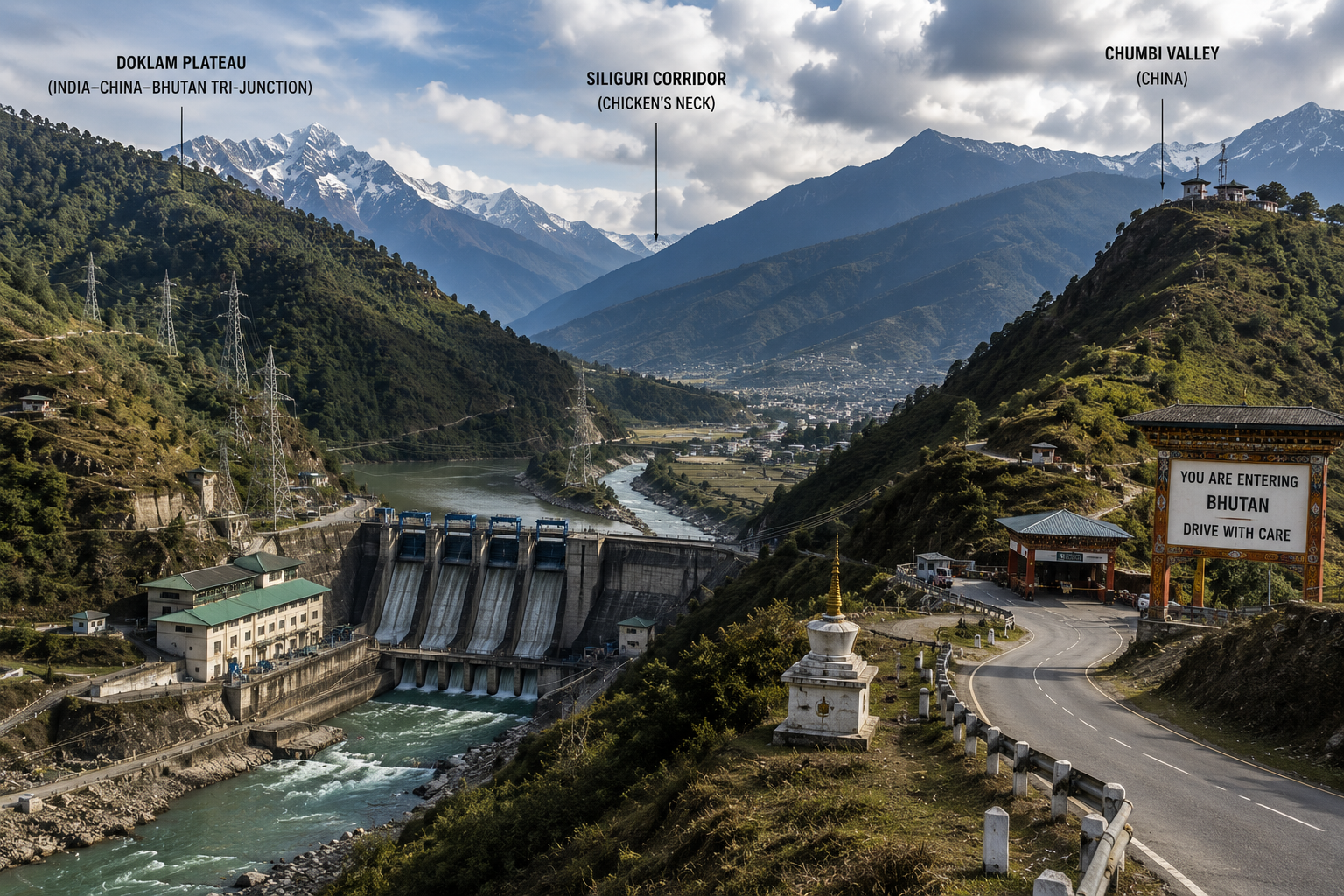
Bhutan rarely speaks in the vocabulary of confrontation. Its diplomacy is careful, its public tone is restrained and its political culture values balance. Yet beneath that quietness, Bhutan has become one of the most sensitive theatres in India-China strategy. It is not a battleground in the conventional sense. There are no loud alliances, no dramatic military declarations and no public race for bases. The contest is quieter: border negotiations, hydropower, development assistance, connectivity, economic diversification and the strategic geography of the Himalayas.
The reason Bhutan matters so deeply is simple. It sits between India and China at a point where geography touches national security. The Doklam plateau, the Chumbi Valley and the Siliguri Corridor form one of the most sensitive strategic triangles in Asia. For India, the Siliguri Corridor is the narrow land link to the Northeast. Any shift in the Himalayan balance around Bhutan is therefore not symbolic. It affects India's military planning, border posture and perception of vulnerability.
The current trigger is Bhutan's continuing boundary engagement with China. Bhutan and China do not have formal diplomatic relations, but they have held multiple rounds of boundary talks, including the 25th round in Beijing in October 2023. The talks themselves are not new; they began decades ago. What has changed is the strategic environment around them. Since the 2017 Doklam standoff, every movement in Bhutan-China negotiations is watched in New Delhi with unusual attention.
For Bhutan, the issue is sovereignty. No responsible Bhutanese government can ignore an unresolved boundary dispute forever. It must negotiate, clarify claims and secure its long-term territorial interests. For India, however, the concern is whether any settlement could alter the security geometry near Doklam or the Chumbi Valley. This is the central tension: Bhutan has the sovereign right to negotiate its boundary, while India has a legitimate security interest in the outcome.
The first analytical dimension is geography. Bhutan's location gives it importance far beyond its size. A line on a Himalayan map can affect road access, military depth and surveillance. China's infrastructure-building capacity near disputed areas adds urgency to Indian concerns. In the Himalayas, distance is not measured only in kilometres. It is measured in ridgelines, approach roads, deployment time and control of heights. That is why a quiet negotiation can carry strategic consequences.
The second dimension is India's development partnership with Bhutan. India has supported Bhutan's economic development since its early Five Year Plans. The latest publicly available Indian mission brief records a major commitment for Bhutan's 13th Five Year Plan, including project-tied assistance and high-impact community development projects. This is not just aid; it is a relationship architecture. It builds schools, roads, administrative capacity, health facilities, energy projects and public trust. In a small Himalayan state, development assistance is also strategic reassurance.
The third dimension is hydropower. For decades, hydropower has been the flagship of India-Bhutan cooperation. Bhutan exports surplus electricity to India and imports during lean seasons. Major projects such as Chukha, Tala, Mangdechhu and Punatsangchhu have created a deep energy interdependence. This relationship benefits both sides: Bhutan earns revenue and India gains clean power. But it also creates new debates inside Bhutan about debt, project delays, tariffs, environmental impact and economic diversification. If hydropower is the old foundation, the future relationship must go beyond it.
The fourth dimension is Bhutan's search for economic transformation. Gelephu Mindfulness City is an example of Bhutan's attempt to reimagine its development model. It is not merely an urban project; it is a signal that Bhutan wants investment, connectivity, technology and global relevance while preserving its identity. For India, supporting such initiatives is strategically wise. A confident and prosperous Bhutan is less vulnerable to external pressure. But India's support must be enabling, not possessive.
The India angle is delicate. India cannot treat Bhutan as a buffer without respecting Bhutan as a sovereign partner. Old security thinking may see Bhutan primarily as strategic depth. A modern partnership must see Bhutan as a co-author of Himalayan stability. If New Delhi appears anxious, intrusive or dismissive of Bhutanese agency, it weakens its own position. If it listens, delivers and adapts, it strengthens trust.
China's approach is different. Beijing seeks boundary resolution, diplomatic normalisation and strategic space. It does not need Bhutan to become an ally overnight. Even gradual normalisation would dilute India's exclusive strategic comfort. A Bhutan-China boundary settlement that leaves India's core security concerns unresolved would be a serious challenge. But a Bhutan-China process that respects Bhutanese sovereignty and Indian sensitivities could reduce uncertainty. The question is whether such a balance is possible.
The counter-view is important. Bhutan should not be reduced to an India-China chess piece. Its citizens care about jobs, youth migration, tourism, environment, governance and modernisation. A foreign policy debate that sees Bhutan only through Doklam misses the Bhutanese perspective. Moreover, India cannot expect Bhutan to freeze its external relations permanently. As Bhutan's economy evolves, it will naturally explore new partners. The real test is whether India can remain Bhutan's most trusted partner without demanding exclusivity in every domain.
Globally, Bhutan reflects a wider trend: small states are becoming strategically consequential. They may not command large armies, but their geography can shape the calculations of major powers. In the Pacific, island states matter because of maritime space. In Central Asia, smaller states matter because of corridors and resources. In the Himalayas, Bhutan matters because of terrain and trust.
What happens next will depend on three factors. First, whether Bhutan-China boundary talks move toward a substantive settlement and what that settlement implies for Doklam and adjacent sectors. Second, whether India can accelerate development, connectivity and energy cooperation without bureaucratic friction. Third, whether Bhutan's new economic ambitions are integrated with India's Northeast and wider regional strategy.
India's best strategy is not to panic over every Bhutan-China interaction. It is to make the India-Bhutan partnership so valuable, respectful and future-ready that no external actor can easily replace it. That requires faster infrastructure, better market access, educational links, private investment, green energy cooperation and sensitivity to Bhutan's domestic priorities.
The quiet battleground is therefore not only at the border. It is in trust. It is in whether Bhutan's next generation sees India as a partner in opportunity or only as a guardian of old security anxieties. The country that understands that will shape the Himalayan balance.
Bhutan's strategic value is also shaped by its political culture. Unlike some neighbours where anti-India rhetoric becomes a regular electoral instrument, Bhutan has generally maintained a disciplined and respectful relationship with India. That restraint should not be mistaken for absence of debate. Inside Bhutan, questions over youth unemployment, economic diversification, hydropower dependence, tourism policy and national identity are real. A new generation will judge India not only by history but by whether the partnership helps Bhutan build a modern economy without losing sovereignty.
The boundary issue with China sits inside this domestic transformation. Bhutan cannot leave an unsettled border indefinitely, especially when Chinese infrastructure and patrol patterns create pressure. Negotiation is a sovereign necessity. India's task is not to prevent Bhutan from talking to China; it is to ensure that Bhutan never feels it must choose between sovereignty and Indian comfort. A mature India-Bhutan relationship will allow Thimphu diplomatic space while maintaining transparent security consultation.
Hydropower remains the backbone, but it also reveals the need for a new model. For Bhutan, hydropower provides revenue, exports and development resources. For India, it provides clean electricity and strategic interdependence. But project delays, geological complications and tariff debates have sometimes created frustration. The next phase should be more diversified: solar, pumped storage, green hydrogen pilots, transmission upgrades, battery storage and private-sector participation. Energy cooperation should become a platform for Bhutan's economic resilience, not only a revenue pipeline.
Connectivity is equally important. Bhutan's landlocked geography limits its options. Better road, rail and digital links through India can transform its access to markets. The proposed linkages around Gelephu and Assam are strategically important because they connect Bhutan's future growth vision with India's Northeast. If Gelephu succeeds, it could become a new model of Himalayan urbanism, sustainability and cross-border economic integration. If it remains isolated, it may become an ambition without adequate arteries.
India should also invest in Bhutan's human capital partnership. Scholarships, technical training, start-up exchanges, digital governance cooperation and tourism skilling can bind the next generation. The old elite-to-elite relationship must be widened into a society-to-society partnership. China may offer diplomatic novelty, but India can offer daily access, education, health care, markets and professional networks.
The environmental dimension cannot be ignored. Bhutan is known globally for its conservation ethic and carbon-negative profile. Any development partnership that disregards this identity will lose legitimacy. India should position itself as the partner that supports Bhutan's sustainability model, not one that pressures it into conventional growth. Hydropower, roads and urban projects must meet high ecological standards because environmental trust is part of political trust in Bhutan.
There is also a military caution. India's security establishment naturally focuses on Doklam and the Siliguri Corridor. But if every conversation with Bhutan is filtered through military anxiety, India risks narrowing the relationship. Bhutan's strategic importance is not only its location; it is also its stability, confidence and goodwill. A secure Bhutan is not one that simply absorbs Indian concerns. It is one that feels secure enough to coordinate with India voluntarily.
China's long-term objective may be incremental. It may seek boundary settlement, diplomatic relations, economic presence and political normalisation over time. None of these individually changes the Himalayan order overnight. Together, however, they can reduce India's strategic exclusivity. India must therefore prepare for a future in which Bhutan talks more openly with China while still remaining close to India. That future is manageable if trust is deep; it is dangerous if trust is brittle.
The quietness of Bhutan's diplomacy should not lull India into complacency. Quiet relationships require constant maintenance because dissatisfaction may not appear publicly until it has matured privately. India should measure the health of ties not only through official statements but through Bhutanese public opinion, youth perceptions, business sentiment and project-level satisfaction.
The final lesson is that Bhutan is not a buffer to be preserved; it is a partner to be empowered. The stronger, wealthier and more confident Bhutan becomes, the more stable India's Himalayan frontier will be. If India helps Bhutan succeed on Bhutan's own terms, China's room for disruptive influence will remain limited. If India treats Bhutan only as a security object, it will weaken the very trust that protects Indian interests.
One area where India can strengthen trust is economic diversification beyond government-led projects. Bhutanese youth increasingly seek opportunities outside traditional state structures. Migration of young people, limited private-sector depth and the desire for global exposure are central concerns. India can respond by opening more spaces for Bhutanese students, professionals, start-ups and creative industries. A neighbour that finds opportunity through India will see India as part of its future, not only its past.
Tourism is another sensitive but promising domain. Bhutan follows a high-value, low-volume tourism philosophy designed to protect environment and culture. India is one of its most important visitor sources, but tourism must not become extractive or culturally careless. Joint tourism circuits, sustainable travel standards, skill development and better transport can create income while respecting Bhutan's national identity. Soft power works best when it is respectful.
India should also support Bhutan's digital ambitions. Digital public infrastructure, cyber security, payment systems, e-governance and education technology can become a new pillar of cooperation. This matters because China's regional influence is increasingly digital, not only physical. Telecom systems, data platforms and surveillance technologies can create long-term dependencies. India can offer trusted digital systems that align with Bhutan's governance values and privacy concerns.
The security dialogue must become more transparent but not theatrical. Bhutan does not benefit from being publicly dragged into India-China confrontation. Quiet consultation is better. India should ensure that Bhutan understands India's red lines near sensitive areas, while also understanding Bhutan's need for a negotiated boundary. Mutual confidence requires both sides to share concerns before decisions become public controversies.
A future Bhutan-China boundary settlement may not necessarily be a disaster for India if managed carefully. It could even reduce uncertainty if it respects India's core concerns. But if a settlement affects the Doklam sector or creates new Chinese access near sensitive geography, India will view it as a strategic setback. This is why the process matters as much as the outcome. India must not be surprised by developments; Bhutan must not feel pressured into secrecy.
The 13th Five Year Plan period offers India a major opportunity to demonstrate that it understands Bhutan's priorities. Development assistance should be linked to employment, local capacity, technology, climate resilience and regional connectivity. Projects should be completed visibly and on time. Bhutan's citizens should be able to see how Indian partnership improves schools, hospitals, roads, energy, digital services and jobs.
The partnership also needs a language upgrade. Phrases such as "special relationship" are valuable, but they can become stale unless backed by new substance. The next generation may prefer the language of co-creation, sustainability, innovation and shared prosperity. India should speak to Bhutan not only as a protector and partner, but as an investor in Bhutan's future imagination.
The strategic conclusion is that Bhutan's quietness increases, not decreases, the need for attention. Loud crises force policy action; quiet shifts can be missed. India must read Bhutan's domestic aspirations as carefully as it reads Chinese maps. The Himalayas will be secure not only through roads and deployments, but through a Bhutan that feels respected, prosperous and strategically comfortable with India.
India must also avoid assuming that Bhutan's strategic caution means permanent strategic alignment without effort. All relationships, even the closest ones, are renewed through experience. If Bhutanese citizens experience India as a source of opportunity, respect and modern connectivity, the strategic relationship will remain socially grounded. If they experience India mainly through delays, restrictions or anxiety about China, the emotional foundation may weaken. The most durable security guarantee is not pressure but preference.
The next decade should therefore be treated as a renewal decade. Hydropower, highways and grants should be joined by digital cooperation, green investment, youth mobility, sustainable tourism and knowledge industries. Bhutan's national philosophy gives India a chance to build a partnership that is not merely strategic but distinctive: growth with restraint, security with respect and modernisation without cultural erasure. That would be a stronger answer to Chinese engagement than any warning.
In the end, Bhutan's importance lies in the fact that small countries can carry large strategic consequences. A boundary discussion in Beijing, a road in the Himalayas, a power project in Punatsangchhu or a city project in Gelephu can all affect India's regional balance. India should approach Bhutan with strategic seriousness, but also with diplomatic gentleness. The Himalayan partnership will endure only if Bhutan feels that India's closeness expands its choices rather than narrows them.
This is why Bhutan should be approached as a relationship of patience. Strategic anxiety may be inevitable, but strategic impatience would be dangerous. India has the advantage of history, geography and trust. It must now add speed, imagination and humility. If it does, Bhutan will remain not a contested buffer, but a confident partner at the centre of Himalayan stability.