Education for All: Access, Learning and Inclusion
Education for all sounds like a simple promise: every child should be able to go to school. In practice, universal education requires much more. A country can enrol children without keeping them in school, keep them enrolled without ensuring that they learn, or offer formal access while poverty, disability, language, geography or discrimination prevents some students from participating on equal terms.
A stronger definition therefore combines several stages: access, participation, completion, learning and inclusion. Education also extends beyond childhood. Adults who missed schooling, young people seeking vocational skills and workers adapting to technological or economic change remain part of the wider right to lifelong learning.
UNESCO's 2026 Global Education Monitoring Report illustrates both how much progress has been made and how incomplete the project remains. Around 1.4 billion students were enrolled in education in 2024. Primary and secondary enrolment had increased by 327 million since 2000, while participation also expanded substantially in pre-primary and post-secondary education. Yet 273 million children and youth remained out of school in 2024, and the global out-of-school population had increased for seven consecutive years. (unesco.org)
Universal education is therefore no longer simply a question of building enough schools.
The harder task is creating systems in which entering education leads to meaningful learning and in which disadvantages outside school do not determine who gets to benefit from it.
Education Is a Right Because It Expands Other Capabilities
International human-rights law treats education as a right rather than a discretionary public service. UNESCO describes the right to education as encompassing quality education and lifelong learning opportunities, and argues that education enables people to exercise other rights and participate more fully in social, economic and political life. (unesco.org)
The importance of education is partly intrinsic. Learning, curiosity and intellectual development have value in themselves.
But education also changes practical capability.
Literacy affects whether someone can understand a medicine label, employment contract or government form. Numeracy affects financial decisions. Scientific and digital literacy influence people's ability to evaluate information. Education can expand occupational options, increase confidence in dealing with institutions and make political participation more meaningful.
A rights-based approach changes the policy question.
Instead of asking whether educating a remote child, refugee, disabled learner or extremely poor student is unusually expensive, it asks what barriers must be removed for that person to exercise the same right as everyone else.
That does not mean every learner requires identical resources.
Equal rights can require different forms of support.
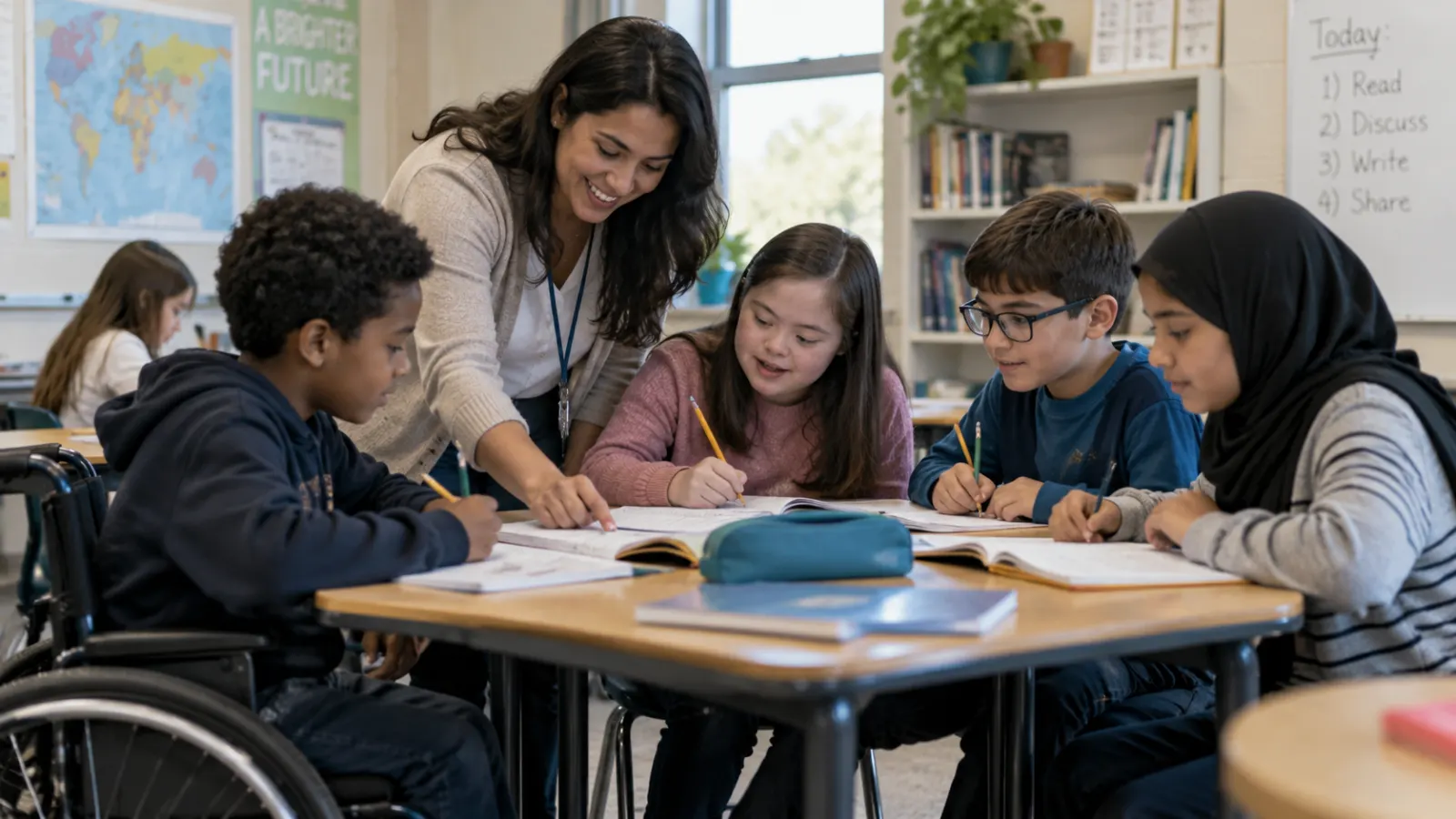
A wheelchair user may need accessible transport and buildings. A student who has recently arrived as a refugee may need language support. A child from a household unable to afford meals or digital devices may require financial assistance. A student with a visual impairment may need accessible learning materials.
This is equity rather than identical treatment: identifying which disadvantage prevents participation and responding to that disadvantage without lowering the underlying entitlement to education.
UNESCO's 2026 monitoring shows that policy has increasingly moved in this direction. The share of countries with inclusive-education laws rose from only 1% in 2000 to 24%, while the proportion of countries whose laws call for children with disabilities to be educated in inclusive settings increased from 17% to 29%. By 2025, 84% of countries had adopted some definition of inclusive education. (unesco.org)
Those legal changes matter.
But legal recognition is only the first stage.
The World Has Expanded Schooling, but Universal Access Has Stalled
The expansion of education since the beginning of this century is one of the largest institutional changes in modern social history.
According to UNESCO's 2026 GEM Report, primary and secondary enrolment increased by 30% between 2000 and 2024, pre-primary enrolment rose by 45% and post-secondary participation increased by 161%. (unesco.org)
Those changes represent more than additional seats inside classrooms.
Mass schooling redistributes literacy, credentials and technical knowledge across societies. It gives children from different households access to a common public institution. It can reduce dependence on family background for basic knowledge and create pathways into occupations previously accessible only to small groups.
Yet progress on exclusion has slowed sharply.
UNESCO reports that 273 million children, adolescents and youth were out of school in 2024, equivalent to roughly one in six people of school age. The number was 3% higher than in 2015. UNESCO also cautions that this total may undercount the real figure by at least 13 million when humanitarian data from conflict-affected countries are used to fill gaps. (unesco.org)
This stagnation matters because the remaining out-of-school population is not randomly distributed.
Children experiencing poverty, conflict, displacement, disability, remote geography or discrimination often face several barriers simultaneously.
Geography illustrates the problem.
A rural child may technically live in a country with universal schooling but face a two-hour journey to the nearest secondary school. Teachers may be reluctant to work in remote regions, specialised subjects may be unavailable and transportation can add costs that poor families cannot absorb.
Urban residence is not an automatic solution. Informal settlements can contain overcrowded schools, insecure housing and large differences in school quality even when several institutions are geographically nearby.
Universal education therefore requires governments to treat geography as a system-design problem rather than an individual inconvenience.
Conflict can dismantle access even faster.
War can destroy school buildings, displace families, scatter teachers and interrupt examinations and school records. Refugees may enter education systems using unfamiliar languages or curricula and may lack documentation required for ordinary enrolment.
These interruptions can last long enough to reshape an entire childhood.
Education in emergencies is therefore not merely an optional humanitarian service delivered after food and shelter have been addressed. Years spent outside education can produce learning gaps and lost qualifications that remain long after a conflict ends.
Enrolment Is Not Completion, and Completion Is Not Learning
Counting how many children enter school answers only the first question.
A child can enrol in primary education and later leave because of cost, work, marriage, pregnancy, family responsibilities, repeated failure, poor teaching or insecurity. This is why completion matters.
The 2026 GEM Report shows substantial long-term improvement. Since 2000, global completion rates increased from 77% to 88% in primary education, 60% to 78% in lower secondary and 37% to 61% in upper secondary education. (unesco.org)
Those gains are significant.
Yet the remaining gap is enormous. At the present pace, UNESCO estimates that 95% global upper-secondary completion would not be reached until 2105. (unesco.org)
Completion also does not guarantee learning.
A student can spend years inside a classroom without mastering foundational literacy or numeracy. UNESCO currently reports that globally only around 58% of students achieve minimum proficiency in reading and 44% in mathematics by the end of primary school. (unesco.org)
This distinction between schooling and learning has become central to contemporary education policy.
A government can expand enrolment quickly by opening classrooms or abolishing fees. Ensuring learning is harder. It requires adequate instructional time, coherent curricula, trained teachers, useful assessment, appropriate language of instruction, learning materials and support for children who fall behind.
Foundational learning is especially important because education is cumulative.
A child who reaches secondary school without basic reading fluency may technically remain enrolled while struggling to learn history, science and mathematics because every subject now assumes skills that were never securely developed.
Early disadvantage can therefore compound.
The same principle applies before primary school. Nutrition, language exposure, early childhood education, responsive caregiving and opportunities to play influence readiness for formal schooling.
UNESCO's 2026 monitoring also questions how conventional pre-primary participation is measured. Although the global indicator suggests that 75% of five-year-olds are in education, many have already entered primary school; the report estimates that only around 60% of primary pupils had actually received at least one year of pre-primary education before entering primary school. (unesco.org)
Education for all therefore begins before the first day of compulsory schooling.
Poverty, Language and Disability Can Turn Formal Access Into Practical Exclusion
Removing tuition fees is important, but education can remain expensive.
Families may pay for uniforms, transport, books, examination charges, meals or digital devices. More importantly, a child attending school may represent lost household labour or income. For a family living close to subsistence, the opportunity cost can be substantial.
Social protection can therefore function as education policy.
School meals can reduce both hunger and the household cost of attendance. Cash transfers can help families survive without withdrawing children from school. Transport support can make secondary education practical in rural areas. Health programmes can reduce absenteeism caused by preventable illness.
UNESCO's 2026 GEM Report documents a major expansion of equity-oriented financing mechanisms over the past quarter century, including transfers to disadvantaged schools, subnational governments and households. School-meal programmes have also expanded substantially. Yet the same report concludes that fewer than one in ten countries have a sufficiently strong overall equity focus in their education financing policies. (unesco.org)
Language can produce another hidden barrier.
A child may sit inside a classroom every day while understanding only part of what the teacher says.
UNESCO estimates that as much as 40% of the global population lacks access to education in a language they speak or understand, with particularly important challenges in linguistically diverse regions. (unesco.org)
Language policy involves genuine trade-offs.
A common national language can support communication across regions and expand access to higher education and employment. But introducing an unfamiliar language too early without support can reduce learning precisely when children are supposed to acquire foundational literacy and numeracy.
Strong systems therefore need bridges between languages rather than assuming that recognising home languages and teaching widely used national languages are mutually exclusive goals.
Disability presents a similar distinction between formal access and usable access.
A child with a mobility impairment may be nominally entitled to education while school transport and buildings remain inaccessible. A deaf learner may attend class without access to communication. A blind child may receive textbooks that cannot be used independently.
UNICEF's Learning is For Everyone global report, published in June 2026, examined disability-inclusive education across several countries and concluded that exclusion is not inevitable. It highlights the need to identify learners' requirements, strengthen teacher capacity, improve accessible materials and infrastructure, reform assessment and provide sustained resources for inclusion. (unicef.org)
The principle extends beyond disability.
A universal education system should not require every learner to resemble one imagined “normal” student before being allowed to participate successfully.
Teachers Are the Core Infrastructure of Learning
Education debates often focus on visible infrastructure.
Schools need classrooms.
Students may need computers.
Internet connectivity can expand access to materials.
But teaching remains the central human infrastructure connecting those resources with learning.
UNESCO and the International Task Force on Teachers estimate that the world needs 44 million additional primary and secondary teachers by 2030 to achieve universal education at those levels. Sub-Saharan Africa alone requires approximately 15 million. (unesco.org)
Teacher shortages affect several dimensions of education at once.
A school without enough teachers may increase class size, reduce subject choice or rely on staff without appropriate preparation. Rural and disadvantaged schools can face the greatest recruitment and retention problems precisely because working conditions are more difficult.
Training matters as much as headcount.
Teachers need subject knowledge, but they also have to explain concepts, diagnose misconceptions, manage classrooms and respond to differences in language, disability and prior knowledge.
This makes teachers part of inclusion policy.
A school may have an accessible ramp but still exclude a child if teachers have no support for adapting instruction.
Investment in teachers can appear less dramatic than distributing devices or opening new buildings because much of the spending is recurrent: salaries, professional development, mentoring and support.
That recurrence is precisely why it matters.
A school system needs functioning teaching capacity every year.
Education for all cannot be built through one-time projects alone.
Technology Can Expand Educational Opportunity Without Replacing the System
Digital technology can help education reach people previously limited by geography or disability.
Online lessons can connect remote learners to specialist teachers. Digital materials can be updated cheaply. Captions, screen readers and adjustable formats can improve accessibility. Students can access libraries and instructional material that would be impossible for every school to stock physically.
But technology can reproduce existing inequality just as easily.
A digital learning programme assumes electricity, connectivity, a suitable device and enough digital skill to use it. If several children share one phone, a platform technically available nationwide may remain practically inaccessible to many households.
Language and accessibility matter online just as they do in classrooms.
An educational platform incompatible with screen readers excludes blind learners. Video without captions can exclude deaf students. Content offered only in one language may widen rather than narrow existing educational gaps.
The central lesson is that technology works best as part of a functioning education system.
It can support teachers, extend resources and provide alternative routes to learning.
It does not eliminate the need for teachers, curriculum, assessment, child protection or public finance.
The same caution applies increasingly to artificial intelligence. AI tools may provide tutoring, translation or personalised exercises, but unequal access, poor-quality outputs, data protection and overreliance create new challenges. Education systems still need to determine what learners should know independently and how automated assistance should support rather than replace human judgment.
Technology should expand the capability of an education system.
It should not become another gate that students must be wealthy or technologically confident enough to pass.
Education for All Must Include Adults and Second Chances
The right to education does not expire at eighteen.
UNESCO currently estimates that 739 million adults aged 15 and above lack basic literacy skills. (unesco.org)
Some never entered school.
Others attended briefly or left before acquiring secure literacy and numeracy.
Many workers who completed formal schooling also face changing labour markets in which existing skills become less valuable and new technical capabilities are required.
Adult literacy, vocational education, workplace training, community learning and second-chance programmes are therefore part of education for all.
UNESCO's Recommendation on Adult Learning and Education explicitly treats adult education as part of lifelong learning and includes literacy, continuing training, professional development and second-chance opportunities for people who never attended school or left early. (unesco.org)
This principle should also shape school systems themselves.
Rigid education pathways can turn one interruption into permanent exclusion.
A teenager who leaves school because of illness, migration, pregnancy, caregiving or work may later be ready to return but find that age rules, examination systems or missing records prevent re-entry.
Second-chance routes make education systems more resilient.
Recognition of prior learning, flexible schooling, vocational pathways and alternative qualifications allow people to recover from interruption without pretending it never happened.
Transitions are particularly vulnerable points.
A child may complete primary school but live too far from the nearest secondary school. A secondary-school student may know little about vocational routes or financial aid. Moving from school into higher education can introduce tuition, housing and transport costs that were absent earlier.
A technically available pathway is not enough if learners and families do not understand how to use it.
Universal education therefore requires not only entry points but navigable routes through the system.
Universal Education Requires Finance, Accountability and Institutions
Rights become real through institutions.
Education systems need stable financing for teachers, buildings, textbooks, accessible materials, transportation, school meals, digital infrastructure, data systems and maintenance.
UNESCO currently reports that 70% of countries allocate less than 4% of GDP to education, illustrating the continuing financing pressure across education systems. (unesco.org)
But spending levels alone do not determine results.
Where money goes matters.
A country can increase education expenditure while directing resources toward already advantaged areas. Schools serving remote, poor or disabled learners may require more resources simply to provide genuinely comparable opportunity.
Accountability therefore has to look beyond total spending and total enrolment.
If governments are judged only on the number of students registered, a school system can appear successful while classrooms remain overcrowded and learning remains weak.
A stronger accountability framework asks several questions at once.
Who enters?
Who attends consistently?
Who leaves early?
Who completes?
Who actually learns?
Which groups are still behind?
Are schools safe?
Do disadvantaged learners receive the additional support required to participate effectively?
The 2026 GEM Report makes a related point about measurement. UNESCO notes major gaps in countries' reporting of educational inequality: around one-third of countries do not report disparities by urban-rural location and about half do not report disparities by wealth. (unesco.org)
What is not measured can remain politically invisible.
Good data cannot replace policy.
It can reveal where the formal promise of universal education is failing.
Education for All Is Ultimately About Capability
Universal education is sometimes described as though the objective were to place every child inside a school building.
That objective is necessary.
It is not sufficient.
UNESCO's 2026 data capture the paradox clearly. The world has 1.4 billion students enrolled, far more than a generation ago, yet 273 million children and youth remain outside education. Completion has improved substantially, but universal upper-secondary completion remains far beyond the current trajectory. And school attendance itself does not guarantee foundational learning. (unesco.org)
The meaning of education for all therefore has to remain larger than enrolment.
Access means a learner can enter.
Participation means poverty, disability, safety or discrimination does not prevent meaningful attendance.
Completion means initial enrolment does not dissolve into dropout.
Learning means students actually acquire knowledge and skills.
Inclusion means the system adapts to human differences rather than excluding people who do not fit one standard model.
Lifelong opportunity means someone who missed education earlier or needs new skills later is not permanently shut out.
Those stages are interconnected.
A child cannot learn in a school they cannot reach.
A student cannot complete education that becomes unaffordable halfway through.
A disabled learner cannot participate fully in an inaccessible environment.
An adult cannot benefit from a right that disappears once compulsory schooling age has passed.
Education also matters beyond individual earnings.
Schools influence how people understand evidence, institutions, history, disagreement and citizenship. They can expose learners to people outside their family or immediate community and provide opportunities to practise cooperation and public reasoning.
But education can also reproduce hierarchy, prejudice or propaganda.
Its civic value therefore depends not only on the existence of schools but on what learners experience inside them: whether evidence matters, whether difference is tolerated, whether rules are applied fairly and whether students have some meaningful voice.
The unfinished global task is consequently much larger than constructing more classrooms.
It is to build education systems in which poverty, disability, conflict, language, gender or geography do not predetermine who is allowed to learn and how far they are able to go.
Education for all becomes real when entry leads to participation, participation leads to learning, learning creates future choices and people retain routes back into education when life interrupts the first one.
That is the difference between providing schooling and guaranteeing a genuine opportunity to learn.