
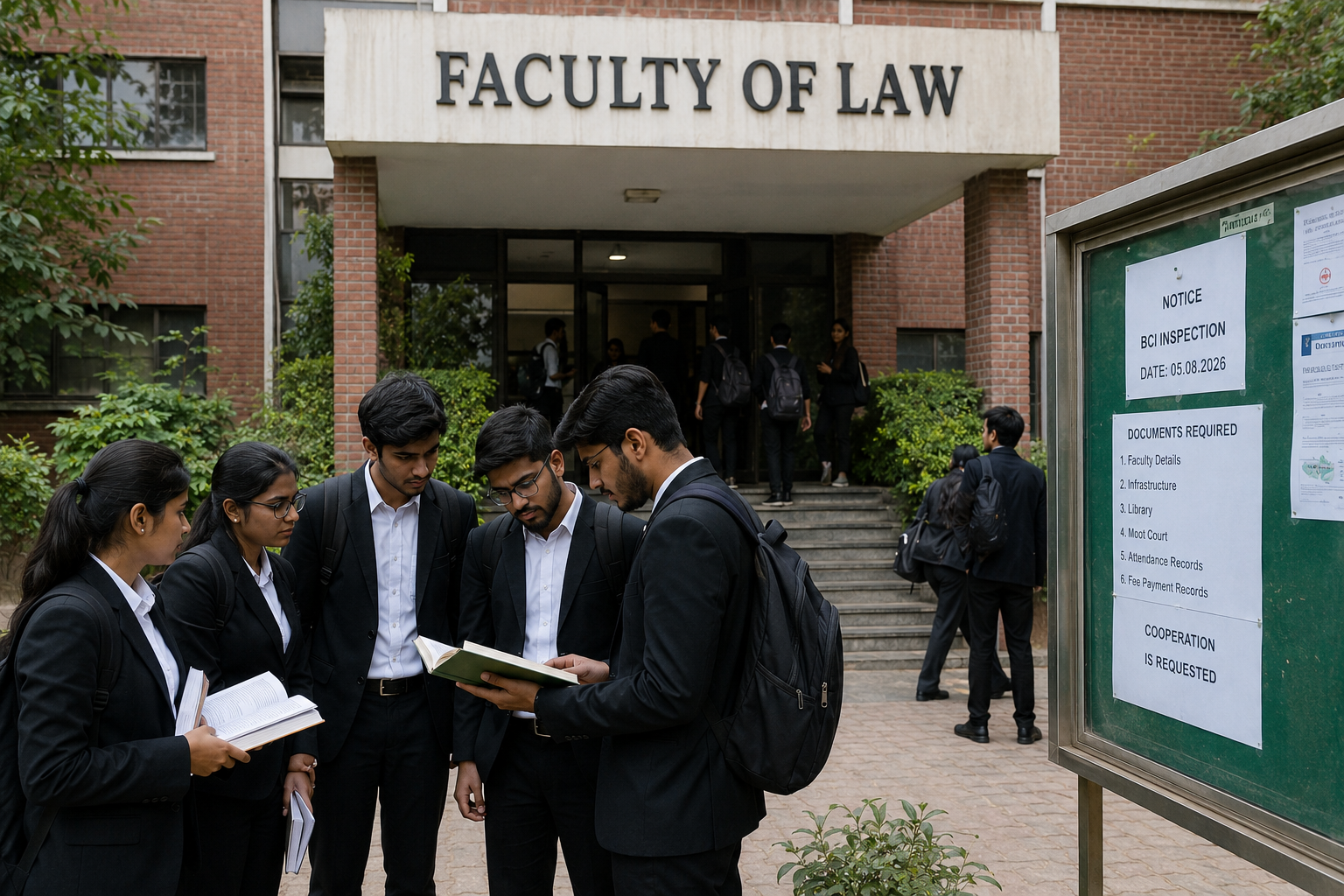
NEW DELHI, Aug. 6, 2026 - The Bar Council of India has directed universities across the country to physically inspect every affiliated and constituent Centre of Legal Education within six weeks, warning that approval should not be routinely renewed where institutions fail to meet faculty, infrastructure and teaching standards.
The July 23 circular was addressed to vice-chancellors, registrars, deans and heads of law faculties. It followed strong oral observations by the Supreme Court during a July 20 hearing about deficient law colleges, including concern that some institutions operate from facilities wholly unsuitable for professional education. The BCI responded by requiring on-site verification rather than relying on affidavits or paperwork submitted by colleges.
Inspection teams must examine full-time faculty strength and qualifications, classrooms, libraries, moot-court and clinical facilities, student services, governance records and fire safety. Universities were also told to verify that faculty members are genuinely present and paid through banking channels. A list of names on a website is not evidence that teachers regularly conduct classes.
The circular targets weekend and evening programmes presented as substitutes for full-time legal education. Under the Rules of Legal Education, recognised courses must satisfy minimum teaching hours, commonly described as at least five hours a day and 30 hours a week. Universities are expected to stop impermissible batches and prevent new admissions where a programme does not meet the rules. Students already enrolled need clear, lawful transition arrangements; abrupt closure without a plan could punish them for a college's failure.
Universities must classify institutions into three broad groups: fully compliant, deficient but capable of correction, and seriously deficient institutions that should face non-renewal, withdrawal of affiliation or closure. That classification creates a basis for proportionate action. A college missing a limited number of library subscriptions should not be treated exactly like one with no regular faculty or safe premises. Serious deficiencies, however, cannot be hidden behind repeated conditional approvals.
The BCI said approval renewals would be held back until reports were received. Universities had a short initial deadline to acknowledge the circular, identify a responsible officer and provide a list of centres under their jurisdiction. Failure to complete the exercise within six weeks could be referred for action.
Affiliation and BCI approval serve different functions. A university may affiliate a college for academic administration, examinations and degrees, but legal education also requires recognition under the Advocates Act and BCI rules for graduates seeking enrolment as advocates. Students should verify both the current university status and BCI approval for the relevant course and academic year rather than relying on an old advertisement.
The inspection drive comes after the BCI withdrew a three-year moratorium on new Centres of Legal Education and returned to an inspection-based framework. That change makes credible inspection even more important. If applications for new institutions or expanded intake are processed without reliable field verification, increased capacity can worsen quality instead of improving access.
Universities face an obvious conflict because affiliation fees and local pressures may encourage them to retain weak colleges. Inspection teams should therefore include members without recent financial or employment links to the institution, use a standard checklist, photograph facilities with dates and speak privately with students and faculty. Reports should be published with limited redaction so applicants can make informed choices.
A reliable national register would make the exercise durable. Each college entry should show approved courses, intake, validity dates, inspection date, deficiencies, corrective deadline and current appeal status. Historical versions should remain visible so a college cannot market an expired approval as current. Students need a helpline for reporting false claims, but complaints should trigger verification rather than automatic punishment. Regulators can then compare inspection findings with enrolment and examination data to identify institutions teaching more students than authorised.
Faculty verification deserves special attention. Law cannot be taught adequately through visiting lecturers who appear only before an inspection. Teams should review timetables, attendance, salary transfers, tax records and course materials across the year. Libraries should be assessed for actual access, updated holdings and research databases, not simply the number of books counted on one day. Moot courts and legal-aid clinics should show regular activity and supervision.
Enforcement must protect students. If a college is denied renewal, regulators should specify whether current batches may complete under monitoring, whether transfer seats are available and who will preserve records and issue documents. Fees should not be collected for a new intake while approval is uncertain. A central public dashboard can prevent institutions from using ambiguity to continue admissions.
The nationwide exercise will succeed only if reports lead to reasoned decisions. A six-week inspection followed by years of inaction would recreate the same problem. The BCI and universities should publish deadlines for corrective action, follow-up visits and appeals. Quality legal education affects not only graduates but also clients, courts and the justice system they will enter.


