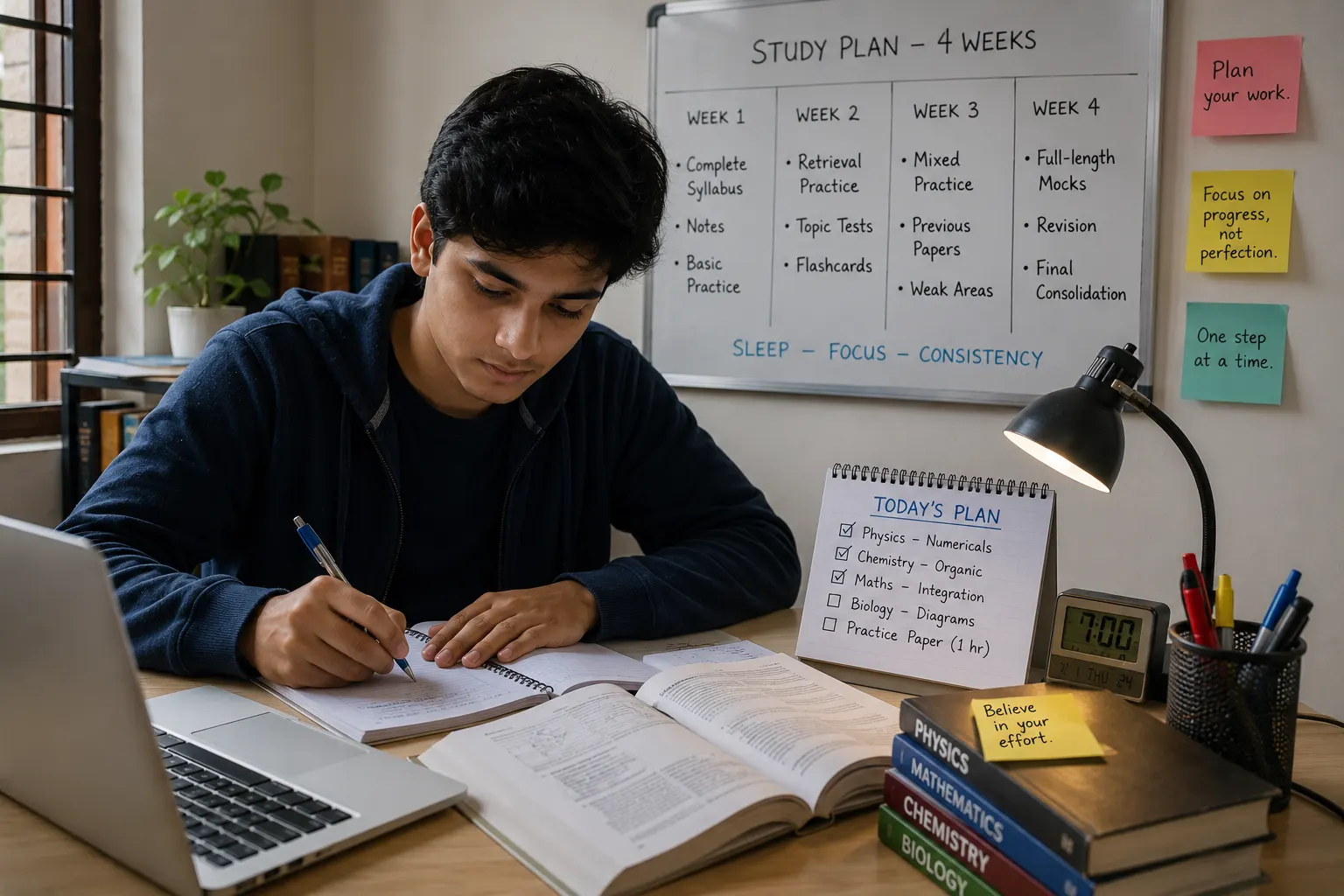
How to Avoid Distractions While Learning: Design Your Attention Before You Study
Distraction is a design problem as much as a discipline problem
Most people do not begin a study session by deciding to lose concentration.
Attention drifts because competing signals are available: a message arrives, a browser tab is open, someone begins talking nearby, an unrelated thought becomes urgent, or the task itself is vague enough that anything else feels easier.
Research on attention in educational settings shows that attentional disengagement is common rather than exceptional. Reviews of smartphone-related cognition and media multitasking also suggest that frequent switching and technology-related interruptions can interfere with sustained attention and academic performance, although effects vary across individuals and contexts.
The practical conclusion is important: do not make concentration carry the entire burden. Change the conditions in which concentration has to operate.
1. Define the exact task before you begin
“Study biology” leaves too much ambiguity.
A better instruction is:
“Answer questions 1–20 on cell division without notes, then check errors.”
A clear task gives attention a target. When the task is vague, the brain must repeatedly decide what to do next, and every decision creates an opportunity to leave the work.
Before each session, write:
the topic;
the activity;
the completion point;
the next action if you finish early.
This takes less than a minute and prevents much of the wandering that is actually uncertainty.
2. Move the phone, do not merely silence it
A silent phone can still be a cue.
Its presence reminds you that messages, social feeds, news and entertainment are available. Research on smartphones and cognition has raised concerns about how habitual phone use, notifications and task switching may compete with attention and working memory.
The strongest practical intervention is often physical separation.
Put the phone in a bag, drawer or another room. If you need it for a timer or study app, disable nonessential notifications and use a mode that blocks competing applications.
The principle is simple:
Make the distraction require a deliberate action rather than a reflex.
3. Close unrelated digital environments
A laptop can contain an entire entertainment system one tab away from your textbook.
Before studying:
close email;
close messaging applications;
close unrelated browser tabs;
disable desktop notifications;
keep only the files required for the session open.
This reduces the number of visual and auditory cues competing for attention.
If you repeatedly open the same distracting sites, use a temporary blocker during the study period. The purpose is not punishment. It is removing a choice that you already decided not to make.
4. Do not confuse multitasking with efficiency
Human attention switches more readily than it performs two demanding cognitive tasks at the same time.
Listening to a lecture while replying to messages, reading while monitoring social media, or solving problems while participating in a group chat creates repeated switching.
The cost can be subtle. You may still finish both activities, but comprehension, memory or error detection can deteriorate.
When learning matters, prefer serial work:
study first;
reply later.
The exception is when the secondary activity is genuinely automatic and does not compete for the same cognitive resources. Even then, judge by performance rather than by how productive the combination feels.
5. Choose a level of background stimulation that fits the task
Complete silence is not universally necessary.
Some people tolerate low, predictable background sound well. Others are strongly disrupted by conversation, television or music with lyrics.
The key distinction is between predictable background and attention-grabbing content.
Speech is especially difficult to ignore because the brain automatically processes meaningful language. A café may therefore work for routine review but poorly for learning dense new material.
Test the environment using an objective measure: after twenty minutes, can you retrieve what you studied?
6. Work in bounded sessions
Attention tends to deteriorate when the task has no visible end.
Use a defined study block:
25 minutes;
40 minutes;
60 minutes.
The exact number is not sacred.
A bounded session creates a psychological contract: for this period, the task has priority. At the end, take a genuine break and decide whether to continue.
The break should not automatically become an open-ended social-media session. Stand up, drink water, walk, stretch or look away from the screen.
7. Capture intrusive thoughts instead of following them
Not every distraction comes from outside.
You remember an email you need to send.
A purchase you need to make.
A question you want to search.
An unrelated idea appears.
Keep a small “later” list.
Write the thought in a few words and return to the task.
This reassures the mind that the item will not be forgotten while preventing a two-minute thought from turning into a twenty-minute detour.
8. Make distracting behaviour slightly inconvenient
If a distraction keeps winning, add friction.
Log out of social media.
Remove shortcuts.
Keep the television remote away from the desk.
Use a separate browser profile for study.
Do not study in bed if bed reliably triggers sleep or entertainment.
Small barriers matter because many distractions are not planned. They are automatic responses to easy availability.
9. Use the environment to signal study
Repeatedly studying in a consistent setting can help create a behavioural cue: when you sit there with the required materials, study begins.
This does not mean memory requires the same physical room. Research on context-dependent memory shows environmental context can sometimes influence recall, but such effects are conditional and can be reduced when stronger non-contextual cues are available.
The practical value of a study location is behavioural, not magical. It reduces setup decisions and makes the beginning of work predictable.
10. Expect attention to drift and practise returning
The goal is not uninterrupted attention for hours.
You will notice yourself rereading the same sentence, thinking about something else or reaching for a device.
The important skill is recovery.
When you notice the drift:
1. identify what captured attention;
2. remove it if possible;
3. restate the next study action;
4. continue.
Do not turn one distracted minute into the conclusion that the session is ruined.
A simple distraction-control checklist
Before studying, ask:
Task: Do I know exactly what I am doing?
Phone: Is it out of reach or locked down?
Laptop: Are unrelated apps and tabs closed?
Environment: Is noise or movement likely to interrupt me?
Time: Do I know when this study block ends?
Recovery: Do I have somewhere to record unrelated thoughts?
This checklist works because it moves attention control earlier in the process.
The best moment to fight a distraction is often before it appears.
Focus is easier when fewer things compete for it
Attention is limited, but that does not mean every lapse is a personal failure.
Study sessions become more reliable when the environment supports the behaviour: the task is clear, the phone is distant, digital noise is reduced, and the session has a visible end.
That is a more durable strategy than repeatedly demanding stronger concentration in a setting designed to interrupt you.
Sources / Further Reading
Unsworth & McMillan, “Attentional disengagements in educational contexts,” 2017
Lodge & Harrison, “The Role of Attention in Learning in the Digital Age,” 2019
Walck-Shannon et al., study planning and distraction among college students, 2024
Suggested Internal Links
The Benefits of a Dedicated Study Space - Planned internal link
How to Build a Daily Routine - Planned internal link
How to Develop Self Discipline - Planned internal link
The Importance of Time Management - Planned internal link
How to Use Flashcards Effectively - Planned internal link
Approximate article word count: 1055