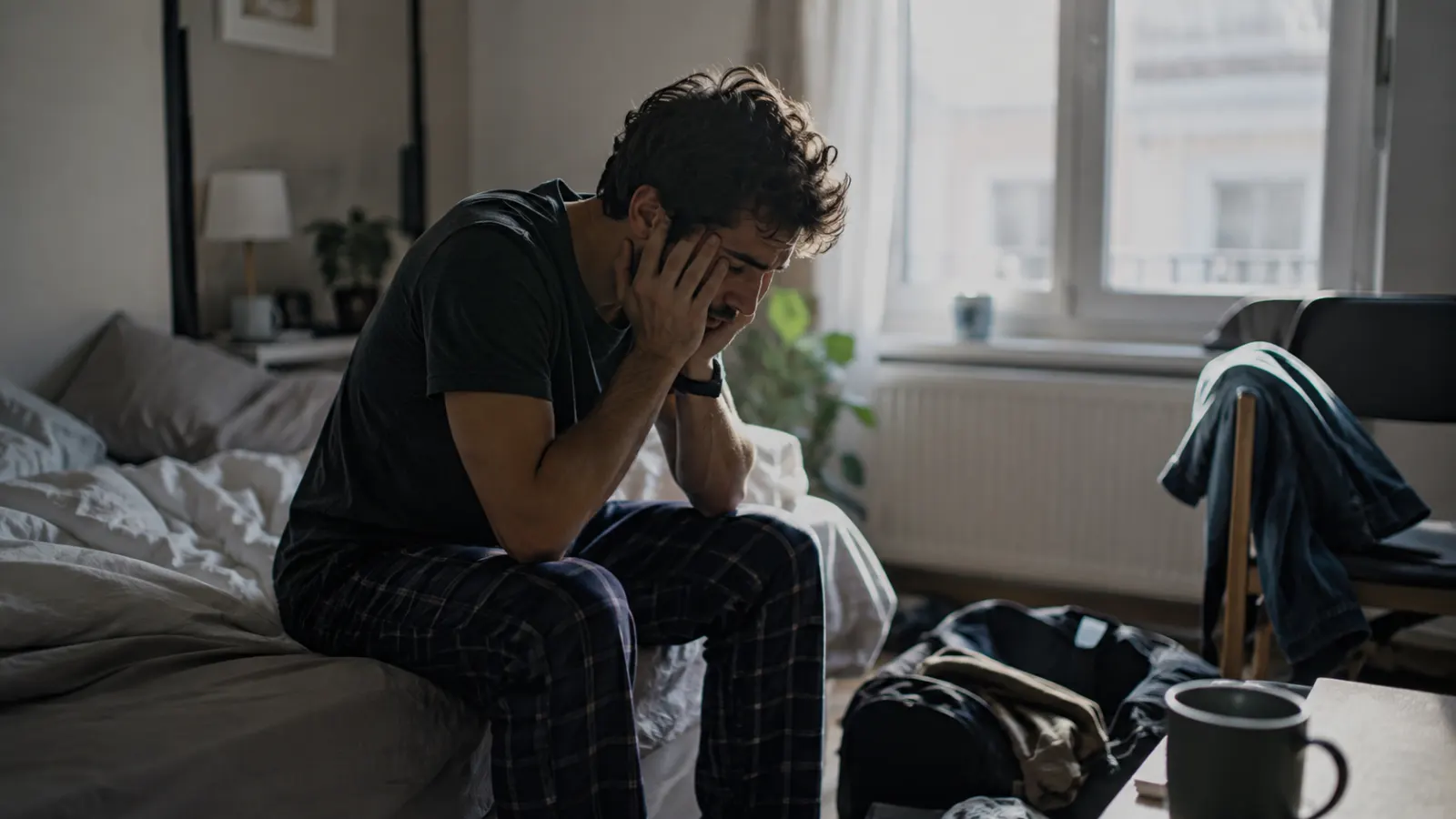
Anxiety is not automatically a disorder
Anxiety is part of normal human threat detection. Before an examination, medical test, difficult conversation or financial decision, increased alertness can help a person prepare. The presence of anxiety therefore does not by itself indicate mental illness.
Anxiety disorders involve more than occasional worry or fear. NIMH describes them as conditions in which anxiety persists, occurs across situations or becomes severe enough to interfere with daily life. The exact pattern differs across generalized anxiety disorder, panic disorder, social anxiety disorder and phobia-related disorders.
When worry becomes generalized anxiety
Generalized anxiety disorder (GAD) involves excessive anxiety and worry across multiple areas of life. Under current diagnostic frameworks described by NIMH, the worry is difficult to control, occurs on most days for at least six months and is accompanied by symptoms such as restlessness, fatigue, concentration difficulty, irritability, muscle tension or sleep problems.
That definition shows why ordinary stress and GAD are not interchangeable. A person facing a short-term crisis may be intensely worried without having GAD. Conversely, someone with GAD may continue to worry even when no single immediate crisis explains the intensity or persistence.
Panic and social anxiety are different patterns
Panic disorder centres on recurrent unexpected panic attacks and continuing concern or behavioural change related to those attacks. The physical sensations can be dramatic: racing heart, breathlessness, dizziness, chest discomfort or a sense of losing control.
Social anxiety disorder is organised around fear of scrutiny, embarrassment or negative evaluation in social or performance situations. A person may understand intellectually that the situation is not dangerous and still experience powerful fear and avoidance.
These distinctions matter because treatment is tailored to the pattern. “Anxiety” is not one homogeneous condition.
Avoidance brings short-term relief and can strengthen fear long term
One of the most important behavioural mechanisms in anxiety disorders is avoidance. Leaving a feared situation usually reduces anxiety immediately. That relief teaches the brain that escape worked, making avoidance more likely the next time.
Life can then shrink: fewer social events, less travel, avoidance of exercise because a fast heartbeat resembles panic, repeated reassurance-seeking, or refusal to encounter particular places or objects.
Exposure-based treatment deliberately reverses this learning. NIMH describes exposure therapy as a CBT method in which a person gradually confronts feared situations or sensations in a supportive context and learns to tolerate the distress rather than repeatedly escaping it.
CBT is not simply “think positive”
Cognitive behavioural therapy examines relationships among thoughts, emotions and behaviour. It may help a person identify distorted predictions, test assumptions and change patterns such as avoidance or reassurance-seeking.
For anxiety disorders, CBT often includes exposure. That is one reason treatment can feel challenging even when it is effective: the goal is not merely to talk about fear but to create new learning in situations that previously triggered avoidance.
NIMH identifies CBT as a well-studied, research-supported psychotherapy for GAD, panic disorder and social anxiety disorder.
Medication is another evidence-based option
Treatment can also involve medication, either alone or with psychotherapy. NIMH notes that antidepressants such as SSRIs and SNRIs are commonly used for several anxiety disorders. They may take weeks to produce full benefit and can cause side effects.
Benzodiazepines reduce anxiety quickly but can produce tolerance and dependence, which is why clinicians may limit their use or duration. Medication choice depends on the anxiety disorder, other medical conditions, co-occurring mental health problems, previous response and patient preference.
A treatment plan therefore cannot be responsibly reduced to “medication is bad” or “therapy is always enough.”
Where mindfulness, breathing and relaxation fit
Relaxation, slow breathing and mindfulness can help manage arousal and distress. Structured mindfulness programmes have also shown efficacy in anxiety research. In a randomised trial, MBSR was noninferior to escitalopram on a primary anxiety outcome in adults with anxiety disorders.
But self-guided calming techniques are not equivalent to a full anxiety treatment plan. NCCIH notes that CBT may be more helpful than relaxation techniques for at least some anxiety disorders. A person can use breathing to settle before an exposure exercise while still needing the exposure-based learning itself.
Lifestyle matters, but anxiety is not a failure of lifestyle
Regular physical activity, adequate sleep, moderating excessive caffeine and alcohol, maintaining social connection and using stress-management skills can support mental health. These are sensible foundations.
They should not be used to blame people whose anxiety persists. Anxiety disorders involve interacting biological, psychological and environmental factors. A person does not prove insufficient discipline because walking, journaling or meditation failed to eliminate symptoms.
When to seek professional help
Professional help is appropriate when anxiety is persistent, worsening, difficult to control or interfering with work, study, relationships, sleep or everyday activities. Recurrent panic attacks, significant avoidance, heavy reliance on alcohol or sedatives, or co-occurring depression are additional reasons to seek assessment.
Physical symptoms should also be evaluated when their cause is uncertain. Palpitations, shortness of breath, tremor, weight change and sleep disturbance can occur with anxiety but can also accompany thyroid disease, cardiac conditions, medication effects and other medical problems.
Management is not the same as eliminating every anxious feeling
Good treatment does not necessarily create a life without anxiety. A more realistic goal is that anxiety becomes proportionate, tolerable and less controlling.
That may mean going to the meeting despite social fear, travelling despite uncertainty, exercising despite noticing a faster heartbeat or allowing a worrying thought to pass without spending an hour seeking reassurance.
Anxiety becomes most powerful when it dictates behaviour. Evidence-based treatment works by changing that relationship—not by requiring a person to feel calm before living normally again.
Anxiety has cognitive, physical and behavioural components
Anxiety can appear as prediction—“something will go wrong”—but also as bodily arousal and behaviour. Common physical symptoms include muscle tension, sweating, gastrointestinal discomfort, rapid heartbeat, trembling and disturbed sleep. Behavioural changes may include avoidance, procrastination, checking or repeated reassurance-seeking.
Because these components interact, treatment can enter the cycle at several points. CBT may change interpretations and behaviour. Exposure changes learning through experience. Medication can reduce symptoms sufficiently for other changes to become possible. Relaxation can help with arousal.
Reassurance can become part of the anxiety cycle
Everyone seeks reassurance sometimes. In anxiety disorders, however, repeated checking can become a short-term relief strategy: searching symptoms for hours, asking several people the same question, repeatedly reviewing messages or seeking repeated medical confirmation after appropriate evaluation.
Relief lasts briefly, uncertainty returns and the person checks again. Treatment may therefore involve learning to tolerate a reasonable degree of uncertainty rather than obtaining perfect certainty, which ordinary life rarely provides.
Caffeine, alcohol and sleep can amplify symptoms without being the whole cause
Large amounts of caffeine can increase jitteriness, palpitations and sleep disruption, which may intensify anxiety in susceptible people. Alcohol may feel calming initially but can disrupt sleep and lead to rebound symptoms; heavy use also creates its own mental and physical health risks.
Addressing these factors can reduce unnecessary physiological load, but it should not be used to imply that an anxiety disorder exists because someone failed to optimise a lifestyle variable.
Treatment choice is individual
A person may prefer psychotherapy because they want skills they can continue using. Another may need medication because symptoms are too severe to engage effectively in therapy. Some benefit from both. Access, cost, pregnancy, other medications, co-occurring depression, substance use and previous treatment response also influence the decision.
The evidence supports options, not one morally superior route. The right question is which approach is safe, evidence-based and workable for the individual situation.
Progress is often behavioural before it feels emotional
People sometimes conclude that treatment is failing because they still feel anxious. Yet one of the earliest signs of progress can be behavioural: attending an event that would previously have been avoided, resisting a reassurance check, staying in a queue despite panic sensations or returning to work after a worry episode.
Repeated experiences of functioning while anxious can gradually change what the brain predicts about threat. The person may still notice fear, but fear loses some of its authority over decisions. That is a meaningful clinical improvement even before anxiety becomes consistently low.
Recovery is possible
Anxiety disorders can be highly disabling, but they are treatable. The existence of effective psychotherapies and medications is important because severe anxiety often convinces people that their reactions are fixed or uniquely uncontrollable. Treatment works gradually, and finding the right approach may take adjustment, but persistent anxiety is not something a person simply has to endure without help.
Medical note: This article provides general information, not a diagnosis. Persistent or impairing anxiety should be assessed by a qualified health professional. Urgent safety concerns or severe physical symptoms require appropriate local emergency or medical care.
Sources / Further Reading
• NIMH — Anxiety Disorders — https://www.nimh.nih.gov/health/topics/anxiety-disorders
• NIMH — Generalized Anxiety Disorder: What You Need to Know — https://www.nimh.nih.gov/health/publications/generalized-anxiety-disorder-gad
• NIMH — Psychotherapies — https://www.nimh.nih.gov/health/topics/psychotherapies
• NIMH — Panic Disorder: What You Need to Know — https://www.nimh.nih.gov/health/publications/panic-disorder-when-fear-overwhelms
• NIMH — Social Anxiety Disorder: What You Need to Know — https://www.nimh.nih.gov/health/publications/social-anxiety-disorder-more-than-just-shyness
• Hoge et al. — MBSR vs Escitalopram for Anxiety Disorders — https://pubmed.ncbi.nlm.nih.gov/36350591/
• NCCIH — Anxiety and Complementary Health Approaches — https://www.nccih.nih.gov/health/anxiety-and-complementary-health-approaches
Suggested Internal Links
• What Is Stress and How It Affects Health — Article 23
• Understanding the Fight or Flight Response — Article 24
• The Science of Relaxation Techniques — Article 26 in this batch
• Understanding Mindfulness and Its Benefits — Article 27 in this batch