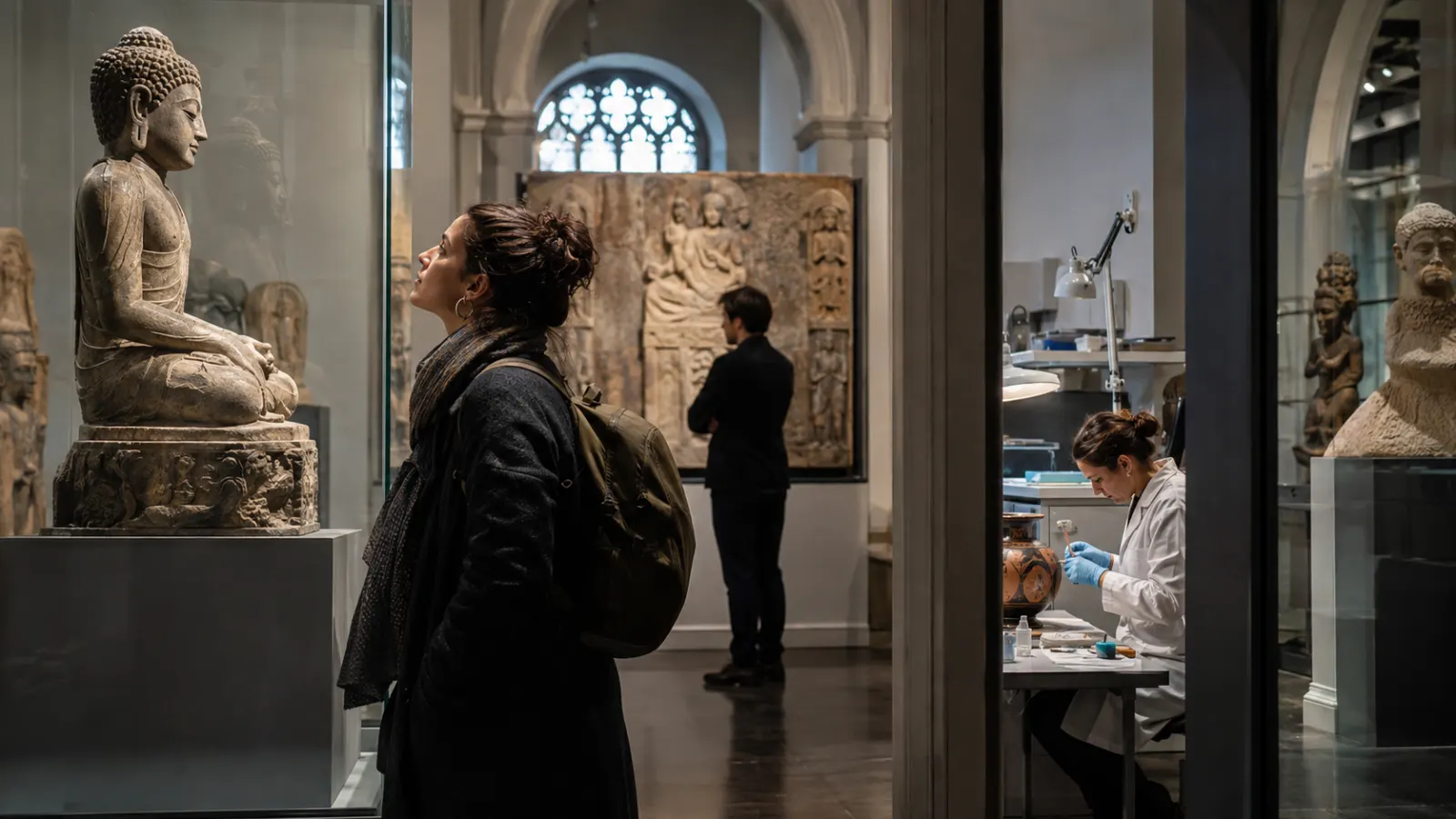
Museums Do Not Preserve the Past; They Preserve Evidence of It
The past cannot be stored. Events end, people die and social worlds change.
What museums can preserve are traces: objects, specimens, recordings, documents, images, techniques and stories linked to those traces.
Memory emerges when those materials are kept, described, interpreted and connected with people.
Step One: Selection
Every museum collection begins with selection. Someone decides that an object or body of material should enter long-term care.
This decision is powerful because storage space, staff time and conservation resources are finite. What is accepted has a greater chance of surviving; what is ignored may disappear.
Collections Policies Make Selection Explicit
ICOM's revised 2026 Code of Ethics states that museums should create and maintain collections policies specifying procedures for acquisition, documentation, protection, conservation and use.
A collections policy prevents acquisition from becoming a series of unrelated personal choices by individual curators.
Step Two: Provenance
An object's memory begins before it enters the museum. Provenance research asks where it came from, who owned or used it, how it moved and under what circumstances it was acquired.
Without provenance, a beautiful object may lose much of its historical meaning.
Provenance Can Reveal Violence
Colonial extraction, wartime looting, illicit excavation and coercive sale have placed many objects in collections under disputed circumstances.
Investigating those histories does not weaken memory. It makes the archive more accurate.
Step Three: Documentation
Museums create records connecting an object to names, dates, materials, dimensions, condition, location, acquisition history, rights and research.
Documentation is memory infrastructure. If an object becomes separated from its records, information can be lost even while the physical item remains intact.
Catalogues Turn Collections Into Searchable Knowledge
A collection of one million objects is of limited research value if nobody can identify what is present.
Cataloguing allows future researchers to find relationships across objects and collections.
Metadata Is Not Neutral
Classification systems use categories created by particular institutions and historical periods. Older catalogues may use colonial names, outdated scientific classifications or terminology rejected by source communities.
Updating records is therefore part of preserving memory honestly.
Step Four: Conservation
Material survives only when physical conditions are managed. Light fades pigments and textiles. Humidity damages paper and metal. Pests destroy organic material. Handling creates wear.
Conservators monitor environments, stabilise fragile objects and design storage and display conditions.
Conservation Tries to Preserve Evidence, Not Make Everything Look New
Aggressive restoration can erase original material. Modern conservation generally prefers interventions that retain evidence and are carefully documented.
The goal is long-term stability, not cosmetic perfection.
Step Five: Storage
Most museum collections are not on permanent display. They are stored in controlled environments where staff can monitor condition and researchers can request access.
Storage design is therefore one of the least visible but most important parts of museum memory.
Step Six: Research
Objects become more meaningful when new questions are asked.
A specimen collected a century ago can support modern environmental research. A household object can be reinterpreted through labour or gender history. Technical imaging can reveal information previously invisible.
Preservation allows evidence to outlive the questions of the original collector.
Step Seven: Interpretation
Museums do not simply put objects in cases. Labels, exhibition design, sequencing and comparison create arguments.
Two exhibitions using the same collection can tell very different stories.
Exhibitions Are Temporary Memory Arrangements
An exhibition selects a small fraction of what the museum holds and places it inside a narrative.
Visitors should therefore understand exhibitions as interpretations rather than complete representations of history.
Oral Histories Restore Context
Objects often enter museums without the voices of people who used them. Oral-history programmes can connect collections to lived experience.
Former workers can explain machines. Migrants can identify household items. Community elders can interpret names and practices missing from institutional documentation.
Community Knowledge Can Correct Museum Records
The 2022 ICOM museum definition and the revised ethical framework emphasise participation and respect for communities connected to collections.
Co-curation can reveal meanings unavailable to curators working only from existing catalogues.
Intangible Heritage Requires Different Memory Practices
A dance, song or ritual cannot be preserved like a vase. Museums may collect recordings, costumes and documentation, but the living practice survives through communities.
The museum's role should support transmission rather than implying that a recording replaces practitioners.
Digital Heritage Is Now Part of Museum Responsibility
The 2026 ICOM Code explicitly recognises tangible, intangible and digital heritage.
Born-digital art, digital photographs, databases and audiovisual files require migration, backups and format management. Digital objects can disappear through technological obsolescence even when no physical decay is visible.
Digitisation Creates Copies, Not Substitutes
High-resolution scans increase access and reduce handling of fragile originals.
But digital copies do not preserve material composition, scale, surface, weight or every future research possibility.
Museums Preserve Memory Through Redundancy
Strong memory systems do not rely on one object or one database. They use physical conservation, documentation, backups, research publications, images and institutional procedures.
Redundancy reduces the chance that one failure destroys the record.
Disaster Planning Is Memory Protection
Fire, flood, conflict and theft can destroy collections quickly.
Risk assessment, emergency plans and collection inventories allow institutions to prioritise rescue and document losses.
Museums Also Forget
No collection is complete. Institutions historically collected some communities intensively and ignored others.
Absence is therefore part of the archive.
Colonial Collections Show How Power Shapes Memory
Museums created under imperial systems often classified colonised societies from the perspective of the collector.
Objects may have been separated from sacred context or represented as evidence of cultures supposedly disappearing.
Contemporary museums increasingly revisit these histories through provenance research, new interpretation and dialogue with source communities.
Restitution Can Change Where Memory Lives
Returning an object does not necessarily destroy public memory. It may relocate authority and allow the object to re-enter the community from which it came.
Digital documentation, loans and research partnerships can maintain scholarly access while ownership or custody changes.
Deaccessioning Requires Ethical Rules
Museums sometimes remove objects from collections because of duplication, irrelevance, deterioration or ethical concerns.
Because deaccessioning can permanently reshape the archive, it requires transparent policy rather than private disposal.
Who Gets to Tell the Story?
Memory becomes more trustworthy when museums distinguish evidence from interpretation and acknowledge disagreement.
A national museum should not pretend one narrative represents every citizen.
Loans Extend Memory Beyond One Building
Museums share collections through temporary and long-term loans. This can reconnect objects with communities, support research and allow audiences in different places to encounter the same evidence.
Loans require careful documentation, insurance, environmental standards and ethical review because movement itself creates risk.
Location Control Is a Memory System
Large collections require exact location records. If an object is moved from storage to conservation, photography, exhibition or loan, the database must follow it.
An object that physically exists but cannot be found is effectively inaccessible to research and at greater risk of loss.
Condition Reports Create a History of the Object
Conservators record cracks, fading, corrosion, previous repairs and other changes. Repeated condition reports create a timeline showing whether deterioration is stable or accelerating.
This record helps future staff distinguish historical damage from recent change.
Climate Control Is Selective, Not Universal
Different materials require different conditions. Metals, photographs, paper, textiles and biological specimens respond differently to humidity, light and temperature.
Collections care therefore depends on material knowledge rather than one ideal museum climate.
Research Can Correct Identification
Museum catalogues are not final. A work can be reattributed, a specimen reclassified, a maker identified or an object's use reinterpreted.
Preserving the object alongside earlier documentation allows scholars to see how knowledge itself changed.
Rights Can Limit Access for Good Reasons
Open access is important, but some collections contain human remains, sacred material, private information or culturally restricted knowledge.
Ethical memory sometimes requires controlled access rather than universal visibility. Community rights and dignity can outweigh the assumption that everything held by a museum should immediately be public.
Exhibition History Is Part of Institutional Memory
Museums increasingly archive their own past exhibitions, labels and catalogues. These records show how interpretation changed over time.
A display from fifty years ago may become evidence of previous assumptions about race, empire, science or gender.
The practical lesson is that preservation and cultural institutions work best when their procedures are explicit enough to be questioned, revised and understood by the public they claim to serve.
Memory Also Depends on Institutional Continuity
Collections may outlive individual curators by centuries. Procedures, inventories, handover practices and stable professional standards allow knowledge to survive staff turnover.
When institutions lose records, expertise or funding, objects can remain physically present while their context slowly disappears. Preserving memory therefore requires maintaining organisations as well as collections.
The Museum as a Memory Institution
Museums preserve memory through systems rather than sentiment: selection, provenance, documentation, conservation, storage, research and interpretation.
Their responsibility is double. They must keep evidence safe, and they must keep the meaning of that evidence open to correction.
The best museum does not freeze memory. It protects enough evidence for society to remember differently tomorrow.
Sources / Further Reading
• International Council of Museums — Code of Ethics for Museums 2026 — https://icom.museum/wp-content/uploads/2026/06/Code-of-Ethics_2026_EN-1.pdf
• International Council of Museums — Revised Code of Ethics adopted in 2026 — https://icom.museum/en/news/the-revised-icom-code-of-ethics-is-officially-adopted/
• International Council of Museums — Museum Definition — https://icom.museum/en/resources/standards-guidelines/museum-definition/
• UNESCO — Recommendation concerning the Protection and Promotion of Museums and Collections — https://www.unesco.org/en/legal-affairs/recommendation-concerning-protection-and-promotion-museums-and-collections-their-diversity-and-their
• UNESCO — Recommendation on preservation and access to documentary heritage — https://www.unesco.org/en/legal-affairs/recommendation-concerning-preservation-and-access-documentary-heritage-including-digital-form
• International Council of Museums — Provenance research in museums — https://icom.museum/en/news/call-for-papers-museum-international-provenance-research-in-museums/
Suggested Internal Links
• Why Museums Matter — Article 43
• Why We Protect the Past — Article 42
• What Heritage Really Means — Article 39
• Why Historical Monuments Matter — Article 40
• What Literature Does for Society — Article 45