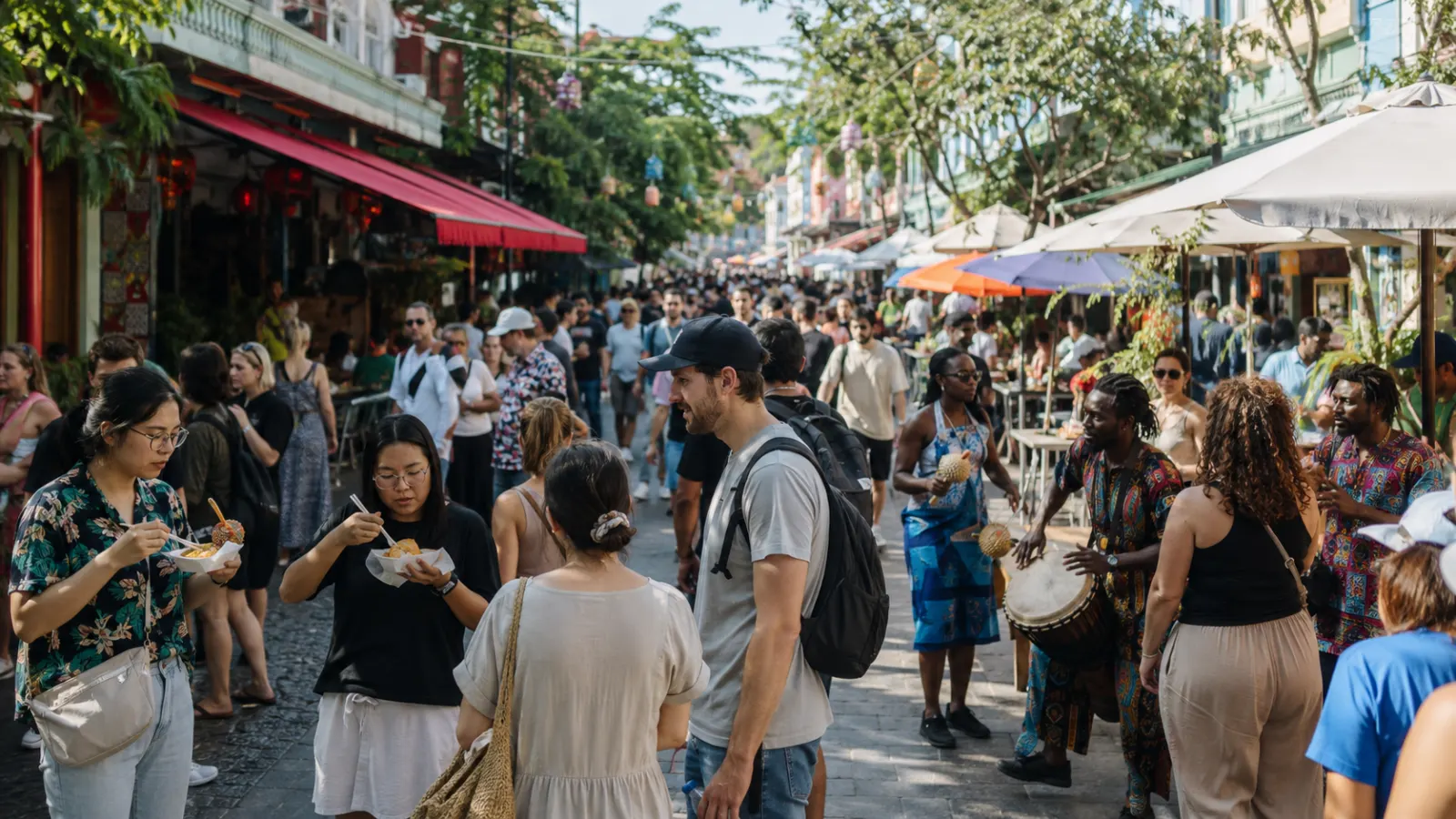
Sameness Is Easy to Notice
Walk through airports in different countries and similar coffee shops, clothing brands, music and phone interfaces may appear.
This visual repetition feeds the idea of cultural homogenisation: the reduction of cultural difference as products, media and lifestyles converge.
Homogenisation Is Not the Same as Globalisation
Globalisation means increasing cross-border interdependence and exchange.
Homogenisation is one possible outcome of those exchanges when differences decline.
Globalisation can also produce hybrid culture, revival and new distinctions.
Standardised Products Create Familiar Environments
Global companies often use similar store design, branding and service models across markets.
The benefit is predictability. The cultural cost can be reduced visual and commercial distinctiveness.
Media Concentration Can Narrow Cultural Visibility
Large studios, broadcasters and platforms can distribute content at scales smaller producers cannot match.
If audiences repeatedly encounter the same high-budget genres and formats, cultural attention can converge even when local production continues.
Language Is a Major Mechanism
A dominant language can become more useful for education, business and digital participation.
This can reduce the domains in which smaller languages are used.
UNESCO warns that linguistic inequality online is a major threat to cultural diversity.
Platform Design Standardises Form
Digital platforms often provide the same interfaces, video lengths, metrics and interaction tools globally.
Creators may adapt content to what the platform rewards.
The cultural message can remain local while the form becomes standardised.
Algorithms Can Reward Familiarity
Recommendation systems are designed to predict engagement.
If familiar formats reliably attract attention, platforms may repeatedly amplify them.
This can create convergence in what becomes visible.
Tourism Can Standardise Local Presentation
Destinations may adapt food, performances and retail to visitor expectations.
Complex traditions can be shortened or packaged into recognisable experiences.
The result may be economically successful while culturally simplified.
Urban Development Can Produce Visual Convergence
Shopping centres, towers, road infrastructure and apartment layouts can make cities look more alike.
Local architecture may disappear when land values and construction systems favour standardised forms.
Consumption Is Not Identity
Using the same smartphone or drinking the same soft drink does not mean two people share the same worldview.
Material convergence can coexist with differences in religion, family structure, language and political identity.
Localisation Limits Homogenisation
Global companies often change menus, marketing and products for local markets.
Audiences remake imported forms through language, humour and custom.
This process is sometimes called localisation or glocalisation.
Hybrid Culture Creates New Differences
When global and local forms combine, the result may be something new rather than more uniform.
A global music genre performed in a regional language can strengthen local identity while using an international format.
People Deliberately Preserve Difference
Globalisation can motivate language revival, heritage festivals and local branding.
Communities may become more conscious of distinctiveness when they fear losing it.
Homogenisation Can Be Uneven Within One Society
Urban middle-class lifestyles may converge internationally while rural communities maintain different practices.
Age, class, education and connectivity affect exposure to global culture.
The Digital Divide Complicates the Story
Not everyone participates in global digital culture equally.
Unequal access means some communities experience intense global connectivity while others remain less connected.
Cultural Power Matters
Homogenisation is more concerning when convergence results from unequal power rather than voluntary exchange.
If local creators cannot compete for visibility or income, cultural choice may narrow despite nominal access to many platforms.
The Market Can Reward Scale
Large cultural products can spread development and marketing costs across global audiences.
Local producers often operate with smaller budgets.
This economic asymmetry affects which culture is easiest to see.
But Markets Can Also Support Niches
Online distribution reduces some physical limits on niche culture.
A small-language musician can find listeners around the world.
Digital markets can therefore increase diversity even while concentrating attention.
How Do We Know Homogenisation Is Happening?
Visual impressions are insufficient.
Researchers need evidence about language use, media consumption, cultural production, architecture, food, music and participation across time.
One standardised shopping street does not prove a society's entire culture has converged.
UNESCO's Position Is More Nuanced Than 'Globalisation Destroys Culture'
UNESCO has repeatedly warned about homogenising pressures while also arguing that diversity is strengthened through exchange and interaction.
Its policy frameworks therefore seek open cultural flows alongside measures that support local creation and linguistic diversity.
The Real Risk Is Reduced Choice
Homogenisation matters when people lose viable alternatives: no schooling in a local language, no market for regional music, no affordable space for traditional craft.
Cultural diversity depends on the practical ability to create and transmit difference.
Homogenisation Can Occur at the Level of Format
Television competitions, short videos, shopping centres and hotel rooms can follow similar templates while the specific content remains local.
This distinction matters because visual standardisation may be real without complete cultural sameness.
Food Shows the Limits of the Theory
Global fast-food chains create recognisable menus and spaces, but local cuisines continue to evolve alongside them.
Chains themselves often add regional dishes, showing that commercial success can depend on cultural adaptation.
Language Shift Is a Stronger Form of Homogenisation
When a community stops transmitting its language, the loss is deeper than adopting a global fashion brand.
Language carries categories, oral literature and knowledge that may not transfer fully into a dominant language.
Architecture Can Converge Faster Than Ritual
Construction technologies and global finance can produce similar towers and retail spaces across cities.
Household rituals, religious practices and kinship norms may remain far more distinctive. Different cultural domains converge at different speeds.
Generational Change Can Be Misread as Global Homogenisation
Older generations often experience youth culture as less local because younger people adopt global music, clothing or slang.
Yet young people may also create new local identities through those imported forms.
Policy Can Expand Cultural Choice
Support for local broadcasting, translation, arts education, minority-language media and independent production can reduce the structural disadvantages faced by smaller cultural markets.
Cultural diversity therefore depends partly on public institutions, not only consumer preference.
Digital Discoverability Is a New Cultural Policy Issue
A local film or song can technically exist online and still be effectively invisible.
Recommendation systems, search ranking and metadata determine whether audiences find it. Diversity of supply is insufficient without diversity of discoverability.
Homogenisation Is Not Always Imposed
People sometimes choose standardised products because they are convenient, affordable or prestigious.
Cultural analysis should not assume every adoption is false consciousness. The relevant question is whether meaningful alternatives remain available.
Homogenisation Can Be Measured Through Market Concentration
If a small number of firms dominate music, film distribution, publishing or digital platforms, fewer institutions decide what receives investment and promotion.
Market concentration does not prove audiences have identical tastes, but it can narrow the range of cultural options that receive large-scale visibility.
Local Culture Can Survive in Private While Disappearing Publicly
Families may continue recipes, rituals or language at home even after shops, schools and media become standardised.
This creates a layered picture: public environments can look homogeneous while private cultural life remains diverse.
Education Can Accelerate or Resist Convergence
National school systems often standardise language, curriculum and cultural references across regions.
This can create shared citizenship while weakening local knowledge. Bilingual and regional curricula can preserve difference within common institutions.
Cultural Homogenisation Is Often Domain-Specific
A society may converge strongly in consumer technology while remaining distinctive in religion, kinship or language.
Claims about homogenisation should therefore identify which cultural domain is changing rather than treating culture as one undivided object.
Cultural Diversity Can Exist Inside Standardised Systems
A global platform may use one technical format while hosting thousands of languages, music traditions and political communities.
The relevant question is whether the system genuinely allows those differences to reach audiences or merely stores them in an invisible long tail.
This is why measuring cultural diversity requires more than counting available titles. Visibility, affordability, language support and the ability of communities to produce new work all determine whether difference remains socially meaningful.
Cultural sameness is therefore a question of capacity, not merely surface resemblance.
That distinction matters for policy and interpretation.
Are Global Cultures Becoming the Same?
In some visible ways, yes. Commercial environments, media formats and technologies have converged.
But culture operates at many levels, and communities continuously reinterpret what they borrow.
Homogenisation is therefore a pressure, not a completed global condition.
The important question is not whether cultures influence one another. They always have. It is whether unequal systems reduce the capacity of communities to keep creating meaningful alternatives.
Sources / Further Reading
• UNESCO — Protecting cultural diversity in the digital era — https://www.unesco.org/en/articles/cutting-edge-protecting-and-preserving-cultural-diversity-digital-era
• UNESCO — Globalization and Cultural Diversity — https://unesdoc.unesco.org/ark:/48223/pf0000121070
• UNESCO — World Report: Investing in Cultural Diversity and Intercultural Dialogue — https://unesdoc.unesco.org/ark:/48223/pf0000184755
• UNESCO — Convention on the Diversity of Cultural Expressions — https://www.unesco.org/en/legal-affairs/convention-protection-and-promotion-diversity-cultural-expressions
• UNESCO — Links between biological and cultural diversity — https://unesdoc.unesco.org/ark:/48223/pf0000159255
Suggested Internal Links
• Understanding the Globalisation of Culture — Article 58
• Understanding the Loss of Local Traditions — Article 60
• What Is Digital Culture — Article 57
• How the Internet Changed Culture — Article 56
• What Is the Importance of Preserving Culture — Planned internal link