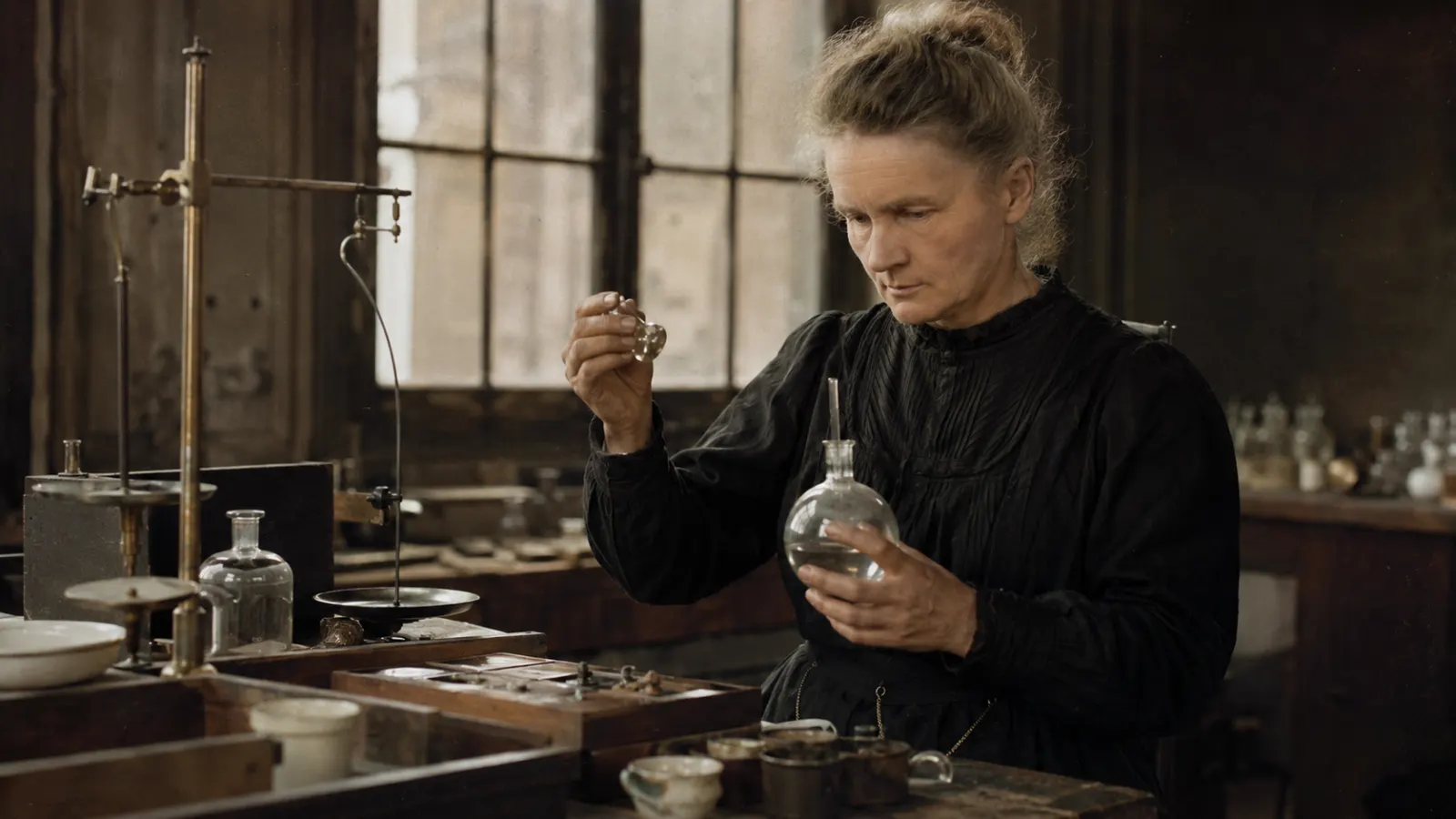
In September 1928, Alexander Fleming returned to his laboratory at St Mary's Hospital in London and noticed something odd on a culture plate. A mould had contaminated a dish of staphylococci, and around the mould colony the bacteria had been inhibited. Fleming studied the effect, cultured the mould and named the antibacterial substance it produced "penicillin."
It is one of the most famous accidental discoveries in science. The usual story then jumps straight to a medical revolution: a messy scientist leaves a window open, mould lands on a plate, and antibiotics are born.
Almost every part of that compressed story needs qualification. The exact source of the mould is uncertain. Fleming's observation was perceptive rather than merely lucky. His crude penicillin was unstable and difficult to purify. He did not turn it into a practical systemic medicine. More than a decade later Howard Florey, Ernst Chain, Norman Heatley and a larger Oxford team developed extraction, purification, animal evidence and clinical use; British and American industry then solved mass-production problems during the Second World War.
Fleming deserves a central place because he identified and published the antibacterial effect, preserved the line of inquiry and understood that a microbial product could selectively inhibit bacteria. He does not deserve to stand alone. Penicillin is a better story when it becomes a chain of discovery rather than a miracle attributed to one contaminated dish.
A Scottish farming childhood
Alexander Fleming was born on 6 August 1881 at Lochfield Farm near Darvel in Ayrshire, Scotland. He grew up in a large farming family and attended local schools before moving to London as a young man.
He initially worked in a shipping office and later entered St Mary's Hospital Medical School. A legacy from an uncle helped make medical training possible. Fleming proved academically strong and joined the laboratory of Almroth Wright, an influential bacteriologist and immunologist who promoted vaccine therapy and quantitative approaches to infection.
St Mary's became Fleming's professional home for most of his career. It provided the environment that shaped his science: clinical problems moved into the bacteriology laboratory, and laboratory findings were evaluated for what they might mean in patients.
That relationship between bedside infection and experimental bacteriology would matter during war.
The First World War and a critique of antiseptics
Fleming served in the Royal Army Medical Corps during the First World War and worked with Wright's group on wound infection. Battlefield injuries were heavily contaminated, and antiseptic chemicals were widely used in attempts to sterilize wounds.
Fleming and colleagues argued that strong antiseptics could damage tissues and white blood cells while failing to reach bacteria deep inside irregular wounds. The problem was not that all antisepsis was useless. It was that substances effective in a test tube could behave differently inside damaged living tissue.
This distinction became a recurring Fleming theme: selective toxicity. The ideal antibacterial agent would harm microbes more than the patient.
The war also exposed the scale of bacterial infection before antibiotics. Surgery could repair trauma but could not reliably prevent sepsis. Pneumonia, wound infections, puerperal infections and other bacterial diseases remained major causes of death.
When Fleming later encountered a naturally produced substance that inhibited bacteria without obvious toxicity to animal tissues, he already understood why that selectivity mattered.
Lysozyme: the discovery before penicillin
In 1922 Fleming reported an antibacterial substance he called lysozyme. The discovery, also associated with chance observation, came from studying the effect of bodily secretions on bacteria. Lysozyme is an enzyme present in tears, saliva and other secretions that can break down cell walls of certain bacteria.
Lysozyme did not become the transformative therapeutic agent Fleming hoped for because many important human pathogens were relatively resistant to it. Yet the work was conceptually significant. The human body and other biological systems could contain naturally occurring antibacterial substances.
This made the later penicillin observation less isolated than popular mythology suggests. Fleming had spent years looking for agents that could inhibit microbes selectively.
He also developed a habit of paying attention to unusual zones on culture plates. A contaminated plate was not automatically rubbish if the contamination produced an interpretable biological effect.
The 1928 plate
The exact reconstruction of Fleming's famous culture plate has generated debate, but the core observation is secure. In 1928 a Penicillium mould contaminated a staphylococcal culture. Around the mould, bacterial colonies failed to grow or dissolved.
Fleming isolated the mould and investigated the antibacterial material diffusing into the medium. He called the filtrate "penicillin." He tested its activity against different bacteria and found strong effects against many Gram-positive organisms while some other bacteria were less affected.
This selective action suggested practical uses. In his 1929 paper, "On the Antibacterial Action of Cultures of a Penicillium," Fleming discussed penicillin's capacity to inhibit staphylococci and other organisms and noted its usefulness in isolating bacteria insensitive to penicillin from mixed cultures.
The paper did not announce a ready-made drug. Fleming knew the material was unstable and difficult to concentrate. His laboratory lacked the chemical capabilities required to isolate penicillin in a form suitable for reliable systemic therapy.
That distinction — discovery of an antibacterial phenomenon versus development of a medicine — is central to the history.
Why penicillin did not immediately change medicine
If penicillin was discovered in 1928, why did patients not receive it widely until the 1940s?
The first obstacle was chemistry. The active substance existed in low concentrations in culture fluid and lost activity easily. Purifying and stabilizing it required methods beyond routine bacteriology.
The second obstacle was institutional attention. Sulfonamide drugs emerged in the 1930s and offered the first widely successful systemic antibacterial chemotherapy. Researchers had reasons to focus elsewhere. Fleming continued to use penicillin experimentally and supplied mould cultures to some investigators, but he did not build a large multidisciplinary program around it.
The third obstacle was scale. Even if a laboratory obtained active penicillin, treating serious infection required enough drug, predictable potency and safe administration. Those were engineering and manufacturing problems as much as biological ones.
A scientific observation becomes a therapy only when multiple systems work: chemistry, pharmacology, clinical testing, production and regulation.
The Oxford team reopens the problem
In the late 1930s, a team at the Sir William Dunn School of Pathology at Oxford began systematically studying antibacterial substances. Howard Florey led the laboratory; Ernst Chain examined biochemical and pharmacological possibilities; Norman Heatley developed crucial extraction and assay methods. Other researchers contributed to cultivation, purification, animal experiments and clinical work.
The team returned to Fleming's 1929 paper and obtained a penicillin-producing mould culture. By 1940 they had produced enough partially purified penicillin to test in mice infected with lethal bacteria. Treated animals survived under conditions in which untreated controls died.
The experiment transformed penicillin from an interesting bacteriological substance into a serious therapeutic candidate.
Human treatment followed. Early cases demonstrated dramatic effects, though supply was so limited that researchers recovered penicillin from patients' urine for reuse. One famous early patient improved but died after the drug ran out, illustrating both penicillin's promise and the production crisis.
The Oxford team's work is why the phrase "Fleming discovered penicillin" must be followed by "Florey, Chain, Heatley and others developed it into a practical medicine."
From laboratory broth to wartime production
Britain in wartime lacked industrial capacity to produce enough penicillin quickly. Florey and Heatley sought support in the United States, where government agencies, agricultural laboratories and pharmaceutical companies helped develop large-scale fermentation and purification.
The production story involved innovations in deep-tank fermentation, nutrient media and strain selection. A higher-yielding Penicillium strain famously came from a mouldy cantaloupe found in Peoria, Illinois, and later improvement programs increased output further.
By the later years of the Second World War, penicillin was available in quantities sufficient to treat many Allied military infections. Production then expanded into civilian medicine.
This industrial phase is often missing from heroic discovery stories because no single photograph captures it. Yet without fermentation engineers, factory workers, government coordination and pharmaceutical chemistry, Fleming's plate would have remained a historical curiosity.
The antibiotic revolution was an infrastructure revolution.
Nobel Prize: three names for a much larger collaboration
In 1945 the Nobel Prize in Physiology or Medicine was awarded jointly to Alexander Fleming, Ernst Boris Chain and Howard Walter Florey "for the discovery of penicillin and its curative effect in various infectious diseases."
The award wisely recognized both discovery and development, though even three laureates could not represent everyone who contributed. Norman Heatley's experimental engineering was indispensable; clinical teams and industrial scientists also mattered.
Fleming's fame nevertheless dominated popular culture. The contaminated-plate story was easier to tell than a decade-long multinational development program. He became the face of penicillin, received a knighthood and was celebrated internationally.
Fleming himself often acknowledged Florey and Chain. The problem is less that he personally stole the story than that public storytelling prefers a lone discoverer.
A modern biography can correct the narrative without diminishing him. Recognizing a phenomenon that others overlooked is genuine scientific achievement.
What Fleming actually saw
The famous mould created a clear zone because it released a chemical compound that interfered with bacterial cell-wall synthesis. Fleming did not know the later molecular mechanism. He observed phenotype: bacteria disappeared or failed to grow near the mould.
His 1929 paper documented sensitivity patterns and practical bacteriological uses. It also contained uncertainties and some errors typical of early work with an unstable substance.
Later chemistry established penicillin's beta-lactam structure and mechanism. Dorothy Crowfoot Hodgkin's X-ray crystallography helped determine its structure in the 1940s. Subsequent generations developed semisynthetic penicillins and other beta-lactam antibiotics.
Scientific discoveries therefore acquire meanings their discoverers could not fully foresee. Fleming saw antibacterial activity. Modern medicine sees a molecular target, resistance enzymes, pharmacokinetics and a family of drugs.
That expansion is how science normally works.
Resistance: Fleming's warning and its limits
Fleming is frequently quoted as having predicted antimicrobial resistance. The claim is substantially true but often simplified into internet slogans.
In his 1945 Nobel lecture and public comments, Fleming warned that exposing bacteria to insufficient concentrations of penicillin could select resistant organisms and that careless use could make treatment fail. He described the danger of underdosing and self-medication.
Resistance was not a mysterious future possibility. Bacterial populations evolve under selection, and resistance to penicillin appeared early. Some bacteria naturally produced penicillin-destroying enzymes; others acquired resistance mechanisms over time.
Fleming's warning remains relevant, but modern antimicrobial resistance is far larger than anything one scientist could have specified. It involves prescribing practices, agricultural use, sanitation, hospital transmission, global drug access, pharmaceutical economics and a thin pipeline of new antibiotics.
Invoking Fleming should lead to stewardship, not nostalgia.
Lysozyme, penicillin and Fleming's scientific style
Fleming's two best-known discoveries shared a pattern. He noticed biological inhibition in contexts others might have ignored. He was a strong observational bacteriologist more than a chemist who could carry a molecule through purification and industrial development.
That strength helps explain both his success and his limitation. Penicillin needed a different kind of laboratory to become a drug. The Oxford group combined pathology, chemistry, pharmacology and technical engineering.
Scientific culture sometimes treats the person who first names a phenomenon as more important than the people who make it useful. Penicillin challenges that hierarchy. Discovery and development were different achievements requiring different skills.
Fleming's legacy becomes more precise when he is described as the crucial first discoverer within a longer translational chain.
The myth of the open window
A popular version says Fleming left a Petri dish by an open window while on holiday and airborne mould drifted in. Historians have questioned the neatness of this reconstruction. The exact origin of the contaminating mould is uncertain, and St Mary's laboratory environment contained multiple possible sources.
The more important myth is not the window. It is the idea that chance automatically produces discovery.
Laboratories are full of contamination. Most contaminated plates are discarded. Fleming's skill was recognizing that the contamination created a structured zone of bacterial inhibition, then testing the effect rather than cleaning the bench and moving on.
Chance supplied an anomaly; prepared observation made it evidence.
That is a better scientific lesson than the romantic idea that great discoveries happen to messy people by luck.
Later life and international fame
After the Second World War Fleming travelled widely, received honors and became one of the best-known scientists in the world. His identity was increasingly tied to penicillin, even though his research career included immunology, antiseptics and lysozyme.
He served as professor at St Mary's and later as emeritus professor. He died in London on 11 March 1955 after a heart attack and was buried in St Paul's Cathedral.
By then penicillin had changed the expectations of medicine. Infections that had once made surgery, childbirth and minor wounds frighteningly dangerous could often be treated. The success also encouraged a search for other antibiotics, including streptomycin, tetracyclines and cephalosporins.
The antibiotic era altered mortality, hospital practice and pharmaceutical research.
Its success also created ecological pressure that medicine is still managing.
Penicillin did not end infectious disease
The phrase "miracle drug" captured public amazement, but antibiotics never abolished infection. They work against bacteria, not viruses. Not all bacteria are susceptible. Resistance can spread. Access can be unequal. Antibiotics also disrupt microbial communities and can cause adverse reactions.
Penicillin itself can trigger severe allergy in a small number of patients, though allergy labels are often over-reported and require careful clinical evaluation.
The broader lesson is that a powerful technology changes the battlefield rather than ending the war. Antibiotics made bacterial infection treatable on a scale previously unimaginable, but microbial evolution continued.
This is why Fleming's story belongs in present-day health policy. The discovery is not merely a triumph in the past. It created a resource whose effectiveness must be protected.
The discovery-development-production chain
Penicillin can be divided into at least four historical achievements.
First, Fleming recognized antibacterial activity and published it. Second, the Oxford group purified and tested penicillin as a systemic therapeutic agent. Third, industrial and government teams developed methods for large-scale production. Fourth, clinicians learned how to use antibiotics effectively while researchers developed derivatives and new drug classes.
No stage can replace another. Without Fleming, the Oxford team might not have had the lead. Without Florey, Chain and Heatley, Fleming's lead may have remained chemically impractical. Without industrial fermentation, clinical promise would have been constrained by scarcity. Without stewardship, effectiveness can be lost.
This layered model is a useful antidote to lone-genius history across science. Innovation is often a relay race whose later runners are as necessary as the first.
A legacy measured in both lives saved and resistance selected
Fleming's name remains attached to one of medicine's clearest breakthroughs. Penicillin and subsequent antibiotics made pneumonia, wound infection, syphilis and many surgical infections far more treatable. They enabled more complex surgery, cancer chemotherapy and intensive care by giving clinicians tools against opportunistic bacterial infection.
The same success encouraged widespread use and misuse. Fleming's resistance warning now seems prophetic because antimicrobial resistance threatens to erode gains made during the antibiotic era.
The modern Fleming legacy therefore contains a paradox. The discovery proved that microbial life could be chemically targeted with remarkable selectivity. Evolution proved that the target would not remain passive.
The right way to honor the discovery is not to repeat the myth of a lucky plate. It is to preserve the scientific habits that made the plate consequential: careful observation, willingness to investigate anomalies, collaboration across disciplines and respect for the biological capacity to adapt.
Alexander Fleming opened the story of penicillin. The reason it changed medicine is that many others carried the story forward.
Why chemistry, not observation, was the bottleneck
Fleming's laboratory could show that penicillin killed susceptible bacteria, but demonstrating activity was not the same as producing a stable medicine. The active material degraded quickly, existed at low concentration and was surrounded by proteins, pigments and other products of mould growth. A clinician could not prescribe a culture filtrate whose dose and purity were uncertain.
The Oxford group changed the problem by treating penicillin as a chemical and engineering challenge as well as a bacteriological one. Heatley devised extraction and assay systems that allowed the team to compare batches, concentrate activity and recover scarce drug. Chain and colleagues worked on purification and pharmacology. This translation from an observation on agar to a measurable therapeutic substance is why penicillin's history belongs to both microbiology and chemical engineering.
The distinction remains relevant today. A molecule can look spectacular in a laboratory assay and still fail as a drug because it cannot be manufactured, delivered safely, stabilized or dosed. Fleming found the biological signal; later teams built the technological system that made the signal medically usable.
Sources / Further Reading
Alexander Fleming, "On the Antibacterial Action of Cultures of a Penicillium, with Special Reference to their Use in the Isolation of B. influenzae," British Journal of Experimental Pathology 10 (1929) — original paper: https://pmc.ncbi.nlm.nih.gov/articles/PMC2048009/
University of Oxford NDORMS archival PDF of Fleming's 1929 paper: https://www.ndorms.ox.ac.uk/files/news/19290510_afleming_ontheantibacterilactionofculturesofapenicillium_bjep.pdf
Nobel Prize, Sir Alexander Fleming — facts and 1945 award record: https://www.nobelprize.org/prizes/medicine/1945/fleming/facts/
Nobel Prize, Alexander Fleming — biographical profile: https://www.nobelprize.org/prizes/medicine/1945/fleming/biographical/
Nobel Prize, Fleming's Nobel lecture on penicillin: https://www.nobelprize.org/prizes/medicine/1945/fleming/lecture/
Imperial College London, historical material on Fleming and St Mary's Hospital, including the penicillin discovery and later legacy: https://www.imperial.ac.uk/news/204713/genome-alexander-flemings-original-penicillin-producing-mould/
American Chemical Society, National Historic Chemical Landmark, "Discovery and Development of Penicillin," on Fleming, Florey, Chain and industrial development: https://www.acs.org/education/whatischemistry/landmarks/flemingpenicillin.html
Richard Sykes, "Penicillin: from discovery to product," Bulletin of the World Health Organization (2001), on the translation from Fleming's observation to a practical drug: https://iris.who.int/bitstreams/00997610-7726-4197-889b-570f8ac26e79/download
Suggested Internal Links
The Antibiotics of Alexander Fleming — Planned companion deep dive
The Discoveries of Louis Pasteur
Planned internal link: How Penicillin Became a Mass-Produced Drug
Planned internal link: Howard Florey, Ernst Chain and the Oxford Penicillin Team
Planned internal link: What Antimicrobial Resistance Means
Planned internal link: The History of Antibiotics After Penicillin