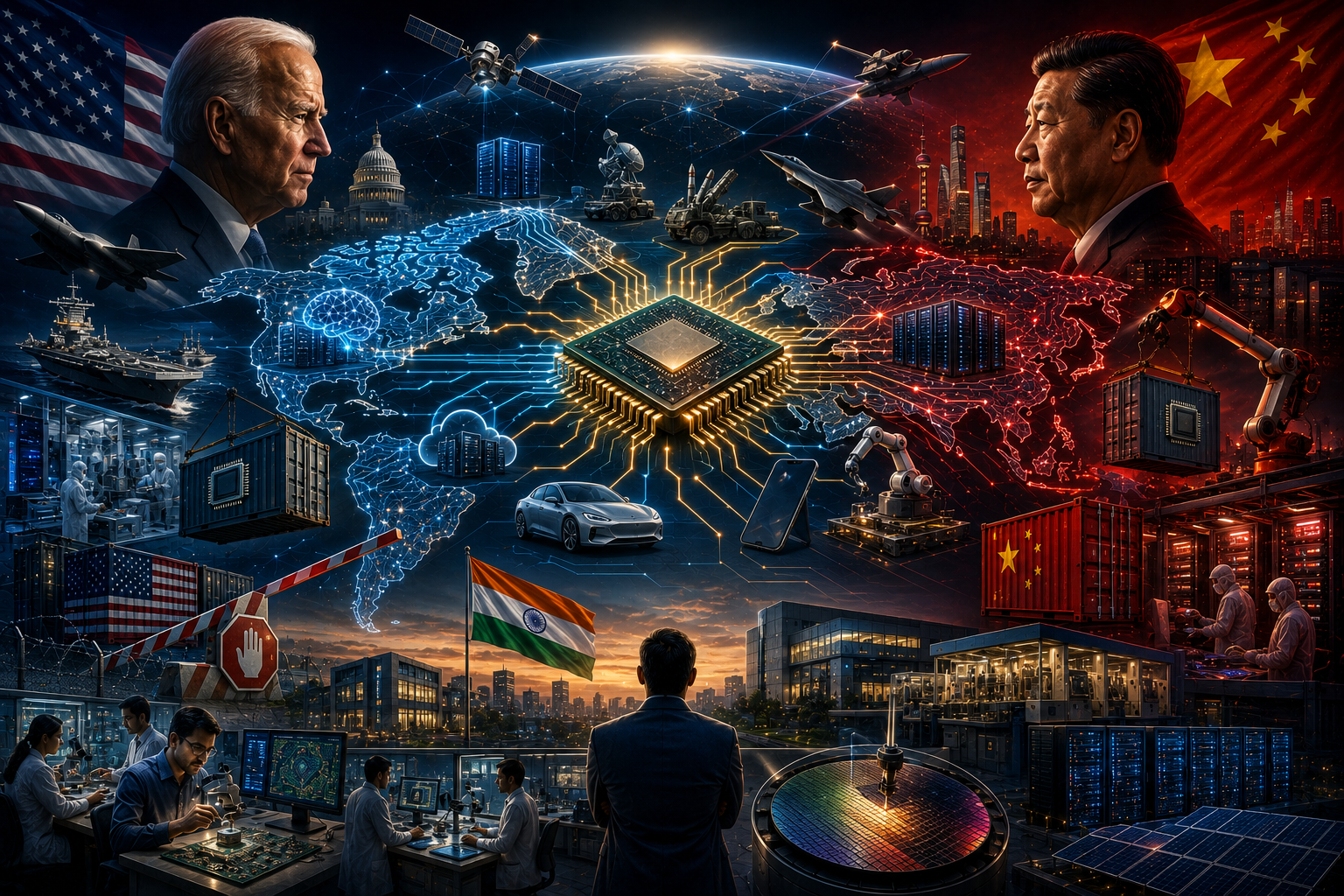
The most important battlefield between the United States and China no longer looks like a battlefield. It looks like a clean room, a lithography machine, a server farm, a design laboratory and a shipping container filled with tools that only a handful of companies in the world know how to make. The semiconductor war has turned a silent industrial chain into the nerve centre of global power. Chips now decide who can train artificial intelligence models, who can build modern weapons, who can dominate cloud infrastructure, who can control the next generation of vehicles, and who can set the standards for the digital economy.
For decades, the story of US-China rivalry was told through trade deficits, naval power, Taiwan, the South China Sea and diplomatic influence. Those issues still matter. But the centre of gravity has shifted. Washington now treats advanced computing chips and semiconductor manufacturing equipment as strategic assets, not normal commercial products. Beijing sees chip dependence as a national vulnerability that must be overcome. Companies such as Nvidia, TSMC, ASML, Intel, Samsung, SMIC and Huawei have become part of a geopolitical drama that was once reserved for ministries of defence and foreign affairs.
Why This Matters Now
The timing is critical because chips sit beneath almost every strategic sector. Artificial intelligence needs advanced GPUs. Modern fighter jets, missiles, satellites, radars and cyber systems require specialized processors. Electric vehicles and industrial automation depend on power electronics and sensors. Data centres run on high-performance chips. Even ordinary consumer devices now form part of a larger data-and-compute ecosystem. This means the country that controls chip design, manufacturing, packaging, export rules and supply chains gains leverage far beyond one industry.
The United States has used export controls to restrict China’s access to advanced computing chips and semiconductor manufacturing tools. The US Bureau of Industry and Security has repeatedly updated controls since October 2022, including rules that restrict China’s ability to buy advanced chips and manufacture high-end semiconductors. These measures show that technology policy has become security policy. The objective is not merely to protect market share. It is to slow the military and AI capabilities of a strategic competitor.
China’s response has been equally strategic. It is investing in domestic chip design, fabrication, packaging, equipment and software. It is trying to reduce dependence on foreign technology while using its own market size, rare earth dominance and manufacturing ecosystem as bargaining power. The result is not a simple trade dispute. It is an industrial cold war in which every chip node, every design tool, every foundry partnership and every export licence becomes a signal of national power.
Historical Roots
The semiconductor supply chain became global because efficiency demanded specialization. American firms led in design and software. Taiwan became the centre of advanced foundry manufacturing. South Korea became dominant in memory. Japan remained important in materials and equipment. The Netherlands became indispensable through ASML’s extreme ultraviolet lithography machines. China became the largest electronics manufacturing base and one of the largest semiconductor markets. For years, this interdependence was celebrated as globalization at its best.
But globalization also created choke points. Once Washington understood that high-end chips could power both civilian AI and military modernization, it began to treat supply chains as strategic terrain. The logic resembled earlier controls on nuclear, missile and aerospace technologies, but the scale was larger because semiconductors touch the whole economy. China, meanwhile, interpreted dependence on foreign chip technology as a strategic humiliation and a security risk. The semiconductor war is therefore rooted in a clash between interdependence and sovereignty.
The First Dimension: Compute as Power
The deepest shift is that compute has become a measure of national capability. In the industrial age, power depended on coal, steel, oil, factories and shipping routes. In the AI age, power increasingly depends on data, algorithms, chips and energy-hungry data centres. Advanced chips shorten research cycles, improve weapons simulation, enable surveillance systems, accelerate biotechnology and strengthen financial modelling. A country blocked from the best chips may still innovate, but it must work harder, spend more and accept delays.
This is why the chip war is also an AI war. Restrictions on GPUs are not merely restrictions on gaming hardware or cloud servers. They affect the training of frontier models, high-performance computing and military-linked research. The more AI becomes embedded in national defence, finance, cyber operations and industrial production, the more semiconductor access becomes a geopolitical instrument.
The Second Dimension: Manufacturing Choke Points
Designing a chip is difficult; manufacturing it at scale is even harder. Advanced nodes require staggering capital expenditure, ultra-clean facilities, specialized chemicals, precision tools, thousands of process steps and a trained workforce. This is why only a few firms can manufacture at the cutting edge. The concentration of capability gives enormous leverage to foundries and to the countries that host them. A disruption in one region can create consequences across the global economy.
The vulnerability is not only about Taiwan. It also includes Dutch lithography, Japanese materials, American design software, South Korean memory, Malaysian packaging and Chinese assembly ecosystems. The semiconductor war has made governments aware that resilience cannot be achieved simply by building one factory. It requires a full ecosystem: materials, tools, talent, power, water, logistics, IP protection, demand and policy stability.
The Third Dimension: Sanctions and Workarounds
Export controls rarely produce clean outcomes. They slow an adversary, but they also encourage substitution, smuggling, rerouting and indigenous innovation. China’s chip sector has faced constraints, yet it has also become more determined. Chinese firms are working on domestic alternatives in design software, equipment, packaging and AI chip architecture. Even when they lag at the most advanced nodes, they can still build capability at mature nodes and develop system-level techniques to improve performance.
This creates a strategic dilemma for Washington. If controls are too loose, they fail. If they are too broad, they hurt allied firms, increase costs and accelerate China’s self-reliance. The semiconductor war therefore requires constant adjustment. Rules must track technology, corporate behaviour, third-country routing and the distinction between commercial and military use.
The India Angle
For India, the semiconductor war is both a warning and an opportunity. The warning is clear: a large digital economy cannot remain permanently dependent on imported chips, foreign design tools, external cloud infrastructure and vulnerable supply chains. India’s electronics ambitions, defence modernization, EV transition, telecom infrastructure and AI ecosystem all require semiconductor depth. Dependence on external suppliers may be commercially convenient, but in a crisis it can become a strategic weakness.
The opportunity is equally real. India has launched the India Semiconductor Mission with a ₹76,000 crore incentive framework and has approved multiple projects across fabrication, compound semiconductors, assembly, testing, packaging and design. Government statements in 2025 and 2026 highlight approved investments of around ₹1.60 lakh crore across six states. This does not make India a semiconductor superpower overnight. But it gives India a platform to enter selected segments of the chain: design, packaging, mature-node manufacturing, power electronics, automotive chips and strategic electronics.
India must be careful not to confuse announcements with capability. A fab is not just a building. It is a precision ecosystem. It needs reliable electricity, water, logistics, specialist engineers, suppliers, IP discipline, long-term customers and the patience to survive technology cycles. India should therefore avoid the trap of chasing prestige alone. The more realistic strategy is to build depth where India has demand and talent: chip design, automotive electronics, defence electronics, telecom chips, compound semiconductors and advanced packaging.
Global Implications
The semiconductor war is fragmenting globalization. The old model assumed that companies would optimize for cost, scale and efficiency. The new model forces them to optimize for geopolitical risk. Firms now ask: where can we manufacture safely, whose export controls apply, which country might impose sanctions, can our supply chain survive a Taiwan crisis, and will customers accept chips made in certain jurisdictions? This changes investment decisions across the world.
It also divides countries into rule-makers, rule-takers and swing states. The US, China, Taiwan, South Korea, Japan, the Netherlands and a few European states sit near the centre of the chip order. Many developing countries remain consumers of technology, not makers of it. For the Global South, the risk is that chip geopolitics creates a new hierarchy where access to compute, cloud and advanced electronics is controlled by a small club.
Counter-View
There is a serious counter-view: the chip war may be exaggerated. China remains deeply integrated into global manufacturing. US companies still depend on Chinese markets. Taiwan, South Korea and Japan do not want a complete economic rupture. Even Washington’s controls are selective rather than total. In this view, the semiconductor war is not a full decoupling but a painful rebalancing of sensitive technologies.
That counter-view is important because interdependence still imposes discipline. A total split would raise costs globally, slow innovation and damage companies in every major economy. The more likely future is selective decoupling: intense restrictions at the cutting edge, continued trade in mature technologies, and constant contestation over grey zones.
What Happens Next
Three scenarios are visible. In the first, the US retains a meaningful lead by coordinating controls with allies, while China narrows the gap through massive investment and domestic substitution. In the second, China achieves enough self-reliance to reduce American leverage, even if it does not dominate the frontier. In the third, a Taiwan crisis or major sanctions shock forces a disorderly restructuring of global electronics supply chains.
For India, the lesson is not to choose dependency under a different name. India must cooperate with the US, Japan, Taiwan, Europe and South Korea, but it must also build sovereign capability where it matters. The semiconductor war has made one truth unavoidable: in the twenty-first century, strategic autonomy will be measured not only by aircraft carriers and missiles, but by wafers, fabs, design talent and access to compute.
Editorial Insight
Source References for Verification
- https://aiindex.stanford.edu
- https://www.itu.int
- https://www.wipo.int
- US Bureau of Industry and Security: Advanced computing and semiconductor export controls - https://www.bis.gov/press-release/bis-updated-public-information-page-export-controls-imposed-advanced-computing-semiconductor
- US BIS: 2023 advanced computing restrictions update - https://www.bis.gov/press-release/commerce-strengthens-restrictions-advanced-computing-semiconductors-semiconductor-manufacturing-equipment
- India Semiconductor Mission 2.0, PIB - https://www.pib.gov.in/PressReleasePage.aspx?PRID=2224839&lang=1®=3
- ITU IMT-2030 / 6G Framework - https://www.itu.int/en/mediacentre/Pages/PR-2023-12-01-IMT-2030-for-6G-mobile-technologies.aspx
- UNCTAD Digital Economy Report 2024 - https://unctad.org/publication/digital-economy-report-2024
- DST National Quantum Mission - https://dst.gov.in/national-quantum-mission-nqm
- NIST Post-Quantum Encryption Standards - https://www.nist.gov/news-events/news/2024/08/nist-releases-first-3-finalized-post-quantum-encryption-standards