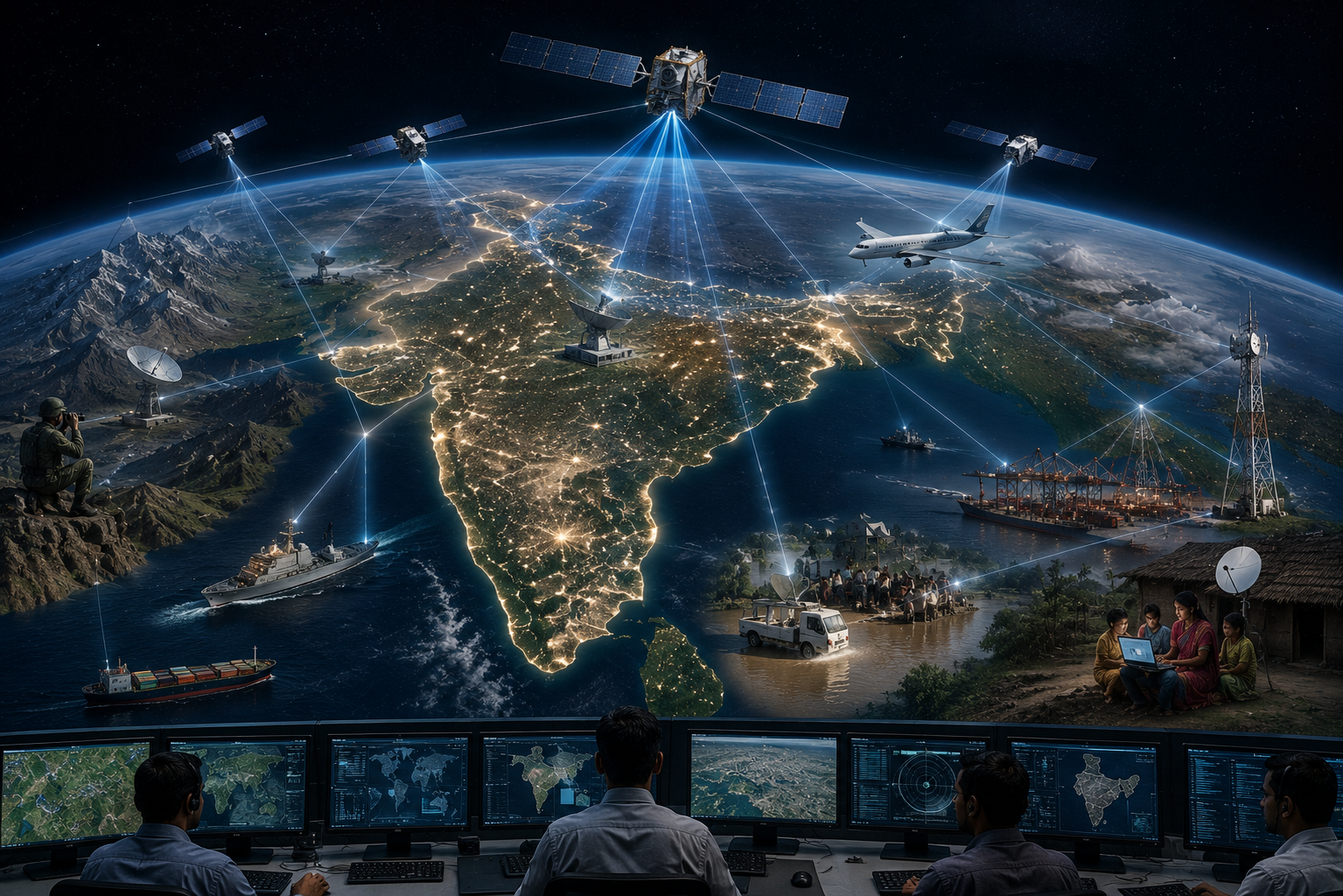
There was a time when satellites belonged mostly to scientists, weather departments, television broadcasters and superpower militaries. They floated above politics in public imagination, appearing distant, technical and almost neutral. They helped predict cyclones, broadcast live events, map forests, connect remote regions and guide aircraft. For ordinary citizens, satellites were invisible infrastructure.
That innocence is over.
Satellite networks have become strategic assets in war, diplomacy, disaster response, economic security and national power. They are no longer just machines orbiting Earth. They are the nervous system of modern statecraft.
A country that controls satellite networks controls communication in remote terrain, navigation for armies and civilians, intelligence from above, missile warning, battlefield awareness, financial timing, border surveillance, maritime monitoring, weather forecasting and crisis coordination. A country that loses satellite access can become blind, slow and vulnerable.
This is why satellites are now central to geopolitics.
The war in Ukraine made this visible to the world. Commercial satellite internet, especially Starlink, became a battlefield communication tool. Satellite imagery shaped global public understanding of troop movements, destroyed cities and war crimes. Western intelligence and commercial space firms helped Ukraine maintain visibility against a larger adversary. At the same time, disputes over satellite access revealed an uncomfortable reality: when a private satellite network becomes essential to a war effort, a private company can acquire geopolitical power.
That is the defining shift.
Satellites are no longer only state assets. They are state assets, commercial assets, military assets, humanitarian assets and diplomatic assets at the same time. Their strategic value lies precisely in this overlap.
The future of war and diplomacy will increasingly depend on who can see, connect, navigate and communicate from space.
The New Strategic Layer Above Earth
Modern power now has an orbital layer.
On land, states compete for territory. At sea, they compete for trade routes and naval access. In the air, they compete for control of skies. In cyberspace, they compete over data, networks and information. In space, they compete over satellites, spectrum, orbital slots, sensors, communication links and space situational awareness.
The difference is that space supports all the other domains.
A modern military operation depends on satellites for positioning, navigation, timing, communications, intelligence, surveillance, reconnaissance, missile warning and targeting. A modern economy depends on satellites for banking synchronisation, shipping, aviation, telecom backhaul, weather data, agriculture, disaster response and remote connectivity. A modern diplomatic crisis is shaped by satellite imagery, satellite internet access, humanitarian monitoring and evidence collection.
Space is therefore not a separate theatre. It is the layer that connects the rest.
The scale of dependence is growing rapidly. The European Space Agency’s 2025 Space Environment Report says space surveillance networks track roughly 40,000 objects, including about 11,000 active payloads. That level of orbital density shows how space has moved from elite state infrastructure to crowded strategic infrastructure.
The more satellites humanity launches, the more useful space becomes. But the more useful it becomes, the more contested it becomes.
Ukraine and the Starlink Lesson
The Russia-Ukraine war changed the way governments think about satellite networks.
When Russia attacked Ukraine’s terrestrial infrastructure, satellite internet helped keep Ukrainian forces and civilians connected. Starlink terminals supported battlefield communications, drone operations, coordination, and public connectivity. This did not make Starlink a weapon by itself, but it made it a war-enabling infrastructure.
That distinction matters.
A satellite network can serve civilian communications and military operations at the same time. A terminal used by a school in one region may look identical to a terminal used by soldiers near the front line. A network designed for internet access can become a command-and-control layer during war.
This created a new geopolitical problem: what happens when the survival of a state depends partly on a private company’s satellite network?
Reuters reported in 2025 that Ukrainian forces faced communications disruption after Elon Musk ordered a Starlink service shutdown during Ukrainian operations, according to officials and others who experienced the outage. The report said drones went dark and artillery units struggled when connectivity failed.
This episode captured the new reality of satellite power. A private company’s decision can affect battlefield outcomes. A commercial service agreement can become a strategic vulnerability. A billionaire can become a geopolitical actor without holding public office.
For states, the lesson is harsh: connectivity is sovereignty.
A country cannot base its national security entirely on a network it does not control, even if that network is technologically superior.
Commercial Space Becomes Strategic Space
The old space age was dominated by governments. The new space age is dominated by a mix of governments and companies.
Private firms launch satellites, provide internet, sell imagery, build rockets, operate data networks, manufacture components and support defence missions. This has created innovation, reduced launch costs and expanded access. It has also made national security dependent on commercial ecosystems.
The United States is already integrating commercial space capability into military architecture. In May 2026, Reuters reported that the US Space Force awarded SpaceX a $2.29 billion contract to build a secure, high-speed military space data network intended to connect sensors and weapons platforms globally. The system is expected to support near-real-time data relay for missile tracking and interception missions.
Just days later, Reuters reported another $4.16 billion US Space Force contract for SpaceX to develop threat-detection satellites under the Space-Based Advanced Moving Target Indicator programme. The initial satellite deployment is expected by 2028.
These contracts show that satellite networks are no longer peripheral to defence. They are becoming the backbone of future military command systems.
The modern battlefield will not be controlled only by tanks, aircraft and ships. It will be controlled by data links. Sensors must find threats. Satellites must move data. AI systems must process signals. Interceptors or weapons platforms must respond. This entire chain depends on resilient space networks.
The side that connects faster may decide faster. The side that decides faster may strike faster. The side that strikes faster may dominate.
That is why satellites are strategic assets.
Satellites as Diplomatic Leverage
Satellite networks are not only instruments of war. They are instruments of diplomacy.
A country that provides satellite connectivity during a disaster gains goodwill. A country that shares satellite imagery during a crisis shapes the international narrative. A country that offers satellite navigation support strengthens strategic partnerships. A country that controls a global satellite internet network gains diplomatic leverage in regions with weak infrastructure.
During humanitarian crises, satellite imagery can identify flood damage, refugee movements, wildfire spread, illegal mining, crop loss and destroyed infrastructure. During wars, satellite imagery can verify attacks, expose mass graves, document troop movements and challenge official propaganda. During diplomatic standoffs, satellite evidence can strengthen or weaken claims.
This creates a new kind of truth politics.
In older wars, governments could deny what happened on the ground for longer. Today, commercial satellites may reveal what states try to hide. Open-source intelligence communities can analyse satellite imagery and influence global opinion. Diplomats can use satellite evidence in international forums.
But satellite evidence is also political. Who provides the image? Who interprets it? What resolution is released? What is withheld? Which areas are monitored? Which crises receive attention?
Space-based visibility can support accountability, but it can also become selective power.
The country or company that controls satellite imagery controls part of the world’s evidence system.
Satellite Internet and the Connectivity Race
Satellite internet has become one of the most important frontiers of digital geopolitics.
Traditional internet access depends on fibre, towers and terrestrial infrastructure. But mountains, deserts, islands, conflict zones, border areas and disaster-hit regions often lack reliable connectivity. Low Earth orbit satellite constellations promise faster, lower-latency internet compared with older geostationary systems, especially for underserved regions.
This has development value. It can support remote education, telemedicine, disaster response, rural entrepreneurship and border connectivity. But it also creates security concerns.
A satellite internet terminal can bypass local networks. It can operate in areas where the state has limited infrastructure. It can support civilians during crises, but it can also be used by insurgents, smugglers, hostile actors or foreign intelligence networks. It can strengthen freedom of communication, but it can also challenge state control during unrest.
India has already confronted this dilemma. The Guardian reported in January 2025 that smuggled Starlink devices were allegedly used in Manipur to bypass internet shutdowns, before Starlink had formal authorisation in India.
That episode explains why satellite internet regulation is not a simple telecom issue. It involves national security, emergency powers, civil liberties, border management, law enforcement and digital sovereignty.
A satellite network does not respect borders the way fibre cables do. Its beams cross territory. Its terminals can move. Its operator may be foreign. Its data routing may involve external infrastructure. Its shutdown or activation may have political consequences.
For governments, satellite internet is both opportunity and anxiety.
India’s Satellite Internet Moment
India is entering a decisive phase in satellite communication policy.
The country has vast connectivity needs: Himalayan border regions, islands, rural communities, disaster-prone areas, maritime zones and remote districts. Satellite broadband can play a useful role where terrestrial networks are economically or physically difficult.
At the same time, India cannot treat satellite internet as a purely commercial service. It affects strategic communications, surveillance, lawful interception, spectrum management, rural inclusion, competition with telecom operators and data security.
India’s satellite communication framework has been evolving. TRAI issued recommendations in May 2025 on terms and conditions for assignment of spectrum for certain satellite-based commercial communication services. The framework became especially important as Starlink moved closer to entering India’s market. Reuters reported that TRAI recommended a five-year satellite spectrum allocation framework with a possible two-year extension, along with revenue charges and rural exemptions for some categories.
Starlink’s India entry has moved through multiple regulatory stages. AP reported in 2025 that India granted Starlink a crucial licence to begin launching satellite internet services, though it still required space regulator approval, spectrum allocation and local security testing before full rollout. Later reports indicated that IN-SPACe approval further cleared the way for Starlink to operate commercially in India.
For India, the policy question is not whether satellite broadband should be allowed. It should. The real question is how to allow it without creating strategic dependence.
India needs satellite internet for inclusion. But it also needs control over security protocols, licensing, lawful interception, emergency access, domestic gateways, data-routing rules, spectrum discipline and resilience.
Connectivity cannot come at the cost of sovereignty.
NavIC and Strategic Autonomy
Satellite networks are not only about internet. Navigation is equally strategic.
Most of the world depends heavily on GPS, a US-operated system. GPS is reliable and globally useful, but dependence on a foreign navigation system creates strategic vulnerability. In wartime or crisis, access can be degraded, restricted or manipulated in specific regions.
That is why independent navigation systems matter.
India’s NavIC, or Navigation with Indian Constellation, is India’s regional satellite navigation system. ISRO states that NavIC is designed to provide accurate position, velocity and timing services to users in India and the region extending about 1,500 km beyond the Indian landmass.
NavIC is not merely a technical achievement. It is a sovereignty asset.
Accurate positioning, navigation and timing support missiles, ships, aircraft, drones, logistics, telecom synchronisation, financial systems, emergency response, fishing fleets, transport and disaster management. If India wants strategic autonomy, it cannot depend entirely on external systems for such foundational services.
The same logic applies to communication satellites, earth observation satellites, weather satellites and military satellites. Sovereignty in the 21st century requires an orbital dimension.
A state without satellite autonomy is not fully blind. But it is partially dependent on the eyes, clocks and signals of others.
Ground Stations: The Forgotten Strategic Infrastructure
Satellites attract attention because they are in orbit. But ground infrastructure is equally important.
A satellite network depends on ground stations, gateways, control centres, spectrum coordination, antennas, data-processing facilities and cybersecurity systems. If ground infrastructure is vulnerable, the satellite network is vulnerable.
Ground stations determine where data lands, who controls it, how quickly it is processed, and which jurisdiction governs it. For remote sensing, ground-station access affects how fast imagery becomes usable. For satellite communication, gateways influence routing and lawful access. For defence, secure ground infrastructure is essential to command and control.
India is beginning to commercialise parts of this infrastructure. In June 2026, the Times of India reported that IN-SPACe invited private firms to set up satellite ground stations at ISRO’s National Remote Sensing Centre campus near Hyderabad under a “Ground Station as a Service” model. The move reflects rising demand for real-time satellite data reception, tracking and communication services.
This is strategically significant.
Opening space infrastructure to private players can accelerate innovation and capacity. But it also requires strict security architecture. Ground stations are sensitive assets. They can support civilian services, but they can also receive strategic imagery, support communications and handle data flows relevant to national security.
India must therefore build a public-private space ecosystem without weakening security control.
Satellites and Crisis Management
Satellite networks are especially valuable during crises.
When earthquakes destroy towers, satellites can restore communication. When cyclones hit coastlines, satellite imagery can guide rescue operations. When floods cut off regions, satellite maps can identify safe routes. When conflicts disrupt terrestrial networks, satellite internet can keep civilians connected. When pandemics or disasters limit movement, satellite data can support remote assessment.
This is why satellite diplomacy matters.
A country that offers satellite support during disasters becomes a partner of first resort. India has used space technology for disaster management, weather forecasting and regional cooperation. In the future, satellite data-sharing can become part of India’s neighbourhood diplomacy, especially in South Asia and the Indian Ocean Region.
For small island states, satellite data can help monitor climate risks, fisheries, illegal maritime activity and disaster vulnerability. For landlocked neighbours, satellite services can support agriculture, infrastructure and governance. For African and Southeast Asian partners, India can offer affordable space-based services as part of development cooperation.
Space diplomacy is not only about prestige missions. It is about practical services.
A satellite image sent at the right time can save lives. A navigation signal can support fishermen. A communication link can support emergency response. A weather forecast can protect agriculture.
Soft power increasingly has an orbital component.
Intelligence, Surveillance and the Politics of Visibility
Satellites have transformed intelligence.
Earlier, high-quality imagery was controlled mainly by major states. Today, commercial satellite firms sell imagery to governments, companies, journalists, NGOs and researchers. This has widened access to strategic information.
During war, commercial imagery can reveal troop buildups, destroyed infrastructure, naval deployments, airbase activity and border movements. During peacetime, it can monitor illegal construction, mining, deforestation, maritime militia activity and infrastructure development.
This creates both transparency and tension.
Transparency can deter aggression by making preparation visible. It can expose violations and strengthen accountability. But visibility can also increase suspicion. If one state sees another building infrastructure near a border, it may assume hostile intent. If imagery is selectively released, it may shape narratives before full context is available.
Satellite intelligence is not neutral. It is interpreted through politics.
The image may be objective. The meaning is contested.
This is why satellite networks matter in diplomacy. They provide evidence, but they also become part of information warfare. States use satellite imagery to accuse, deny, pressure and persuade.
The country that controls the image has an advantage in the argument.
The Private Actor Problem
The rise of private satellite companies creates a governance challenge that international law has not fully solved.
The Outer Space Treaty framework places responsibility on states for national space activities, including activities by non-governmental entities. The UN Office for Outer Space Affairs summarises the space law treaties as covering non-appropriation of outer space, arms control, liability for damage, registration, harmful interference and other principles.
But the commercial space age has moved faster than the treaty system.
What happens if a private company provides battlefield connectivity to one side in a war? What happens if another state attacks that company’s satellites? What happens if a company refuses service during a military operation? What happens if satellite imagery from a private company becomes decisive evidence in an international criminal case? What happens if a satellite internet provider has more influence over connectivity in a conflict zone than the local government?
These are not abstract questions anymore.
Private satellite networks are becoming geopolitical actors. But they are not accountable like states. They answer to shareholders, regulators, contracts and sometimes the personal judgment of executives.
This is dangerous.
National security cannot be outsourced entirely to private discretion. At the same time, governments cannot easily recreate all commercial innovation inside the state. The solution is not to reject private space, but to govern it clearly.
Contracts, emergency protocols, service obligations, conflict-zone rules, cybersecurity requirements and data-sharing frameworks must be defined before crises occur.
A satellite network that becomes strategic infrastructure cannot be governed like an ordinary subscription service.
Satellite Networks and Deterrence
Satellites now play a central role in deterrence.
They detect missile launches. They monitor military movements. They support nuclear command-and-control. They enable secure communications. They provide early warning. They help verify arms-control agreements. They make surprise attacks harder.
This stabilises deterrence in some ways. If states can see more, they may miscalculate less. If missile launches are detected quickly, retaliation systems remain credible. If troop movements are visible, deception becomes harder.
But satellites also create new vulnerabilities.
If a state fears that its satellites may be attacked, it may move faster in a crisis. If early-warning satellites are blinded or jammed, leaders may assume the worst. If communication satellites fail, command systems may become unstable. If a cyberattack disrupts satellite networks, attribution may be uncertain.
The most dangerous scenario is one in which an attack on satellites is mistaken for preparation for a nuclear or major military strike.
That is why space resilience is not just a technical issue. It is a crisis-stability issue.
Countries need backup systems, distributed constellations, hardened satellites, rapid replacement capacity, secure ground infrastructure and clear doctrines. Deterrence depends not only on having satellites, but on ensuring that their loss does not trigger panic.
The Risk of Satellite Dependence
Satellite networks are powerful, but dependence on them creates fragility.
If armies rely too heavily on satellite communications, jamming can paralyse them. If civilians rely on satellite navigation for everything, spoofing can disrupt transport and finance. If disaster management depends on satellite data, cloud or ground-station failure can slow response. If farmers depend on satellite weather and positioning services, outages can affect livelihoods.
The more a society integrates satellites into daily life, the more invisible its dependency becomes.
This is the paradox of infrastructure. When it works, nobody notices. When it fails, everything stops.
A resilient state must therefore build redundancy. Terrestrial networks, fibre systems, radio communication, alternative navigation methods, independent timing systems and local command capacity remain important. Satellites should strengthen resilience, not replace every other layer.
The best strategic architecture is hybrid.
A country should be able to use satellites when available and function when satellites are degraded.
The Orbital Crowding Problem
As satellite networks expand, orbital congestion becomes a strategic concern.
Large constellations provide better coverage, but they also increase collision risks, spectrum disputes, debris concerns and traffic-management challenges. A collision in orbit can create debris that threatens many other satellites. A poorly regulated constellation can interfere with astronomy, spectrum use and other operators.
Orbital space is not infinite in practical terms. Useful orbits and frequencies are scarce. Countries and companies that move early may gain advantage. Latecomers may face crowded conditions.
This creates a global equity question.
Will advanced countries and powerful companies occupy the most valuable orbital and spectrum resources first? Will developing countries have fair access? Will global rules prevent irresponsible deployment? Who manages collision risks? Who pays for debris removal? Who is liable when one operator’s satellite damages another?
These questions will shape the next era of space diplomacy.
Satellite networks are strategic assets, but space is still a shared environment. If each actor maximises only its own advantage, everyone’s access becomes less secure.
India’s Strategic Choices
India must make several strategic choices in satellite policy.
First, it must build domestic satellite capability across communication, navigation, earth observation, meteorology, defence and commercial services.
Second, it must allow private sector participation while maintaining security oversight. The Indian Space Policy 2023 encourages greater private participation across the space value chain, including creation of space and ground-based assets.
Third, it must regulate foreign satellite internet providers carefully. India should welcome connectivity, but not surrender control over critical communications.
Fourth, it must strengthen NavIC adoption. A national navigation system matters only if it is widely integrated into devices, vehicles, logistics, defence platforms and public systems.
Fifth, it must develop space situational awareness to monitor satellites, debris and hostile manoeuvres.
Sixth, it must use satellite services as a diplomatic tool in the Global South.
Seventh, it must build resilience against jamming, cyberattacks, spoofing and satellite disruption.
Eighth, it must avoid overdependence on any single commercial provider, domestic or foreign.
India’s goal should be clear: not isolation, but sovereign interdependence.
It should cooperate globally while ensuring that essential orbital services cannot be switched off by external pressure.
The Future of War: Network Against Network
Future wars will increasingly be fought as network against network.
One side will try to connect sensors, drones, satellites, soldiers, aircraft, ships, missiles and command centres. The other side will try to disrupt that connection. The contest will not be only about firepower. It will be about information flow.
Can the army see? Can it communicate? Can it navigate? Can it target? Can it verify? Can it adapt?
Satellite networks answer many of these questions.
A military with resilient satellite networks can operate across distance, coordinate in remote terrain, guide precision weapons and maintain situational awareness. A military without them may become dependent on vulnerable terrestrial systems.
This is why satellite networks are not just support systems. They are force multipliers.
But the same logic applies to diplomacy. A state with satellite capability can monitor crises, support allies, expose aggression, deliver connectivity, verify claims and shape narratives. A state without such capability depends on others for evidence and communication.
In both war and diplomacy, satellites create agency.
The Ethical Question
Satellite networks also raise ethical questions.
Should private companies decide connectivity in war zones? Should satellite imagery of civilian areas be sold without restriction? Should governments use satellite data for mass surveillance? Should satellite internet bypass local laws in authoritarian states? Should it support resistance movements? Should democratic states restrict it during internal conflict?
There are no simple answers.
Satellite networks can protect human rights by exposing atrocities and restoring communication. They can also support targeting, surveillance and repression. Like all strategic technologies, their moral value depends on governance.
A democratic satellite policy must balance security, freedom, privacy, sovereignty and humanitarian access.
The worst approach would be technological determinism: assuming that more connectivity automatically means more freedom, or that more state control automatically means more security.
Satellite power must be governed, not worshipped.
Conclusion: The Sky Is Now Strategic
Satellite networks have changed the grammar of power.
They decide who can see across borders. They decide who can communicate when towers fall. They decide who can navigate without foreign dependence. They decide who can expose battlefield truth. They decide who can coordinate disaster response. They decide who can monitor oceans, borders, missiles, crops, cities and climate risks.
In war, they are command infrastructure.
In diplomacy, they are evidence infrastructure.
In development, they are connectivity infrastructure.
In sovereignty, they are strategic infrastructure.
This is why satellite networks have become assets no serious state can ignore.
The challenge is that the most important satellite networks are increasingly commercial, transnational and dual-use. They can serve civilians in the morning, soldiers in the afternoon and diplomats by evening. They can connect villages, guide drones, expose war crimes, support missile defence and influence negotiations.
That makes them powerful. It also makes them dangerous.
For India, the lesson is urgent. Build domestic capability. Regulate foreign providers carefully. Expand NavIC. Strengthen satellite communications. Support private innovation. Protect ground infrastructure. Use space diplomacy. Prepare for conflict. Preserve sovereignty.
The next great-power contest will not happen only on land, sea, air or cyberspace. It will happen above all of them, in the orbital networks that quietly hold modern civilisation together.
The sky is no longer distant.
It is strategic territory.