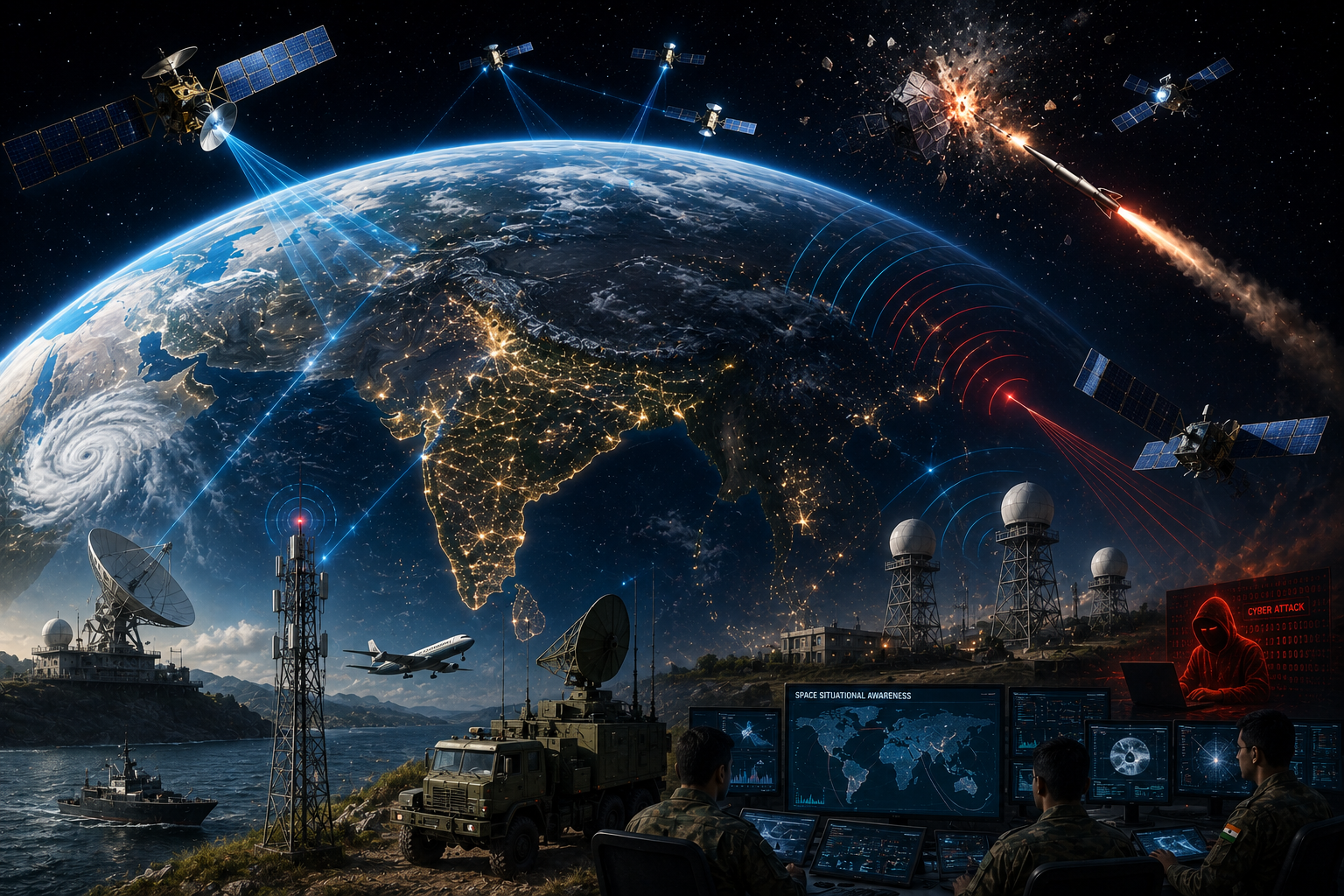
For centuries, human conflict was mapped across land, sea and air.
The 20th century added nuclear deterrence, missile systems, submarines and satellites. The 21st century is adding another domain of rivalry: outer space.
Space was once imagined as the final frontier of scientific progress. It carried the language of exploration, cooperation and human ambition. Astronauts became symbols of collective achievement. Satellites connected continents, monitored weather, guided navigation, enabled television, supported disaster relief and helped scientists observe Earth from above.
But the romance of space has always lived beside the reality of power.
The first space race itself was born out of Cold War rivalry. Rockets that launched satellites were cousins of missiles that could deliver warheads. Space exploration and military capability grew together. What is different today is the scale, density and strategic importance of space infrastructure.
Modern civilisation now depends on satellites. Banking, navigation, aviation, telecom, weather forecasting, television, logistics, agriculture, disaster management, military command, missile warning, intelligence gathering and internet connectivity all rely on orbital systems. The European Space Agency’s 2025 Space Environment Report says about 40,000 objects are tracked by space surveillance networks, including roughly 11,000 active payloads.
That number tells us something important: space is no longer empty.
It is crowded, commercial, strategic and increasingly contested.
When any domain becomes essential to national power, militarisation follows. That does not automatically mean weapons will be fired in space tomorrow. But it does mean that states are preparing to defend, disrupt, deceive, blind, jam or destroy the space assets of rivals if conflict demands it.
The risk is clear: humanity may be entering a new arms race, not over territory on Earth, but over the infrastructure orbiting above it.
Militarisation Is Not the Same as Weaponisation
To understand the danger, one distinction matters.
Space militarisation means the use of space systems for military purposes: surveillance, communications, navigation, missile warning, targeting, intelligence and command control.
Space weaponisation means placing or using weapons in, from or against space.
Militarisation has existed for decades. Satellites have long supported military operations. They help armies communicate, guide missiles, locate targets, monitor adversaries and detect launches. The modern battlefield is already space-enabled.
Weaponisation is more dangerous. It includes anti-satellite missiles, co-orbital systems, directed-energy weapons, cyberattacks against satellites, electronic jamming, dazzling sensors with lasers, and potentially the placement of weapons in orbit.
The problem is that the line between militarisation and weaponisation is becoming thinner.
A satellite that inspects another satellite may be a maintenance tool — or a co-orbital weapon. A cyber tool may defend a network — or disable an enemy satellite. A laser may track debris — or blind optical sensors. A commercial satellite constellation may provide internet — or battlefield communications. A space-based sensor may support missile defence — or strategic targeting.
In space, dual-use technology is not the exception. It is the rule.
This ambiguity makes crisis management dangerous. If one country moves a satellite near another country’s asset, is it inspection, espionage or attack preparation? If a satellite suddenly fails, was it technical malfunction, cyber sabotage or electronic warfare? If a laser illuminates a satellite, was it tracking or hostile interference?
On Earth, intentions can sometimes be read from troop movements. In space, the same manoeuvre may carry multiple meanings.
That is how miscalculation begins.
The Law Is Old; The Threats Are New
The foundation of space law remains the 1967 Outer Space Treaty.
The treaty prohibits states from placing nuclear weapons or other weapons of mass destruction in orbit, stationing them in outer space, or placing them on celestial bodies. It also requires that the Moon and other celestial bodies be used exclusively for peaceful purposes and forbids military bases, weapons testing and military manoeuvres on celestial bodies.
This was a major achievement of Cold War diplomacy. It prevented the most terrifying scenario: nuclear weapons stationed in orbit.
But the treaty has a serious gap.
It does not ban all military uses of space. It does not prohibit conventional anti-satellite weapons. It does not provide a strong verification system for many emerging threats. It was written before mega-constellations, cyber warfare, AI-enabled targeting, commercial satellite internet, rendezvous-and-proximity operations and modern counterspace technologies.
In other words, the treaty prevents some of the worst possibilities, but it does not govern the full reality of 21st-century space competition.
This is why countries keep talking about preventing an arms race in outer space, yet struggle to agree on binding rules. Everyone says space should remain peaceful. But each major power wants to preserve its own strategic options.
That is the central contradiction of space security.
No country wants vulnerability. But every country’s attempt to reduce vulnerability can make others feel less secure.
Anti-Satellite Weapons: The Most Visible Danger
Anti-satellite weapons are the most dramatic symbol of space militarisation.
An anti-satellite weapon, or ASAT, is designed to disable, damage or destroy satellites. Some are kinetic, meaning they physically collide with a satellite. Others may use cyber, electronic, laser or co-orbital methods to disrupt or degrade satellite functions.
The destructive kinetic ASAT test is especially dangerous because it creates debris.
In November 2021, Russia conducted a direct-ascent anti-satellite missile test against its own COSMOS 1408 satellite. US Space Command said the test generated more than 1,500 pieces of trackable orbital debris and likely hundreds of thousands of smaller pieces.
This matters because space debris does not politely disappear after a test. It keeps moving at extremely high speed. Even a small fragment can damage or destroy a satellite. A debris field can threaten astronauts, commercial satellites, scientific missions and national security assets.
The Secure World Foundation’s 2026 Global Counterspace Capabilities Report notes that counterspace testing by the United States, Russia, China and India has produced 6,904 cataloged pieces of debris, of which 2,773 remain in orbit.
That is the madness of destructive ASAT testing: a state may demonstrate strength for a few minutes and create risk for years.
The weapon proves capability. The debris punishes everyone.
India’s Mission Shakti and the Deterrence Logic
India entered the ASAT club in March 2019 with Mission Shakti.
The Indian government described Mission Shakti as the country’s first anti-satellite missile test, conducted on 27 March 2019 from Dr A.P.J. Abdul Kalam Island in Odisha, where a fast-moving Indian satellite in low Earth orbit was neutralised with precision.
For India, the logic was deterrence.
India’s space assets support communication, navigation, weather forecasting, earth observation, scientific work and defence. As China’s military-space capability grew and the space domain became more contested, India did not want to remain without a demonstrated counterspace capability.
This is the hard logic of security competition.
A country may say it does not want to fight in space, but it still wants adversaries to know that its satellites cannot be attacked without consequence. Demonstrated capability becomes a form of warning.
However, deterrence in space is more unstable than deterrence on Earth.
A nuclear attack is obvious. A satellite disruption may be ambiguous. A cyber intrusion may be deniable. A jamming incident may be temporary. A laser dazzling incident may not leave visible debris. A co-orbital satellite may look suspicious but not yet hostile.
If attribution is uncertain, deterrence becomes harder.
The attacker may believe it can act below the threshold of war. The defender may overreact because it cannot distinguish temporary interference from the start of a broader attack.
This makes space deterrence delicate, technical and dangerous.
The Ukraine War Changed the Space Debate
The war in Ukraine has shown how important space has become to modern conflict.
Commercial satellite imagery, communications and geolocation have played visible roles in battlefield awareness, public intelligence, drone operations and military coordination. The lesson is not that commercial space replaces military systems. The lesson is that commercial space has become part of the strategic environment.
This creates a new problem: civilian satellites may become military targets.
If a commercial satellite network supports battlefield communication, does it become a legitimate target in war? If a private satellite company provides imagery to one side, can the other side attack its systems? If commercial space infrastructure becomes integrated into national defence, can it still claim purely civilian status?
These questions are no longer theoretical.
Recent US defence procurement also shows how deeply space is being integrated into military architecture. In May 2026, Reuters reported that the US Space Force awarded SpaceX a $2.29 billion contract for a military space data network intended to link military sensors and weapons platforms, and another $4.16 billion contract for threat-detection satellites under the Space-Based Advanced Moving Target Indicator programme.
This is the future of warfare: sensors, satellites, data links, AI systems, interceptors, drones, missiles and command networks connected in near real time.
Space is no longer just supporting war from above. It is becoming the connective tissue of war itself.
The Debris Problem Is a Security Problem
Space debris is often discussed as an environmental issue. It is also a security issue.
A crowded orbital environment makes military and civilian operations more fragile. Satellites must perform more collision-avoidance manoeuvres. Operators must track more objects. The risk of accidental collision rises. Insurance costs increase. Strategic assets become more vulnerable.
The nightmare scenario is a cascading debris event, often associated with the Kessler Syndrome concept, where collisions create debris that triggers more collisions, making certain orbits increasingly hazardous.
This would not only affect space powers. It would affect everyone.
A developing country that depends on satellite weather data, GPS, banking systems or disaster monitoring would suffer even if it had no role in creating the debris. That is why destructive ASAT testing is not merely a national security issue. It is a global public-goods issue.
Space is a shared environment. Debris is shared damage.
This is why voluntary norms against destructive ASAT testing matter. In April 2022, the United States announced that it would not conduct destructive direct-ascent ASAT missile testing and sought to establish this as an international norm. Later in 2022, the UN General Assembly adopted a resolution on destructive direct-ascent anti-satellite missile testing, reflecting growing international concern over debris-generating tests.
These steps are useful, but incomplete.
A voluntary pledge is not a treaty. A norm is not enforcement. A resolution is not verification. And ASAT threats are not limited to direct-ascent missiles.
The world needs stronger rules, but great powers do not yet trust each other enough to accept them.
The Nuclear Shadow Over Space
The most alarming possibility is the return of nuclear fears in space.
The Outer Space Treaty already prohibits nuclear weapons and other weapons of mass destruction in orbit. But recent concerns about possible Russian development of a nuclear anti-satellite capability reopened one of the darkest questions in space security.
In 2024, the United States accused Russia of developing a troubling anti-satellite capability, while Russia denied hostile intent. Reuters reported that the US believed Russia was developing a space-based anti-satellite nuclear weapon whose detonation could disrupt systems ranging from military communications to civilian services.
Russia later vetoed a UN Security Council resolution backed by the United States and Japan that would have reaffirmed the treaty obligation against placing nuclear weapons in orbit and called on states not to develop nuclear weapons specifically designed for orbit.
This episode matters even if the full intelligence remains classified.
A nuclear detonation in space would not look like a normal battlefield strike. It could generate electromagnetic effects and radiation impacts that damage many satellites indiscriminately. It would not simply target one enemy asset. It could damage the orbital environment on which the world depends.
That is why nuclear weapons in space are not just another military escalation. They are a civilisation-level threat to the space infrastructure of modern life.
The Rise of Counterspace Capabilities
Counterspace capability does not only mean blowing up satellites.
States can attack satellites in many ways. They can jam satellite communications. They can spoof navigation signals. They can dazzle or blind optical sensors. They can launch cyberattacks against ground stations. They can interfere with command links. They can use co-orbital satellites to approach, inspect, grab or disable other satellites. They can attack the ground infrastructure that controls space assets.
These methods are attractive because many are reversible, deniable or below the threshold of open war.
A missile strike creates debris and political outrage. Jamming may be temporary. Cyberattack may be difficult to attribute. Laser dazzling may be hard to prove. A suspicious satellite manoeuvre may be explained as inspection or servicing.
This is why the future space arms race may not look like the nuclear arms race.
It may not be built only around visible weapons. It may be built around hidden capabilities, software access, electronic warfare, cyber intrusion, proximity operations, AI-enabled space tracking and rapid replacement constellations.
The danger is that the threshold for use may become lower.
A state may hesitate before destroying a satellite. It may not hesitate to jam, blind, spoof or hack one.
Commercial Space Complicates Security
The commercialisation of space makes the problem even more complex.
Private companies now launch satellites, build constellations, provide communications, sell earth observation data, manage launch services and support national security missions. This has increased innovation and reduced costs. It has also blurred the line between public and private infrastructure.
A privately owned satellite can serve civilian users, businesses, humanitarian agencies and militaries at the same time.
If war comes, adversaries may not treat that satellite as neutral.
This raises legal, ethical and strategic questions. Should commercial satellites supporting military operations be protected as civilian assets? Should governments be responsible for defending private constellations? Can private companies refuse military use in wartime? Can they become targets if they support one side?
The old space governance model assumed states were the primary actors. The new space economy includes powerful private actors whose decisions may affect war and diplomacy.
Space law has not fully caught up.
Space Militarisation and Great-Power Rivalry
The space arms race is being driven by great-power rivalry.
The United States depends heavily on satellites for military superiority. China has invested deeply in space systems, counterspace capabilities and satellite navigation. Russia has long-standing military-space expertise and has demonstrated destructive ASAT capability. India is building deterrent capacity while expanding its civilian and defence space programmes. Europe, Japan, France, Israel and others are also strengthening space security policies.
This is not accidental.
A military that loses access to space becomes weaker. It loses precision, timing, communication, surveillance and battlefield awareness. Modern military power is built on information. Space provides that information.
Therefore, any major power planning for war must also plan for conflict in space.
This does not mean war in space is inevitable. It means space will be part of any serious military contingency. A crisis over Taiwan, Ukraine, the Indo-Pacific, the Korean Peninsula or another flashpoint could quickly involve satellite jamming, cyberattacks or counterspace signalling.
The danger is escalation.
If one side attacks satellites that support nuclear command-and-control or missile warning systems, the other side may interpret it as preparation for a larger attack. Space escalation can therefore become nuclear escalation.
This is the most serious risk.
India’s Space Security Challenge
India’s space security challenge is unusually complex.
India is a rising space power with major civilian achievements, including lunar exploration, Mars missions, navigation systems, earth observation and commercial launch capabilities. It is also a country with two nuclear-armed neighbours, one of which — China — is a major space and counterspace power.
India cannot ignore military space capability.
Its satellites support communications, weather, surveillance, navigation, border management, disaster response and military operations. In a crisis, adversaries may try to jam or disable these systems. India therefore needs resilience, redundancy and deterrence.
But India must avoid a reckless arms race.
The correct strategy is not to chase every possible space weapon. The correct strategy is to build survivable and resilient space architecture: distributed satellites, rapid launch capability, hardened ground stations, cyber protection, electronic warfare defence, space situational awareness, trusted supply chains, domestic satellite manufacturing and clear doctrines.
India needs to know what is happening in space. It needs to protect what it owns. It needs to deter attacks. And it needs to support international norms that reduce debris and reckless behaviour.
A responsible space power must combine capability with restraint.
Space Situational Awareness: The Foundation of Security
No country can protect its space assets if it cannot see what is happening around them.
Space situational awareness means tracking satellites, debris, manoeuvres, conjunction risks and possible threats. It is the foundation of space security.
Without good tracking, a country may not know whether a satellite failure was caused by debris, malfunction, cyberattack, jamming or hostile proximity. Without tracking, collision risks rise. Without tracking, deterrence weakens because attribution becomes uncertain.
For India, space situational awareness should be a national priority. It requires radars, telescopes, data-sharing agreements, analytics, AI-assisted tracking, military-civilian coordination and international partnerships.
This is not glamorous, but it is essential.
A country that cannot observe space cannot defend itself in space.
Why Arms Control Is So Difficult
Everyone agrees that space conflict would be dangerous. Yet arms control remains difficult.
There are several reasons.
First, verification is hard. Many space technologies are dual-use. A satellite designed for repair can also be used for interference. A laser designed for tracking may have military applications. A cyber capability may be hidden.
Second, definitions are contested. What counts as a space weapon? Is a ground-based missile a space weapon if it targets satellites? Is a satellite with a robotic arm a weapon? Is jamming a weapon? Is cyber interference a space attack?
Third, trust is low. The United States, China and Russia do not trust each other’s intentions. India must consider China. Smaller countries worry about being ignored by major powers.
Fourth, military dependence on space is increasing. As countries rely more on satellites, they become more reluctant to accept constraints that might limit defence options.
Fifth, commercial systems complicate classification. A private satellite can have military value without being a military satellite.
This does not mean arms control is impossible. It means the world may need a layered approach: norms, transparency measures, debris-mitigation rules, crisis communication channels, ASAT testing moratoriums, space-traffic coordination, cyber norms and eventually binding agreements.
The perfect treaty may not arrive soon. But practical restraint can still reduce risk.
The Moral Problem of Fighting in a Shared Domain
Space conflict has a unique moral problem.
If a country destroys a satellite and creates debris, the harm does not remain between the attacker and the victim. Debris can threaten satellites belonging to neutral countries, scientific missions, astronauts and commercial operators. It can damage services used by ordinary people far from the conflict.
That means space war can injure the global commons.
This is similar to polluting the high seas or damaging the atmosphere. The consequences spread beyond national boundaries.
A responsible state must therefore ask not only, “Can we do this?” but “What will this do to the orbital environment everyone needs?”
The weaponisation of space is dangerous because it turns a shared domain into a battlefield without clear boundaries.
What the World Must Do
The world needs a realistic space-security agenda.
First, countries should strengthen the norm against destructive kinetic ASAT testing. This is the easiest and most urgent step because debris-generating tests harm all space users.
Second, states should improve transparency around satellite manoeuvres, especially close approaches to other satellites.
Third, countries need crisis communication channels for space incidents, similar to military hotlines on Earth.
Fourth, space-traffic management must be strengthened as orbital congestion grows.
Fifth, cyber protection of space infrastructure must become a priority, including ground stations, command links and supply chains.
Sixth, international law must evolve to address dual-use systems, commercial satellites and non-kinetic attacks.
Seventh, emerging space powers, including India, should be central to rule-making. Space governance cannot be written only by older superpowers.
Eighth, countries must separate legitimate military use of space from reckless actions that create long-term environmental harm.
The goal should not be the demilitarisation of space. That is unrealistic. The goal should be the prevention of uncontrolled weaponisation and debris-generating conflict.
Conclusion: The Next Arms Race May Orbit Above Us
Space militarisation is not a future possibility. It is already here.
Satellites support modern armies. Governments build counterspace capabilities. Commercial constellations are becoming strategic infrastructure. Missile defence and threat-detection systems increasingly look upward. Cyber and electronic warfare extend into orbital systems. ASAT tests have already shown how quickly one act of military signalling can create long-term debris.
The danger is not only that countries may fight in space.
The danger is that they may make space unusable while trying to dominate it.
A space arms race would be different from earlier arms races. It would unfold in an environment where debris lasts, attribution is difficult, civilian and military systems overlap, and the same satellites may serve both war and daily life.
The consequences would not remain in orbit. They would fall back into human society as disrupted communication, broken navigation, weaker disaster forecasting, financial instability, military escalation and greater insecurity.
Humanity has already made one wise decision: it banned nuclear weapons of mass destruction from orbit. But that is not enough for the age of satellites, cyber operations, ASAT systems and mega-constellations.
The world does not need to choose between using space and protecting space. It must do both.
For India and other rising powers, the path is clear: build capability, protect assets, strengthen deterrence, but support rules that prevent reckless weaponisation. A country can be strong in space without being irresponsible in space.
The final frontier should not become the next battlefield by accident.
Because if war reaches space without restraint, the damage will not remain above us.
It will return to Earth through every system we have taught ourselves to depend on.