Quantum technology sounds distant until one understands what it threatens. It could break today’s encryption, transform sensing, secure communication, improve simulation, accelerate materials research and reshape intelligence gathering. The security consequences are enormous. Quantum is not just another scientific frontier. It is a potential reordering of the foundations of cyber security, defence, finance and strategic stability.
The danger is not that quantum computers will suddenly appear tomorrow and destroy the internet. The danger is more subtle. Sensitive data intercepted today may be stored and decrypted later when quantum capabilities mature. Military communications, diplomatic cables, financial records, health databases and intellectual property may already be targets for “harvest now, decrypt later” strategies. That means the quantum security problem exists before the quantum computer is fully ready.
Why This Matters Now
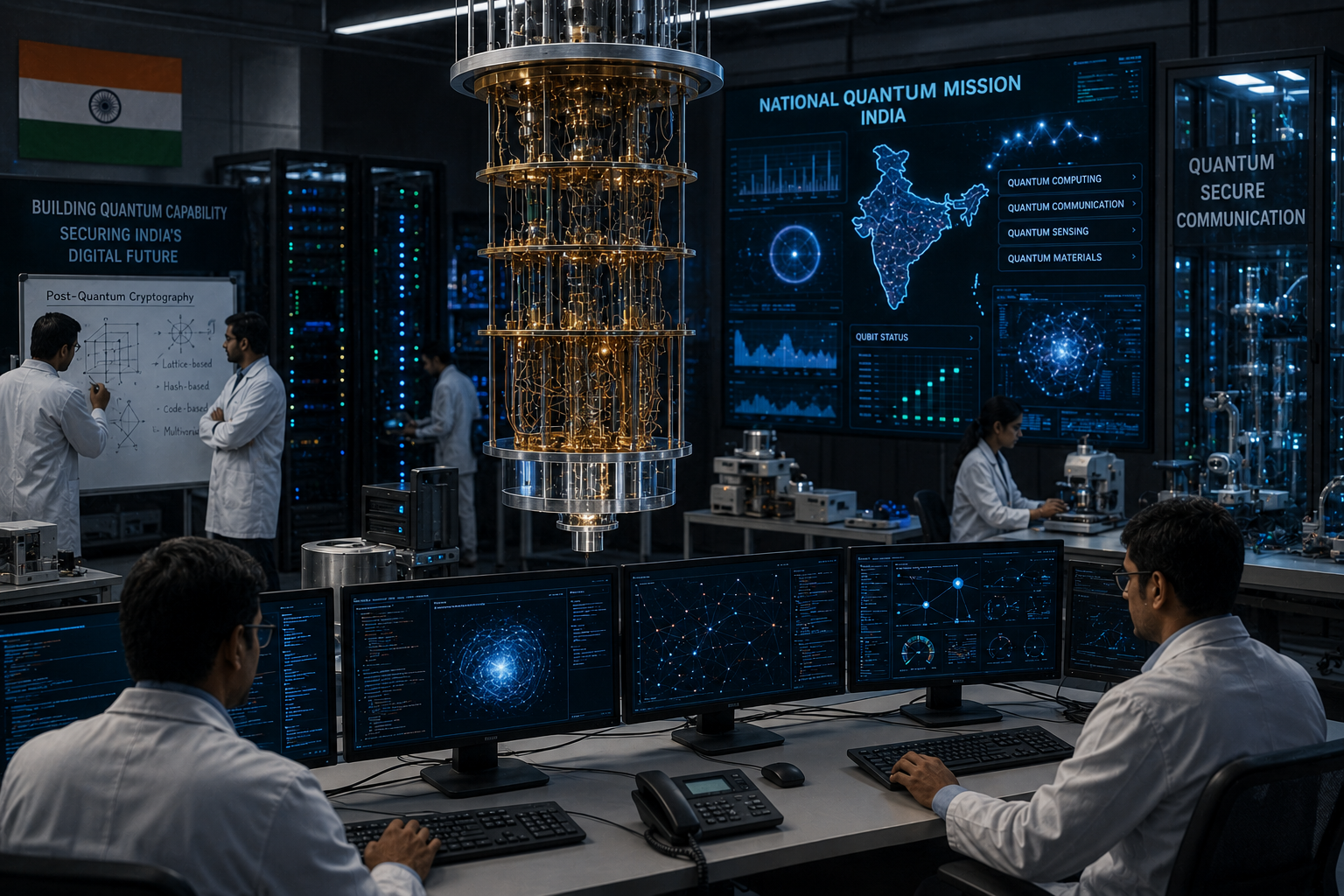
Governments are preparing. The United States National Institute of Standards and Technology released finalized post-quantum encryption standards in 2024. India approved the National Quantum Mission with a budget of ₹6,003.65 crore for 2023-24 to 2030-31. The mission aims to build a quantum technology ecosystem across computing, communication, sensing and materials. Other major powers are investing heavily too.
This matters because quantum technology is dual-use by nature. The same scientific advances that improve medicine or materials can also strengthen surveillance, code-breaking or military sensing. The same quantum communication tools that secure networks can create new forms of strategic competition. The countries that move early will set standards, train talent and capture patents.
Historical Roots
Security has always depended on information advantage. From codebooks to radar, satellites and cyber tools, states have pursued technologies that reveal adversaries while protecting their own secrets. Quantum continues this tradition but at a deeper physical level. It exploits properties of matter and information that classical systems cannot easily replicate.
The first quantum revolution gave the world semiconductors, lasers and modern electronics. The second quantum revolution aims to control quantum states directly. That opens possibilities in computing, sensing, communication and simulation. The difficulty is technical: quantum systems are fragile, error-prone and expensive. But even partial breakthroughs can matter strategically.
The First Dimension: Cryptography
The most discussed quantum threat is to public-key cryptography. Much of today’s secure communication depends on mathematical problems that classical computers find hard. A sufficiently powerful quantum computer could weaken or break widely used systems. This would affect banking, government communications, digital signatures, military networks and critical infrastructure.
The response is post-quantum cryptography: new algorithms designed to resist quantum attacks. Migration will take years because cryptography is embedded everywhere. Hardware, software, certificates, protocols and legacy systems must be updated. The challenge is not only invention but implementation. A country that delays migration may expose decades of sensitive data.
The Second Dimension: Sensing and Defence
Quantum sensing may transform submarines, navigation, mineral exploration, missile detection and intelligence. More precise sensors could reduce the stealth advantage of submarines or improve navigation where GPS is denied. Quantum clocks could strengthen timing systems essential to finance, telecom and military operations.
These capabilities could destabilize existing doctrines. If submarines become easier to detect, nuclear deterrence could be affected. If navigation becomes less dependent on satellites, militaries gain resilience. If sensing improves battlefield awareness, surprise becomes harder. Quantum security is therefore not only about cyber systems; it may affect military balance.
The Third Dimension: Communication
Quantum communication, including quantum key distribution, promises secure exchange of keys under specific conditions. But it is not a magic solution. Agencies such as the US National Security Agency have expressed caution about QKD for national security systems, emphasizing post-quantum cryptography as more practical for broad deployment. This debate shows that quantum policy must avoid hype.
Countries must distinguish between laboratory demonstrations and scalable security. Some quantum systems may be useful for niche applications, while others may not be cost-effective. Strategic policy should be ambitious but technically sober.
India Angle
India’s National Quantum Mission is an important step because it recognizes that quantum cannot be left entirely to foreign ecosystems. India has scientific talent, but it needs laboratories, fabrication facilities, industry participation, standards work, procurement pathways and patient funding. The mission’s success will depend on whether research becomes usable technology.
India should prioritize quantum-safe security for government, defence, banking, telecom and critical infrastructure. It should begin cryptographic inventory: what systems use vulnerable algorithms, what data must remain confidential for decades, and what migration timelines are realistic. The country should also invest in quantum education and interdisciplinary talent because quantum sits between physics, computer science, engineering and cybersecurity.
India’s opportunity is not only defensive. Quantum sensing, materials research and simulation can support energy, pharma, agriculture, logistics and defence. If India builds capability early, it can avoid becoming merely a buyer of quantum products later.
Global Implications
Quantum technology could create a new hierarchy of security. Countries with advanced quantum capability may gain intelligence advantages. Those without quantum-safe systems may become vulnerable. Alliances may include quantum cooperation. Export controls may emerge around quantum hardware, cryogenic systems, photonics and specialized software.
The technology could also complicate arms control. Unlike nuclear weapons, quantum capabilities are not easily visible. A breakthrough may occur in a lab or company, not a missile silo. Verification will be hard. Strategic mistrust may grow if states believe rivals are secretly gaining code-breaking capability.
Counter-View
The strongest counter-view is that quantum hype exceeds reality. Useful, fault-tolerant quantum computers remain technically difficult. Many claims are speculative. Governments may waste money chasing prestige. Some quantum communication solutions may be less practical than improved classical security.
This warning is valuable. But underpreparation is also dangerous. Security migration takes time. Even if a cryptographically relevant quantum computer arrives later than feared, governments must prepare now because sensitive data has long shelf life. The right approach is neither panic nor complacency. It is disciplined preparation.
What Happens Next
The next phase will involve post-quantum migration, standards adoption, quantum testbeds, talent competition, export controls and defence applications. Countries will audit cryptographic systems, fund research hubs and create quantum industry clusters. Private firms will sell both real solutions and exaggerated promises. Policymakers must develop technical literacy to separate them.
India should build a national quantum security roadmap. It should align the National Quantum Mission with cybersecurity agencies, defence planners, financial regulators and telecom authorities. Quantum cannot remain confined to science departments. It is a national security agenda.
Editorial Insight
Quantum technology could reshape security because it attacks the hidden assumptions of the digital world. Today’s systems assume certain problems are too hard to solve. Quantum asks what happens if that assumption fails. The future of security will belong to countries that protect secrets before they are broken, build talent before the market matures, and treat quantum not as science fiction but as strategic infrastructure.
Source References for Verification
- https://aiindex.stanford.edu
- https://www.itu.int
- https://www.wipo.int
- US Bureau of Industry and Security: Advanced computing and semiconductor export controls - https://www.bis.gov/press-release/bis-updated-public-information-page-export-controls-imposed-advanced-computing-semiconductor
- US BIS: 2023 advanced computing restrictions update - https://www.bis.gov/press-release/commerce-strengthens-restrictions-advanced-computing-semiconductors-semiconductor-manufacturing-equipment
- India Semiconductor Mission 2.0, PIB - https://www.pib.gov.in/PressReleasePage.aspx?PRID=2224839&lang=1®=3
- ITU IMT-2030 / 6G Framework - https://www.itu.int/en/mediacentre/Pages/PR-2023-12-01-IMT-2030-for-6G-mobile-technologies.aspx
- UNCTAD Digital Economy Report 2024 - https://unctad.org/publication/digital-economy-report-2024
- DST National Quantum Mission - https://dst.gov.in/national-quantum-mission-nqm
- NIST Post-Quantum Encryption Standards - https://www.nist.gov/news-events/news/2024/08/nist-releases-first-3-finalized-post-quantum-encryption-standards