The first Cold War was fought through nuclear weapons, military alliances, proxy wars, ideology, espionage, space races and economic blocs.
The next Cold War may be quieter, but not softer.
It may not begin with tanks crossing borders or missiles placed near capitals. It may begin with export controls on chips, restrictions on artificial intelligence models, bans on telecom vendors, disputes over data flows, competing digital payment systems, cloud dependency, software sanctions, algorithmic influence operations and rival technology standards.
The old Cold War asked: who controls territory, ideology and nuclear deterrence?
The new cold war asks: who controls computation, data and intelligence?
That is the central transformation of global power. Nations are no longer competing only for land, oil, ports, military bases or trade routes. They are competing for the foundational technologies that decide how economies function, how societies communicate, how weapons are guided, how citizens are profiled, how markets are predicted and how states govern.
In this new world, chips are not just industrial components. They are strategic fuel.
Data is not just information. It is behavioural raw material.
Algorithms are not just software instructions. They are systems of influence, classification, prediction and control.
A country that controls advanced chips controls the speed of artificial intelligence. A country that controls data controls the training material of digital intelligence. A country that controls algorithms controls what people see, buy, believe, fear and desire.
This is why the next Cold War may not look like the last one. It may be fought less through walls and more through platforms. Less through occupied territory and more through dependency. Less through formal empire and more through technological lock-in.
The battlefield will be invisible to many citizens, but its consequences will shape everything.
The New Strategic Triad
The 20th-century strategic triad was nuclear: land-based missiles, submarines and strategic bombers.
The 21st-century strategic triad may be technological: chips, data and algorithms.
Chips provide compute. Without advanced chips, artificial intelligence slows, defence systems weaken, cloud infrastructure struggles and high-performance scientific research becomes limited. Data provides the raw material. Without data, AI systems cannot learn patterns, platforms cannot predict behaviour and states cannot build advanced digital governance tools. Algorithms convert compute and data into power. They classify, recommend, decide, target, rank, optimise and automate.
Together, these three elements form the infrastructure of modern intelligence.
This is why technology competition has moved from the commercial sphere into national security rooms. A semiconductor export rule is no longer only a trade regulation. A data protection law is no longer only a privacy measure. An AI model is no longer only a product. A cloud platform is no longer only business infrastructure.
They are now strategic assets.
The United States’ advanced semiconductor export controls targeting China show this clearly. The US Bureau of Industry and Security says its October 2022 controls were designed to restrict China’s ability to purchase and manufacture high-end semiconductors critical for military applications, with further updates in 2023, 2024 and beyond.
That sentence explains the new world: military capability now depends on commercial technology supply chains.
Chips: The Oil of the AI Age
Oil powered the industrial and military machines of the 20th century. Chips power the digital and artificial intelligence systems of the 21st.
Every advanced economy runs on semiconductors. They are inside phones, cars, satellites, missiles, medical devices, telecom networks, banking systems, drones, cloud servers and AI data centres. But the most advanced chips are difficult to design, manufacture and scale. Their supply chain is concentrated, expensive and geopolitically exposed.
This is why chips have become instruments of strategic pressure.
A country can have money and ambition, but if it cannot access advanced processors, lithography tools, design software, high-bandwidth memory or manufacturing equipment, its technological progress can be delayed. That delay matters. In artificial intelligence, defence systems and high-performance computing, a five-year lag can become a strategic disadvantage.
The chip war is therefore not only about today’s devices. It is about tomorrow’s capability.
The United States does not restrict advanced chips merely because they are commercially valuable. It restricts them because advanced compute can support military modernisation, surveillance systems, AI research, cyber operations and autonomous weapons. The December 2024 BIS rules expanded controls on semiconductor manufacturing equipment and advanced computing items, showing that Washington sees chip access as a core strategic lever.
This is the logic of technological denial: do not simply compete with a rival; slow the rival’s ability to build the future.
The latest tightening of this approach is even more revealing. On May 31, 2026, the US Commerce Department issued guidance aimed at preventing Chinese-headquartered companies from obtaining advanced AI chips through subsidiaries outside China, after concerns that chips could be accessed through third-country routes.
That is not ordinary trade policy. It is technological containment.
Data: The Territory No One Can See
If chips are the fuel, data is the territory.
Traditional empires wanted land because land produced crops, minerals, labour and taxes. Digital powers want data because data produces prediction, personalisation, surveillance, advertising revenue, AI training material and behavioural control.
Every search query, purchase, payment, location ping, social media interaction, biometric scan, medical record, classroom platform, transport pattern and video view becomes part of a larger data economy. The more people live digitally, the more their lives produce machine-readable traces.
This has created a new form of geopolitical inequality.
Developing countries may generate enormous quantities of data, but the platforms, cloud systems and AI models that extract value from that data are often owned elsewhere. The citizen creates the raw material. The foreign platform refines it. The AI model learns from it. The profits, patents and power often accumulate outside the society that generated it.
This is why data sovereignty has become a serious political issue.
The contest is not simply about privacy. It is about who has the right to collect, store, process, monetise and transfer the behavioural material of a population. A country that cannot govern its data cannot fully govern its digital economy.
UNCTAD’s Digital Economy Report 2024 warns that digital technology and infrastructure depend heavily on raw materials and that growing device production, disposal, energy use and water needs are placing increasing pressure on the planet. This matters because the digital economy is not weightless. Data centres, devices and AI systems have physical supply chains, energy demands and environmental costs.
The new Cold War will therefore not be fought only over abstract information. It will be fought over data centres, submarine cables, cloud regions, rare minerals, electricity, water, chips and servers.
Digital power has a physical body.
Algorithms: The New Instruments of Influence
Algorithms are the most subtle part of the new strategic order.
A chip can be counted. A data centre can be located. A law can regulate cross-border data transfer. But an algorithm can shape society invisibly.
Algorithms decide what content is recommended, which product appears first, whose loan application is flagged, which job profile is ranked, which political video goes viral, which news story is amplified, which user is considered risky, which student needs intervention and which neighbourhood deserves policing attention.
This is power without a uniform.
The old Cold War used radio broadcasts, newspapers, cultural diplomacy, propaganda and intelligence networks to influence societies. The new cold war can use recommendation systems, bots, deepfakes, search rankings, targeted advertising, synthetic media and AI-generated persuasion.
The danger is not only misinformation. The deeper danger is behavioural architecture.
When platforms shape attention, they shape politics. When algorithms optimise outrage, they reshape public debate. When AI systems generate persuasive narratives at scale, propaganda becomes cheaper. When deepfakes make evidence uncertain, truth itself becomes easier to attack.
This is why AI regulation has become a geopolitical contest. The European Union’s AI Act entered into force on 1 August 2024 and aims to regulate AI development and deployment through a risk-based framework.
Europe is trying to govern AI through rights and regulation. The United States has leaned more heavily on innovation and market leadership. China’s model places stronger emphasis on state control and information governance. India is searching for a middle path between innovation, inclusion, sovereignty and citizen protection.
These are not merely regulatory differences. They are political visions of machine intelligence.
The Return of Blocs
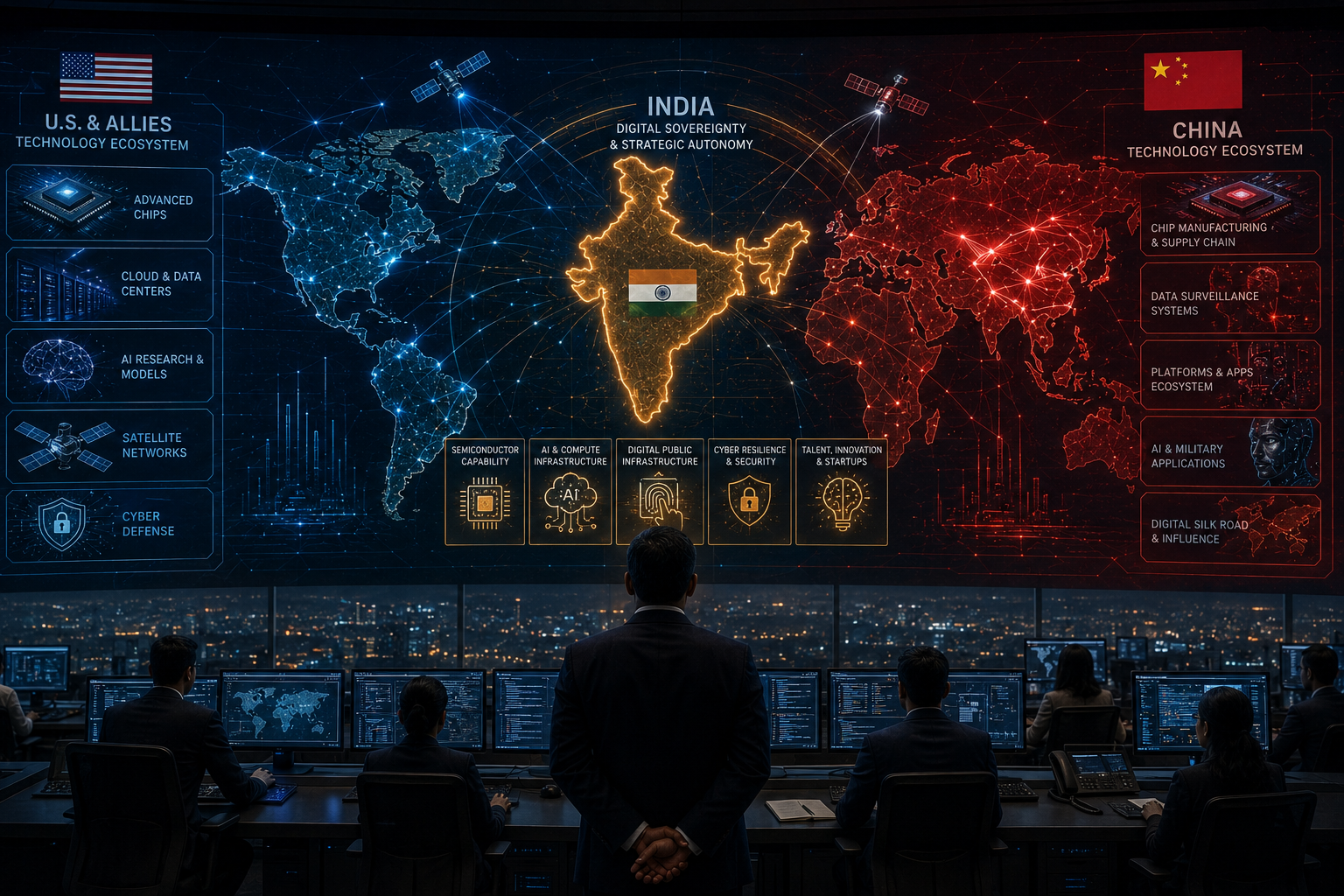
The first Cold War divided the world into rival political and military blocs. The next cold war may divide the world into digital blocs.
One bloc may use American cloud platforms, Western AI tools, US-designed chips, European-style regulation and allied telecom networks. Another may use Chinese platforms, Chinese telecom equipment, Chinese digital payment systems, state-supervised AI and alternative standards. A third group of countries may try to avoid full alignment, using technology from multiple sources while seeking strategic autonomy.
This is already visible in fragmented debates over 5G vendors, semiconductor export controls, AI governance, data localisation, app bans, cloud sovereignty and digital trade.
The IMF has warned that geopolitical fragmentation can reshape trade patterns, with trade between rival blocs historically weaker than trade within blocs during the original Cold War. That warning applies powerfully to technology, where trust and supply-chain security increasingly influence commercial flows.
Technology blocs will not be as neat as military alliances. A country may buy weapons from one partner, cloud services from another, chips from a third and telecom equipment from a fourth. But the direction is clear: the open global technology market is becoming more political, more conditional and more suspicious.
The question every country must answer is no longer only: “Which technology is best?”
It is: “Which technology can we trust when politics turns hostile?”
The Cold War Without One Wall
The old Cold War had symbols: the Berlin Wall, NATO, the Warsaw Pact, nuclear missiles, ideological speeches and proxy battlefields.
The new cold war may not have one wall. It will have many invisible walls.
An export-control wall will restrict advanced chips.
A data wall will limit cross-border transfers.
A platform wall will separate information ecosystems.
A payment wall may divide financial rails.
A cloud wall may determine where computation happens.
A standards wall may decide whose technology becomes globally compatible.
A model wall may restrict access to frontier AI systems.
A talent wall may limit movement of engineers, researchers and scientists.
These walls will not always be physical, but they will be real. They will shape who can innovate, who can compete, who can access compute, who can train AI models and who remains dependent.
The next Cold War may therefore be less dramatic but more pervasive. It will enter universities, startups, telecom networks, app stores, research labs, corporate procurement departments, customs offices, chip foundries and cloud contracts.
It will not always announce itself as war.
Sometimes it will arrive as a compliance requirement.
The Corporate Statecraft Problem
One major difference between the old Cold War and the new one is the role of corporations.
In the old Cold War, states were the principal actors. Corporations mattered, but nuclear weapons, ideology, diplomacy and military alliances were controlled by governments.
Today, many strategic technologies are controlled by private firms.
A chip designer, cloud provider, satellite internet company, social media platform, AI lab, operating system owner, app store or cybersecurity company can shape geopolitical outcomes. A private company can decide whether a government gets access to cloud compute. A platform can decide whether political content is amplified or suppressed. A satellite firm can decide whether connectivity remains active in a war zone. An AI company can decide which countries can access its models.
This creates a strange new reality: private companies now perform functions that resemble statecraft.
But corporations are not democratically accountable in the same way governments are. They answer to shareholders, executives, regulators, customers and sometimes public pressure. Their decisions may affect national security, elections, wars and diplomatic crises, but their governance remains private.
This creates a tension that every major state is trying to manage.
Governments need private innovation. But they also fear private technological power. They want AI companies to move fast, but not recklessly. They want chip firms to sell globally, but not to rivals. They want platforms to moderate content, but not censor politically. They want cloud providers to scale, but also serve national security priorities.
The new Cold War will therefore be fought not only between states, but inside the relationship between states and their own technology companies.
India’s Position: Strategic Autonomy in a Digital Cold War
India cannot afford to be passive in this new order.
It is too large to be a mere technology market. It is too exposed to ignore supply-chain risks. It is too ambitious to remain dependent on imported digital infrastructure. It is too democratic to adopt a pure state-control model. It is too developmental to accept expensive digital exclusion. It is too geopolitically important to avoid pressure from rival blocs.
India’s challenge is to build digital strategic autonomy.
That does not mean isolation. India cannot build every chip, every cloud system, every AI model and every software layer alone. No country can. Strategic autonomy means the ability to choose, negotiate, substitute and protect critical interests.
India must partner with the United States, Europe, Japan, Taiwan, South Korea and others in semiconductors, AI, quantum technology, cyber security and supply chains. But it must also build domestic capability so that partnership does not become dependency.
The semiconductor mission, digital public infrastructure, IndiaAI efforts, data protection law, 5G rollout, 6G ambitions, NavIC, space ecosystem and cybersecurity policy are all parts of the same strategic puzzle.
They are not separate policy files.
They are India’s answer to the technological cold war.
Why India Cannot Be Only a Consumer
India has often been celebrated as a digital adoption success story. That is true, but not sufficient.
A billion users do not automatically create sovereignty. A large app market does not automatically create technological power. A strong IT services sector does not automatically create control over chips, cloud, AI models, operating systems or platforms.
India must move from digital consumption to digital production.
It must design chips, not only import them.
It must build AI models in Indian languages, not only use foreign models.
It must create cloud and compute capacity, not only rent it.
It must govern data, not merely generate it.
It must shape standards, not merely adopt them.
It must build cybersecurity tools, not only buy them.
It must create global digital products, not only provide backend services.
This is the central test of India’s technological decade.
A country may have millions of engineers and still remain dependent if the commanding layers of technology are controlled elsewhere. Human talent must be converted into institutions, intellectual property, manufacturing capability, research ecosystems and sovereign infrastructure.
The Risk for Developing Nations
For many developing countries, the next Cold War may be especially dangerous.
They may be forced to choose between technology ecosystems before they have built their own. They may be offered cheap infrastructure with hidden dependencies. They may be pressured to align with one bloc’s cybersecurity rules, AI systems, telecom vendors or data standards. They may become sites of digital extraction rather than digital empowerment.
The danger is a new dependency trap.
In the old global economy, poorer countries supplied raw materials and consumed finished goods. In the new digital economy, they may supply data and consume finished intelligence.
Their citizens generate data. Foreign companies train models. Foreign platforms control distribution. Foreign clouds store information. Foreign algorithms shape behaviour. Foreign regulators write rules that become global defaults.
That is not full sovereignty.
This is why digital public infrastructure, local AI ecosystems, open-source tools, regional data governance, public cloud options and technology education matter for the Global South.
The choice is not between rejecting global technology and surrendering to it. The choice is between dependent adoption and sovereign adoption.
The Algorithmic Arms Race
The AI race is not only about who builds the largest model. It is about who integrates algorithms into state and economic systems most effectively.
AI can improve logistics, medicine, education, tax administration, defence analysis, cyber security, disaster response, weather prediction, fraud detection and scientific research. It can also support surveillance, propaganda, automated discrimination, cyberattacks, military targeting and social control.
This dual-use nature makes AI central to the next Cold War.
A country with stronger AI systems may have better intelligence analysis, faster weapons development, more efficient manufacturing, stronger cyber defence and more persuasive information operations. A country without AI capability may become slower, more dependent and more vulnerable.
But AI also creates internal political risks.
If democratic states use AI without accountability, they may damage civil liberties. If authoritarian states use AI effectively, they may strengthen surveillance and social control. If corporations control AI infrastructure, public governance may become dependent on private systems. If open models spread without safeguards, misuse may become harder to control.
The algorithmic arms race is therefore not only between countries. It is also between liberty and control.
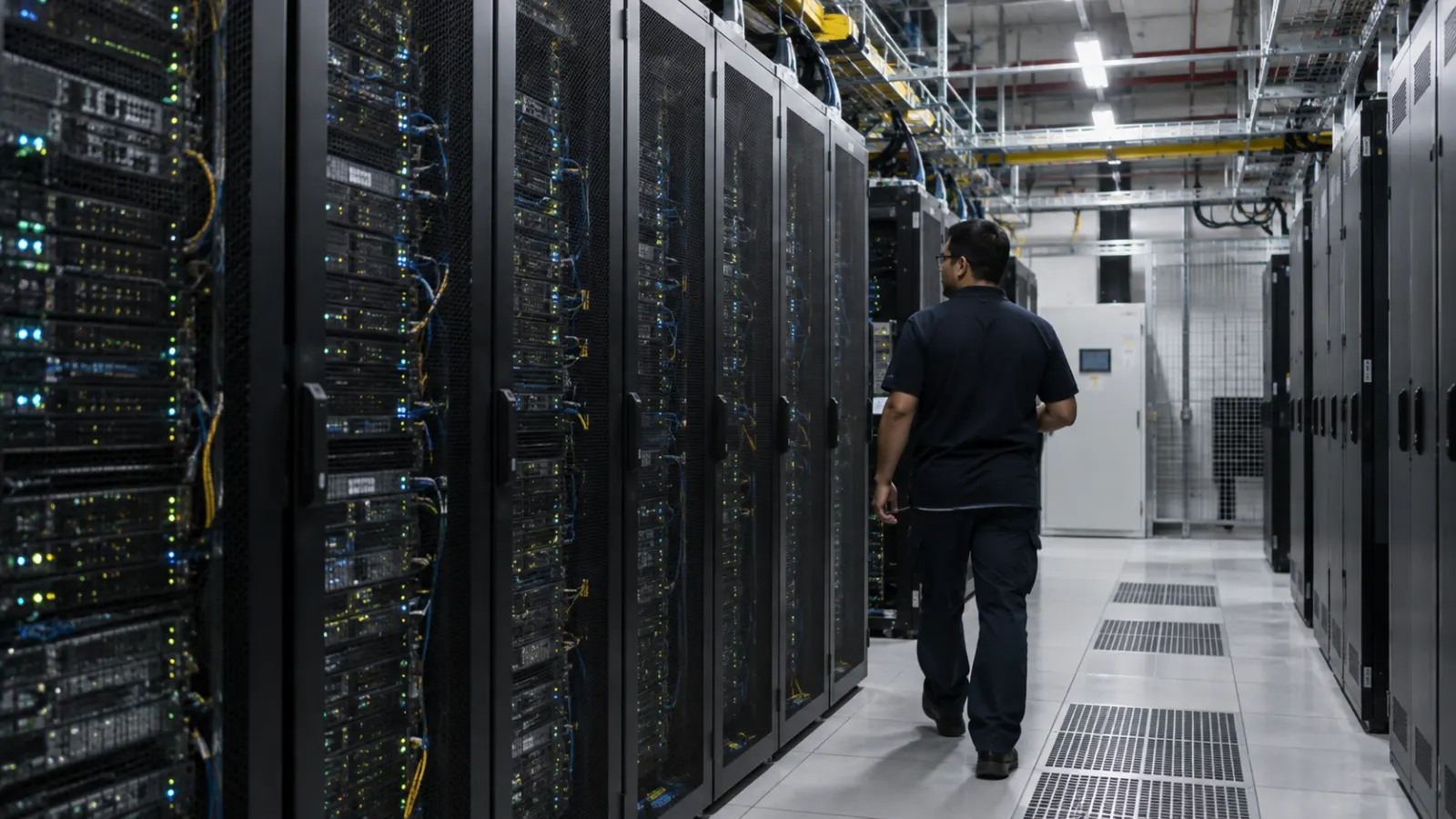
The Data Centre as a Strategic Facility
In the old Cold War, military bases were obvious strategic sites. In the new cold war, data centres are strategic facilities.
A data centre contains compute, storage, networking and cloud infrastructure. It can host government systems, AI training workloads, banking operations, commercial platforms, surveillance systems, defence applications and emergency services. It requires electricity, cooling, land, water, chips, fibre connectivity and physical security.
This makes data centres part of national infrastructure.
Countries that host major cloud and AI compute capacity gain economic and strategic advantage. Countries without compute capacity must depend on external providers for AI development, cloud services and digital resilience.
This dependence can become dangerous. If access is restricted, prices rise, sanctions apply or foreign policy changes, a country’s digital capacity can be affected. A startup ecosystem without affordable compute cannot compete in AI. A government without sovereign cloud options may expose sensitive data. A defence system dependent on external infrastructure may carry unacceptable risk.
The future of sovereignty will therefore include questions that sound technical but are deeply political: Where is the data stored? Who owns the server? Which chips are inside? Who controls the cloud management layer? Which law governs access? Can the service be switched off?
The answer to these questions will define power.
Standards: The Quiet Battlefield
Technology standards are one of the quietest battlefields of the next Cold War.
Standards decide how systems connect. They shape telecom networks, AI governance, cybersecurity protocols, satellite communication, data exchange, digital identity, payment systems, quantum security and semiconductor interfaces.
A country that influences standards can shape global markets. Its companies can gain patent revenue, compatibility advantages and first-mover influence. A country that arrives late becomes a rule-taker.
This is why 5G, 6G, AI safety, quantum cryptography and digital identity standards matter. Standards appear technical, but they carry political and industrial consequences.
The next Cold War will not only be fought in military alliances. It will be fought in standards bodies, regulatory forums, export-control groups, digital trade negotiations and technical committees.
The meeting room may replace the battlefield, but the stakes remain strategic.
The Information War Becomes Automated
The first Cold War had propaganda. The next cold war will have automated persuasion.
Generative AI allows political content, fake images, synthetic videos, bot commentary, personalised propaganda and deepfake audio to be produced at scale. Influence operations no longer require large media infrastructure. They require models, prompts, distribution systems and targeting data.
This can destabilise democracies.
Elections depend on shared reality. Public debate depends on some ability to distinguish evidence from fabrication. Courts, media and citizens depend on trust in documents, images, voice and video. AI-generated misinformation does not need to convince everyone. It only needs to create enough confusion that truth becomes exhausting.
The phrase “post-truth” was once cultural criticism. AI may turn it into infrastructure.
The countries that master algorithmic influence will be able to shape narratives abroad at lower cost. The countries that fail to defend their information ecosystems will become vulnerable to manipulation.
This makes media literacy, platform accountability, election integrity, AI watermarking, fact-checking, cyber defence and public trust part of national security.
In the next Cold War, the mind is a battlefield and the feed is a front line.
The Danger of Over-Securitising Everything
There is, however, a serious danger in this analysis.
If every technology becomes national security, governments may overreach. Innovation may suffer. Scientific collaboration may weaken. Students and researchers may face suspicion. Digital trade may become fragmented. Citizens may lose privacy in the name of security. Companies may face excessive compliance burdens. Poorer countries may be denied technologies they need for development.
The new Cold War mindset can become self-fulfilling.
If states assume every technological interaction is a threat, they will build barriers. Those barriers will reduce trust. Reduced trust will create more barriers. Eventually, the world may split into rival technology systems not because separation was inevitable, but because fear made cooperation impossible.
This is the central dilemma.
Some technologies genuinely require security controls: advanced chips, military AI, cyber tools, quantum systems, satellite networks and sensitive data infrastructure. But not every digital product should become a strategic weapon. Not every scientific exchange should be treated as espionage. Not every foreign technology firm should be assumed hostile without evidence.
Good policy must distinguish between risk and paranoia.
A world that securitises everything will become poorer, slower and more suspicious.
The Need for Democratic Technology Strategy
Democracies face a harder task than authoritarian states.
An authoritarian state can impose technological control more easily. It can restrict platforms, control data, direct companies and integrate surveillance into governance. Democracies must compete without abandoning openness, rights and accountability.
That is difficult, but necessary.
A democratic technology strategy must do four things at once.
It must protect national security.
It must preserve civil liberties.
It must support innovation.
It must prevent private monopolies from becoming unaccountable digital states.
This balance is hard because the pressures are contradictory. Security agencies want control. Startups want freedom. Citizens want privacy. Big Tech wants scale. Regulators want accountability. Diplomats want alignment. Defence planners want capability.
The country that manages these tensions well will lead the next era. The country that fails will either become insecure or unfree.
India’s Democratic Advantage
India’s democratic complexity is often seen as a weakness. In technology governance, it can become an advantage if managed intelligently.
India’s diversity forces technology to work across languages, incomes, geographies and social realities. Its electoral democracy creates public pressure against excessive centralisation. Its digital public infrastructure shows that population-scale systems can be built outside pure Big Tech control. Its startup ecosystem can innovate for affordability. Its strategic position allows partnerships across blocs.
But India must strengthen institutions.
Digital sovereignty cannot depend only on executive decisions. It needs independent regulators, strong courts, credible cybersecurity agencies, transparent procurement, parliamentary oversight, competitive markets, public-interest research and citizen rights.
A powerful digital state without accountability can become dangerous. A weak digital state without capability can become dependent.
India must avoid both extremes.
What the Next Cold War Will Test
The next Cold War will test countries on several fronts.
It will test industrial depth: who can build chips, batteries, telecom equipment, satellites and data centres?
It will test regulatory intelligence: who can govern AI without killing innovation?
It will test cyber resilience: who can protect critical infrastructure?
It will test public trust: who can defend democracy against algorithmic manipulation?
It will test talent systems: who can train and retain engineers, scientists and researchers?
It will test energy systems: who can power the compute economy sustainably?
It will test diplomacy: who can build trusted technology partnerships without becoming subordinate?
It will test constitutional values: who can remain free while becoming secure?
This is why the coming contest is more complex than the old Cold War. Nuclear deterrence was terrifying, but strategically legible. Chips, data and algorithms are more diffuse. They are everywhere and nowhere. They run through daily life.
The next Cold War will not pause when citizens leave the battlefield. Citizens will live inside it.
Conclusion: Power Has Moved Into the Stack
The world is entering an era where power is moving into the technology stack.
At the bottom are minerals, energy, chips and hardware.
Above them are networks, cloud systems and data centres.
Above them are data flows, platforms and AI models.
Above them are algorithms that shape decisions, markets and minds.
Whoever controls these layers controls the future.
This does not mean war is inevitable. It means competition is already here. The question is whether the world can manage that competition without dividing itself into hostile digital empires.
For India, the answer must be clear. Build capability. Protect sovereignty. Partner widely. Regulate wisely. Defend democracy. Invest in chips, data, AI, quantum, cyber, telecom and space. Do not become merely a market in someone else’s technological cold war.
The next Cold War may not be announced by a speech or symbolised by a wall.
It may arrive through a chip that cannot be bought, a platform that cannot be trusted, a dataset that cannot be accessed, a cloud system that cannot be controlled, an algorithm that cannot be explained and an AI model that cannot be governed.
The future will belong to nations that understand this early.
Because in the age of chips, data and algorithms, sovereignty is no longer only about borders.
It is about the systems that think, compute and decide within them.