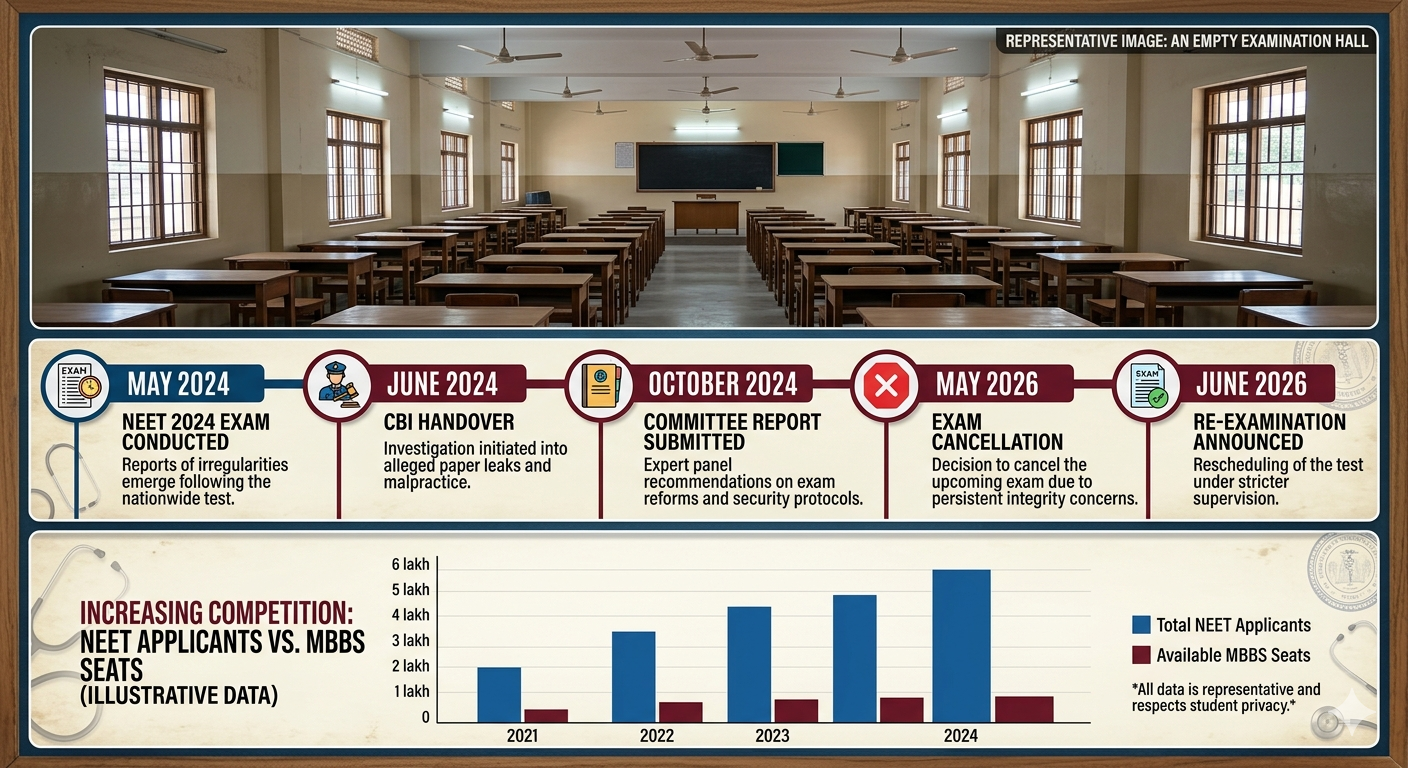
On 12 May 2026, ten days after roughly twenty-three lakh students had sat across 551 cities in India and fourteen overseas centres to write the National Eligibility cum Entrance Test for medical undergraduate admissions, the National Testing Agency announced what increasingly large parts of the country had already begun to suspect. The exam was being cancelled. A re-examination would be held on 21 June. The reason: credible information of malpractice received on 7 May, four days after the test on 3 May. The case had been handed to the Central Bureau of Investigation. By the time the Supreme Court heard the matter on Monday, 25 May, the CBI had arrested eleven accused from Delhi, Jaipur, Gurugram, Nasik, Pune, Latur and Ahliyanagar. The Tribune and India TV News carried the chronology.
A bench led by Justice P.S. Narasimha and Justice Alok Aradhe used a phrase that will stay in the record for some time. “It is sad that they have not learnt their lessons,” the Bench said, asking the NTA to file an affidavit within three days on the steps it had taken since the controversies of NEET-UG 2024. Business Standard and The Federal both quoted the exchange. Petitions from the Federation of All India Medical Association and the United Doctors Front were before the Court, asking, in the strongest possible language, for the NTA to be either replaced or comprehensively restructured, alleging a “systemic failure” and seeking the creation of an autonomous testing body through fresh parliamentary legislation.
It is hard to overstate what this moment means for Indian education. The country’s largest medical entrance test, taken by twenty-three lakh students who collectively represent roughly two trillion rupees of family investment in preparation and coaching, was cancelled because the system could not guarantee that the question paper they had answered was the question paper they were supposed to answer. The re-examination is now four weeks away. The case is in court. The institution that conducted both exams is being asked, in open hearings, to justify why it should continue to exist.
This is not a procedural failure. It is the visible breakdown of a trust contract between Indian students and the Indian state.
What is actually happening
The NEET-UG 2026 examination was conducted on 3 May 2026 across 551 Indian cities and 14 overseas centres, with approximately 23 lakh candidates appearing. According to the NTA’s chronology, on 7 May the agency received information regarding alleged paper leak and malpractice. The Education Ministry referred the matter to the CBI through a formal written complaint by the Department of Higher Education. The CBI registered its case. By 25 May, the agency had made eleven arrests across seven cities — Delhi, Jaipur, Gurugram, Nasik, Pune, Latur and Ahliyanagar — and was examining bank transactions and questioning students, parents and associates linked to the accused, Sunday Guardian Live reported.
The Supreme Court bench, hearing petitions on 25 May, issued notices to the Central Government, the NTA and the CBI, asking the NTA to file an affidavit within three days on the steps it had taken to comply with directions issued in the 2024 NEET matter. The Centre is represented by Solicitor General Tushar Mehta. The petitioners are represented in part by Advocate Ritu Reniwal.
The re-examination has been scheduled for 21 June 2026. Whether that schedule holds will depend on the Court, on the CBI’s investigation, on the NTA’s affidavit, and on the Education Ministry’s decision on whether to keep the existing testing architecture or modify it.
How we got here: the 2024 crisis and the committee that followed
The 2026 controversy is not an isolated event. It is the second NEET-UG crisis in two years, and the deeper history is what makes the Supreme Court’s “they have not learnt their lessons” so cutting.
NEET-UG 2024 was held on 5 May 2024, with approximately 24 lakh candidates. Allegations of paper leak surfaced within days. A Telegram channel reportedly disclosed the question paper and answers the day before the exam. Bihar police filed an FIR. Sixty-seven candidates scored a perfect 720 out of 720, against a historical pattern of one to three perfect scores in any year, with six of them from the same examination centre — a statistical pattern that the petitioners’ counsel before the Supreme Court called “mathematically not possible”. Gujarat, Rajasthan and Maharashtra reported impersonation and cheating cases. Students from Odisha, Karnataka and Jharkhand were found to have travelled over 1,000 kilometres to write the exam at a specific centre in Godhra, Gujarat, raising suspicions about centre-level manipulation.
The case was handed to the CBI on 22 June 2024. By 1 August 2024, the agency had filed its first chargesheet against thirteen accused — Nitish Kumar, Amit Anand, Sikander Yadvendu and others — and forty arrests had been made in total across six FIRs, Careers360 reported at the time. The Supreme Court, hearing the case in July and August 2024, observed that the sanctity of the exam had been compromised and that a paper leak was an admitted fact, but on 2 August 2024 declined to annul the entire examination on the ground that there was insufficient material to indicate a systemic leak compromising the integrity of the test across the country.
The Ministry of Education had, on 22 June 2024, constituted a seven-member High-Level Committee of Experts chaired by Dr K. Radhakrishnan, the former chairman of the Indian Space Research Organisation and chairman of the Board of Governors of IIT Kanpur. The committee was tasked with reviewing the NTA’s functioning, examination security protocols and reform of the testing process. Its report was submitted in October 2024. The Ministry made it public, six months later, in April 2025.
The Radhakrishnan Committee’s recommendations were substantive. A network of 500 computer-based testing centres to be established using Kendriya Vidyalayas and Jawahar Navodaya Vidyalayas within one year. A phased shift to computer-based testing for major entrance examinations. Multi-stage and multi-session testing to distribute logistical load. Reduced dependence on private vendors for paper printing and distribution. Stronger monitoring mechanisms in NTA’s Standard Operating Procedures. Coordination with state governments and specialised examination partners. The Centre filed a compliance report in December 2024 outlining measures adopted, and the Solicitor General assured the Supreme Court on 2 January 2025 that all corrective measures would be implemented, Careers360 and Press Trust of India reported.
Eighteen months later, the same Supreme Court bench told the same Solicitor General that the lessons had not, in fact, been learnt.
What the law was supposed to do
Running in parallel to the committee process was a legislative response. The Public Examinations (Prevention of Unfair Means) Act, 2024 — popularly called the anti-paper-leak law — was passed by Parliament on 9 February 2024, received Presidential assent on 13 February, and was notified into force on 21 June 2024, immediately after the NEET-UG 2024 controversy. The Act criminalises a wide range of malpractices in major public examinations conducted by bodies including the UPSC, SSC, Railways, banking recruitment boards and the NTA.
The penalties are stiff. Individuals using unfair means face three to five years’ imprisonment and fines up to ten lakh rupees. Examination service providers — the private vendors who handle paper printing, transport, encryption and distribution — face fines up to one crore rupees and a four-year debarment from conducting public examinations, with personal liability for directors and management. Organised crime — networks rather than individuals — attracts five to ten years’ imprisonment and a minimum one crore rupees fine, alongside property attachment. The offences are non-bailable.
The Act has been described, in legal commentary published by Livelaw and Lawctopus, as a serious legislative effort. The 2026 NEET-UG cancellation indicates, in the most direct way possible, that the legal framework has not been sufficient on its own. The deterrent has not deterred. Eleven accused have been arrested in the latest case; whether prosecution under the 2024 Act produces convictions, and at what pace, will tell us whether the law works in practice or only on paper.
What students are actually carrying
It is worth pausing on what twenty-three lakh students went through in May 2026, because most coverage moves to court proceedings without sitting with the human reality.
A NEET aspirant in 2026 is typically a young person who has spent two to four years preparing for a single examination. The family has often relocated to Kota, Hyderabad, Sikar, Vijayawada or one of the other coaching hubs. Loans have been taken — sometimes against gold, sometimes against land, sometimes simply on credit from extended family. A younger sibling has often been told that their educational plans depend on this older sibling’s result. Mock tests have been written by the hundred. Sleep has been rationed. The promise of a medical seat — a path that for many Indian families remains the single most reliable route to middle-class security — has been treated as the justification for every sacrifice.
These students sat the exam on 3 May. They returned home. They waited. They learnt on 12 May that the exam had been cancelled. They were told to prepare again for 21 June. Some of them, in the days that followed, asked the only question that mattered: was my effort fair?
The cost of the answer is being borne by them. The 2024 cycle saw NEET aspirants delay college admissions, miss state counselling deadlines, and in some cases lose a full academic year. The 2026 cycle could replicate that pattern if the re-examination is itself contested in court or further delayed. The National Crime Records Bureau’s annual Accidental Deaths and Suicides in India report has documented year-on-year increases in student suicides over the past several cycles, with examination stress identified as a contributing factor in a significant share of cases. The connection between paper leaks, repeated examinations and student mental health is not coincidental; it is causal in ways that demand acknowledgement.
Class inequality, again
A wealthy family can absorb a cancelled NEET examination. They can fund another year of coaching, hire an additional subject tutor, send the student to a different state for the re-examination, and absorb the opportunity cost of a delayed college admission. A poor family often cannot. If the leak networks tend to advantage those who can pay for access — and the CBI’s investigation of bank transactions linked to the accused suggests a paid-network structure — then the system effectively penalises precisely those students for whom the meritocratic promise of NEET was meant to be most reliable.
Rural students, first-generation aspirants, women from conservative households who have negotiated permission to write the exam at all, and aspirants from less prestigious coaching pipelines all face compounding disadvantages when the formal process loses credibility. The Federation of All India Medical Association’s petition before the Supreme Court explicitly cites Articles 14 (right to equality) and 21 (right to life and personal liberty) of the Constitution, arguing that repeated paper leaks violate both. Whether the Court accepts that framing is uncertain. The argument is constitutional, but the underlying point is moral.
What most reports are missing
Most coverage of the 2026 NEET cancellation has focused on the CBI investigation and the Supreme Court hearings. Two angles are under-reported.
First, the structural problem is not the NTA alone. The NTA is the visible point of failure, and its restructuring is the easier political response. But the deeper failure is that the entire Indian examination system — NEET, JEE, UPSC, SSC, state PSCs, railway recruitment, banking exams — funnels too many aspirations through too few seats, with security architectures that were designed for a smaller scale than they now serve. Replacing the NTA without expanding the number of quality medical, engineering and government-recruitment opportunities is a procedural fix to a structural problem. The Radhakrishnan Committee’s recommendation to shift to computer-based testing across a 500-centre KV-JNV network addresses delivery; it does not, on its own, address the funnel.
Second, the political economy of the paper leak industry remains opaque. The CBI’s investigation of bank transactions in the 2026 case points to a network, not lone actors. The same was true in 2024, with thirteen accused in the first chargesheet and forty total arrests. The networks have insiders at printing presses, transport handlers, coaching network operatives, and end-buyers who can pay in cash or through informal channels. The Public Examinations Act 2024 covers all of these in principle. In practice, prosecutions are slow, plea bargains are common, and the architecture for tracking the money — not just the paper — is underdeveloped. The leaks will keep happening until the economics of leaking gets worse than the economics of conducting clean exams.
What happens next
Three sequenced questions will shape the rest of this year.
The 21 June re-examination. Will it be held on schedule? Will the question paper itself be procedurally sound this time? Will the CBI investigation produce arrests or evidence that requires a further postponement? Twenty-three lakh students are waiting for clarity.
The NTA’s affidavit and the Court’s view. The Supreme Court’s request for an NTA affidavit on compliance with the Radhakrishnan Committee recommendations is the most important short-term variable. If the affidavit is found wanting, the Court could appoint an independent monitoring committee, direct further reforms or, in the most far-reaching scenario, accept the petitioners’ demand for a fresh institutional structure created through parliamentary legislation.
The Education Ministry’s longer-term decision. Whether the Ministry retains the NTA in its current form, restructures it under fresh statutory backing, or moves toward a more autonomous testing authority will shape Indian examination policy for the next decade. The political appetite for institutional reform during a crisis is usually higher than the appetite for sustaining the reform once the crisis recedes. Whether 2026 produces a durable answer or another temporary patch remains to be seen.
Conclusion
The Supreme Court bench’s observation — that the NTA had not learnt its lessons — was not addressed only to the agency. It was, on a fair reading, addressed to the entire ecosystem that produces, prepares for and administers India’s most consequential examinations. The agency, the Ministry, the political class, the coaching industry, the printers and transporters who handle the papers, the police forces who investigate the leaks, and the courts that take years to deliver verdicts — all of them, in different ways, are part of the system that has now failed twice in two years on the single test that decides whether twenty-three lakh young Indians get to become doctors.
The honest version of the conclusion is this. India’s exam crisis is not really a story about a leaked paper or a cancelled examination. It is a story about a society in which too many dreams have been funnelled through too few gates, with too thin a security architecture, and the gates have begun to break under the pressure. Every leak is a small confirmation, to a generation of students, that the system they were taught to revere does not always reciprocate their commitment. Restoring trust will take more than catching a few accused or restructuring an agency. It will take an honest reckoning with how India sorts its young people, and a willingness — politically, financially and institutionally — to do that sorting in a way that does not produce a 25 May Supreme Court remark every two years. So far, the political class has not shown that willingness. The students, again, are waiting.