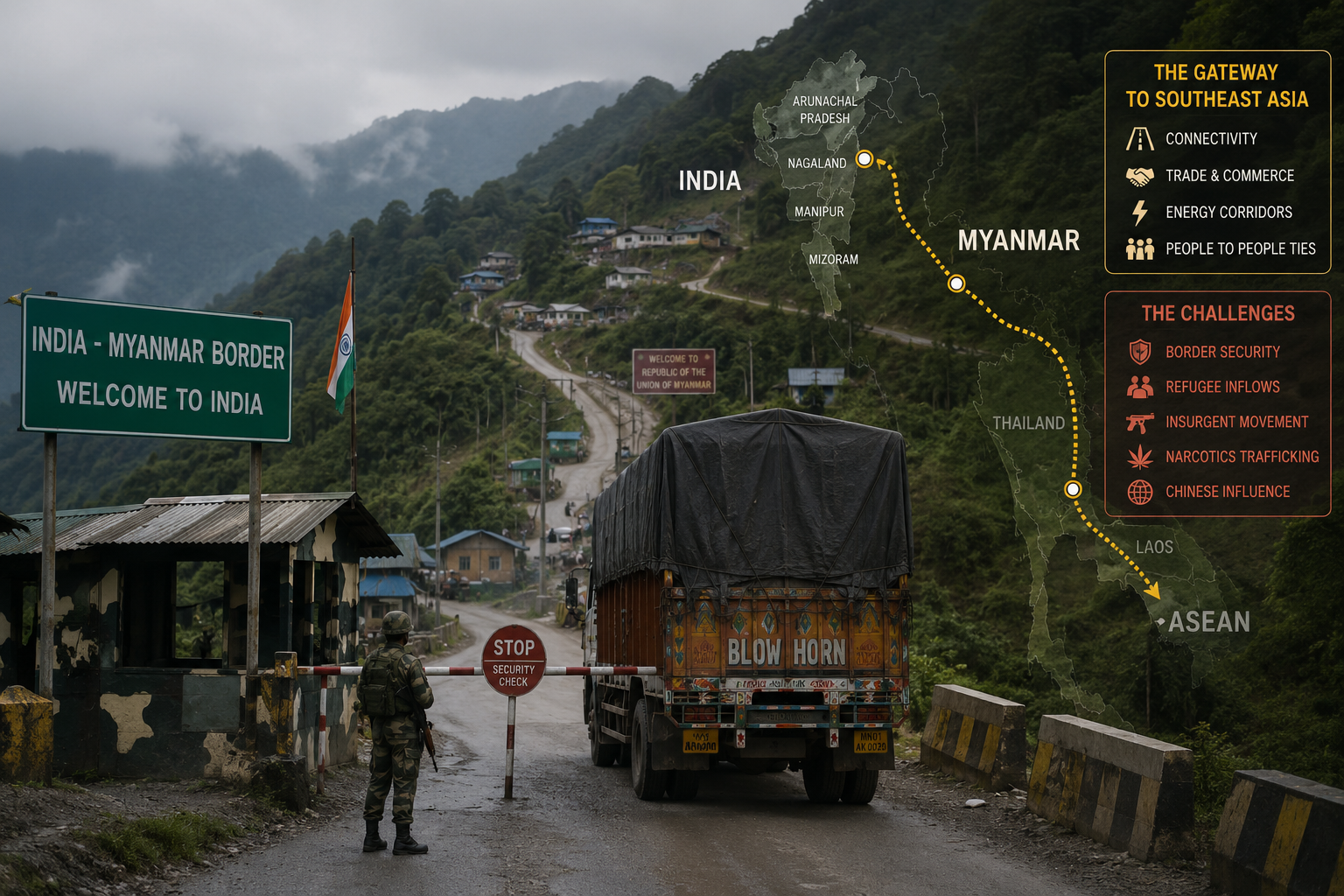
Myanmar is the doorway through which India’s Northeast was supposed to connect with Southeast Asia.
It was meant to be the land bridge of India’s Act East policy: roads, ports, trade corridors, cultural links, Buddhist circuits, energy flows and commercial access from India to ASEAN. For years, policymakers described the Northeast as India’s gateway to the East. Myanmar was central to that vision.
Today, that gateway is unstable.
Myanmar’s civil conflict has turned India’s eastern frontier into a zone of strategic anxiety. Border security, refugee inflows, insurgent movement, narcotics trafficking, ethnic linkages, China’s influence, delayed connectivity projects and humanitarian concerns have all converged. India is now forced to manage a difficult contradiction: it wants democracy and stability in Myanmar, but it also needs working relations with whoever controls territory across its border.
This is why the Myanmar crisis has become one of the most complicated challenges for Indian foreign policy.
It is not only about Myanmar. It is about Manipur, Mizoram, Nagaland and Arunachal Pradesh. It is about the future of Act East. It is about China’s role in India’s eastern neighbourhood. It is about whether India can turn geography into connectivity when the territory between India and ASEAN is trapped in conflict.
Myanmar Is Not a Distant Foreign Policy Problem
Myanmar is the only ASEAN country that shares a land border with India. India shares a land boundary of over 1,643 km with Myanmar, touching Arunachal Pradesh, Nagaland, Manipur and Mizoram, along with a maritime boundary in the Bay of Bengal. The Ministry of External Affairs has described Myanmar as India’s gateway to Southeast Asia and a key country for both Act East and Neighbourhood First policies.
This geography makes Myanmar central to India’s security.
Instability in Myanmar does not remain inside Myanmar. It spills into India’s Northeast through refugees, armed groups, narcotics routes, illegal trade, ethnic networks and border tensions. Unlike distant conflicts, Myanmar’s internal disorder can quickly become an Indian domestic challenge.
This is why New Delhi cannot treat Myanmar only through moral language or only through strategic realism. It needs both.
India must care about democracy and humanitarian suffering. But it must also secure its border, protect its citizens, manage refugees, keep connectivity alive and prevent China from monopolising influence in Myanmar.
The 2021 Coup Changed Everything
Myanmar’s current crisis began with the military coup of February 2021, when the elected civilian government was removed and the military took power. Since then, the country has moved into deep internal conflict involving the military, ethnic armed organisations, resistance forces and local militias. AP notes that Myanmar remains under military-backed rule after the 2021 coup, with continuing civil conflict and international condemnation.
The conflict has fragmented authority across Myanmar.
This matters for India because agreements signed in capital cities may not translate into control on the ground. A project route may pass through areas controlled by ethnic armed groups. Border security may depend on actors who do not answer fully to Naypyidaw. Refugee flows may be driven by fighting far from diplomatic negotiations. Trade corridors may be blocked not by policy failure, but by territorial fragmentation.
The Indian state is therefore dealing not with one Myanmar, but with several Myanmars: the military government, ethnic armed groups, resistance forces, border communities, refugees, criminal networks and Chinese-linked interests.
That complexity makes policy difficult.
India’s June 2026 Engagement Shows Hard Realism
India’s engagement with Myanmar’s military-backed leadership shows the hard realism of neighbourhood policy.
U Min Aung Hlaing visited India from 30 May to 3 June 2026, his first official visit to India after assuming the presidency in April 2026. AP reported that the visit was aimed at strengthening bilateral relations and included meetings with Indian leaders, while also drawing criticism from groups that accused India of legitimising Myanmar’s military-backed regime.
During the visit, Prime Minister Narendra Modi raised India’s concerns about border security, refugee issues, armed groups active near the India-Myanmar border and the impact of Myanmar’s internal conflict on Indian border communities. The discussions also included connectivity projects and cyber scam operations.
This meeting captures India’s dilemma perfectly.
India may not like Myanmar’s internal political reality. But India cannot ignore the authority that controls parts of the state, military institutions, border mechanisms and official channels. Western countries can sanction and isolate Myanmar from a distance. India cannot fully do that because India shares a border.
Geography limits moral distance.
Border Security Has Become the Core Concern
The India-Myanmar border has historically been porous.
Communities on both sides share ethnic, cultural and family ties. For decades, the Free Movement Regime allowed people living within a 16-km zone on either side to cross without visa or passport. But India decided in February 2024 to end this arrangement, citing national security and concerns about the demographic structure of the Northeast. Reuters reported that the decision came after India also announced plans to fence the border.
In March 2024, Reuters reported that India planned to spend nearly $3.7 billion to fence the India-Myanmar border over about a decade to prevent smuggling and other illegal activities.
This is a major policy shift.
The old border logic was based on cultural continuity. The new border logic is based on security control.
That shift is understandable, but it is also sensitive. Many border communities do not see the India-Myanmar frontier as a hard civilisational line. They see it as a colonial boundary cutting across ethnic families and traditional movement. Fencing may improve security, but it can also create resentment if handled without local consultation.
India must therefore manage the border with both firmness and sensitivity.
Manipur, Mizoram and the Human Cost of Instability
Myanmar’s crisis has direct consequences for India’s northeastern states.
Mizoram has hosted large numbers of refugees from Myanmar, many of whom share ethnic kinship with local communities. Manipur has faced its own ethnic conflict, making cross-border movement and security anxieties even more sensitive. Nagaland and Arunachal Pradesh also remain connected to Myanmar through geography, ethnicity and security history.
This creates a difficult humanitarian-security balance.
India cannot allow uncontrolled movement that may be misused by armed groups, traffickers or criminal networks. But India also cannot ignore people fleeing conflict, airstrikes, repression or economic collapse.
The humanitarian situation inside Myanmar is severe. UN OCHA states that conflict and disasters have displaced an estimated 3.6 million people. The Myanmar Humanitarian Needs and Response Plan for 2026 prioritises assistance for the most vulnerable, with the UN noting that conflict and earthquake shocks are driving urgent needs across large parts of the country.
When a neighbouring country produces displacement at this scale, border states naturally feel the pressure.
India’s challenge is to protect security without abandoning humanitarian responsibility.
Refugees Are Not Only a Humanitarian Issue
Refugee inflows from Myanmar create a sensitive policy challenge because India does not have a national refugee law.
This means refugees often fall into a grey zone: tolerated in some states, restricted in others, and treated differently depending on security circumstances. Mizoram has generally taken a more sympathetic approach because of ethnic kinship with Chin communities. Manipur has been more security-conscious, especially after its own internal violence.
This unevenness creates policy confusion.
India needs a clearer framework for dealing with refugees from neighbouring conflicts. Such a framework should distinguish between civilians fleeing violence and security threats using refugee routes. It should involve biometric registration, humanitarian support, coordination with state governments, and clear rules for movement and documentation.
A border crisis cannot be managed only through police methods. It requires administrative clarity and political sensitivity.
The Rohingya Crisis Adds Regional Pressure
Myanmar’s instability also affects Bangladesh and indirectly India through the Rohingya crisis.
Reuters reported on 2 June 2026 that the UN refugee agency warned funding cuts could worsen conditions for about 1.2 million Rohingya refugees in Bangladesh, with around 150,000 additional Rohingya arriving since early 2024 because of escalating violence in Myanmar.
This matters for India because instability in Myanmar creates a chain reaction.
Conflict in Rakhine affects Bangladesh. Bangladesh’s refugee burden affects regional stability. Desperation can increase trafficking, radicalisation, maritime movement and crime. Myanmar’s disorder therefore affects not only India’s land border, but also the Bay of Bengal security environment.
India’s Myanmar policy, Bangladesh policy and Northeast policy cannot be treated separately. They are now connected by the same crisis.
Act East Depends on Myanmar
India’s Act East policy was built on the promise of turning the Northeast from a frontier into a gateway.
The policy rests on connectivity, commerce, culture and capacity building. An MEA lecture described Act East as focused on connectivity in its broadest sense — physical, digital, economic and people-to-people ties — and highlighted the Kaladan Multimodal Transit Transport Project and the India-Myanmar-Thailand Trilateral Highway as major initiatives.
But both major connectivity projects have been affected by Myanmar’s internal instability.
This is the core strategic damage caused by the Myanmar crisis. It does not merely create border problems. It delays India’s eastward economic imagination.
Without a stable Myanmar, India’s land connectivity to Southeast Asia remains incomplete.
Kaladan: The Project That Shows the Problem
The Kaladan Multimodal Transit Transport Project is one of India’s most important connectivity projects.
It is designed to connect India’s eastern seaboard to Myanmar’s Sittwe Port and then onward through inland waterways and roads to Mizoram. The MEA has stated that the project aims to provide connectivity from Indian ports to Myanmar’s Sittwe Port and further to India’s Northeast.
In strategic terms, Kaladan is meant to reduce the Northeast’s dependence on the narrow Siliguri Corridor and open an alternative access route through the Bay of Bengal.
But Myanmar’s internal conflict has delayed full operationalisation. An MEA lecture noted that due to circumstances beyond India’s control and the internal situation in Myanmar, both Kaladan and the India-Myanmar-Thailand Trilateral Highway have been delayed. It also noted that the full Kaladan route requires the inland waterway from Sittwe to Paletwa and the road from Paletwa to Zorinpui to be completed.
This is where maps meet reality.
A corridor exists on paper. A port may be built. A road may be planned. But if the territory is unstable, commercial movement remains uncertain.
Connectivity requires sovereignty, security and trust along the route.
The Trilateral Highway Faces the Same Barrier
The India-Myanmar-Thailand Trilateral Highway is another flagship project.
It is supposed to connect India to Thailand through Myanmar, giving India a direct land route to mainland Southeast Asia. In theory, it is one of the most important instruments of Act East. In practice, Myanmar’s instability has slowed progress.
The MEA lecture noted that road infrastructure on the Indian and Thai sides is complete, but a section within Myanmar still requires the upgrade of around 69 bridges.
This is strategically frustrating for India.
India can build on its side. Thailand can build on its side. But the corridor still depends on Myanmar’s internal stability.
The lesson is clear: India’s Act East policy cannot be only an infrastructure policy. It must also be a conflict-management policy.
China Gains From India’s Myanmar Dilemma
China’s role in Myanmar makes India’s challenge even more complicated.
China has deep influence in Myanmar through infrastructure, energy pipelines, mining, trade, political engagement and relations with both official and non-state actors. It has a stronger ability than India to operate across different centres of power inside Myanmar.
Reuters reported in May 2026 that India viewed Min Aung Hlaing’s visit as an opportunity to dilute China’s outsized influence in Myanmar, secure access to rare earth resources and strengthen security along India’s northeastern borders.
This shows how Myanmar has become part of the India-China strategic competition.
If India disengages from Myanmar, China’s influence grows further. If India engages Myanmar’s military-backed leadership, India risks criticism from democratic groups and Western partners. If India works only with pro-democracy actors, it loses access to official security channels. If India works only with the junta, it alienates other forces that may control territory or shape Myanmar’s future.
China’s advantage is flexibility. India’s burden is democratic expectation, border security and regional reputation.
Critical Minerals Add a New Layer
Myanmar is also important because of resources, including critical minerals and rare earths.
As the global economy becomes more dependent on electric vehicles, batteries, electronics, clean energy and advanced defence systems, critical minerals are becoming strategic assets. Myanmar’s mineral resources therefore add another dimension to India’s engagement.
During the June 2026 India-Myanmar discussions, critical minerals were reportedly among the areas of cooperation discussed.
This matters because India is trying to reduce strategic dependence in critical supply chains. But resource cooperation in conflict-affected countries is always sensitive. It must be transparent, locally responsible and insulated from exploitative practices.
India should avoid appearing as a power interested only in minerals while ignoring Myanmar’s political suffering. Resource diplomacy must be linked to stability, livelihoods and accountable development.
Cyber Scam Networks Are a New Security Threat
Myanmar’s crisis has also created space for cybercrime.
Several conflict-affected zones in Myanmar and nearby border regions have become associated with cyber scam operations, trafficking, forced labour and online fraud networks. India has raised concerns over such cyber scam operations during its recent engagement with Myanmar.
This is a new kind of neighbourhood threat.
It does not look like traditional insurgency. It does not require tanks or armed crossings. It uses digital fraud, human trafficking, weak law enforcement and conflict zones to exploit citizens across borders.
For India, Myanmar is now not only a border security issue. It is also a cyber-security and citizen-protection issue.
Act East was supposed to build digital and economic links. But instability has also created digital criminal corridors.
India’s Moral Dilemma
India’s Myanmar policy is often criticised for engaging the military-backed regime.
That criticism is not baseless. Myanmar’s military has been accused of serious human rights abuses, repression and violence. Democratic forces and civil society groups argue that international engagement gives legitimacy to the junta.
But India’s position is more complicated than that of distant democracies.
India shares a border. It has insurgency concerns. It has refugees. It has unfinished projects. It has citizens caught in scam networks. It has China to consider. It has Northeast stability to protect.
This does not mean India should ignore democracy. It means India cannot build policy on moral distance alone.
A realistic Indian approach should involve three tracks: maintain official channels with the authorities, quietly engage ethnic and civil society actors where possible, and support humanitarian assistance without turning Myanmar into an ideological battlefield.
India must avoid both extremes: moral posturing without influence and strategic engagement without conscience.
The Northeast Must Be Central to Policy
Myanmar policy cannot be made only in New Delhi.
The people most affected live in Manipur, Mizoram, Nagaland and Arunachal Pradesh. Their ethnic ties, security concerns, economic hopes and humanitarian instincts must shape policy.
Mizoram’s approach to refugees has often differed from the Union government’s security-first approach because Mizoram sees many refugees as ethnic kin. Manipur’s concerns are shaped by its own internal conflict and fears about demographic change, illegal arms and cross-border movement.
This means India needs a federal consultation mechanism for Myanmar policy.
Border fencing, refugee registration, trade routes, local movement and security operations should involve state governments meaningfully. Otherwise, national security policy may create local resentment.
A good Myanmar policy must protect India’s borders without alienating India’s border people.
The Free Movement Regime Cannot Simply Be Erased Without Replacement
Ending the Free Movement Regime may address some security concerns. But it cannot be treated as a complete solution.
For border communities, movement across the India-Myanmar frontier is not only about illegal activity. It is about family, ethnicity, markets, religion, farming, festivals and survival. If the FMR is abolished without local alternatives, it may produce informal movement rather than controlled movement.
India needs a regulated border mobility system.
This could include border passes, biometric registration, designated crossing points, limited local trade windows, humanitarian corridors during conflict, and stronger intelligence coordination. The goal should be to separate legitimate community movement from security threats.
A border that is too open creates risk. A border that is too rigid creates resentment.
India needs a smart border, not merely a fenced border.
Narcotics and Arms Flows Are Growing Concerns
Myanmar’s instability also affects narcotics and arms trafficking.
The Golden Triangle region has long been associated with drug production and trafficking. Conflict, weak governance and armed groups create conditions where narcotics networks can expand. India’s northeastern states are vulnerable because of geography and porous movement routes.
Arms flows are equally dangerous. Conflict zones create leakage. Weapons can move across borders, intensify local violence and feed insurgent or criminal networks.
This is why India’s security concerns are not imaginary.
When a neighbouring state loses control over territory, illegal economies often gain strength. These economies do not respect borders.
India’s border policy must therefore combine fencing, intelligence, local policing, financial tracking, anti-narcotics operations and community cooperation.
Bay of Bengal Security Is Also Affected
Myanmar is not only a land-border issue. It is also a Bay of Bengal issue.
Rakhine State, Sittwe Port, the Kaladan route, the Rohingya crisis, maritime movement, illegal trade and China’s infrastructure presence all connect Myanmar to the Bay of Bengal.
For India, the Bay of Bengal is increasingly important because it links eastern India, Bangladesh, Myanmar, Sri Lanka, Thailand and Southeast Asia. Instability in Myanmar weakens India’s ability to build a stable Bay of Bengal economic and security architecture.
This is why Myanmar’s internal conflict affects India’s maritime strategy.
The Northeast, Bay of Bengal and Southeast Asia are part of one strategic geography.
The Counter-View: India Should Distance Itself From the Junta
A strong counter-argument says India should reduce engagement with Myanmar’s military-backed leadership and support democratic forces more openly.
This argument is morally powerful. Myanmar’s people have suffered enormously. The military’s legitimacy is deeply contested. India, as the world’s largest democracy, risks damaging its values-based credibility by dealing with the junta.
But the counter-argument has limits.
If India fully distances itself, it loses operational access on border security, refugees, insurgency, connectivity and citizen rescue. It also gives China more room. A policy of isolation may feel morally satisfying but produce little practical influence.
The better approach is calibrated engagement.
India should not give unconditional political endorsement. It should keep communication channels open, press for stability and inclusive dialogue, support humanitarian needs, protect border communities, and maintain contact with multiple actors where feasible.
In Myanmar, India must be principled but not powerless.
What India Must Do Now
India needs a sharper Myanmar strategy.
First, it must secure the border without ignoring ethnic sensitivities. Fencing alone cannot solve social and security complexity.
Second, it must create a clear refugee management framework that combines registration, humanitarian support and security screening.
Third, it must accelerate Kaladan and Trilateral Highway work wherever feasible, while recognising that conflict zones require flexible project planning.
Fourth, it must coordinate more closely with Northeast state governments.
Fifth, it must prevent Chinese monopoly over Myanmar’s strategic space by remaining engaged, but without appearing to blindly back the military regime.
Sixth, it must build stronger anti-narcotics, anti-trafficking and cybercrime coordination.
Seventh, it must strengthen Bay of Bengal cooperation with Bangladesh, Thailand and ASEAN so that Myanmar’s instability does not paralyse the entire eastern strategy.
Eighth, it must support humanitarian assistance through credible channels.
Ninth, it must prepare for a long crisis. Myanmar is unlikely to stabilise quickly.
Tenth, it must keep Act East alive by developing alternative routes through Bangladesh and maritime corridors while Myanmar remains unstable.
Conclusion: Myanmar Is the Stress Test of Act East
Myanmar was supposed to make India’s Act East policy real.
It was supposed to connect Kolkata to Sittwe, Mizoram to the Bay of Bengal, Manipur to Thailand, and India’s Northeast to Southeast Asia. It was supposed to turn borders into bridges.
Instead, Myanmar’s crisis has turned bridges into chokepoints.
India now faces a difficult reality: the success of Act East depends not only on Indian ambition, but also on Myanmar’s stability. Roads, ports and corridors cannot function if the territory between them is fragmented by conflict.
The Myanmar crisis tests every part of Indian statecraft: security, diplomacy, federal coordination, humanitarian policy, China strategy, connectivity planning and democratic values.
India cannot walk away. It cannot fully embrace the junta. It cannot ignore refugees. It cannot leave the field open to China. It cannot allow the Northeast to suffer. It cannot allow Act East to collapse into a slogan.
The only workable path is disciplined realism.
India must secure its border, protect its people, engage all relevant actors where possible, support humanitarian needs, keep connectivity alive and prepare for a long period of instability.
Myanmar is no longer just India’s gateway to the East.