Diplomacy is also a language game
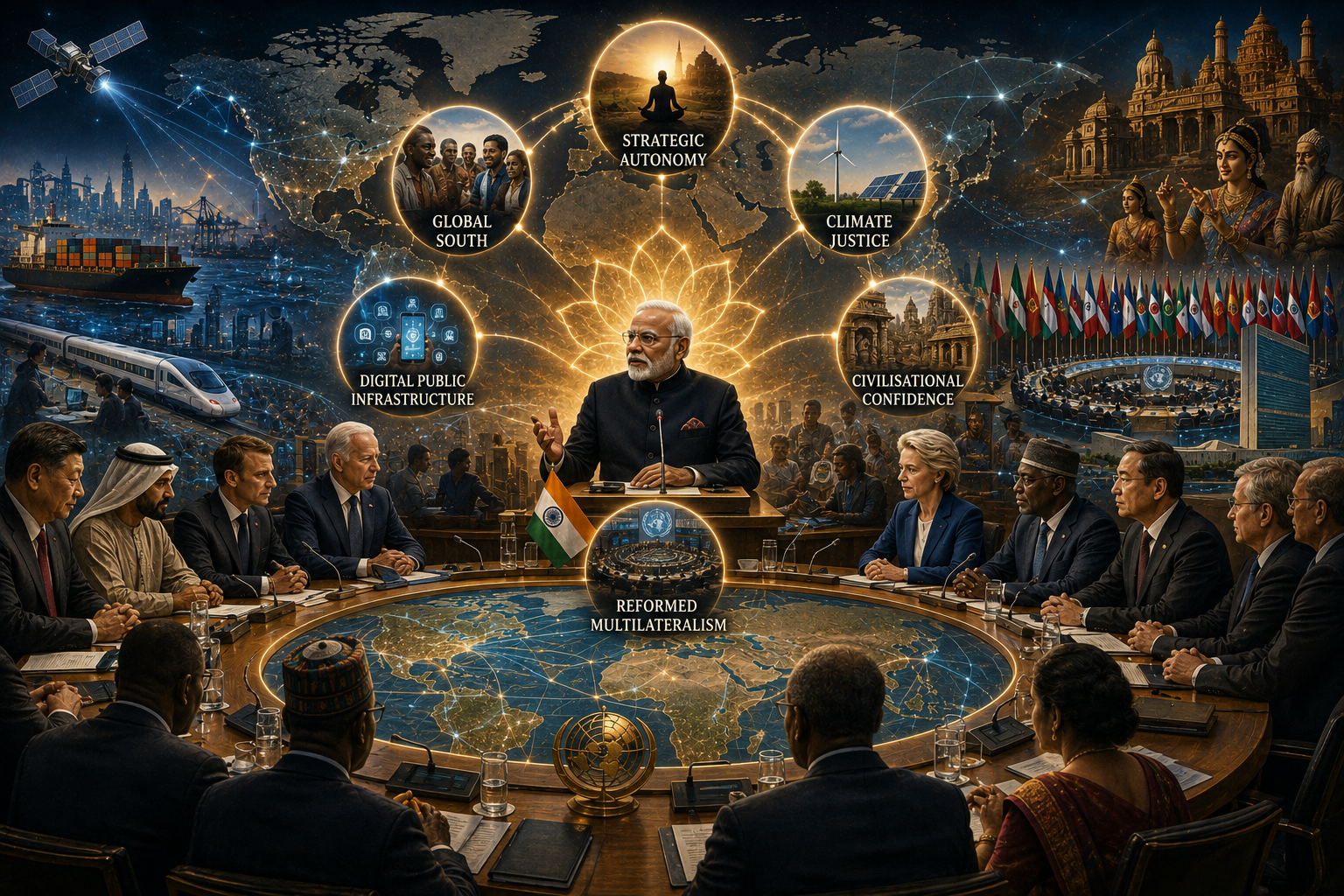
Every rising power changes the language of diplomacy before it changes the architecture of the world. Power first appears as vocabulary. A country begins to name its interests differently, frame its identity differently and insist that others recognise its categories. India's rise is now producing precisely this shift. New Delhi speaks of strategic autonomy, Vishwa Bandhu, the Global South, resilient supply chains, digital public infrastructure, climate justice, reformed multilateralism and civilisational confidence. These are not decorative phrases. They are instruments of positioning.
The older diplomatic language around India was largely written by others. India was described as a developing country, a non-aligned state, a South Asian power, a democracy with poverty, a market waiting to be opened, or a swing state between larger blocs. That vocabulary no longer captures the country's self-image or the way many partners now engage with it. India wants to be seen not as a passive beneficiary of global order but as a shaper of rules, platforms and coalitions.
This matters because diplomacy is not only negotiation over treaties. It is also negotiation over meaning. The state that defines the words often influences the agenda. When India says 'Global South', it is not merely describing geography. It is building a constituency. When it says 'strategic autonomy', it is not simply avoiding alignment. It is asserting that partnership does not require obedience. When it says 'climate justice', it is challenging a green transition designed by countries that became wealthy through high emissions. When it says 'digital public infrastructure', it is offering a development model different from both Western platform capitalism and Chinese state surveillance.
The current trigger: India's platforms have become louder
The current trigger for this linguistic shift lies in India's recent diplomatic platforms. The G20 presidency turned phrases such as 'One Earth, One Family, One Future' into a global governance frame. The Voice of Global South summits gave New Delhi a way to gather developing-country concerns outside traditional Western-led forums. India's vaccine diplomacy, disaster relief, digital stack narrative, development partnerships and diaspora outreach have all added to a new style of external communication.
India's diplomatic language now tries to do three things at once. First, it reassures major powers that India is a responsible stakeholder. Second, it tells developing countries that India understands their constraints. Third, it tells domestic audiences that India is no longer merely adapting to the world but commanding respect from it. This three-level messaging is the essence of modern Indian diplomacy.
The change is visible in tone. India no longer speaks only in the defensive grammar of sovereignty and non-interference. It now speaks in the proactive grammar of solutions, capacity building, connectivity, standards and reform. The language has moved from complaint to proposition.
Strategic autonomy: the phrase that replaced neutrality
One of the most important diplomatic shifts is the transformation of non-alignment into strategic autonomy. Non-alignment belonged to a Cold War world of blocs. Strategic autonomy belongs to a fragmented world of overlapping dependencies. India does not want to be equidistant from all powers. It wants to be issue-based, interest-driven and option-rich.
This distinction is crucial. India may work closely with the United States in the Quad, buy energy from Russia, negotiate trade with Europe, compete with China, deepen ties with the Gulf, support the Global South and join minilateral platforms without seeing these choices as contradictions. In the Indian reading, contradiction is not created by multiple partnerships; contradiction is created when one partnership controls all decisions.
Critics call this hedging. Indian officials often call it realism. The truth lies between the two. Strategic autonomy gives India bargaining power, but it also demands constant management. It is easy to declare autonomy; it is harder to preserve it when sanctions, wars, technology controls and tariff threats turn neutrality into a cost.
Global South: from moral category to bargaining coalition
The phrase Global South has become central to India's diplomatic vocabulary. It allows New Delhi to connect its own development experience with the concerns of Asia, Africa, Latin America and small island states. Food security, debt stress, climate finance, energy transition, vaccine access, digital inclusion and reform of multilateral institutions all fit within this frame.
This is different from the older rhetoric of Third World solidarity. Today's Global South language is less ideological and more transactional. It asks who pays for climate transition, who controls technology, who writes financial rules, who dominates institutions and who carries the costs of geopolitical conflicts. India uses this vocabulary to position itself as a bridge between the industrialised world and developing countries.
The risk is that the phrase becomes too broad to carry policy weight. The Global South is not a single bloc. Oil exporters, small island states, African economies, middle-income Asian countries and Latin American powers often have different interests. India can speak with them, but it cannot automatically speak for them. The credibility of this language will depend on delivery: credit lines, technology sharing, health partnerships, capacity building and fairer trade positions.
Civilisational confidence and soft power
Another notable shift is the language of civilisation. India increasingly frames itself not merely as a modern nation-state but as a civilisational society with a long memory, plural traditions and cultural influence. Yoga, Ayurveda, Buddhism, diaspora networks, Indian festivals, cinema, cuisine and democratic diversity are used as diplomatic assets.
This language has power because global politics is not only about armies and markets. It is also about recognition. Countries seek respect for their histories, symbols and worldviews. India's civilisational vocabulary tells the world that modernity need not be Western in cultural form. It also speaks to domestic audiences who see global recognition as national pride.
But civilisational language must be handled carefully. If it becomes inclusive, it expands India's soft power. If it becomes narrow, it reduces India's appeal. The world is attracted to India because of scale, diversity, openness and cultural depth. The diplomatic value of civilisation lies in plural confidence, not cultural insecurity.
Digital public infrastructure: a new development language
India's digital public infrastructure narrative is one of the most important additions to global development vocabulary. By presenting platforms for identity, payments and public service delivery as scalable public infrastructure, India has created a language that many developing countries can understand. It is neither purely private-platform driven nor fully closed-state controlled.
This gives India a new form of diplomatic capital. Traditional development diplomacy often involved roads, credit, training and technical assistance. Digital diplomacy adds protocols, software architecture, governance standards, privacy debates, financial inclusion and public service delivery. It allows India to move from recipient of technology to exporter of institutional design.
The challenge is that digital confidence must be matched by data protection, cybersecurity, inclusion and rights safeguards. A model becomes globally attractive when it is not only efficient but trusted.
Counter-view: language cannot replace power
The counter-view is strong. Diplomacy can be rhetorically impressive and materially weak at the same time. If India's manufacturing share remains limited, if its trade deficit widens, if its universities underperform, if its defence imports stay high and if its neighbourhood remains unstable, then new language will not automatically produce influence.
Words also invite scrutiny. When India speaks of rules-based order, partners ask about consistency. When it speaks of Global South leadership, developing countries ask what resources India can mobilise. When it speaks of climate justice, industrialised countries ask about implementation. When it speaks of strategic autonomy, major powers ask what India will actually do during crises.
This does not make the language meaningless. It means language must be treated as the first layer of power, not the final proof of it.
What happens next
India's diplomatic vocabulary will become more influential if it is tied to practical coalitions. Strategic autonomy must become supply-chain capacity. Global South rhetoric must become development finance and technology access. Civilisational confidence must become cultural openness. Digital public infrastructure must become trusted governance. Reformed multilateralism must become institutional negotiation.
The editorial insight is that India's rise is not only altering the balance of power; it is altering the grammar through which global power is discussed. The world is beginning to learn India's diplomatic vocabulary. Now India must prove that its words can build outcomes.
Internal Links to Add
• New Delhi’s Global Ambition Meets the Reality of Great Power Rivalry
• India’s Foreign Policy Enters a New Era of Strategic Balancing
• India-China Rivalry Is Now Economic, Military and Technological
• Why India Refuses to Choose Sides in a Divided World