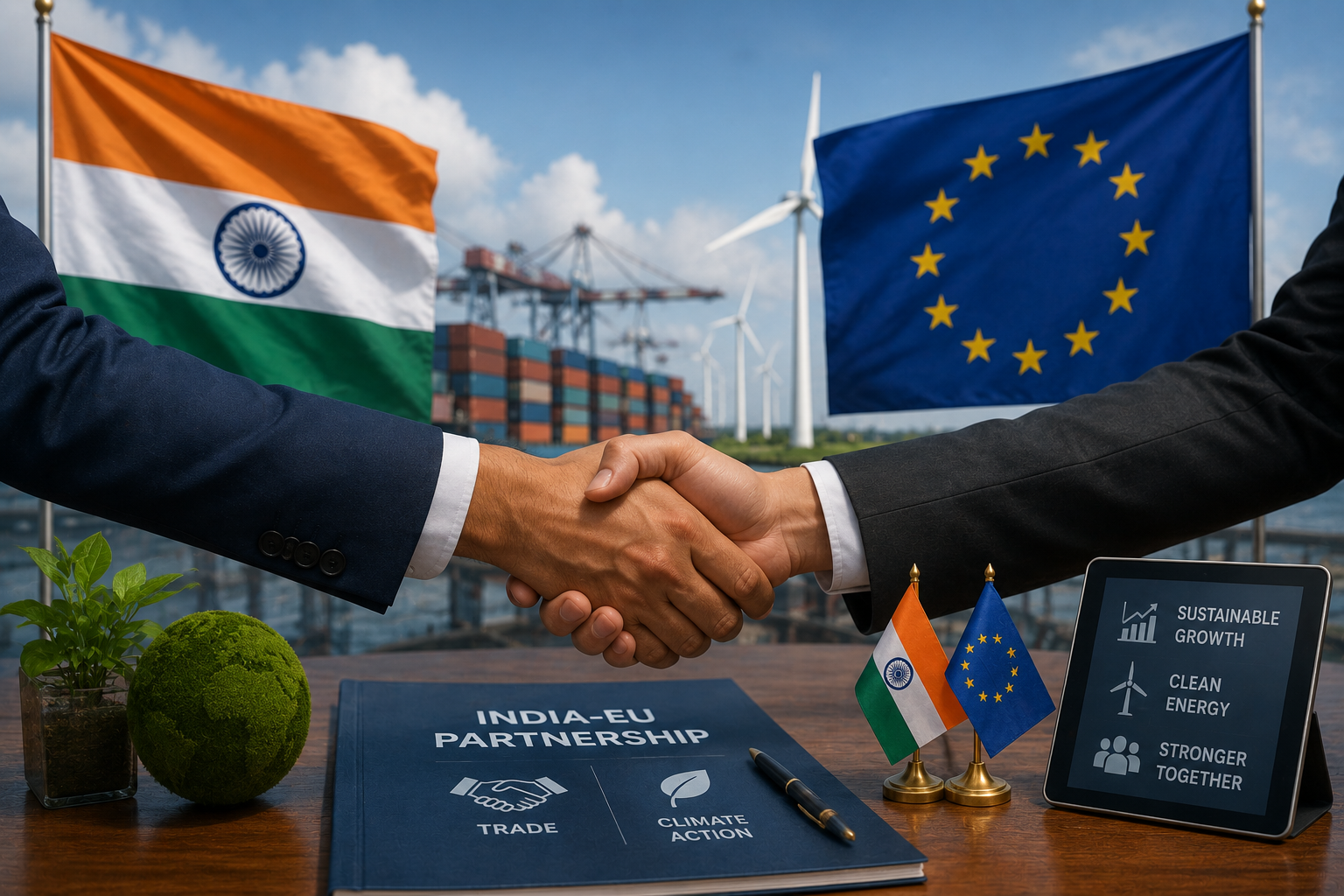
India and the European Union are entering a more serious phase of partnership. For years, the relationship was described with impressive words but limited urgency. Both sides spoke of shared democratic values, trade potential, climate cooperation and global stability. Yet the relationship often moved slowly, trapped by regulatory differences, market-access disputes, climate disagreements and a lack of political energy.
That phase is changing.
The India-EU partnership now matters because the world around it has become more uncertain. The United States is more transactional. China is more assertive. Russia’s war in Ukraine has shaken Europe’s security thinking. Global trade is fragmenting. Supply chains are being reorganised. Climate rules are becoming trade rules. Technology is becoming strategic. The WTO is weaker. Protectionism is rising.
In this world, India and the EU need each other more than before.
India needs European technology, investment, market access, green finance, defence cooperation and regulatory engagement. Europe needs India as a large democratic market, a supply-chain partner, a geopolitical counterweight, a source of talent, and a bridge to the Global South.
But this partnership is not simple. It sits at the intersection of trade ambition and climate friction. The EU wants high standards on sustainability, emissions, digital regulation, labour and environment. India wants market access, investment and technology — but not rules that become disguised barriers against developing-country exporters.
This is why India-EU relations have gained weight. They are no longer just about diplomacy. They are about the future of globalisation itself.
Europe Is No Longer a Secondary Theatre for India
For a long time, India’s foreign-policy imagination was dominated by the United States, Russia, China, Pakistan, West Asia and the neighbourhood. Europe mattered, but often as an economic partner rather than a central strategic actor.
That view is outdated.
The EU is one of the world’s largest markets, a regulatory superpower, a major source of investment, a climate-policy leader, a technology player and an important voice in global governance. Even when Europe lacks the military unity of the United States or the manufacturing scale of China, it shapes global rules through standards, compliance frameworks, data laws, sustainability regulations and trade agreements.
For India, this matters deeply. If Indian exporters want access to European markets, they must increasingly comply with European rules. If Indian firms want investment, they must understand European expectations on governance, sustainability and transparency. If India wants to shape global climate and digital standards, it cannot ignore Europe.
India’s engagement with the EU has therefore become strategically important. A January 2026 PIB note described the EU as India’s largest goods trading partner, with bilateral goods trade of approximately USD 136 billion in 2024-25. It also noted that India-EU trade in services had grown steadily between 2019 and 2024.
This is not a peripheral relationship. It is one of India’s most important economic relationships.
The FTA Is a Major Breakthrough, but Not the End of the Story
The India-EU Free Trade Agreement has been one of the longest-running trade stories in India’s external economic policy. Negotiations originally began years ago, stalled repeatedly, and then gained fresh momentum as global trade politics changed.
The 16th India-EU Summit in New Delhi in January 2026 marked a major turning point. The joint statement from the summit referred to the India-EU relationship as a strategic partnership and set out cooperation across trade, technology, connectivity, security, defence, climate, clean energy and multilateral reform.
The European Commission’s chapter-by-chapter summary of the India-EU FTA shows the breadth of the agreement. It covers not only trade in goods, but also services, investment, digital trade, government procurement, intellectual property, sustainable development, regulatory cooperation and climate-related commitments.
This matters because the FTA is not merely a tariff document. It is a framework for economic alignment between two large regulatory spaces.
For India, the agreement can open export opportunities in textiles, engineering goods, pharmaceuticals, chemicals, services and other sectors. For Europe, it can improve access to India’s large and growing market. For both, it can reduce dependence on uncertain supply chains and strengthen economic resilience.
But the FTA should not be romanticised. Trade agreements create opportunities; they do not automatically create competitiveness. Indian firms will still need quality, scale, certification, logistics, compliance capacity and product sophistication. European firms will still have to navigate India’s regulatory complexity, federal structure and price-sensitive market.
The agreement is a door. It is not the destination.
The Core Tension: Trade Access Versus Regulatory Burden
The central challenge in India-EU relations is this: Europe offers a wealthy market, but access to that market comes with heavy regulatory expectations.
The EU is not just a buyer. It is a rule-maker.
It sets high standards on product safety, environment, labour, sustainability, data protection, digital markets, emissions reporting, corporate due diligence and supply-chain transparency. For European policymakers, these rules reflect values and long-term public interest. For Indian exporters, they can often feel like complex compliance burdens.
This creates a structural tension.
India wants better access to the EU market. But Indian exporters, especially MSMEs, may struggle with documentation, certification, traceability, carbon accounting and sustainability reporting. Large firms can hire consultants, invest in cleaner technology and manage compliance. Smaller firms may be pushed out unless they receive support.
This is why India-EU trade diplomacy cannot end at tariff reduction.
The real battle will be compliance readiness.
If India wants to benefit from the FTA, it must help exporters meet European standards. That requires testing labs, certification systems, digital traceability, green manufacturing support, export finance, logistics upgrades and sector-specific advisory support.
Otherwise, the agreement may benefit only a narrow group of well-prepared firms.
CBAM Is the Flashpoint
No issue captures the collision between trade and climate better than the EU’s Carbon Border Adjustment Mechanism.
CBAM is designed to impose a carbon cost on certain imported goods so that foreign producers face climate-related costs comparable to European producers. The European Commission says CBAM entered into force on 1 January 2026 after its transitional phase, integrating the CBAM Registry with EU customs systems.
From the EU’s point of view, CBAM is a climate measure. It is meant to prevent carbon leakage — the movement of production to countries with weaker climate rules — and protect the integrity of Europe’s emissions-reduction system.
From India’s point of view, CBAM can become a trade barrier.
Indian steel, aluminium, cement, fertiliser and other carbon-intensive exports may face additional costs. This can reduce competitiveness in the European market. India argues that developed countries industrialised using fossil fuels and should not now impose climate-linked trade burdens on developing economies without adequate finance, technology and transition support.
This is not a small disagreement. It is a clash between two principles.
Europe says climate ambition must apply to trade.India says climate action must respect development equity.
Both sides have a point. But the burden of adjustment may fall heavily on Indian industry.
Climate Rules Are Becoming Trade Rules
The larger lesson from CBAM is that climate policy is becoming trade policy.
In the old model of trade, competitiveness was judged mainly by price, quality and delivery. In the new model, exporters will also be judged by carbon intensity, environmental footprint, labour conditions, traceability, recycling standards and supply-chain transparency.
This changes the nature of global commerce.
An Indian manufacturer may produce a good at a competitive price. But if it cannot prove its emissions profile, meet documentation requirements or satisfy sustainability audits, it may lose market access. A small exporter may have a good product but fail because it cannot manage regulatory paperwork. A steel producer may be efficient by Indian standards but penalised under European carbon rules.
This is why CBAM is not only about climate. It is about industrial transformation.
India must treat European climate rules as an early warning. Other developed markets may follow similar models. Large global buyers may also impose private sustainability requirements even where governments do not.
The future exporter will need to be clean, traceable, certified and digitally documented.
India must prepare now.
India Should Challenge Unfairness, but Also Upgrade
India is right to challenge unfair climate-linked trade barriers. Developed countries have historical responsibility for emissions. They have more capital, technology and institutional capacity. Developing countries need space for industrialisation and poverty reduction.
But India cannot rely only on moral argument.
Even if India opposes CBAM, European rules will still shape market access. Reuters reported in January 2026 that the India-EU trade deal left the EU’s carbon border tariff intact despite India’s concerns, while the two sides agreed to technical consultations and the EU committed support to help India reduce emissions.
This is the reality of modern trade diplomacy. India may object, negotiate and demand fairness, but it must also adapt.
The correct strategy is two-track.
Externally, India should push for fair treatment, transition periods, technology transfer, climate finance, recognition of development differences and protection against discriminatory application.
Internally, India must decarbonise industry, improve carbon accounting, support MSMEs, strengthen renewable energy supply, upgrade steel and aluminium production, and create domestic systems for emissions verification.
A country that only complains loses time. A country that prepares gains leverage.
Europe Needs India Too
India should not approach the EU as a passive rule-taker. Europe also needs India.
Europe is trying to reduce excessive dependence on China. It needs trusted supply-chain partners in Asia. It needs access to growth markets. It needs geopolitical partnerships beyond the Atlantic framework. It needs cooperation on climate, technology, maritime security and global governance.
India offers all of these.
India is a large market, a democratic system, a talent base, a technology services power, a strategic actor in the Indo-Pacific, and a country with credibility in the Global South. Europe cannot build a serious Asia strategy by focusing only on China or Southeast Asia. India is too large to ignore.
This gives India bargaining power.
But bargaining power must be used carefully. India should not assume that Europe will compromise automatically. European politics is shaped by farmers, industries, climate activists, labour groups, green regulations, data-protection concerns and member-state interests. Trade policy in Europe is politically complex.
India must therefore negotiate with patience, technical depth and sectoral clarity.
The Trade and Technology Council Shows Strategic Convergence
The India-EU Trade and Technology Council is one of the most important platforms in the relationship.
The second TTC ministerial meeting was held in New Delhi on 28 February 2025. The joint statement identified cooperation in strategic technologies, digital governance, clean and green technologies, trade, investment and resilient value chains.
This matters because India-EU relations cannot be reduced to tariffs.
The future of the partnership lies in technology standards, trusted supply chains, AI governance, semiconductors, quantum technologies, digital public infrastructure, green hydrogen, batteries, renewable energy, cyber security and research collaboration.
Europe has regulatory depth, advanced industrial capability and climate technology. India has scale, talent, digital public infrastructure, engineering capacity and a massive growth market.
The combination can be powerful.
But again, the key question is whether cooperation leads to real Indian capability. India should not be satisfied with workshops and joint statements. It needs technology partnerships that support manufacturing, research, industrial deployment and export competitiveness.
Defence and Security Are Emerging Pillars
India-EU relations are increasingly strategic because Europe’s security outlook has changed.
Russia’s war in Ukraine forced Europe to rethink defence, energy security and dependence on authoritarian powers. China’s assertiveness has also made Europe more attentive to the Indo-Pacific. Maritime security, supply-chain resilience and strategic connectivity have become more important.
India and the EU are now discussing security and defence more seriously than before. The January 2026 India-EU Joint Statement and the Joint India-EU Comprehensive Strategic Agenda endorsed at the 16th Summit referred to cooperation across security, defence, maritime security, cyber, counter-terrorism and the Indo-Pacific.
This is a major shift.
For India, Europe is not a single military actor like the United States, but individual European countries matter greatly. France is already a major defence partner. Germany, Italy, Spain and others have growing defence-industrial relevance. The EU as a bloc matters for maritime security, cyber rules, connectivity and sanctions policy.
India should use Europe not as an alternative to the United States, but as a diversification pillar.
Strategic autonomy requires multiple partners. Europe can help India avoid overdependence on any one power.
Connectivity Links India and Europe Through the Gulf
India-EU partnership also intersects with connectivity.
The India-Middle East-Europe Economic Corridor, announced during India’s G20 presidency, is strategically important because it imagines India’s western connectivity through the Gulf to Europe. If implemented, it could strengthen trade routes, logistics integration, energy links and digital connectivity between India, West Asia and Europe.
This makes the EU part of India’s wider West Asia and Indian Ocean strategy.
Connectivity is no longer only about roads and ports. It is about supply-chain resilience, customs systems, digital tracking, energy pipelines, railway links, maritime corridors and trusted infrastructure.
For Europe, IMEC offers an alternative connectivity vision that is not dominated by China’s Belt and Road Initiative. For India, it offers a way to connect more directly with European markets through trusted partners in the Gulf.
But implementation will be difficult. West Asian instability, financing challenges, infrastructure gaps and political uncertainty can slow progress. India and the EU must therefore treat connectivity as a long-term strategic project, not a summit headline.
Digital Regulation Will Be Another Area of Friction
The EU is one of the world’s most influential digital regulators. Its data-protection rules, competition regulations, AI governance frameworks and platform laws often shape global business behaviour.
India is also building its own digital governance model. It has digital public infrastructure, a large data economy, a growing startup ecosystem and a state interest in digital sovereignty.
This creates both opportunity and friction.
India and the EU can cooperate on trusted digital infrastructure, cyber security, AI ethics, digital payments, e-governance, privacy and standards. But they may disagree on data flows, localisation, platform regulation, competition rules and AI governance.
Europe tends to regulate early and heavily. India wants regulation, but also wants space for innovation, inclusion and domestic digital growth.
The challenge is to avoid a situation where digital regulation becomes another hidden trade barrier.
India must engage Europe seriously because European digital rules often become global benchmarks. But India must also defend its own model of digital development.
The Services Question Matters for India
India’s trade strength lies heavily in services. Any serious India-EU economic partnership must therefore include services, mobility and recognition of professional qualifications.
Indian IT companies, consultants, engineers, designers, financial professionals, healthcare workers and researchers can contribute significantly to European economies. Europe faces demographic pressures and skill shortages in several sectors. India has talent at scale.
But mobility is politically sensitive in Europe. Immigration debates, labour-market concerns and domestic politics often limit openness.
India must negotiate services access firmly. A trade agreement that opens India’s goods market but does not provide meaningful services and mobility benefits would be politically difficult for New Delhi.
The India-EU partnership must recognise complementarity: Europe has capital and advanced industry; India has talent and scale.
Mobility should not be treated as a concession to India. It should be treated as a shared economic need.
Agriculture and Dairy Remain Sensitive
India’s trade negotiations with Europe have always faced sensitivity around agriculture and dairy.
For India, agriculture is not just a business sector. It is linked to livelihoods, rural stability, food security and political economy. Millions of small farmers cannot be exposed casually to highly competitive or subsidised European products.
Europe, meanwhile, has strong agricultural interests and powerful producer lobbies.
This makes agriculture one of the most difficult areas in India-EU trade negotiations.
India must protect vulnerable farmers while creating export opportunities in processed foods, spices, organic products, marine products, basmati rice, tea, coffee, fruits, vegetables and value-added agricultural goods.
The goal should not be defensive agriculture forever. It should be competitive agriculture with protection where necessary and export ambition where possible.
European Standards Can Improve Indian Industry — If Managed Well
There is another side to the standards debate.
European rules can be burdensome, but they can also push Indian industry to upgrade. If Indian firms learn to meet EU standards, they become more competitive globally. Quality certification, clean production, better packaging, traceability, labour compliance and environmental management can open not only Europe but also other premium markets.
The problem is not standards themselves. The problem is unequal capacity to comply.
Large firms may benefit from higher standards because they can afford transition. Small firms may be excluded unless supported. This is where Indian policy must intervene.
India needs a national export-readiness mission for EU compliance. It should identify sectors likely to gain from the FTA, map regulatory requirements, train exporters, subsidise certification for MSMEs, create common testing facilities, and build digital compliance tools.
A standard can become a barrier. But with preparation, it can also become a ladder.
The Global South Dimension
India and the EU also differ in how they view the Global South.
India positions itself as a voice for developing countries on climate justice, development finance, debt relief, food security, health equity and institutional reform. The EU sees itself as a promoter of rules, rights, sustainability and multilateralism.
These positions can complement each other, but they can also clash.
India often argues that global rules are written by developed countries and imposed on poorer economies. The EU argues that high standards are necessary for sustainability and fairness. The Global South may see European rules as moral language attached to economic power.
If India and the EU want a deeper partnership, they must address this trust gap.
Europe should listen more seriously to development concerns. India should show that climate equity does not mean avoiding transition. Both sides should work together on practical solutions: green finance, technology transfer, resilient agriculture, public health, digital infrastructure, disaster response and capacity building for poorer countries.
An India-EU partnership that includes the Global South will be stronger than one limited to bilateral trade.
India Must Avoid Seeing Europe Only Through the EU
While the EU is important, India must also engage key European states individually.
France is critical for defence, nuclear energy, space and the Indian Ocean. Germany matters for manufacturing, engineering, clean technology and skilled mobility. Italy matters for manufacturing, design, maritime and industrial cooperation. The Netherlands matters for logistics, ports, agriculture technology and investment. The Nordic countries matter for sustainability, green technology and innovation. Eastern Europe matters for defence, pharmaceuticals, agriculture and emerging markets.
India’s Europe policy should therefore operate at two levels: Brussels and national capitals.
The EU sets rules. Member states bring capabilities.
India needs both.
Europe Must Understand India’s Development Reality
Europe often expects partners to move quickly on climate, sustainability and regulatory alignment. But India’s development reality is different.
India has a massive population, large employment needs, uneven industrial capacity, energy-transition challenges, millions of MSMEs and a continuing need for affordable growth. It cannot follow the same transition pathway as wealthy European countries.
This does not mean India should avoid climate responsibility. India is already investing heavily in renewable energy, green hydrogen, electric mobility and energy efficiency. But the pace and method of transition must consider development needs.
Europe must avoid turning climate ambition into economic punishment for developing exporters.
A fair India-EU partnership should combine market access with technology transfer, finance, capacity building and industrial transition support.
India Must Also Be Honest About Its Weaknesses
India should not blame every difficulty on European protectionism.
Some Indian weaknesses are domestic.
Logistics costs remain a challenge. Product quality is uneven in several sectors. Contract enforcement can be slow. MSMEs often lack scale and compliance systems. Industrial clusters need upgrading. Research and development intensity remains limited. Regulatory uncertainty discourages investors. Exporters often lack market intelligence.
If India wants to benefit from Europe, it must fix these internal problems.
Foreign policy can negotiate access. Domestic policy must create competitiveness.
The India-EU partnership will succeed only if Indian firms can actually use the opportunity.
Why This Matters for Ordinary Indians
India-EU relations may sound like elite diplomacy, but they affect ordinary Indians.
If the FTA expands exports, it can create jobs in textiles, engineering, pharmaceuticals, chemicals, services and manufacturing. If European investment flows into India, it can support infrastructure, clean energy, technology and industrial growth. If CBAM hits Indian exports, workers in steel, aluminium and related sectors may face pressure. If services mobility improves, Indian professionals may gain opportunities. If climate cooperation succeeds, India can access cleaner technology and finance.
Trade and climate rules are no longer abstract policy issues. They shape employment, industrial competitiveness, energy transition and export growth.
For India’s young workforce, the question is simple: will the India-EU partnership create real jobs and capabilities, or only diplomatic declarations?
The Risks Ahead
The India-EU partnership faces several risks.
First, regulatory overload. If European rules become too burdensome, Indian exporters may struggle despite tariff benefits.
Second, climate friction. CBAM and future climate-linked rules can create resentment unless managed fairly.
Third, slow implementation. A large agreement without fast execution can lose momentum.
Fourth, uneven gains. Large firms may benefit more than MSMEs unless India provides support.
Fifth, political backlash. Sensitive sectors such as agriculture, dairy, automobiles, alcohol and procurement can create domestic opposition.
Sixth, geopolitical distraction. Wars, US-China rivalry and European internal politics can divert attention.
Seventh, trust gaps. India may see Europe as moralising; Europe may see India as too cautious on global crises.
These risks are manageable, but only if both sides treat the partnership as strategic, not transactional.
What India Must Do Next
India needs a clear strategy for Europe.
First, convert the FTA into export gains. Identify priority sectors and help firms meet EU standards.
Second, build CBAM readiness. Create carbon-accounting systems, support industrial decarbonisation and protect MSMEs.
Third, negotiate services and mobility seriously. India’s talent must be part of the partnership.
Fourth, deepen technology cooperation. Semiconductors, AI, cyber security, clean energy, batteries, green hydrogen and advanced manufacturing should be priority areas.
Fifth, use Europe for strategic diversification. Defence, supply chains and technology partnerships with Europe can reduce overdependence on any single power.
Sixth, engage both Brussels and member states. India needs the EU system and national-level industrial partnerships.
Seventh, frame climate cooperation around equity and delivery. India should demand fairness while accelerating its own transition.
Conclusion: A Partnership Built on Opportunity and Friction
India-EU relations are gaining weight because both sides now face a harder world.
India wants markets, technology, investment, clean-energy support, supply-chain diversification and strategic options. Europe wants access to India’s market, trusted partners beyond China, climate cooperation, technology engagement and geopolitical relevance in the Indo-Pacific and Global South.
The partnership makes sense.
But it will not be easy.
Trade and climate rules are colliding. The EU’s regulatory power can open doors but also create barriers. India’s development needs require flexibility, but India must also upgrade its industry. CBAM may become a source of tension, but it can also push India toward cleaner competitiveness. The FTA can create opportunity, but only if Indian firms are prepared.
This is the new reality of India-EU relations: cooperation and friction will grow together.
That is not a weakness. It is a sign that the relationship has become serious.
India and the EU are no longer exchanging polite statements from a distance. They are negotiating the rules of trade, technology, climate and strategic power in a fragmented world.
If they manage the balance well, the India-EU partnership can become one of the most important pillars of India’s global rise.
If they fail, the relationship may remain trapped between ambition and regulation.
The choice now is not whether India and Europe need each other. They clearly do.