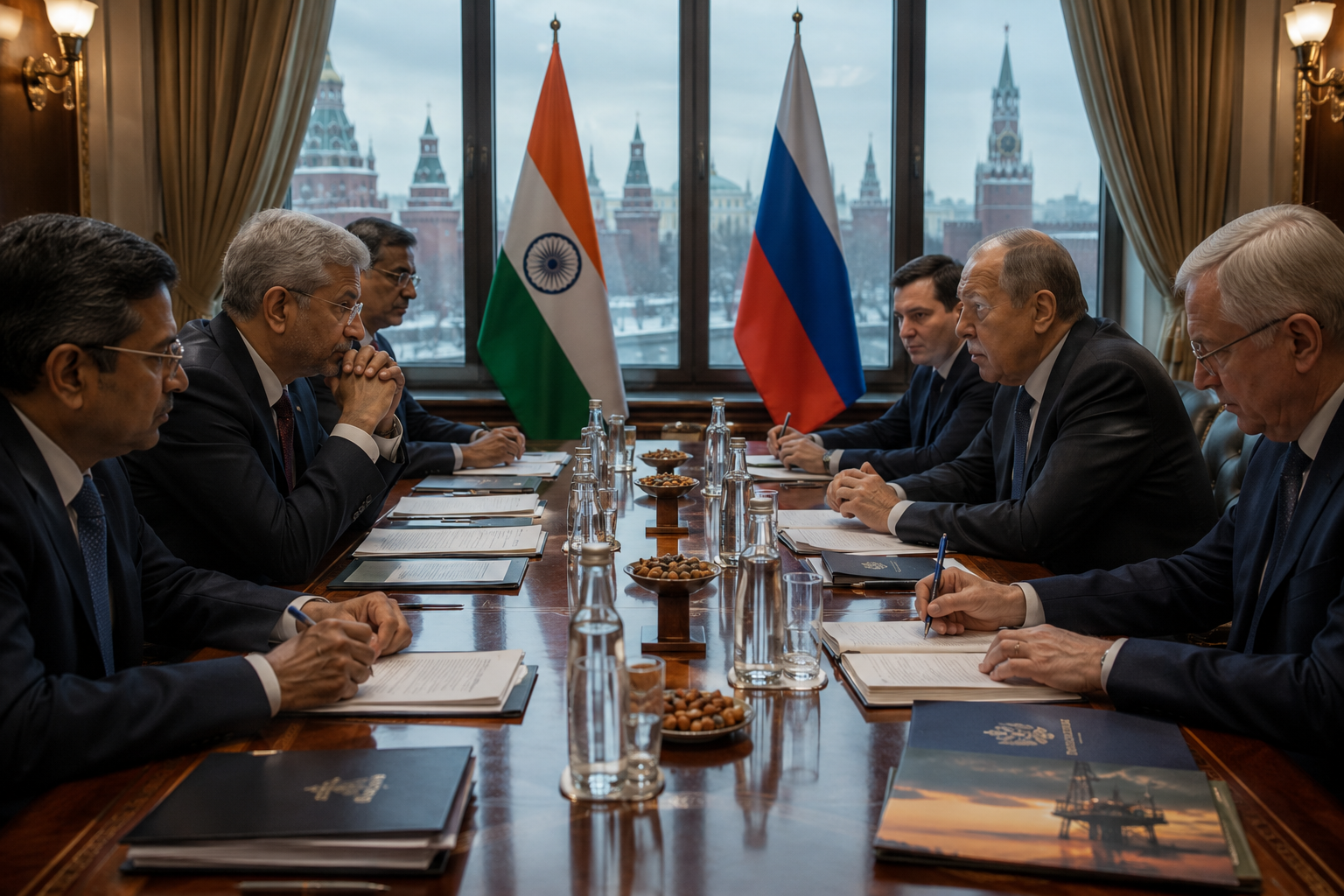
When the White House announced in February 2026 that India had agreed to stop buying Russian oil as part of a trade understanding with the United States, it marked a symbolic moment in one of the world's most durable partnerships. For decades, the relationship between New Delhi and Moscow had seemed almost immune to outside pressure, a friendship the Indians liked to call "time-tested." Now, under the weight of American tariffs and Western sanctions, India was publicly signalling a retreat from a pillar of that relationship. Russian officials absorbed the news quietly. The partnership is not over, but it is facing its hardest test since the end of the Cold War.
The relationship matters because it touches the most sensitive nerves of Indian security and economics: the oil that fuels its economy and the weapons that defend its borders. How India navigates the strain with Russia will reveal a great deal about the limits of its strategic autonomy and the direction of its foreign policy in a polarised world.
A Friendship Forged in the Cold War
The bond runs deep and long. As newly independent India sought arms and industrial support in the 1960s, and Western suppliers proved reluctant, the Soviet Union stepped in, offering fighter jets, licensed production and steadfast diplomatic backing, including vetoes at the United Nations on Kashmir. Over the following decades Moscow became the backbone of India's military, the partner in flagship projects from the BrahMos cruise missile to the Kudankulam nuclear power plant, and a reliable friend through crises when others wavered. Even after the Soviet collapse, the relationship endured, sustained by defence ties and a shared instinct for a multipolar world.
That continuity is precisely why the present strain is so striking. The partnership survived the Cold War, the rise of an India-US friendship, and the turbulence of the post-Soviet years. It is now being tested not by a falling-out between the two countries but by the gravitational pull of a wider geopolitical realignment.
Oil at the Centre of the Storm
After Russia's full-scale invasion of Ukraine in 2022, Western buyers shunned Russian crude, and Moscow offered it elsewhere at a steep discount. India, importing the overwhelming majority of its oil and desperate to shield its economy from a global price spike, became one of the largest buyers of discounted Russian barrels. The arrangement saved India billions of dollars, helped contain inflation, and gave Moscow a vital market. New Delhi defended it as a sovereign economic decision in the interest of its own people, and refused for years to bow to Western objections.
That position became untenable in 2025. Washington tied steep tariffs directly to Indian oil purchases, sanctions tightened around Russia's largest producers, and the cost of defiance began to outweigh the savings. India started trimming its Russian crude imports under pressure, and by early 2026 had signalled a broader wind-down as part of its deal with the United States. The retreat is gradual and hedged, but its direction is unmistakable, and it strikes at the most lucrative dimension of the current relationship.
The Slow Decline of Arms Dependence
The defence relationship tells a parallel story of erosion. Russia was for generations the dominant supplier of Indian weaponry, and a large share of India's tanks, jets, submarines and air-defence systems remain Russian in origin. India operates several regiments of the advanced S-400 air-defence system, with further deliveries delayed by the strains of Russia's war.
But the trend is clear. According to the Stockholm International Peace Research Institute, Russia's share of India's arms imports fell from roughly three-quarters in the period around 2009 to 2013 to a little over a third by 2019 to 2023. India has diversified aggressively toward France, the United States and Israel, and has poured resources into building its own defence industry under the self-reliance agenda. The war in Ukraine accelerated the shift, exposing weaknesses in Russian equipment, delaying deliveries, and complicating payments as Russian banks were cut off from global financial systems. India still depends on Russia for spares and maintenance of its existing arsenal, a dependence that cannot be unwound quickly. But Moscow is no longer the partner of first resort for new acquisitions.
The mechanics of the energy relationship reveal how deep the entanglement runs. After 2022, India did not merely buy discounted Russian crude; it refined large volumes of it and re-exported the products, including to Western markets, turning sanctioned oil into a profitable trade. Payment itself became a geopolitical puzzle, conducted increasingly outside the dollar through rupees, dirhams and other arrangements designed to evade the reach of Western financial sanctions. This improvisation kept the oil flowing for years, but it also created exposure: as sanctions tightened around Russia's largest producers and the financial plumbing came under scrutiny, the cost and complexity of the trade rose, and the political price extracted by Washington grew until it could no longer be ignored.
The defence relationship is similarly layered and similarly difficult to unwind. Beyond the headline systems lies a vast installed base of Russian-origin equipment that requires a constant supply of spares, upgrades and technical support, the kind of dependence that locks two militaries together for decades regardless of political mood. There is also a record of genuine co-development that distinguishes the relationship from a simple buyer-seller arrangement: the BrahMos cruise missile, developed jointly and now even marketed for export; the AK-203 assault rifles manufactured in India under a joint venture; the nuclear reactors at Kudankulam; and offers, periodically floated by Moscow, to co-produce advanced fighter aircraft on Indian soil. This depth is why talk of a clean break is unrealistic. India cannot simply switch off a relationship woven into the hardware of its armed forces.
Diplomacy adds another layer of attachment. Through the Cold War and after, Moscow was the partner that could be relied upon to shield India at the United Nations Security Council, particularly on Kashmir, and the two shared a worldview that favoured a multipolar order over Western dominance. That convergence of outlook persists in the rhetoric of both capitals and in their participation in groupings such as BRICS and the Shanghai Cooperation Organisation. For an India that prizes its independence, Russia has long represented a useful counterweight, a great power that asked little of India's domestic choices and offered much in return. The tragedy, from New Delhi's perspective, is that this counterweight is now tilting decisively toward the one rival India fears most, hollowing out the very logic that made the friendship so valuable.
Beyond Oil and Arms: Trade and Connectivity
The relationship has always been narrower than its diplomatic warmth suggested, and its commercial limits are now coming into focus. Outside energy and defence, trade between India and Russia has long been modest and lopsided, dominated since 2022 by India's oil purchases, which created a large imbalance that New Delhi struggled to offset with its own exports. The two governments have spoken for years of raising bilateral trade and investment to ambitious targets, and of building new routes such as the International North-South Transport Corridor and a maritime link between Chennai and Vladivostok to knit their economies more closely together. Progress has been slow, hampered by sanctions, payment difficulties and the simple fact that the two economies are not natural complements on the scale their leaders envision.
This commercial thinness matters because it limits how much can replace what is now being lost. If oil purchases wind down and new arms orders dwindle, the relationship is left resting on the maintenance of a legacy arsenal and a shared diplomatic outlook, a narrower foundation than the partnership once enjoyed. Russia's pivot toward China compounds the problem, since much of the economic integration Moscow now pursues runs through Beijing rather than New Delhi, drawing Russia deeper into an orbit that works against Indian interests.
For India, the practical task is to preserve the elements of the relationship that still serve it, reliable defence support, a diplomatic partner outside the Western camp, a hedge in a multipolar world, while accepting that the era of expansive ambition has passed. The friendship endures, but as a more limited arrangement, valued for specific functions rather than as a central pillar of national strategy. Managing that transition without rupture, and without driving Moscow entirely into China's arms, is the delicate work that now defines the relationship.
The China Problem
Looming over everything is Russia's deepening embrace of China. Isolated by the West, Moscow has drawn ever closer to Beijing, becoming in many respects the junior partner in a relationship that points directly at India's chief strategic rival. This is the most uncomfortable development of all for New Delhi. A Russia dependent on China is a Russia less able to serve as an independent counterweight, and potentially one whose technology and intelligence could flow toward an adversary. India's traditional logic, that friendship with Moscow balanced its other relationships, is being undermined by Moscow's own choices.
The India Angle
For India, the relationship with Russia is a study in the costs and limits of autonomy. Russia offers cheap energy, a legacy arsenal that still must be maintained, a partner for a multipolar vision, and a hedge against over-dependence on the West. Abandoning it entirely would be strategically foolish and practically impossible given the depth of defence ties. Yet clinging to it too tightly now carries mounting costs: friction with the United States, exposure to sanctions, and association with a power sliding into China's orbit.
India's chosen path is managed distance: reducing the most exposed dependencies, especially oil, diversifying defence procurement, and preserving enough of the relationship to keep Moscow from becoming wholly hostile or wholly captured by Beijing. It is a delicate calibration, and the events of 2025 and 2026 show how external pressure can force the pace.
Global Implications
How India handles Russia is watched closely in every major capital. For the West, India's gradual distancing from Moscow is a quiet victory, evidence that sanctions and economic pressure can shift even a determined partner over time. For Russia, the loss of Indian custom and confidence deepens its dependence on China and narrows its options. And for the wider Global South, India's balancing act is a closely studied case of how a developing power manages relations with a sanctioned giant without fully submitting to Western demands.
The Counter-View
It would be premature to write the obituary of India-Russia ties. The defence relationship, however diminished, locks the two together for years through maintenance, spares and co-production. Many in New Delhi continue to value Russia as a strategic counterweight and resent what they see as Western coercion. Russia, for its part, has every reason to keep India close as one of its last major non-Chinese partners. The relationship is being recalibrated, its sceptics argue, not severed, and reports of its death have been exaggerated before. The deep institutional and military links may prove far stickier than the headlines about oil suggest.
There is force in this. The partnership will not vanish. But its character is changing from a central pillar of Indian strategy to one relationship among many, managed carefully and at growing arm's length.
What Happens Next
In one scenario, India completes a gradual, controlled drawdown of its most exposed dependencies while preserving a working defence and diplomatic relationship, settling into a quieter, narrower partnership. In a second, an end to the Ukraine war eases sanctions and lets the relationship stabilise on new terms, with energy and arms ties partially restored. In a third, Russia's accelerating dependence on China forces India to distance itself further, treating Moscow as an increasingly unreliable friend drifting into an adversary's camp.