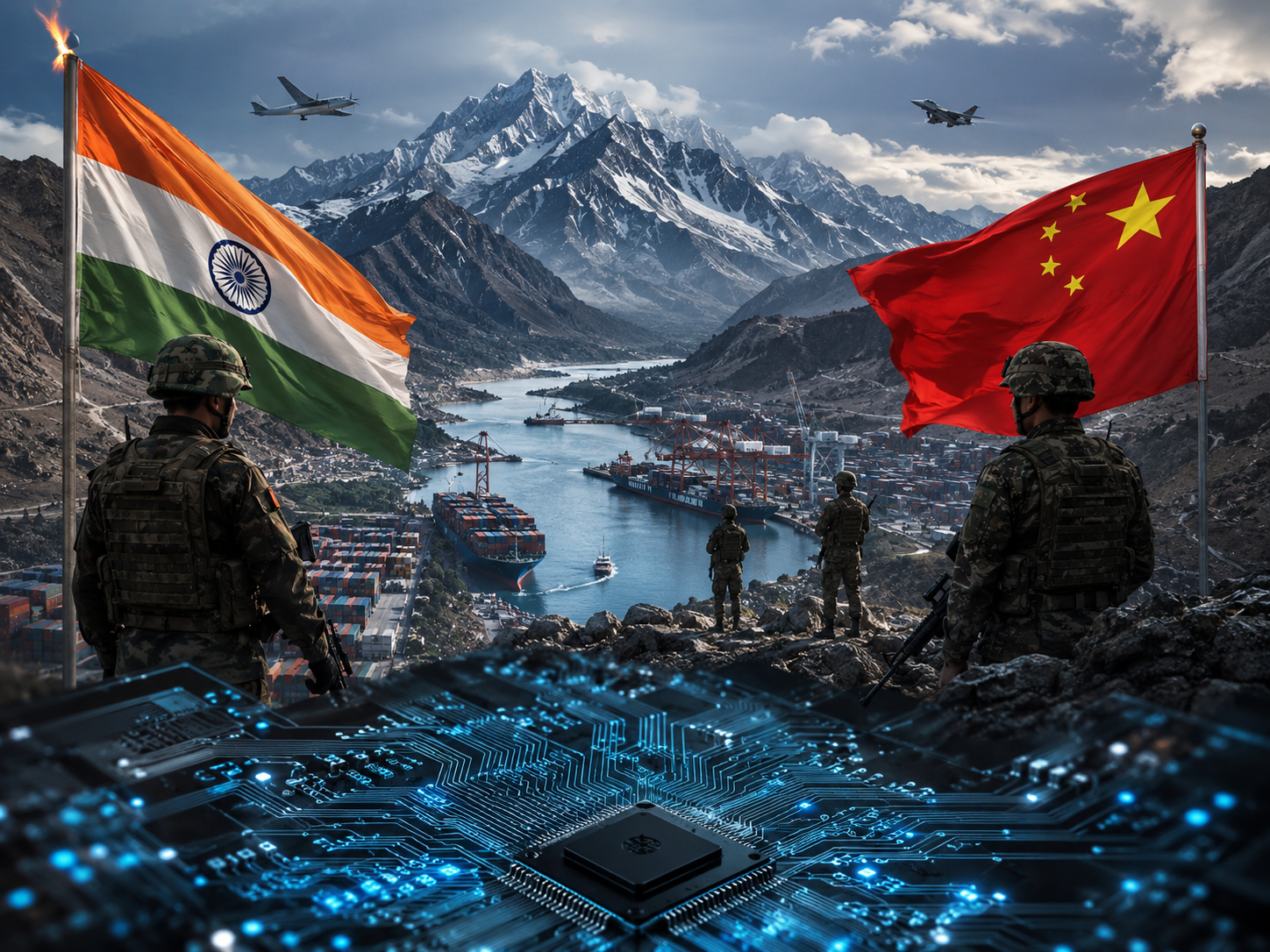
In May 2026, Indian and Chinese officials sat across a table in Beijing and described their talks on the disputed Himalayan border as "constructive and forward-looking." Patrolling has resumed at the last friction points in eastern Ladakh. Direct flights are returning. The language of normalisation is back. And yet no serious analyst in New Delhi believes the rivalry between Asia's two largest powers has ended. It has simply changed shape.
The contradiction at the heart of the India-China relationship is that the two countries are stabilising their border while competing more intensely than ever everywhere else. The military standoff that began with the deadly Galwan Valley clash in 2020 has eased, but the deeper contest over trade, technology, influence and the future shape of Asia has hardened. Rivalry is no longer measured only in troops on a ridge line. It is measured in trade deficits, semiconductor supply chains, port projects across the Indian Ocean and the quiet question of who sets the rules for the region.
This is why the relationship matters now in a way it did not a decade ago. India is no longer a distant second to China in the global imagination. It is the world's most populous country, its fastest-growing major economy, and an increasingly assertive voice in technology, climate and global governance. The gap with China remains large, but it is no longer the gap of a junior power facing a senior one. It is the gap of a challenger that has begun to close the distance and that China can no longer ignore.
A Rivalry Older Than the Republic
The roots run deep. India and China fought a brief, humiliating war in 1962 that left a scar on the Indian strategic psyche and an unsettled boundary that survives to this day. For decades the two managed an uneasy peace, choosing trade and dialogue over confrontation. That arrangement collapsed in June 2020, when hand-to-hand fighting in the Galwan Valley killed soldiers on both sides and shattered the assumption that the border could stay quiet while commerce flourished.
The four years that followed were the tensest since the war. Tens of thousands of troops faced each other across the Line of Actual Control through brutal Himalayan winters. It was only in October 2024, on the eve of the BRICS summit in Kazan, that the two sides reached a disengagement agreement covering the final friction points at Depsang and Demchok. Prime Minister Narendra Modi and President Xi Jinping met there, and again at the Shanghai Cooperation Organisation summit in Tianjin in 2025, opening a cautious thaw that continues into 2026. But disengagement is not resolution. The boundary remains undefined, the trust remains thin, and the structural rivalry remains intact.
Three Fronts of Competition
The contest now plays out across at least three distinct fronts, each more consequential than the border itself.
The first is economic. China is one of India's largest trading partners, but the relationship is dangerously lopsided. India runs a vast and persistent trade deficit with China, importing electronics, machinery, active pharmaceutical ingredients and the components that feed its own manufacturing ambitions. This dependence is a strategic vulnerability. New Delhi's "China plus one" pitch to global manufacturers, its production-linked incentive schemes and its push for domestic capacity in electronics and pharmaceuticals are all, in part, attempts to reduce a reliance that gives Beijing quiet leverage over the Indian economy.
The second front is military and territorial. Even with disengagement, both armies are building roads, airstrips and forward infrastructure along the frontier. China's deepening partnership with Pakistan keeps India facing the prospect of a two-front problem. India, in turn, has accelerated its own border infrastructure and is modernising forces oriented toward the northern frontier rather than only the western one. The border may be quieter, but it is also more militarised than at any point in living memory.
The third front is technological and strategic. The competition for advanced technology, undersea cables, telecom standards and control of critical mineral supply chains is now central to national power. India has restricted Chinese investment in sensitive sectors, banned a wave of Chinese apps after 2020, and is trying to build sovereign capacity in areas from semiconductors to clean energy. China's lead is substantial, but India's scale and its growing alignment with Western technology partners make it a genuine long-term competitor rather than a bystander.
The Contest Across the Indian Ocean
The fourth and least visible front is the struggle for influence across South Asia and the Indian Ocean, a region India has long regarded as its natural sphere. For two decades China has extended its reach through a web of port, power and infrastructure projects financed under its Belt and Road Initiative, from Hambantota in Sri Lanka to Gwadar in Pakistan to investments in Bangladesh, the Maldives and Myanmar. Indian strategists describe this as a "string of pearls" that could one day give the Chinese navy a chain of footholds around the subcontinent. The arrival of Chinese research and naval vessels in the Indian Ocean, and the periodic docking of Chinese submarines at regional ports, have sharpened the anxiety.
India has responded by becoming a more active regional power in its own right. It has positioned itself as a first responder in regional crises, extended lines of credit and development assistance to its neighbours, deepened maritime cooperation with island states, and invested in its own naval modernisation and basing arrangements. The competition is not only military but economic and political: when a government in Colombo, Male or Dhaka tilts toward Beijing, New Delhi feels the loss directly, and when it tilts back, China takes note. This is a slow, continuous contest for the loyalty of the states that ring India, and it is one in which geography gives India an advantage that Chinese capital has worked steadily to erode.
The financial dimension of this regional contest is striking. China's capacity to deploy capital at scale long outstripped India's, and several of its partners have found themselves carrying heavy debt burdens on projects of questionable return. India has tried to offer an alternative model, emphasising transparency, local ownership and projects delivered on time, often in coordination with partners such as Japan. The competition between these two approaches to development finance is, in miniature, a contest between two visions of how a rising power should engage the smaller states around it.
The dependence that worries New Delhi most is industrial. India imports a large share of the active pharmaceutical ingredients that supply the world's biggest generic-drug industry from China, along with the solar cells, batteries and electronic components that its clean-energy and manufacturing ambitions rely upon. This is the paradox of the relationship in its sharpest form: even as the two compete strategically, India's factories and pharmacies depend on Chinese inputs. Reducing that exposure without choking its own industry is among the hardest balancing acts Indian policymakers face, and it explains why "self-reliance" has become a central organising idea of national economic policy rather than a mere slogan.
The Technology Race
Nowhere is the long-term contest clearer than in technology, where the gap is wide today but the stakes are generational. China is a leader in electric vehicles, batteries, solar manufacturing, telecommunications equipment and a growing range of artificial-intelligence applications, and it has built dominant positions across the supply chains that feed them. India is starting from further back, but it brings formidable assets: a vast pool of engineering talent, a thriving software and digital-services industry, a large and fast-digitising domestic market, and a public digital infrastructure for payments and identity that is admired around the world.
India's strategy is to climb the value chain while reducing its exposure to Chinese inputs. It has launched incentive schemes to draw semiconductor fabrication and electronics assembly onto Indian soil, courted global chipmakers and their suppliers, and pushed domestic manufacturing of solar cells, batteries and telecom gear. Crucially, it is doing this in partnership with the United States, Japan, South Korea, Taiwan and Europe, aligning itself with the democratic world's effort to build supply chains that do not run through China. The competition is therefore not India against China in isolation, but India as part of a wider coalition seeking to dilute Chinese dominance of the technologies that will define economic and military power for decades.
The outcome is far from settled. China's head start is real, and its scale in manufacturing is difficult to match. But technology races are rarely won by the early leader alone; they are won by those who sustain investment, talent and openness over time. India's bet is that its demographic energy and its alignment with the world's most advanced economies will let it close the gap in the sectors that matter most, even if it never matches China across the board.
The Numbers Behind the Contest
The figures tell the story of asymmetry. China's economy remains several times the size of India's, and Beijing's defence budget dwarfs New Delhi's. India's trade deficit with China runs into the tens of billions of dollars annually and has proven stubbornly resistant to correction. In the contest for influence across South Asia and the Indian Ocean, China has poured capital into ports, power plants and infrastructure from Sri Lanka to Bangladesh to the Maldives, while India has worked to match that reach with its own lines of credit and connectivity projects.
Yet asymmetry is not destiny. India's demographic position, its expanding consumer market, its software and services strength, and its appeal as an alternative manufacturing base give it advantages that a slowing, ageing China cannot easily replicate. The rivalry is not a sprint that China has already won. It is a marathon whose later stages will be shaped by which country sustains growth, innovation and social cohesion over the coming decades.
What It Means for India
For India, managing China is the single most demanding task of its statecraft. Every other foreign-policy choice, from its courtship of the United States to its tightrope with Russia, is shaped in part by the China factor. The deepening of the Quad, the warmth toward Japan and Australia, the outreach to Vietnam and the Philippines, and the investment in indigenous defence production are all responses to a single strategic reality: India must build the economic and military weight to stand on its own against a far larger neighbour.
The thaw of 2024-26 buys India something precious, which is time. A quieter border lets New Delhi concentrate resources on long-term capacity rather than on an endless standoff. But India's planners know the calm is conditional. It rests on Chinese restraint, on the absence of a fresh incident, and on the goodwill of a relationship that history suggests can sour quickly.
The Wider Stakes
The India-China rivalry is not only an Asian affair. It will help decide whether the twenty-first century is dominated by a single power or shaped by a genuine balance among several. A stronger, more confident India is, for much of the democratic world, a stabilising counterweight to Chinese ambition. For the Global South, the contest offers a choice of partners, models and sources of investment. And for the global economy, the question of whether supply chains continue to flow through China or diversify toward India and Southeast Asia is worth trillions.
The Counter-View
It would be a mistake to read the relationship purely as confrontation. The thaw is real, and it reflects genuine interests on both sides. Beijing does not want a hostile India driven fully into the American camp. New Delhi does not want a permanently militarised border draining its resources, nor an abrupt decoupling that would cripple its own industry. The two economies remain deeply entangled, and pragmatic cooperation on trade, climate and river-water management is not only possible but necessary. Those who see only rivalry miss the careful management that has kept an old conflict from becoming a new war.
What Happens Next
Three scenarios are plausible. In the first, the thaw deepens into a stable, competitive coexistence in which the two manage their differences through dialogue while quietly racing on every other front. In the second, a fresh border incident or a crisis involving Pakistan shatters the calm and returns the relationship to confrontation. In the third, and least likely, a genuine boundary settlement is reached, transforming the relationship for a generation.