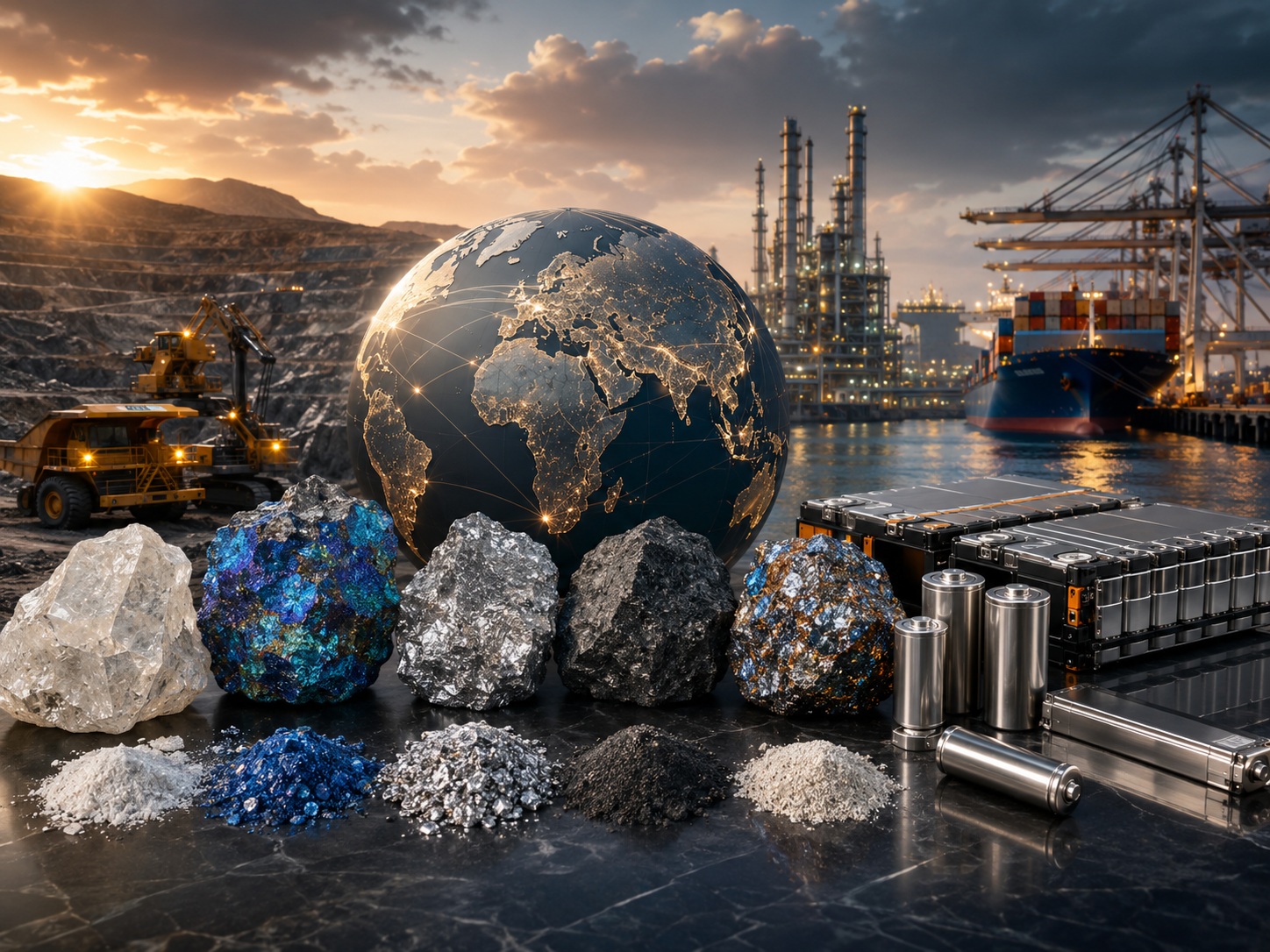
Oil shaped the 20th century.
It powered cars, ships, aircraft, factories, wars, empires, alliances and crises. Countries rose and fell around oil routes. Middle East politics became global politics because energy security depended on oil. The price of oil could create inflation, recession, geopolitical panic and military intervention.
Now the world is entering a new resource age.
The strategic resource of the 21st century may not be oil alone. It may be lithium, cobalt, nickel, copper, graphite, manganese, gallium, germanium and rare earth elements.
These minerals are not famous in ordinary political conversation. They do not carry the emotional weight of oil. No one stands at a petrol pump thinking about neodymium, dysprosium, cobalt or graphite. But these minerals quietly sit inside the technologies that will define the future: electric vehicles, batteries, solar panels, wind turbines, power grids, semiconductors, drones, satellites, missiles, fighter jets, smartphones, data centres and artificial intelligence infrastructure.
The world wants clean energy, electric mobility, digital systems and advanced defence technologies.
All of them need minerals.
That is why critical minerals are becoming the new oil of the global economy.
But there is one important difference. Oil geopolitics was mainly about extraction. Critical mineral geopolitics is about extraction, processing, refining, technology, manufacturing and recycling. A country may have mineral reserves, but if it cannot process them, it remains dependent. A country may mine lithium, but if refining and battery manufacturing happen elsewhere, the real value goes elsewhere.
This is why the critical minerals race is not only a mining race.
It is a supply-chain race.
Why Critical Minerals Matter
Critical minerals are called “critical” because they are essential for modern economies and vulnerable to supply disruption.
They are critical for clean energy because batteries, electric vehicles, wind turbines, solar equipment, transmission networks and grid-scale storage depend on them. They are critical for digital power because semiconductors, data centres, telecom equipment and electronics require specialised minerals. They are critical for defence because missiles, aircraft, radar systems, satellites, drones and precision-guided weapons depend on high-performance materials.
The International Energy Agency’s Global Critical Minerals Outlook 2025 reported that demand for key energy minerals continued to rise in 2024, with lithium demand increasing by nearly 30%, while demand for nickel, cobalt, graphite and rare earths rose by 6–8%, driven largely by electric vehicles, battery storage, renewable energy and grid networks.
This is the central point.
The energy transition does not eliminate resource dependence. It changes the resources on which countries depend.
The old energy system depended on oil, gas and coal.
The new energy system depends on lithium, nickel, cobalt, graphite, copper and rare earths.
So the question is not whether the world can escape resource politics. It cannot. The question is whether the new resource politics will be more secure, diversified and fair than the old one.
At present, the answer is uncertain.
The Clean Energy Paradox
Critical minerals reveal a paradox at the heart of the clean energy transition.
Countries want to reduce dependence on fossil fuels because fossil fuels create climate risk, import dependence and price volatility. But the technologies needed to move away from fossil fuels create new forms of dependence on minerals and processing chains.
An electric vehicle may reduce oil consumption, but it increases demand for battery minerals.
A wind turbine may reduce coal use, but it requires rare earth magnets.
A solar economy may reduce carbon emissions, but it needs polysilicon, silver, copper, aluminium and other inputs.
A modern grid may support renewable energy, but it requires huge amounts of copper and other materials.
This does not mean the clean energy transition is wrong. It means it must be understood honestly. Energy transition is not simply a shift from dirty energy to clean energy. It is also a shift from fuel dependence to mineral dependence.
That shift creates winners, losers and new vulnerabilities.
Countries that control mineral supply chains will gain power. Countries that depend on imports without diversification will face risk. Companies that secure long-term mineral access will dominate clean technologies. Countries that fail to process, refine or recycle minerals may remain at the lower end of the value chain.
The climate transition is therefore also an industrial transition.
And industrial transitions are never geopolitically neutral.
China’s Dominance Is the Core Strategic Anxiety
The most important fact in critical mineral geopolitics is China’s dominance in processing and refining.
The IEA noted in 2025 that China was the leading refiner for 19 out of 20 important strategic minerals, with an average market share of about 70%, and that concentration in processing and refining has intensified in recent years.
This is the heart of the problem.
China does not control every mine in the world. Many minerals are mined in countries such as Australia, Chile, Indonesia, the Democratic Republic of Congo, Argentina, Brazil and others. But China has built enormous processing, refining and manufacturing capacity. That gives it leverage across the chain.
Processing is where raw minerals become usable industrial inputs.
Rare earth ore is not enough. It must be separated and refined.
Lithium resources are not enough. They must be converted into battery-grade chemicals.
Graphite is not enough. It must be processed into battery anode material.
Nickel ore is not enough. It must be refined into forms suitable for batteries and industry.
This is why China’s advantage is powerful. It has built the middle of the chain, where industrial value and strategic control often concentrate.
The Reuters report on China’s rare earth position noted that China controls around 70% of rare-earth mining and 85% of refining, while rare-earth-free motor alternatives remain years away from mass adoption.
This means the global economy faces a difficult reality: many countries want to reduce dependence on China, but they still need Chinese processing capacity.
That is strategic vulnerability.
Export Controls Show the Weaponisation of Minerals
Critical minerals become geopolitical weapons when countries restrict access.
China’s export controls on rare earths and related technologies have turned theoretical supply-chain risk into practical anxiety. In October 2025, China expanded rare earth export controls, adding new elements, increasing scrutiny for semiconductor users and placing refining technologies under tighter control.
This matters because export controls do not merely raise prices.
They can stop production.
If an automobile company cannot access rare earth magnets, EV production can slow. If a semiconductor company cannot access indium, gallium or germanium, advanced chip production may be affected. If defence manufacturers cannot access key minerals, military supply chains become vulnerable.
A tariff makes a product more expensive.
An export control can make it unavailable.
That is why critical minerals are more powerful than ordinary commodities. They sit inside strategic technologies where substitutes may be difficult, expensive or years away.
In May 2026, China said its rare earth and critical mineral export controls were lawful and that it would review compliant civilian licence applications, after discussions with the United States over supply concerns.
That diplomatic language is careful. But the message is clear: control over minerals gives bargaining power.
Defence Makes Critical Minerals Even More Sensitive
Critical minerals are not only about electric cars and green energy.
They are also about war.
Modern defence systems require specialised minerals. Fighter aircraft, missiles, submarines, satellites, night-vision systems, radar, drones, laser systems and secure communications depend on high-performance materials and rare earth magnets.
The United States has treated processed critical minerals and derivative products as essential to national security because of their role in military infrastructure, advanced defence systems, jet engines, missile guidance, radar, secure communications and advanced computing.
This is why the critical minerals debate cannot be reduced to climate policy.
It is also defence policy.
A country that lacks access to critical minerals may struggle to produce advanced weapons. A country that depends on a rival for mineral processing may face supply risk during conflict. A country that cannot recycle or stockpile key minerals may find itself vulnerable in prolonged crises.
The Russia-Ukraine war has already shown how industrial capacity, ammunition supply and technology inputs matter in modern conflict. Critical minerals are part of that larger lesson.
The future battlefield will not only be supplied by oil.
It will be supplied by minerals.
Critical Minerals and the Electric Vehicle Race
Electric vehicles are one of the biggest drivers of critical mineral demand.
EV batteries require lithium, nickel, cobalt, manganese, graphite and other materials, depending on chemistry. Motors may require rare earth magnets. Charging infrastructure requires copper and other inputs. Grid expansion requires more minerals.
This creates a new industrial race.
Countries that control EV supply chains will shape the future of mobility. China currently has a major advantage in battery manufacturing, processing and EV production. Western countries are trying to respond through subsidies, domestic manufacturing, mineral partnerships and local content rules. India is trying to build its EV ecosystem while reducing dependence on imported components.
The problem is that EV supply chains are deeply mineral-intensive.
If lithium prices rise, battery costs are affected.
If cobalt supply is disrupted, battery chemistry choices change.
If rare earth magnets become restricted, motor design becomes a strategic issue.
If graphite processing is controlled by one country, battery manufacturing becomes vulnerable.
This is why carmakers are now forced to think like mining strategists. They must secure long-term mineral supply, diversify sourcing, invest in recycling and monitor geopolitics.
The automobile industry is no longer just about engines, design and brands.
It is about mineral security.
Copper: The Unsung Strategic Metal
While lithium and rare earths attract attention, copper may be one of the most important minerals of the energy transition.
Copper is essential for power grids, electric vehicles, renewable energy systems, transmission lines, motors and electronics. A clean-energy economy needs far more electrical infrastructure, and electrical infrastructure needs copper.
The strategic issue with copper is not just scarcity. It is permitting, investment, ore quality, environmental concerns, mining timelines and geopolitical risk. New mines often take years to develop. Communities oppose mining projects. Environmental rules delay approvals. Capital investment is high.
This creates a slow supply response.
The world may demand minerals quickly, but mines do not appear quickly.
That time lag is one of the biggest risks in the energy transition.
The Global South’s Resource Opportunity
Critical minerals create a major opportunity for the Global South.
Many mineral-rich countries are in Africa, Latin America and parts of Asia. The Democratic Republic of Congo is central to cobalt. Chile and Argentina matter for lithium. Indonesia matters for nickel. Australia is a major mineral power. Several African countries hold copper, cobalt, graphite, manganese and rare earth potential.
This gives resource-rich developing countries bargaining power.
But it also creates danger.
If these countries only export raw minerals, they may repeat the old colonial pattern: resources leave, value is added elsewhere, and local economies remain dependent on commodity cycles.
The real opportunity lies in value addition.
Mineral-rich countries should push for processing, refining, battery manufacturing, skills development, infrastructure, environmental safeguards and local employment. They should avoid becoming mere extraction zones for the clean energy ambitions of richer countries.
The green transition must not become green colonialism.
That is the moral challenge.
Africa’s Critical Mineral Moment
Africa sits at the centre of the critical minerals race.
The continent has major resources needed for clean energy, batteries, infrastructure and advanced manufacturing. But Africa has historically suffered from resource extraction without adequate industrial transformation. Minerals have often left the continent in raw form, while processing, technology and profits were captured elsewhere.
Critical minerals could change this — but only if African countries negotiate better terms.
They need mineral diplomacy that demands local processing, infrastructure, skills, environmental standards and sovereign control. They need regional coordination so countries do not undercut each other. They need financing that does not create debt traps. They need technology partnerships that build local capability.
India, Japan, Europe, the United States and China will all seek mineral partnerships in Africa. African countries must use this competition to secure better deals.
The old resource model was extraction.
The new model must be co-development.
Latin America and Lithium Politics
Latin America is central to lithium politics.
Countries such as Chile, Argentina and Bolivia are often discussed in relation to lithium resources. Lithium is essential for many battery technologies, making it strategically important for electric vehicles and energy storage.
But lithium politics is complex.
Countries want investment, but they also want sovereignty over resources. They want exports, but they also want domestic value addition. They want environmental protection, but extraction can affect water, land and communities. They want foreign partners, but they do not want dependency.
This is why lithium is not merely a commodity.
It is a national development question.
How countries manage lithium will determine whether they become raw material suppliers or participants in the battery economy.
India’s Critical Mineral Challenge
India’s critical mineral challenge is serious.
India wants to become a manufacturing power. It wants electric mobility, renewable energy, battery storage, electronics manufacturing, semiconductor capacity, defence modernisation and strategic autonomy. All of this requires critical minerals.
But India does not yet control enough of the critical mineral chain.
It has some domestic mineral potential, but exploration and extraction are still developing. It imports many key minerals and processed inputs. Its processing and refining capacity is limited in several strategic areas. Its recycling ecosystem is still emerging.
This is why India launched the National Critical Mineral Mission in 2025. The government described the mission as a blueprint to secure domestic and global supply chains of critical minerals, with goals including 1,000 patents by 2030, seven Centres of Excellence and a ₹1,500 crore incentive scheme to boost recycling capacity.
This is a necessary step.
But the challenge is much larger than one mission.
India must explore, mine, process, refine, recycle, stockpile and secure overseas assets. It must work with resource-rich countries. It must build private-sector capability. It must reduce import dependence in strategic minerals. It must create mineral processing parks. It must connect mineral policy with EVs, batteries, defence, electronics and renewable energy.
Critical mineral security must become a whole-of-economy strategy.
India’s National Critical Mineral Mission
The National Critical Mineral Mission is India’s most important policy response to the mineral security challenge.
The Cabinet approved the mission in January 2025, aiming to encourage Indian public sector and private companies to acquire critical mineral assets abroad, enhance trade with resource-rich countries, develop domestic stockpiles, set up mineral processing parks, support recycling and promote research through a Centre of Excellence on Critical Minerals.
The mission runs from FY 2024–25 to FY 2030–31, with an earmarked expenditure of ₹16,300 crore and expected public sector undertaking investment of ₹18,000 crore over seven years.
This shows India understands the scale of the issue.
But policy design is only the beginning. The real test will be implementation.
Can India auction and develop mineral blocks quickly?
Can it attract serious private investment?
Can it build processing technology?
Can it acquire overseas assets before competitors do?
Can it recycle minerals at scale?
Can it build reliable environmental and social safeguards?
Can it avoid bureaucratic delay?
These questions will decide whether the mission becomes strategic transformation or another policy announcement.
Auctions, Exploration and the Domestic Base
India has begun auctioning critical and strategic mineral blocks.
The Ministry of Mines announced in September 2025 that the sixth tranche of critical and strategic mineral auctions would include blocks containing minerals such as rare earth elements, tungsten, lithium, tin, graphite, vanadium, titanium, cobalt, zirconium, gallium, rock phosphate, potash and rare metals.
This is important because India must first understand and develop its domestic mineral base.
However, mining is not easy.
Exploration takes time. Resource estimates must be reliable. Environmental permissions matter. Local communities must be consulted. Infrastructure must be built. Investors need confidence in geology, policy and returns.
India’s lithium story shows the difficulty. The Jammu and Kashmir lithium block did not attract bids in a second auction attempt in 2024, partly reflecting uncertainty around the deposit and commercial viability.
This is a useful warning.
Discovering minerals is not the same as producing minerals.
Producing minerals is not the same as processing them.
Processing minerals is not the same as controlling a supply chain.
India must move through all these stages carefully.
Overseas Mineral Strategy
India cannot rely only on domestic resources.
It must secure overseas mineral partnerships.
This means working with countries such as Australia, Argentina, Chile, Brazil, African mineral-rich states and others. It also means using diplomatic, financial and corporate tools to acquire stakes in mines, offtake agreements, refining projects and recycling partnerships.
The National Critical Mineral Mission explicitly aims to encourage Indian companies to acquire mineral assets abroad and deepen trade with resource-rich countries.
This is where foreign policy becomes mineral policy.
Embassies must track opportunities.
Public sector firms must move faster.
Private firms must be supported with finance and risk insurance.
Trade agreements must include mineral cooperation.
Development partnerships must include value addition, not just extraction.
India’s future manufacturing ambitions will depend partly on whether it can secure resources before global competition tightens further.
Recycling: The Urban Mine
Critical mineral security is not only about mining new resources.
It is also about recycling old ones.
Used batteries, electronic waste, end-of-life vehicles, magnets, industrial scrap and renewable energy equipment contain valuable minerals. As EV adoption and electronics consumption rise, recycling can become a major source of supply.
India has recognised this. Under the National Critical Mineral Mission, the government approved a ₹1,500 crore incentive scheme to boost recycling capacity for critical minerals.
This is strategically smart.
India is a large electronics and vehicle market. Over time, it can create an “urban mine” from e-waste, battery scrap and industrial materials. Recycling reduces import dependence, lowers environmental pressure and creates circular economy jobs.
But recycling requires technology, collection systems, formalisation, safety standards and scale.
India’s informal recycling sector is large but often unsafe and inefficient. The challenge is to build a formal recycling ecosystem that can recover minerals without harming workers or the environment.
The country that masters recycling will reduce its dependence on unstable mining supply chains.
Processing Is the Real Bottleneck
India’s biggest weakness is not only mining.
It is processing.
Critical minerals become useful only after complex processing and refining. Rare earth separation is technically difficult. Battery-grade lithium chemicals require precision. Graphite anode processing requires specialised systems. Cobalt, nickel and manganese require chemical processing chains.
China’s dominance exists because it invested in this middle layer.
India must not repeat the mistake of focusing only on extraction. If India mines minerals but sends them abroad for processing, it will remain dependent. If India imports processed materials and only assembles finished products, it will capture limited value.
The real strategy must be to build processing parks, chemical refining capability, metallurgical research, specialised equipment, environmental systems and skilled manpower.
This is the hard industrial work behind mineral security.
Environmental and Social Risks
Critical mineral mining has environmental costs.
Lithium extraction can affect water systems. Cobalt mining can involve labour and human rights concerns. Nickel processing can create pollution. Rare earth refining can generate toxic waste. Mining projects can displace communities or damage ecosystems.
The clean energy transition must not ignore these costs.
A mineral used in green technology is not automatically green if extracted irresponsibly.
This is a major challenge for India and the world. Countries must build mineral supply chains that are environmentally responsible, socially fair and transparent. Otherwise, the green transition may reproduce the same extractive injustices associated with fossil fuels.
The future of critical minerals must include strong environmental safeguards, community consent, worker safety and responsible mining standards.
Clean energy cannot be built on dirty extraction.
Critical Minerals and Trade Wars
Critical minerals are now entering trade wars.
Countries are using export controls, subsidies, tariffs, local-content rules and strategic stockpiling. The United States, China, Europe, Japan, Australia and India are all trying to secure supply chains. The Quad has also moved toward stronger cooperation on critical minerals.
Recent reporting said Quad countries planned to mobilise $20 billion from government and private sources to strengthen mining, processing and recycling capabilities in critical minerals, with the initiative widely seen as a response to supply concentration concerns around China.
This shows that mineral diplomacy is now alliance diplomacy.
Countries are not only looking for resources. They are looking for trusted mineral networks.
The phrase “trusted supply chains” will become increasingly important. Minerals will not move only through the cheapest route. They will move through politically reliable routes.
This may make supply chains more resilient, but also more fragmented and expensive.
The Price Volatility Problem
Critical mineral markets are volatile.
Prices can rise quickly when demand surges or supply is disrupted. They can also fall when investment rushes in or demand slows. This creates uncertainty for miners, manufacturers and policymakers.
If prices are too high, clean energy becomes expensive.
If prices fall too much, new mining projects become financially unviable.
This boom-bust cycle can delay supply expansion. Companies may hesitate to invest in new mines if prices are unstable. Governments may struggle to design incentives. Consumers may face higher EV or battery costs during shortages.
Oil markets had decades to develop financial, storage and strategic systems.
Critical mineral markets are still maturing.
That immaturity is a risk.
Substitution and Innovation
One way to reduce mineral vulnerability is technological innovation.
Battery chemistry can shift away from scarce or expensive minerals. Motors can be designed with fewer rare earths. Recycling can recover materials. New extraction technologies can reduce environmental impact. AI and satellite systems can improve exploration. Material science can create substitutes.
But substitution takes time.
Reuters reported that rare-earth-free motor alternatives remain years away from mass adoption, which means current rare earth dependence cannot be eliminated quickly.
This is why countries cannot rely only on innovation.
They need supply security now and technological alternatives over time.
The smartest strategy is both: secure today’s minerals while investing in tomorrow’s substitutes.
Stockpiling: The Strategic Reserve Question
Countries may need strategic reserves of critical minerals, just as they maintain petroleum reserves.
The National Critical Mineral Mission includes the development of critical mineral stockpiles within India.
This is sensible because supply disruptions can happen suddenly. Export controls, wars, shipping disruptions or price spikes can affect industries quickly.
Stockpiling cannot solve long-term dependence, but it can provide short-term resilience.
The question is which minerals to stockpile, how much to store, where to store them, and how to manage quality and rotation. This requires coordination between government, industry and defence planners.
Critical mineral reserves will become part of national security planning.
India’s Manufacturing Future Depends on Minerals
India wants to become a manufacturing power.
But manufacturing power requires mineral security.
EVs require batteries and magnets.
Solar manufacturing requires mineral inputs.
Electronics require rare materials and semiconductors.
Defence manufacturing requires high-performance metals and rare earths.
Semiconductor ecosystems require specialised minerals and gases.
If India wants to build these industries, it must secure their inputs.
This is why critical minerals are connected to Make in India, Atmanirbhar Bharat, PLI schemes, EV policy, renewable energy targets, defence modernisation and semiconductor strategy.
Mineral security is not a separate sector.
It is the foundation beneath many sectors.
The New Resource Diplomacy
Critical minerals are creating a new form of diplomacy.
India’s foreign policy will increasingly include mineral agreements, offtake contracts, joint ventures, exploration partnerships, processing investments and recycling cooperation. Countries rich in minerals will gain new diplomatic attention. Countries with processing technology will gain influence. Countries with finance will shape projects. Countries with large markets will negotiate supply security.
This will create new partnerships.
India-Australia ties will deepen around lithium, cobalt and other minerals.
India-Latin America engagement will include lithium and copper.
India-Africa relations will include cobalt, graphite, manganese and rare earths.
India-Japan and India-US cooperation will include supply-chain resilience.
India’s trade diplomacy will become mineral diplomacy.
The country that understands this early will have an advantage.
The Risk of a New Dependency
The biggest risk is that the world replaces oil dependency with mineral dependency.
If clean energy supply chains depend heavily on one country for processing, the energy transition becomes geopolitically fragile. If developing countries supply raw materials while rich and powerful countries capture processing and manufacturing, inequality continues. If environmental damage shifts from oil fields to mineral mines, the moral credibility of the green transition weakens.
The goal should not be merely to move away from oil.
The goal should be to build a more diversified, transparent, resilient and fair resource system.
Critical minerals should not become the new oil in the worst sense: a source of conflict, exploitation and dependency.
They should become the foundation of a more balanced industrial order.
But that will require deliberate policy.
Markets alone will not ensure fairness.
What India Must Do
India needs a serious critical mineral strategy with seven pillars.
First, accelerate exploration with better geological data, AI tools, private participation and transparent auctions.
Second, build domestic processing and refining capacity, not just mining.
Third, acquire overseas assets through public-private partnerships and mineral diplomacy.
Fourth, create strategic stockpiles for the most vulnerable minerals.
Fifth, scale recycling from e-waste, battery scrap and end-of-life vehicles.
Sixth, invest in research, patents, substitutes and advanced material science.
Seventh, integrate mineral strategy with manufacturing policy, especially EVs, batteries, semiconductors, defence and renewable energy.
This cannot be handled by one ministry alone.
It requires coordination between mines, commerce, heavy industries, renewable energy, defence, external affairs, environment, finance, science and technology, and state governments.
Critical mineral security is a national project.
Conclusion: The Mineral Age Has Begun
Critical minerals have become the new oil because they sit at the centre of the technologies that will define the 21st century.
Oil powered the industrial and military order of the last century.
Critical minerals will power the clean-energy, digital and defence order of this century.
The struggle is already visible. China dominates processing. The United States and its partners are trying to build trusted supply chains. Europe wants strategic autonomy. India has launched its National Critical Mineral Mission. African and Latin American countries are seeking better value from their resources. Automakers, battery companies and defence firms are rushing to secure supplies.
This is not a temporary commodity story.
It is a structural transformation of global power.
For India, the stakes are enormous. Without critical minerals, India’s ambitions in electric mobility, renewable energy, electronics, semiconductors, defence manufacturing and strategic autonomy will remain vulnerable. With a strong mineral strategy, India can build industrial depth, reduce dependence and become a serious player in the new global economy.
But India must act fast.
The mineral race has already begun.
The countries that secure resources, processing technology, recycling systems and trusted partnerships will shape the next phase of globalisation.
The countries that delay will remain dependent.
In the 20th century, the world learned that oil could decide wars, inflation, alliances and development.
In the 21st century, lithium, cobalt, nickel, graphite and rare earths may do the same.
The age of critical minerals is not coming.