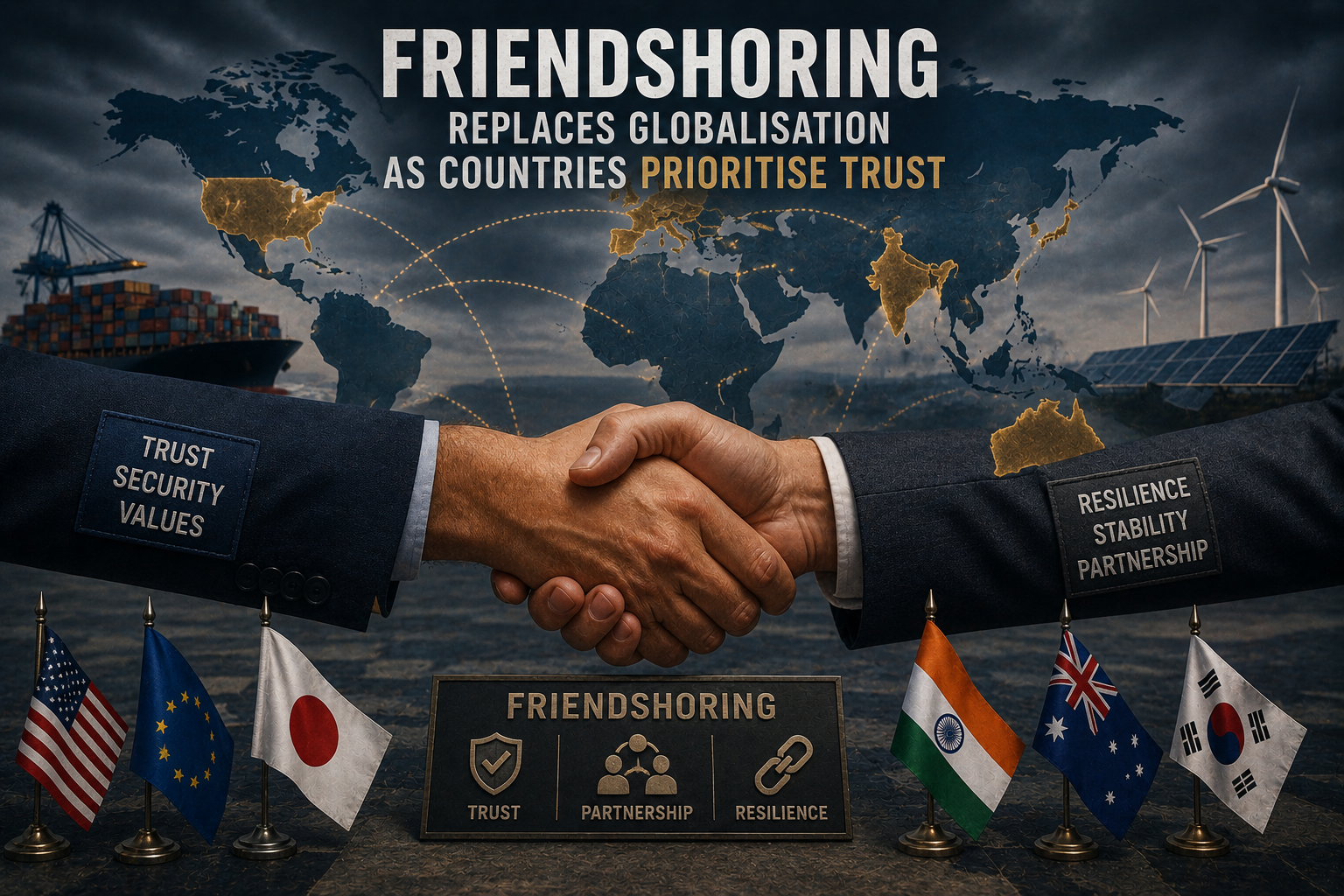
Trust becomes an economic input
Globalisation once asked one main question: where is production cheapest? Friendshoring asks a different question: whom can we trust when the world breaks? That shift captures the transformation of the global economy. Countries and firms still care about cost, but trust has become an economic input. A supplier in a politically reliable country may now be worth more than a cheaper supplier in a risky one.
Friendshoring does not mean trade only with allies. It means shifting critical production, sourcing and logistics toward countries considered politically safer, strategically aligned or less likely to weaponise interdependence. It is the economic expression of geopolitical anxiety.
The idea gained force after the pandemic, US-China rivalry, the Ukraine war, sanctions, export controls and shipping disruptions. Businesses discovered that efficiency without resilience can become fragility. Governments discovered that dependence can become vulnerability. The old globalisation promised interdependence would reduce conflict. The new logic says interdependence must be filtered through trust because conflict can weaponise it.
The current trigger: China risk and crisis memory
The biggest driver of friendshoring is China risk. China remains central to global manufacturing, but its scale now creates unease. Western governments worry about dependence in semiconductors, batteries, pharmaceuticals, telecom, rare earths and clean technology. Firms worry about tariffs, export controls, political pressure and sudden disruptions. Countries in Asia worry about being forced into strategic choices.
Pandemic memory also matters. Shortages of medical supplies and logistics breakdowns taught governments that critical goods cannot be treated like ordinary consumer products. The Ukraine war then showed how energy dependence could reshape foreign policy. Red Sea shipping disruptions showed how conflict far from factories can still raise costs globally.
Friendshoring is therefore not a fashion. It is a response to accumulated shocks.
How friendshoring differs from old globalisation
Old globalisation measured success by efficiency, scale and integration. Friendshoring measures success by resilience, redundancy and political reliability. It does not abandon global trade; it edits it. Non-critical goods may still follow cost logic. Critical sectors receive strategic treatment.
This creates a hierarchy of goods. Semiconductors, defence components, energy systems, critical minerals, medicines, food, telecom equipment and data infrastructure are treated differently from toys, apparel or furniture. The more strategic the product, the more likely governments will intervene.
The geography of production also changes. Mexico benefits from nearshoring to the US. Eastern Europe and Turkey matter for Europe. Vietnam, India, Indonesia and Malaysia matter for Asia diversification. The Gulf becomes important for energy, capital and logistics. Africa may gain if it can connect minerals, labour and infrastructure.
India angle: opportunity with a performance test
India is one of the biggest potential beneficiaries of friendshoring. It is democratic, large, strategically relevant, relatively trusted by the West, connected to the Global South and interested in reducing dependence on China. Its domestic market gives firms a demand base. Its services strength supports manufacturing through software, design, finance and management.
But trust alone will not bring factories. Friendshoring opens the door; competitiveness keeps investors inside. India must improve logistics, simplify compliance, deepen supplier networks, ensure policy stability and raise workforce skills. Investors compare India not with an abstract ideal but with Vietnam, Mexico, Indonesia, Thailand, Eastern Europe and China itself.
The risk is that India becomes a political alternative but not an operational alternative. To avoid that, it must convert geopolitical goodwill into industrial capability.
Friendshoring and the Global South
Friendshoring can create new opportunities for developing countries, but it can also create exclusion. Countries that are seen as politically risky may be bypassed even if they are cost-competitive. Countries outside major alliance networks may struggle to attract strategic investment. Standards may become tools of exclusion disguised as trust.
This is where India has a diplomatic role. It can argue that trusted supply chains should not become closed clubs of rich economies. If resilience simply means moving production from one advanced-economy partner to another, the Global South gains little. A fair friendshoring model should include capacity building, technology transfer, infrastructure finance and market access for developing countries.
India can position itself as both beneficiary and advocate: a trusted partner for advanced economies and a voice for inclusive supply-chain restructuring.
Global implications: the politics of dependence
Friendshoring changes how countries think about dependence. Dependence on a rival becomes dangerous. Dependence on a friend becomes manageable. But this logic has limits. Friends can also change governments, impose tariffs, demand concessions or prioritise domestic interests. Trust in international economics is never absolute; it is always conditional.
Friendshoring may also reduce efficiency. Duplicating supply chains, holding inventories and moving production to higher-cost locations can raise prices. Consumers may pay for resilience without always seeing the benefit. Firms may resist if political demands undermine profitability.
At the same time, the cost of fragility can be higher than the cost of redundancy. The pandemic and wars taught governments that resilience is expensive until crisis arrives; then the lack of resilience is more expensive.
Counter-view: globalisation is adapting, not dying
The counter-view is that friendshoring is overstated. Global supply chains remain deeply interconnected. China is too large and efficient to be replaced quickly. Many companies talk about diversification but continue sourcing heavily from China. Trade data often show rerouting rather than true decoupling, with Chinese components moving through third countries.
This is true. Friendshoring is not a clean break. It is a layered adjustment. Firms may add capacity in India or Vietnam while keeping China as a core supplier. Governments may restrict advanced chips while allowing consumer trade. The future is selective de-risking, not total separation.
But selective de-risking still changes globalisation. It means politics now sits inside every major supply-chain decision.
What happens next
India should track actual investment flows, not announcements; component localisation, not only assembly; export growth, not only domestic sales; and supplier depth, not only flagship factories. It should also negotiate standards partnerships with trusted economies while preserving autonomy.
The editorial conclusion is that friendshoring replaces the innocence of old globalisation with the caution of a harder world. Trust is now part of cost. Politics is now part of logistics. The countries that understand this early will shape the next map of trade.
Internal Links to Add
• The WTO Struggles to Survive in a World of Trade Wars
• Trade Corridors Become Strategic Tools in the New World Economy
• Global Debt Crisis Puts Developing Nations Under Pressure
• Supply Chains Become the New Battlefield of International Power