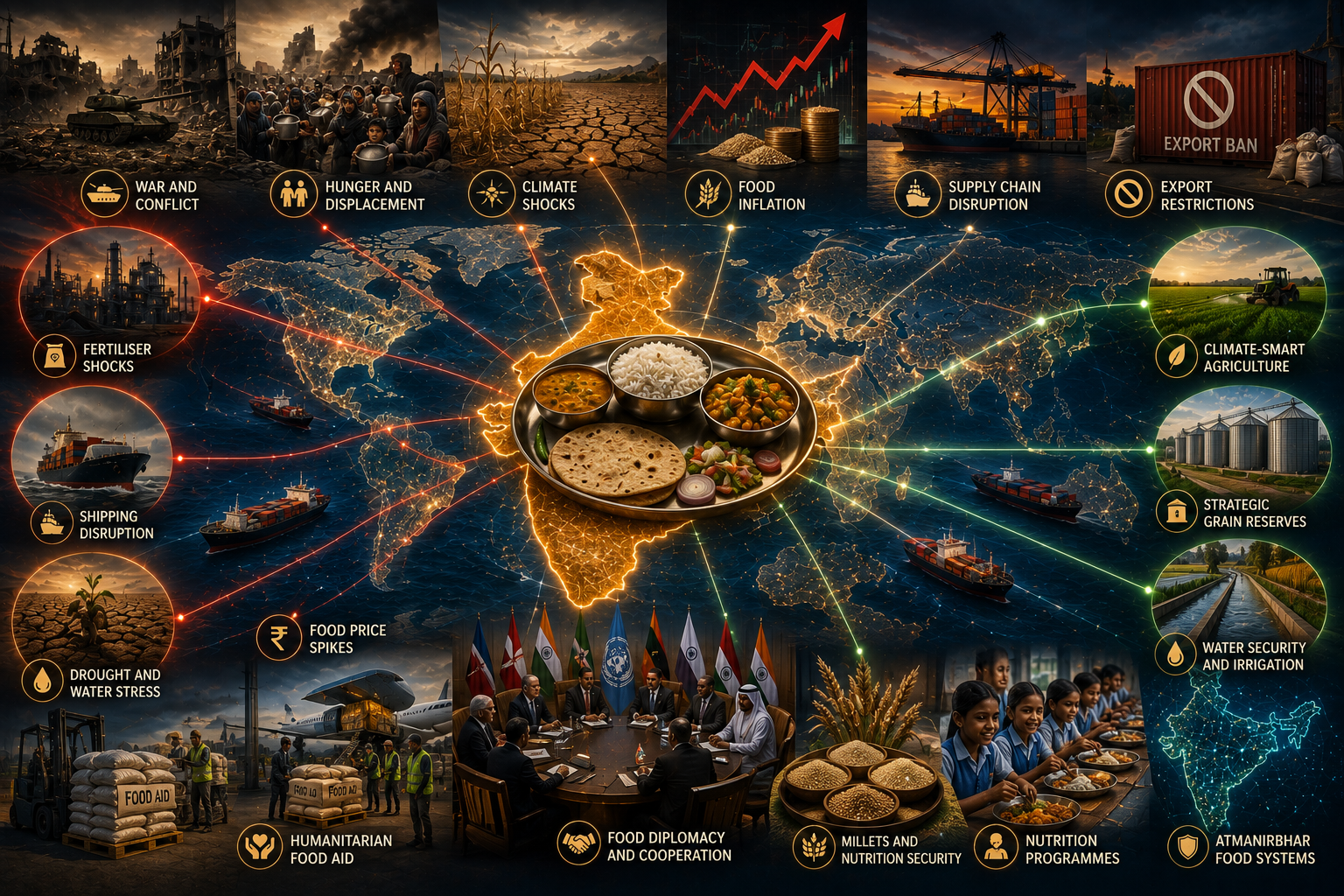
Food was once treated mainly as a domestic policy issue.
Governments worried about farmers, prices, public distribution, storage, subsidies, nutrition and agricultural production. Foreign policy was seen as something different: diplomacy, war, alliances, trade routes, sanctions and global institutions.
That separation no longer works.
Food security has become a major foreign policy concern because hunger is now shaped by events far beyond national borders. A war in one region can raise grain prices in another. A fertiliser shock can reduce harvests across continents. A drought can trigger export bans. A blocked sea route can delay food shipments. A currency crisis can make imports unaffordable. A conflict can turn famine into a political weapon.
The dinner plate is now connected to geopolitics.
This is why food security is no longer only about agriculture. It is about national security, climate security, trade security, humanitarian diplomacy and global power. Countries that cannot secure food face instability. Countries that can supply food gain influence. Countries that control fertiliser, grain, shipping routes, seeds, finance and agricultural technology acquire strategic leverage.
The world is not facing a simple shortage of food. It is facing a crisis of access, affordability, distribution, conflict and resilience.
The 2026 Global Report on Food Crises found that 266 million people in 47 countries and territories faced high levels of acute food insecurity in 2025, representing almost 23% of the analysed population. It also confirmed famine in Gaza Governorate and parts of Sudan in 2025, the first time since the report began that famine was confirmed in two separate contexts in the same year.
These numbers reveal why food has entered foreign policy. Hunger is no longer a humanitarian footnote. It is a global stability issue.
Food Security Is Now National Security
Food insecurity can destabilise societies faster than many traditional security threats.
When food prices rise sharply, household budgets collapse. Poor families cut meals. Children leave school. Malnutrition rises. Public anger grows. Governments face protests. Migration increases. Extremist groups exploit desperation. Conflict zones become harder to stabilise.
This is why food security is now national security.
A country may have strong borders and a powerful military, but if people cannot afford food, internal stability weakens. A government that cannot manage food prices loses legitimacy. A state that depends heavily on imported staples becomes vulnerable to external shocks.
Food security therefore has three layers.
The first is availability: whether enough food exists.
The second is access: whether people can afford and obtain it.
The third is resilience: whether the food system can survive shocks.
Modern crises often occur not because the world has no food, but because food is priced, blocked, redirected or made unaffordable.
The World Bank’s May 2026 Food Security Update said global food and nutrition insecurity was increasing despite broadly stable supplies of major staples. It identified conflict and climate shocks as the primary drivers of acute food insecurity, while agricultural and cereal price indices had risen since March 2026.
That sentence captures the new reality: food exists, but security does not.
Hunger Is a Political Failure, Not Only a Production Failure
The world produces enough food to feed humanity. Yet hunger persists because food systems are unequal, fragile and politically exposed.
Some regions waste food. Others cannot afford imports. Some countries subsidise farmers heavily. Others lack irrigation and storage. Some governments use food exports as leverage. Others depend on external aid. Some conflict actors deliberately block food access. Others destroy farms, ports and supply chains.
This is why hunger is often a political failure.
The State of Food Security and Nutrition in the World 2025 estimated that 673 million people faced hunger in 2024, equal to 8.3% of the global population. It also reported that about 2.3 billion people experienced moderate or severe food insecurity in 2024, which was 336 million more than in 2019 before the pandemic.
These figures show that hunger is not limited to famine zones. It exists across income levels, but it hits poorer societies hardest because they spend a larger share of income on food.
Food price inflation is therefore not just an economic statistic. It is a hunger multiplier.
When prices rise, rich households adjust. Poor households sacrifice nutrition.
War Has Become a Direct Driver of Hunger
Conflict is now one of the strongest drivers of food insecurity.
Wars destroy farms, kill livestock, mine fields, disrupt planting seasons, damage ports, block roads, raise insurance costs and force people to flee. They also make humanitarian access difficult. In many conflicts, food is not merely a casualty. It becomes a weapon.
The 2026 Global Report on Food Crises identified conflict as a central driver of acute food insecurity and warned that severe levels of food insecurity would remain critical in multiple contexts in 2026. It also said ongoing conflicts, climate variability and global economic uncertainty are likely to sustain or worsen conditions in many countries.
This is why foreign policy cannot treat food separately from peace.
A ceasefire can become a food intervention. A safe corridor can become a nutrition policy. A sanctions exemption can become a humanitarian necessity. A port reopening can save lives. A diplomatic negotiation over access can matter as much as a shipment of grain.
Food diplomacy begins where conflict blocks survival.
The Russia-Ukraine War Changed the Food Debate
The Russia-Ukraine war reminded the world how concentrated grain and fertiliser systems can affect global stability.
Russia and Ukraine are major players in wheat, sunflower oil, fertilisers and energy-linked agricultural inputs. When the war disrupted Black Sea exports, the effects were felt far beyond Europe. Import-dependent countries in Africa, West Asia and parts of Asia faced higher prices and uncertainty.
The lesson was clear: food security is not only about farms inside national borders. It depends on shipping lanes, insurance markets, ports, payment systems, fertiliser supply chains and geopolitical stability.
This war also revealed a moral contradiction. Rich countries could absorb higher food prices more easily. Poor import-dependent countries faced hunger risk. The same shock produced inconvenience in one place and catastrophe in another.
That is why food security has become a Global South issue.
Many developing nations do not control global grain prices, fertiliser markets, shipping costs or major currency movements. Yet they suffer when those systems break.
Fertiliser Is the Hidden Link in Food Diplomacy
Food security is not only about grain. It is also about fertiliser.
Modern agriculture depends heavily on nitrogen, phosphorus and potassium. Fertiliser prices are linked to energy prices, especially natural gas. When energy markets are disrupted, fertiliser becomes expensive. When fertiliser becomes expensive, farmers use less. When farmers use less, yields can fall. When yields fall, food prices rise.
This chain turns energy geopolitics into food insecurity.
The World Bank’s May 2026 update said disruptions to oil, gas and fertiliser flows through the Strait of Hormuz had driven a 46% month-on-month rise in urea prices, and it projected that fertiliser prices would rise by 31% on average in 2026, reaching their least affordable levels since 2022.
This is why fertiliser is now a strategic commodity.
Countries that depend on imported fertiliser are vulnerable. Countries that produce fertiliser gain leverage. Countries that can support efficient fertiliser use, biofertilisers, soil health, irrigation and climate-smart agriculture will have stronger food security.
For India, fertiliser security is especially important because millions of farmers depend on timely access to affordable inputs. India’s food security cannot be separated from fertiliser diplomacy with Russia, West Asia, Africa and global suppliers.
Export Bans Show the Conflict Between Domestic Security and Global Responsibility
When food prices rise, governments often restrict exports to protect domestic consumers.
This is politically understandable. No government wants to explain to citizens why food is being exported while local prices are rising. But when major exporters impose restrictions, global prices can rise further, hurting import-dependent countries.
This is the food security dilemma.
Domestic responsibility can create global instability.
India has faced this dilemma repeatedly. As a major rice exporter and large food-consuming nation, India must balance domestic price stability with global market expectations. During periods of uncertainty, India has imposed or relaxed export restrictions to protect domestic availability.
The problem is not India alone. Many countries use export restrictions during crises. But when several exporters do this together, the global market becomes more volatile.
Food-importing countries then lose trust in open trade and start building reserves, diversifying suppliers or investing abroad in farmland and logistics.
This is how food becomes foreign policy.
A rice export decision in New Delhi, a wheat decision in Moscow, a fertiliser decision in Beijing or an oil decision in the Gulf can influence food security in Africa, West Asia and small island economies.
Climate Change Is Turning Agriculture Into a Diplomatic Issue
Climate change is making food security more unpredictable.
Droughts, floods, heatwaves, cyclones, erratic rainfall, changing pest patterns and water stress are affecting agricultural production. Climate shocks are not limited to one region. They can occur simultaneously across major breadbaskets, creating global price pressure.
Food systems are climate systems.
The FAO Food Price Index averaged 130.7 points in April 2026, rising for a third consecutive month. FAO linked cereal-price pressure partly to drought in parts of the United States, rainfall concerns in Australia, high fertiliser prices, elevated energy costs and disruptions connected to the effective closure of the Strait of Hormuz.
This shows how climate, energy, fertiliser and geopolitics now interact.
A heatwave is no longer only an agricultural event. It can become a trade event. A drought can become an inflation event. A crop failure can become a migration event. A water crisis can become a diplomatic dispute.
Climate adaptation must therefore become part of foreign policy.
Countries need cooperation on drought-resistant seeds, weather forecasting, crop insurance, water management, grain reserves, climate finance and resilient supply chains.
Food Prices Create Political Instability
Food prices have historically shaped politics.
Bread prices contributed to unrest in different eras. Food inflation has triggered protests in many countries. When ordinary citizens cannot afford staples, political legitimacy erodes quickly.
This is why governments monitor food prices obsessively.
Food inflation hurts the poor most because food accounts for a large share of their expenditure. Even moderate price increases can reduce dietary diversity. Families shift from nutritious foods to cheaper staples. Children suffer. Women often reduce their own consumption first. Malnutrition becomes hidden before it becomes visible.
The SOFI 2025 report warned that high prices can push families toward cheaper, ultra-processed foods with low nutritional value while fruits, vegetables and high-quality proteins remain expensive. It also found that a 10% increase in food prices is associated with a rise in child wasting and severe wasting among children under five.
This is why food affordability matters as much as food availability.
A country may have full markets and still have hungry citizens if prices are too high.
Food Imports Are a Strategic Vulnerability
Many countries depend heavily on food imports because of geography, water scarcity, small land area, conflict, weak agriculture or rapid urbanisation.
The Gulf imports much of its food because water scarcity limits domestic production. Many African countries import wheat, rice or fertilisers. Small island states depend on shipping routes. Conflict-affected countries depend on humanitarian aid.
Import dependence is not automatically bad. Trade can improve food access. But excessive dependence without reserves, diversified suppliers and stable foreign exchange can become dangerous.
If shipping routes are disrupted, insurance costs rise, currencies weaken or exporters restrict supply, import-dependent countries face immediate pressure.
This is why food-importing countries increasingly treat food as a strategic asset.
They invest in storage. They build supplier relationships. They purchase farmland abroad. They sign long-term grain agreements. They support logistics corridors. They develop strategic reserves. They diversify diets and promote local production where possible.
Food diplomacy is partly about avoiding panic.
Food Aid Is Diplomacy
Humanitarian food assistance is not only charity. It is diplomacy.
When a country supplies grain, rice or pulses to another country in crisis, it builds goodwill. It projects responsibility. It strengthens soft power. It creates moral credibility. It can also stabilise regions that matter strategically.
India has increasingly used food assistance as part of its global role.
On February 18, 2026, the Food Corporation of India and the World Food Programme signed a five-year memorandum under which FCI will supply 200,000 metric tonnes of rice to WFP for global humanitarian operations. The PIB statement described the agreement as support for global humanitarian efforts to combat hunger.
This is a major example of food diplomacy.
India is not merely feeding its own population. It is positioning itself as a responsible contributor to global food security.
For a rising power, this matters. Global leadership is not built only through military strength or economic size. It is also built by helping in crises.
India’s Food Security Is a Strategic Achievement
India’s domestic food security architecture is one of the largest in the world.
The country supports farmers through procurement, minimum support prices, subsidies, irrigation schemes, fertiliser support and agricultural programmes. It supports consumers through the public distribution system and food welfare schemes. It manages buffer stocks through the Food Corporation of India.
This system has flaws: storage losses, regional imbalances, groundwater stress, cereal bias, fiscal burden and nutritional gaps. But its strategic importance is undeniable.
India cannot conduct an independent foreign policy if it cannot feed its population.
For a country of India’s size, food security is sovereignty.
Recent official agriculture estimates show India continues to maintain a strong production base. The Department of Agriculture and Farmers Welfare lists the Third Advance Estimates for foodgrains, oilseeds and commercial crops for 2025–26, released on June 1, 2026.
This production capacity gives India strategic confidence. It allows India to manage domestic needs, respond to global crises and participate in food diplomacy.
But India must not become complacent.
Climate change, groundwater depletion, soil stress, small farm sizes, nutrition inequality and market volatility all threaten long-term food security.
Rice, Wheat and the Politics of Staples
Rice and wheat are more than crops in India. They are political, social and strategic commodities.
They shape farmer incomes, consumer prices, public distribution, procurement policy and export decisions. They also shape India’s global role because India is a major producer and exporter of rice and a large wheat producer.
But staple dependence has risks.
An excessive focus on rice and wheat can distort cropping patterns, worsen groundwater depletion and reduce dietary diversity. It can also limit the growth of pulses, oilseeds, coarse grains, fruits and vegetables.
This is why India’s food security policy must evolve from calorie security to nutrition security.
A person who receives enough calories but lacks protein, micronutrients and dietary diversity is still food insecure in a deeper sense.
Foreign policy also has a role here. India can promote millets, climate-resilient crops, pulses, traditional grains and nutrition-sensitive agriculture as part of global food diplomacy.
Millet Diplomacy and India’s Civilisational Food Power
India’s promotion of millets is an important example of food diplomacy.
Millets are climate-resilient, water-efficient and nutritionally valuable. They are suitable for dryland farming and can support small farmers. In a warming world, such crops matter.
India’s push for the International Year of Millets in 2023 helped convert an agricultural tradition into a global diplomatic platform. Millet diplomacy showed that food power is not only about exporting rice and wheat. It is also about shaping global conversations around sustainable diets, climate-resilient agriculture and nutrition.
This is where India has a distinctive advantage.
India can speak from lived experience. It has managed hunger, public distribution, farmer politics, monsoon uncertainty, nutrition schemes and agricultural transformation at enormous scale. It can offer practical knowledge to the Global South.
India’s food diplomacy should therefore combine exports, humanitarian assistance, technology, traditional knowledge and capacity building.
The Global South Needs Food Sovereignty, Not Food Nationalism
Food sovereignty means countries should have the capacity to shape their own food systems. It does not mean rejecting trade. It means avoiding helpless dependence.
Food nationalism, by contrast, means hoarding, export bans, panic restrictions and zero-sum policies.
The Global South needs the first, not the second.
Developing countries need more investment in agriculture, irrigation, storage, rural roads, extension services, farmer credit, soil health, digital market access, nutrition schemes and climate adaptation. They also need fair global trade rules that do not punish public stockholding, food security programmes or poor farmers.
Food security must not be reduced to market efficiency alone.
For poor countries, food is not an ordinary commodity. It is a right, a welfare instrument, a political stabiliser and a development foundation.
This is why India has consistently defended food security concerns at the World Trade Organization, especially around public stockholding.
Food Security and the WTO
Food security is one of the most difficult issues in global trade negotiations.
Developed countries often criticise subsidies and public procurement as market-distorting. Developing countries argue that food security, farmer livelihoods and public distribution require policy space.
India’s position is shaped by its scale. It must support millions of farmers while providing affordable food to millions of vulnerable households. A purely market-driven food system would create enormous social risk.
The WTO’s agricultural rules were not designed for a world where climate shocks, pandemic disruptions and geopolitical conflicts repeatedly threaten food systems. The rules need to recognise that public food stocks can be essential for stability.
At the same time, countries must ensure that food security policies are transparent and do not unfairly damage other producers.
The challenge is balance.
Global trade rules should prevent harmful protectionism, but they should not weaken the ability of developing countries to feed their people.
Technology Will Shape Future Food Diplomacy
The future of food security will depend on technology.
Drought-resistant seeds, precision agriculture, satellite-based weather systems, AI crop forecasting, soil health mapping, digital procurement, cold chains, storage technology, water-saving irrigation, climate insurance and biotechnology will all become important.
Countries that control agricultural technology will gain influence.
Just as semiconductors shape digital power, seeds and climate-smart agriculture will shape food power. Data on crops, soil, pests and weather will become valuable. Agritech platforms will influence how farmers access markets and inputs. Digital payment and identity systems can improve subsidy delivery.
India has an opportunity here.
It can build food diplomacy around low-cost agricultural technology for the Global South: digital advisory systems, weather alerts, millet cultivation knowledge, storage solutions, dairy models, cooperative systems and public distribution experience.
This would make India a practical partner, not only a grain supplier.
Water Is the Next Food Security Battleground
Food security is deeply connected to water.
Agriculture consumes large amounts of freshwater. Groundwater depletion, glacier melt, erratic monsoons, river disputes and droughts can all threaten food production. Water stress can create local conflict and international tension.
In South Asia, this is especially serious.
The Indus, Ganga-Brahmaputra-Meghna and other river systems support hundreds of millions of people. Climate change can alter flows, intensify floods and worsen dry-season stress. Food security, water security and regional diplomacy are therefore connected.
India must integrate food security into water diplomacy.
This means better river-basin cooperation, flood forecasting, irrigation efficiency, groundwater regulation and climate adaptation. Without water security, food security will weaken.
Food Corridors and Maritime Security
Food moves through corridors.
Grain ships, fertiliser cargoes, cold chains, ports, railways and roads all matter. A food system is only as resilient as the logistics that carry it.
The Red Sea crisis, Black Sea disruption, Strait of Hormuz risks and Panama Canal stress have all shown that maritime chokepoints can affect food availability and prices. For food-importing countries, secure sea lanes are part of food security.
India’s location in the Indian Ocean gives it an important role.
It can help secure maritime routes, support humanitarian logistics, build port partnerships and maintain resilient food corridors with Africa, West Asia and Southeast Asia.
Food security is therefore connected to naval strategy and trade corridor diplomacy.
A sack of grain may look simple, but it depends on a chain of security.
Food Security and Migration
Food insecurity can drive migration.
When crops fail repeatedly, rural livelihoods collapse. When conflict destroys agriculture, people flee. When food prices become unaffordable, families move in search of survival. Climate change will intensify this pattern.
Migration caused by hunger is not only a humanitarian issue. It is a political issue for destination countries and a stability issue for regions.
This is why preventing food crises is cheaper and wiser than responding after displacement begins.
Investment in agriculture, rural livelihoods, climate adaptation and conflict prevention can reduce forced migration. Food security should therefore be part of regional stability policy.
For India, this matters in South Asia and the Indian Ocean region. Food crises in neighbouring countries can create humanitarian and security pressures.
Africa Will Be Central to Future Food Security
Africa is central to the global food security debate.
The continent has enormous agricultural potential, but also faces major challenges: climate vulnerability, low productivity, conflict, weak infrastructure, post-harvest losses, fertiliser access problems and rapid population growth.
SOFI 2025 reported that hunger is rising in Africa, where more than one in five people are affected. It also projected that if current trends continue, 512 million people could face hunger in 2030, with nearly 60% of them in Africa.
This has major foreign policy implications.
Countries that help Africa build resilient food systems will gain goodwill and influence. Countries that treat Africa only as a market or resource base will miss the larger strategic picture.
India can be a major partner here through agricultural training, affordable technology, seeds, irrigation, dairy cooperation, digital public infrastructure and food assistance.
India-Africa food cooperation should become a pillar of South-South diplomacy.
Food Security Cannot Ignore Nutrition
Food security is not only about avoiding hunger.
A country can reduce starvation while still facing malnutrition, anaemia, stunting, obesity and poor dietary diversity. Nutrition security requires access to diverse, healthy and affordable diets.
The SOFI 2025 data showed that only one in three children aged 6–23 months met minimum dietary diversity, and that anaemia among women of reproductive age increased from 27.6% to 30.7% between 2012 and 2023.
This is a serious warning.
The future food policy debate must move beyond grain availability. Pulses, milk, eggs, vegetables, fruits, coarse grains, fortified foods and diverse diets matter.
For India, this means food diplomacy can also include nutrition diplomacy. India can share lessons from school meals, public distribution, fortified rice, millets, dairy cooperatives and community nutrition programmes.
A hungry world does not need only calories. It needs nourishment.
The Humanitarian System Is Under Pressure
Global food assistance depends on funding, logistics and access.
When humanitarian agencies lack money, they must reduce rations, cut programmes or prioritise only the most extreme cases. This creates a tragic hierarchy of hunger: some people receive help only when they are already near catastrophe.
The 2026 Global Report on Food Crises warned that declining humanitarian and development financing is limiting the ability of governments and humanitarian actors to respond effectively. It also noted major data gaps, with fewer countries able to produce reliable food security and nutrition estimates.
This is dangerous.
If the world cannot measure hunger properly, it cannot respond properly. If it waits until famine is declared, it has already failed.
Food security diplomacy must therefore include predictable funding for humanitarian agencies and early-warning systems.
India’s Role: From Food Self-Sufficiency to Food Responsibility
India’s food journey has strategic meaning.
From dependence on food aid in the 1960s to becoming a major grain producer and humanitarian food contributor, India’s transformation is one of the most important food security stories in modern history.
This gives India credibility.
But with credibility comes responsibility.
India should build a food diplomacy strategy based on five pillars.
First, domestic resilience: protect Indian food security through climate-smart agriculture, water reform, nutrition improvement and farmer support.
Second, humanitarian contribution: use surplus capacity responsibly through WFP, bilateral assistance and emergency shipments.
Third, Global South partnership: share agricultural technology, training, digital tools and millet-based nutrition models.
Fourth, fair trade advocacy: defend policy space for developing countries at the WTO while supporting transparency.
Fifth, climate adaptation: make food systems central to climate diplomacy.
This approach would allow India to act not merely as a food exporter, but as a food security partner.
The Future: Food Will Shape Alliances
Food will shape future alliances in several ways.
Countries will form grain partnerships. Fertiliser agreements will become strategic. Agricultural technology will be part of development diplomacy. Climate-resilient seeds will become valuable. Food corridors will shape infrastructure investments. Maritime security will protect food routes. Public stockholding will remain central to trade negotiations. Nutrition will become a public health and economic productivity issue.
This means foreign ministries will need to understand agriculture.
Agriculture ministries will need to understand geopolitics.
The old division between domestic food policy and external strategy is outdated.
A country’s food system is now part of its global power.
Conclusion: Hunger Has Entered the Strategic Map
Food security has become a major foreign policy concern because the world has become more fragile.
War, climate change, fertiliser shocks, energy prices, trade restrictions, debt crises, weak currencies, shipping disruptions and humanitarian funding cuts are now directly connected to hunger. A food crisis in one region can create inflation, migration, instability and diplomatic pressure elsewhere.
The lesson is clear: no country can treat food as a purely domestic issue anymore.
For India, food security is both a national duty and a diplomatic opportunity. India must protect its own people first, but it can also help shape a more resilient global food system. Its production capacity, public distribution experience, millet diplomacy, agricultural knowledge and WFP partnership give it a strong platform.
But the future will be harder.
Climate change will test harvests. Water stress will intensify. Fertiliser markets will remain vulnerable. Conflicts will disrupt trade routes. Food prices will remain politically sensitive. Nutrition will require deeper reform than calorie distribution.
The countries that prepare will be stable. The countries that do not will be exposed.
Food is no longer only a matter of farms and kitchens.
It is a matter of diplomacy, security and power.