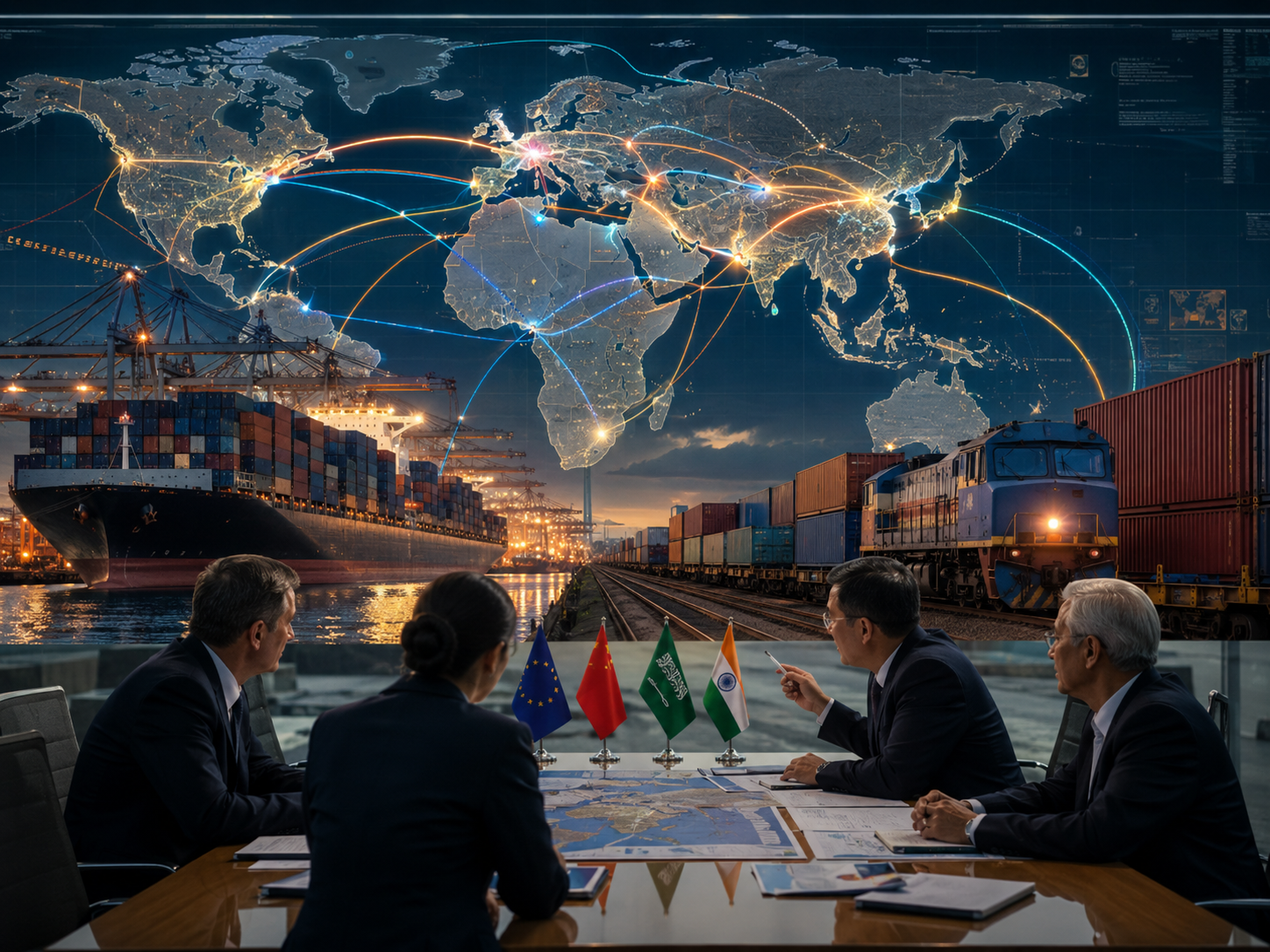
Geography returns to globalisation
For years, globalisation was described as if geography had lost importance. Goods moved, capital flowed, data travelled and firms built networks across borders. But geography never disappeared. It waited underneath the system. Today it has returned with force. Ports, canals, railways, pipelines, shipping lanes, industrial corridors, digital cables and energy routes are once again central to power.
Trade corridors are no longer merely infrastructure projects. They are strategic tools. They decide who connects to whom, which routes are trusted, which chokepoints matter, which ports become gateways and which countries become indispensable transit nodes. A corridor can reduce transport time, attract investment and integrate markets. It can also bypass rivals, create dependencies and signal geopolitical alignment.
This is why connectivity has become one of the sharpest arenas of international competition. China's Belt and Road Initiative, the India-Middle East-Europe Economic Corridor, the International North-South Transport Corridor, the Middle Corridor through Central Asia, the EU's Global Gateway and other initiatives all reflect the same reality: routes are power.
The current trigger: war, chokepoints and rerouting
The immediate trigger is the vulnerability of existing routes. The Red Sea crisis reminded the world that a narrow maritime corridor can affect global shipping costs. The Russia-Ukraine war disrupted energy, grain and transport flows. Tensions around the Taiwan Strait raise fears about semiconductor and shipping risks. The Suez Canal, Strait of Hormuz, Bab el-Mandeb, Malacca Strait and Black Sea all show how geography can interrupt economics.
At the same time, countries are building alternatives. They do not want one route, one supplier, one canal or one geopolitical gatekeeper. Corridors promise redundancy. They allow states to say: if one path is blocked, another remains open.
The strategic value of corridors therefore lies not only in speed. It lies in optionality.
IMEC and the politics of connectivity
The India-Middle East-Europe Economic Corridor, announced during the New Delhi G20 summit, is a symbol of the new corridor politics. According to the MEA description, it includes an Eastern Corridor connecting India to the Gulf and a Northern Corridor connecting the Gulf to Europe. Its ambition is not merely commercial. It links trade, energy, digital connectivity and strategic partnership across India, the Gulf, Europe and the United States.
For India, IMEC offers a way to connect its western coast to Gulf capital, European markets and transcontinental logistics networks. For Gulf states, it supports diversification beyond oil and reinforces their role as connectivity hubs. For Europe and the United States, it offers a democratic-partner-backed alternative to China-centred infrastructure influence. For the world, it signals that connectivity is now geopolitical architecture.
But IMEC also shows the difficulty of corridor strategy. West Asian instability, Israel-Palestine tensions, financing, technical coordination, port integration and political changes can delay implementation. A corridor is not built by announcement. It requires engineering, finance, security, customs coordination, standards and long-term political trust.
India angle: corridors and continental imagination
India's geography gives it both opportunity and constraint. It has a long coastline, proximity to the Indian Ocean, links to the Gulf, access to Southeast Asia and a central position in Indo-Pacific maritime strategy. But its land connectivity to Eurasia is constrained by Pakistan and difficult terrain. This makes maritime and multimodal corridors especially important.
India's corridor strategy must operate in multiple directions. Westward, IMEC and Gulf connectivity matter. Northward, the International North-South Transport Corridor offers access to Central Asia, Russia and Europe through Iran and the Caspian region, though sanctions and geopolitics complicate it. Eastward, connectivity with ASEAN through India's Act East policy remains crucial. Southward, the Indian Ocean links India to Africa and island states.
Corridors can also transform domestic geography. Ports, freight corridors, logistics parks, coastal economic zones and industrial clusters can connect Indian manufacturing to global markets. External connectivity is only as strong as internal logistics.
Trade corridors as instruments of influence
A corridor creates influence because it makes countries useful to one another. Transit states gain bargaining power. Port operators gain commercial and strategic relevance. Financiers gain leverage. Standard-setting bodies gain influence. Security providers gain importance. Digital cable routes can shape data flows and cyber resilience.
This is why infrastructure finance has become diplomatic currency. China used BRI to expand its presence across Asia, Africa, Europe and Latin America. The West responded with PGII and Global Gateway. Middle powers are now trying to avoid dependence on any single infrastructure sponsor.
For developing countries, the opportunity is real but risky. Good corridors can lower logistics costs and attract investment. Badly designed corridors can create debt, environmental damage, local displacement and strategic dependence. The quality of governance matters as much as the scale of financing.
The global trade effect
Corridors can reshape trade by reducing time, diversifying routes and creating new production zones. A port connected to rail and industrial clusters becomes more than a transit point; it becomes a manufacturing and services hub. A digital corridor can support finance, data centres and cloud infrastructure. An energy corridor can support green hydrogen, electricity interconnections and fuel security.
In a protectionist world, corridors also become a way to build trusted trade networks. Countries may prefer routes that pass through politically aligned or stable partners. This does not eliminate market logic, but it overlays market logic with security logic.
The future of trade will therefore be shaped not only by tariff schedules but by maps.
Counter-view: corridor hype can hide execution gaps
The counter-view is necessary. Corridor announcements often exceed implementation. Many projects face financing shortages, political instability, environmental objections, land acquisition delays, customs problems and security threats. Some corridors become maps in speeches rather than assets on the ground.
There is also the risk of geopolitical overinterpretation. Not every road is a strategy. Not every port is a military foothold. Commercial viability must matter. If cargo volumes are weak, if costs are high or if coordination fails, a corridor can become symbolic infrastructure.
India must therefore judge corridors by hard metrics: cargo movement, time saved, investment attracted, jobs created, resilience added and strategic dependence reduced.
What happens next
The next phase will depend on whether IMEC and other corridors move from memoranda to implementation plans. India should prioritise port modernisation, customs integration, logistics data systems, Gulf partnerships, European standards alignment and domestic freight connectivity. It should also ensure that corridor diplomacy includes private firms, financiers and state governments, not only foreign ministries.
The editorial conclusion is that trade corridors are the new strategic grammar of globalisation. In a world of rivalry, the country that controls routes does not merely move goods. It shapes choices.
Internal Links to Add
• Friendshoring Replaces Globalisation as Countries Prioritise Trust
• Global Debt Crisis Puts Developing Nations Under Pressure
• AI Goods and Digital Trade Reshape the Future of Global Commerce
• Supply Chains Become the New Battlefield of International Power