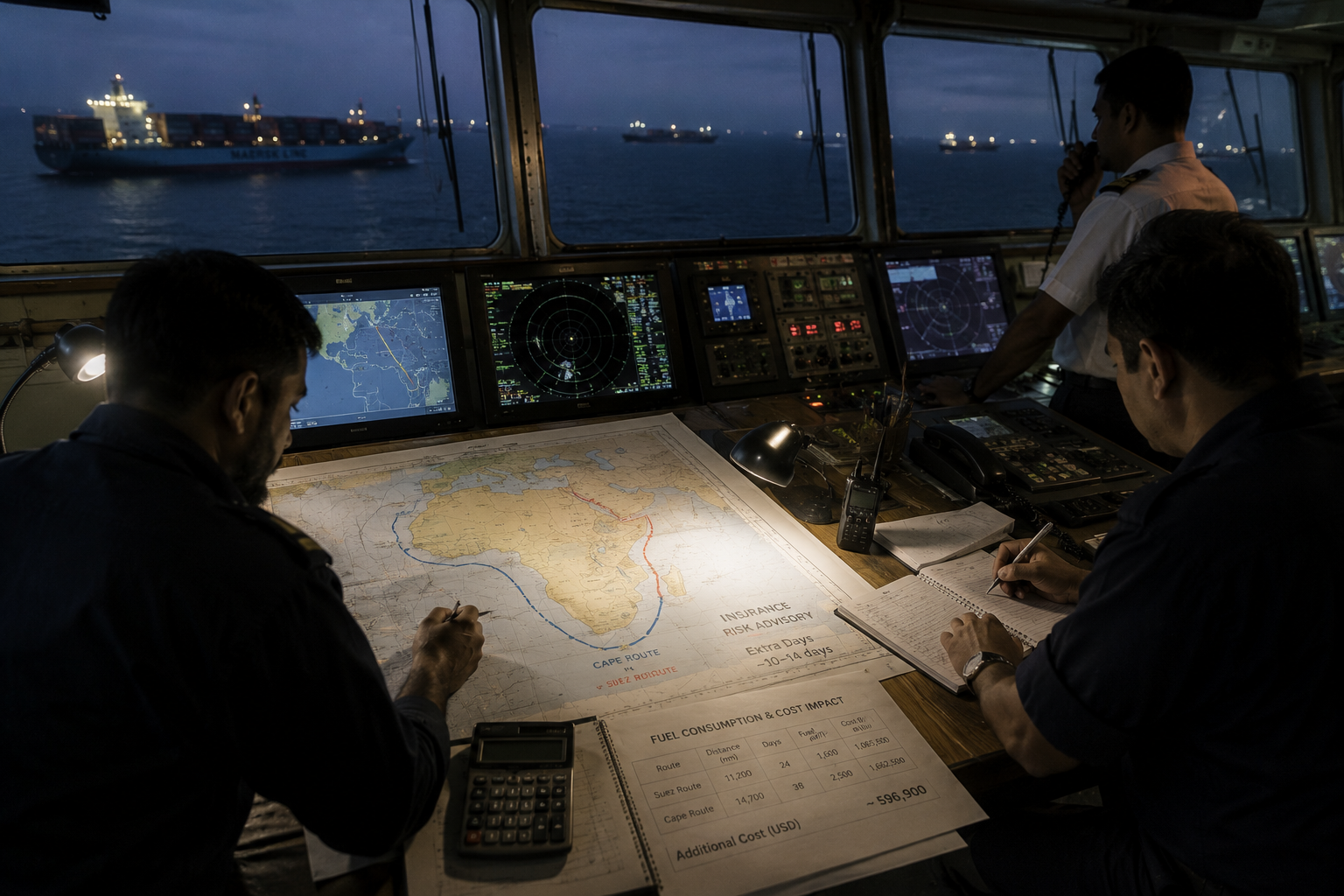
The Red Sea crisis has taught the world a hard lesson: sea lanes are not background infrastructure. They are strategic assets.
For years, globalisation made shipping look invisible. Consumers saw products on shelves, companies saw delivery schedules, governments saw import-export data, and investors saw freight rates. But behind all of it was a fragile maritime system: ports, canals, chokepoints, insurance markets, naval escorts, container ships, tankers, undersea cables and crews moving through dangerous waters.
The Red Sea crisis made that invisible system visible.
When attacks on shipping began around the Red Sea and Bab el-Mandeb after the Gaza war, the impact moved far beyond the Middle East. Ships rerouted around Africa. Freight rates rose. Delivery schedules lengthened. Egypt’s Suez Canal revenue collapsed. Navies deployed. Insurance risk changed. Energy and cargo flows became more vulnerable. India’s Navy expanded its maritime security role. A regional conflict turned into a global trade problem.
That is why the Red Sea crisis is not only a Middle East story. It is a maritime-geopolitical story.
It proves that the 21st-century economy does not run only on factories, finance and data. It runs on secure sea lanes.
The Red Sea Is a Narrow Route With Global Consequences
The Red Sea connects the Indian Ocean to the Mediterranean through Bab el-Mandeb and the Suez Canal. This route is one of the fastest maritime links between Asia and Europe. When it works smoothly, ships avoid the long journey around southern Africa. When it becomes unsafe, the cost of global trade changes.
The Suez Canal has historically handled a significant share of global trade. AP reported that about 10% of world trade had flowed through the waterway in recent years, while Reuters noted that the Suez route was the fastest link between Europe and Asia and accounted for about 10% of global seaborne trade before the attacks disrupted the corridor.
This is why Bab el-Mandeb matters so much. It is not only a narrow passage near Yemen. It is a strategic gate. If that gate becomes unsafe, ships must choose between risk and distance. Both are expensive.
The Red Sea crisis showed that a chokepoint does not need to close completely to damage global trade. It only needs to become risky enough for major carriers to avoid it.
The Crisis Changed Shipping Routes
The most immediate impact of the Red Sea crisis was rerouting.
Major shipping companies avoided the Red Sea and Suez Canal route and sent vessels around the Cape of Good Hope. That alternative is safer from Red Sea attacks but much longer. Longer routes mean more fuel, more crew time, more vessel demand, more delays and higher freight costs.
The IMF reported that in the first two months of 2024, Suez Canal trade dropped by 50% year-on-year, while trade volume around the Cape of Good Hope surged by an estimated 74%. It also noted that the Suez Canal normally carried about 15% of global maritime trade volume.
UNCTAD’s 2024 maritime transport review showed the disruption even more sharply: by mid-2024, ship capacity crossing the Gulf of Aden was down 76%, Suez Canal tonnage was cut by 70%, and Cape of Good Hope arrivals had surged 89%.
These numbers show the strategic value of sea lanes. The world did not stop trading. It adapted. But adaptation was costly.
That is the key lesson. Sea-lane disruption does not always produce immediate collapse. It produces friction. In global trade, friction becomes inflation, delay, uncertainty and political pressure.
Egypt Paid the Price First
The most direct economic victim was Egypt.
The Suez Canal is not just a waterway. It is a major source of foreign currency for Egypt. When vessels avoid the canal, Egypt loses revenue immediately.
AP reported that Egypt’s Suez Canal revenue fell from a record $10.25 billion in 2023 to $3.991 billion in 2024, a drop of almost two-thirds. Ship traffic also fell sharply: only 13,213 ships passed through in 2024, compared with over 26,000 in 2023.
This is a powerful reminder that sea lanes are national economic assets. Egypt did not start the Red Sea crisis, but its economy absorbed the shock. A conflict linked to Gaza and Yemen damaged a core Egyptian revenue stream.
That is how maritime chokepoints work. They turn regional insecurity into international economic pain.
Shipping Companies Became Strategic Actors
The Red Sea crisis also showed that private shipping companies can become geopolitical actors.
When carriers such as Maersk, Hapag-Lloyd and others decide whether to use the Red Sea route, they are not only making commercial choices. They are making decisions that affect global freight rates, port congestion, supply chains, delivery timelines and inflation.
Reuters reported in December 2025 that Maersk completed its first Red Sea and Bab el-Mandeb transit in nearly two years, but the company still avoided a full return and described its approach as stepwise. Reuters also noted that many carriers remained cautious and that a meaningful reopening would likely be gradual.
This caution matters. Even when security conditions improve, shipping does not return overnight. Networks must be realigned. Insurance must be recalculated. Schedules must be rebuilt. Ports must adjust. Customers must regain confidence.
A sea lane is therefore not only a physical route. It is a trust system.
Once trust breaks, it takes time to restore.
The Crisis Was Asymmetric Warfare at Sea
The Red Sea crisis was not a conventional naval war.
The disruption was caused by a non-state armed group using drones, missiles, hijacking attempts and maritime threats. This is what makes the crisis strategically important. It showed that relatively low-cost weapons can impose high costs on global shipping.
A missile or drone costing far less than a merchant vessel can force billion-dollar shipping networks to reroute. A small armed group can pull major navies into a regional theatre. A local conflict can affect global freight rates.
This is asymmetric warfare at sea.
The old model of maritime security focused heavily on state navies, warships and blockades. The Red Sea crisis shows that future sea-lane threats may come from non-state actors, militias, pirates, drones, cyberattacks, floating mines, missile batteries, sabotage operations and grey-zone tactics.
That changes naval planning. Protecting sea lanes now requires more than aircraft carriers and destroyers. It requires intelligence, surveillance, drones, convoy management, information-sharing, legal coordination, insurance stability and rapid response.
Sea Lanes Are Also Energy Routes
The Red Sea route is not only about containers. It is also tied to energy movement.
The Bab el-Mandeb Strait connects the Red Sea with the Gulf of Aden and the wider Indian Ocean. It is part of the maritime system through which oil, refined products and LNG move between West Asia, Europe and Asia. The U.S. Energy Information Administration’s chokepoint analysis notes that Red Sea attacks and oil disruptions reduced Bab el-Mandeb flows, and that LNG flows through Bab el-Mandeb were near zero in 2024 and the first half of 2025.
This matters because energy security is extremely sensitive to maritime risk. Tankers can reroute, but rerouting increases time, cost and exposure. Insurance premiums can rise. Buyers may need alternative supplies. Refiners may face uncertainty. Countries dependent on imported energy face inflationary pressure.
India, China, Japan, South Korea and Europe all understand this. The Red Sea is geographically near Africa and West Asia, but its consequences reach Asian fuel markets and European consumers.
Energy security is maritime security.
India Cannot Ignore the Red Sea
For India, the Red Sea crisis is directly relevant.
India’s trade with Europe, energy links with West Asia, diaspora connections, and maritime presence in the Arabian Sea and Gulf of Aden all make the Red Sea corridor important. If ships avoid Suez and reroute around the Cape of Good Hope, Indian exporters and importers face longer routes, higher costs and disrupted schedules.
The Indian Navy’s response under Operation Sankalp showed India’s growing maritime role. The Ministry of Defence said that from 14 December 2023 to 23 March 2024, the Navy responded to 18 incidents, deployed more than 5,000 personnel at sea, accumulated more than 450 ship-days with over 21 ships deployed, and played the role of “First Responder” and “Preferred Security Partner” in the Indian Ocean Region.
This is not a small development. It shows India moving from coastal defence to regional maritime responsibility.
India’s Navy was not simply defending Indian ships. It was helping stabilise a wider maritime environment. That is what rising powers are expected to do.
Operation Sankalp Shows India’s Maritime Maturity
Operation Sankalp is important because it demonstrated several features of Indian maritime strategy.
First, India can respond quickly to threats across the western Indian Ocean. Second, the Indian Navy can protect commercial shipping, not only military interests. Third, India can act independently while also operating in a crowded environment where U.S., European and regional navies are present. Fourth, India’s maritime role is increasingly tied to global public goods: safe shipping, anti-piracy, rescue, escort and crisis response.
The Ministry of Defence stated that Indian naval operations during the period saved over 110 lives, including 45 Indian seafarers; escorted 15 lakh tons of critical commodities such as fertilisers, crude oil and finished products; conducted nearly 1,000 boarding operations; seized more than 3,000 kg of narcotics; and assured over 450 merchant vessels of Indian naval presence.
These details matter because they show maritime power in practice. It is not only about missiles and warships. It is about keeping the global economy moving.
India’s strategic rise will be judged partly by whether it can provide such security consistently.
The Red Sea Links the Mediterranean, Middle East and Indo-Pacific
The Red Sea crisis also proves that regions cannot be studied separately anymore.
A war in Gaza triggered Houthi attacks. Those attacks disrupted the Red Sea. The disruption affected the Suez Canal. Ships rerouted around Africa. Freight costs changed for Asia-Europe trade. Egypt lost revenue. Navies from outside the region deployed. India expanded its maritime presence. Energy and commodity flows became more uncertain.
This is a perfect example of connected geopolitics.
The Mediterranean, Middle East, Indian Ocean and Indo-Pacific are part of one maritime system. A disturbance in one segment can affect the whole chain.
This is why the Indo-Pacific concept matters. The Indian Ocean and the Pacific cannot be separated from West Asia, East Africa and Europe. Sea lanes connect them all.
The Red Sea is a hinge point in that wider system.
Maritime Insurance Became a Security Indicator
One under-discussed part of the Red Sea crisis is insurance.
Shipping depends on insurance. If a route becomes risky, insurance premiums rise. If insurance becomes too expensive or unavailable, ships avoid the route. That means security risk becomes a financial signal.
A missile threat does not have to hit every ship to be effective. It only has to raise perceived risk. Once perceived risk rises, insurers, charterers, shipowners and cargo owners adjust. The entire route becomes commercially less attractive.
This is why sea-lane security is partly psychological. Confidence matters.
A secure sea lane is one where shipowners, insurers, ports and navies believe risks are manageable. An insecure sea lane is one where uncertainty becomes more expensive than distance.
The Red Sea crisis turned fear into freight cost.
Supply Chains Learned a Familiar Lesson Again
The Red Sea crisis was another reminder that global supply chains are efficient but fragile.
The world learned this during COVID-19. It learned it again during the Russia-Ukraine war. It learned it through semiconductor shortages. It learned it through the Panama Canal drought. The Red Sea added one more lesson: shipping routes cannot be taken for granted.
Modern companies often rely on just-in-time inventories, predictable shipping schedules and low transport costs. When ships take longer routes, inventory planning changes. When containers arrive late, factories can face shortages. When freight rates rise, companies pass costs to consumers or absorb margin pressure.
UNCTAD’s 2025 maritime transport review noted that ships once passing through the Red Sea in days were sailing for weeks around the Cape of Good Hope, and that freight rates remained high and volatile.
This means maritime security is now part of supply-chain strategy. Companies and governments must ask not only where goods are made, but how they move.
A factory is only as reliable as the route that connects it to markets.
The Environmental Cost of Rerouting
Rerouting around the Cape of Good Hope is not only expensive. It is also environmentally costly.
Longer voyages require more fuel. More fuel means more emissions. Extra distance increases vessel demand and can push ships to sail faster to maintain schedules, which further raises fuel consumption.
UNCTAD’s 2024 review found that longer routes raised global vessel ton-mile demand and container ship demand, while rerouting around the Cape became a major consequence of the Suez disruption.
This creates a contradiction. The world wants cleaner trade, but insecurity forces ships onto longer routes. Maritime security and climate policy are therefore linked.
A safe sea lane is also a greener sea lane.
The Crisis Exposed the Limits of Naval Power
The Red Sea crisis also revealed an uncomfortable truth: even powerful navies cannot fully eliminate asymmetric maritime threats quickly.
The United States and its partners deployed naval assets. Airstrikes were carried out. Defensive operations intercepted missiles and drones. Yet commercial shipping remained cautious for a long time. This shows that naval superiority does not automatically restore commercial confidence.
There is a difference between military control and commercial trust.
A navy may reduce risk, but shipping companies must decide whether risk is low enough to send billion-dollar cargo and crews through a dangerous corridor. That decision depends on threat persistence, insurance, intelligence, political stability and the likelihood of renewed attacks.
This is why Maersk’s late-2025 test transit did not immediately mean full normalisation. Reuters reported that Maersk had no firm plans to fully reopen the route despite the successful voyage and would proceed gradually.
The lesson is clear: sea-lane security is not restored by one operation. It is restored by sustained confidence.
The Strategic Value of Chokepoints Has Increased
The Red Sea crisis has increased the strategic value of chokepoints.
Chokepoints are narrow maritime passages where large volumes of trade or energy move through limited space. Bab el-Mandeb, Suez, Hormuz, Malacca, the Turkish Straits and Panama are all examples.
Chokepoints matter because they compress global dependency into narrow geography. That makes them vulnerable. It also makes them powerful.
A state or non-state actor near a chokepoint can affect global flows. A navy that can secure a chokepoint gains influence. A country dependent on a chokepoint faces vulnerability. A shipping company using a chokepoint must price risk.
The Red Sea crisis showed that chokepoints are not old-world geography. They are modern strategic pressure points.
In a globalised economy, narrow waters can move wide markets.
What the Crisis Means for India’s Maritime Doctrine
India must draw several lessons from the Red Sea crisis.
First, India needs a stronger blue-water navy. Threats will not remain near Indian shores. They will emerge in the Gulf, Red Sea, East Africa, Malacca and beyond.
Second, India must protect sea lines of communication as a core national-security priority. Trade and energy routes are not commercial details. They are strategic lifelines.
Third, India needs stronger maritime domain awareness. It must track vessels, drones, suspicious movements, piracy risks, missile threats and undersea vulnerabilities across the Indian Ocean Region.
Fourth, India must build partnerships. The Red Sea crisis involved many navies, shipping firms, insurers and governments. No country can secure such a wide space alone.
Fifth, India must link maritime security with economic policy. Exporters, ports, insurers, shipping companies and the Navy need better coordination.
Sixth, India must prepare for non-state maritime threats. Drones, missiles, piracy, sabotage and cyberattacks can disrupt sea lanes without a formal war.
The Red Sea crisis is not an exception. It is a preview.
Why the Global South Should Care
The Red Sea crisis affects developing countries disproportionately.
Rich countries can absorb higher freight costs more easily. Poorer countries suffer more when food, fuel, fertiliser and imported goods become expensive. Small exporters lose competitiveness when shipping costs rise. Countries dependent on canal revenues, ports or maritime employment suffer directly.
The IMF noted that disruptions in the Red Sea reduced Suez traffic sharply while Cape of Good Hope traffic surged, showing how quickly global trade patterns can be distorted by maritime insecurity.
For the Global South, the lesson is clear: maritime security is development security.
A country may not have a major navy, but it still depends on secure shipping. Food imports, fertiliser supplies, fuel prices and export earnings are tied to maritime stability. That means sea-lane security should not be treated as only a great-power issue.
It is a public good.
The Great-Power Layer
The Red Sea crisis also has a great-power dimension.
The United States wants to protect global shipping and preserve its role as the leading maritime security provider. Europe wants safe trade through Suez. China wants its trade routes protected but also benefits from observing how U.S.-led maritime security faces limits. India wants to prove itself as a reliable Indian Ocean security actor. Gulf states want stability but must manage regional politics. Iran’s role through the Houthi connection adds another strategic layer.
This means the Red Sea is not only about Houthis and ships. It is about the future of maritime order.
Who protects sea lanes?Who pays for protection?Who has legitimacy?Who has local access?Who can respond quickly?Who benefits when routes are disrupted?
These questions will shape the next phase of maritime geopolitics.
The Red Sea and the Indian Ocean Are Connected
India must treat the Red Sea as part of the wider Indian Ocean security system.
The Gulf of Aden, Arabian Sea, western Indian Ocean and Red Sea form a connected maritime arc. Piracy off Somalia, instability in Yemen, conflict in Gaza, tensions with Iran, shipping routes to Europe and energy flows from the Gulf all overlap in this space.
This is why India’s western maritime strategy must be stronger.
India needs deeper ties with Oman, Saudi Arabia, the UAE, Egypt, Kenya, Tanzania, Djibouti, Ethiopia, France and other actors in the western Indian Ocean. It also needs coordination with shipping companies and Indian exporters.
The Red Sea crisis should push India to expand its maritime imagination westward.
The Indian Ocean does not end at India’s coast. It extends into the strategic routes India depends on.
The Human Side: Seafarers Became Frontline Workers
One of the least discussed aspects of the crisis is the human risk to seafarers.
Merchant sailors became targets in a conflict they did not start. Ships were attacked, crews were threatened, and sailors faced the psychological pressure of navigating dangerous waters. India, the Philippines and other seafaring nations have direct stakes because their citizens work on global merchant fleets.
The Indian Navy’s operations saving lives and assisting merchant vessels reflect this human-security dimension. The Ministry of Defence noted that over 110 lives were saved during the 100-day operational period, including 45 Indian seafarers.
Maritime security is therefore not only about cargo. It is about people.
A sea lane is safe only when crews can pass without fear.
The Counter-View: The System Adapted
A balanced analysis must acknowledge the counter-view: the global trade system adapted.
Ships rerouted. Goods still moved. Companies adjusted. Freight rates rose but did not permanently freeze trade. The Suez Canal lost revenue, but global commerce did not collapse. By late 2025, some carriers began cautiously testing the route again as conditions appeared to improve.
This resilience matters. It shows that global shipping has flexibility.
But adaptation is not the same as immunity.
The system survived because costs were absorbed, routes were extended and delays were managed. Those costs fell unevenly on consumers, exporters, importers, canal economies, ship crews and developing countries.
The lesson is not that sea lanes are unimportant because alternatives exist. The lesson is that alternatives are expensive.
Resilience is valuable, but prevention is cheaper.
What Happens Next
The Red Sea crisis will shape maritime policy in several ways.
First, navies will pay more attention to protecting commercial shipping from drones and missiles. Anti-drone warfare, air defence, electronic warfare and convoy coordination will become more important.
Second, shipping companies will build more flexible routing strategies. They will no longer assume that Suez is always available.
Third, insurance and risk pricing will become more central to maritime strategy.
Fourth, countries dependent on sea lanes will invest more in maritime domain awareness.
Fifth, India will likely expand its role in western Indian Ocean security.
Sixth, Egypt will try to restore confidence in the Suez route because canal revenue is economically vital.
Seventh, non-state actors may see that maritime disruption gives them global visibility. That could make similar threats more likely elsewhere.
The Red Sea crisis may ease, but the lesson will remain.
Conclusion: The Sea Lane Is the Strategy
The Red Sea crisis shows that sea lanes are strategic assets because they carry the modern world.
They carry oil, gas, food, fertiliser, electronics, cars, textiles, medicines, containers and industrial inputs. They carry inflation risk, diplomatic pressure and military responsibility. They connect local wars to global markets. They turn narrow passages into global pressure points.
The crisis proved that a regional armed group can disrupt global shipping, that private carriers can reshape trade routes, that navies remain essential, that chokepoints are vulnerable, and that countries like India must treat maritime security as national security.
For India, the lesson is especially important. A rising economy cannot depend on insecure routes without building the power to protect them. India’s trade, energy security and global role require a stronger Navy, deeper partnerships, better maritime surveillance and a wider strategic view from the Gulf to the Red Sea, from the Arabian Sea to the Malacca Strait.
The Red Sea crisis was not just a shipping disruption.
It was a warning.