Naval power as diplomatic language
Naval diplomacy is the use of maritime capability to shape relationships before, during and after crisis. A naval exercise builds interoperability. A port call signals attention. A rescue operation builds goodwill. A patrol reassures commercial shipping. A training programme strengthens partner capacity. A ship at sea communicates seriousness without the escalation of land deployment.
India has increasingly understood this language. Its naval diplomacy now operates across several layers: neighbourhood reassurance, Indian Ocean security, engagement with major powers, outreach to Southeast Asia and selective presence in the Pacific. This expansion reflects India’s larger strategic transition from a primarily continental power to a continental-maritime power.
From SAGAR to wider regional ambition
The SAGAR framework—Security and Growth for All in the Region—gave India a language for maritime responsibility. MAHASAGAR extends that imagination toward a wider vision of cooperation across regions. The vocabulary matters because it frames India not as a domineering power, but as a provider of public goods: safety, stability, growth, disaster response and capacity building.
The test is delivery. Island states and littoral partners judge India by response time, project execution, training quality, financial reliability and respect for sovereignty. Naval diplomacy works best when it is quiet, consistent and useful. It fails when it appears as performative signalling without material benefit.
The Indian Ocean base of Pacific outreach
India’s first responsibility remains the Indian Ocean. Without credibility in its near seas, India cannot project influence meaningfully into the Pacific. Anti-piracy missions, HADR operations, coastal surveillance partnerships, information fusion and exercises with regional navies form the base from which wider outreach becomes believable.
The Pacific dimension arises because India’s interests no longer stop at Malacca. Trade, technology, diaspora, supply chains and China’s maritime behaviour connect India to Southeast Asia, Japan, Australia, the United States and the Pacific islands. Naval diplomacy allows India to participate in this larger space without becoming a formal treaty ally.
Partnerships without alliance entrapment
India’s naval partnerships are deliberately flexible. The Malabar exercise, engagements with France in the Indian Ocean, cooperation with Australia, capacity building with island states, and dialogues with ASEAN countries all support a networked approach. India wants interoperability without automatic alliance obligations. This suits its strategic autonomy, but it also creates expectations. Partners want to know whether India will act in crisis or remain cautious.
This tension is visible in the Indo-Pacific. India supports a free, open and inclusive region, but avoids framing itself as an anti-China alliance state. That ambiguity gives India room, but it can also frustrate partners seeking clearer commitments. The art of Indian naval diplomacy lies in contributing enough to shape the balance while avoiding commitments that narrow India’s independent choices.
Capability constraints
Ambition at sea requires ships, submarines, aircraft, drones, logistics, maintenance and trained personnel. Naval diplomacy cannot expand indefinitely on rhetoric. A navy that is asked to deter, patrol, rescue, exercise, train, surveil and project presence must have sufficient assets and readiness. Shipbuilding delays, budget constraints and competing continental priorities can limit India’s maritime reach.
This is why domestic shipbuilding and maritime industrial capacity matter strategically. A country that depends excessively on external supply chains for naval capability will find its diplomacy constrained. Maritime self-reliance is not isolation; it is the foundation for sustained outward engagement.
Counter-view and future
The counter-view is that naval diplomacy can be overread. Port calls and exercises do not automatically translate into political influence. Smaller countries welcome Indian assistance but may still invite Chinese finance or Western technology. Great powers may praise India’s role while expecting more than India is willing to provide. Naval diplomacy is effective, but not magical.
The future will depend on whether India can institutionalise its maritime partnerships. Regular exercises, logistics agreements, white-shipping data, HADR mechanisms, coastal radar networks, training pipelines and coordinated responses will matter more than dramatic announcements. India’s naval diplomacy is expanding because the Indo-Pacific demands it. The question is whether India can turn episodic presence into durable regional confidence.
Exercises as strategic signalling
Naval exercises are not merely training events. They signal political trust, operational compatibility and strategic intent. The more complex the exercise, the deeper the underlying relationship usually is. Anti-submarine drills, carrier operations and cross-deck cooperation communicate more than ceremonial visits.
India must choose exercises carefully. Too little participation reduces influence; too much alignment can create perceptions of bloc politics. The balance lies in diversified engagement across partners while preserving an independent Indian voice.
HADR as influence
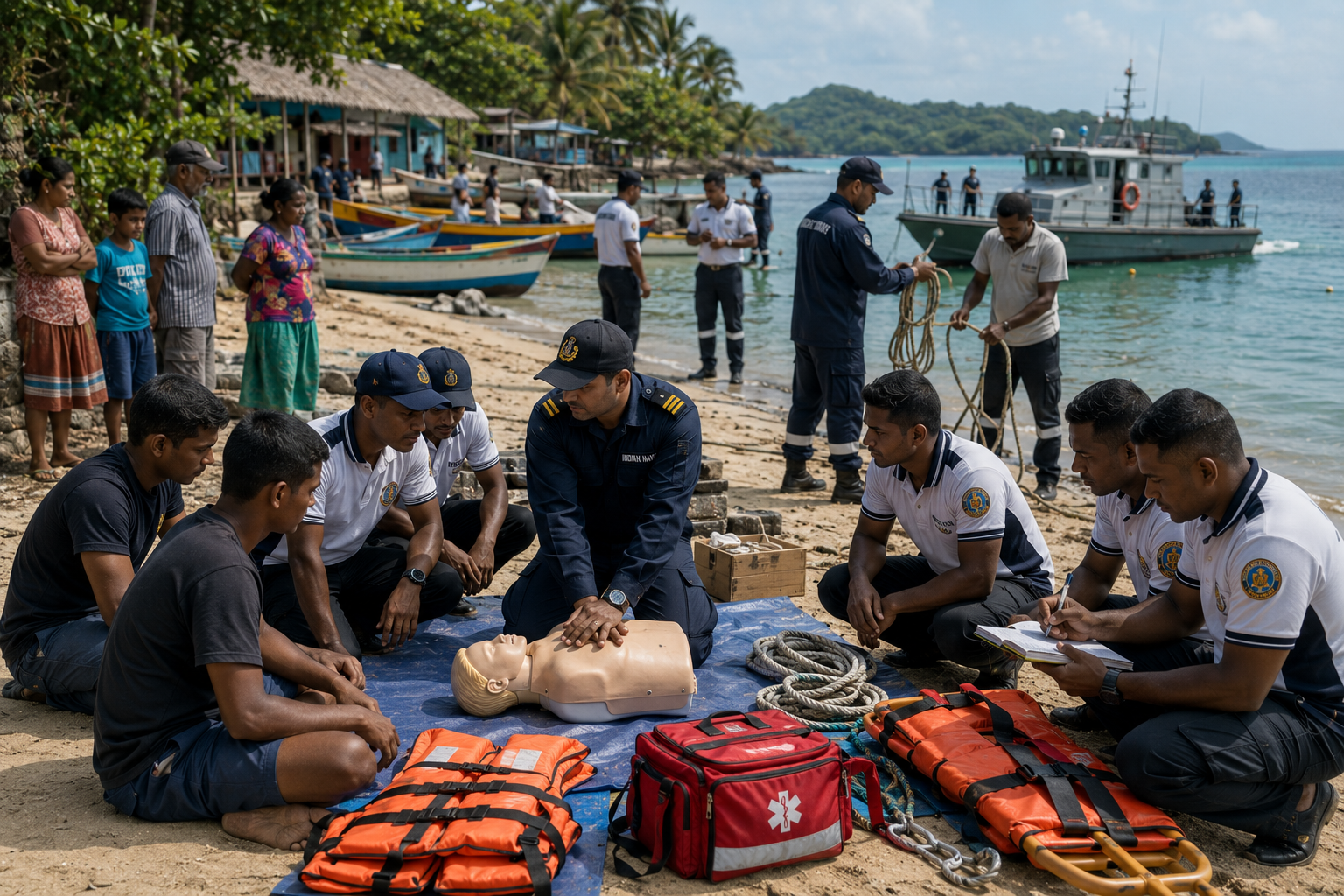
Humanitarian assistance and disaster relief may be India’s most powerful form of naval diplomacy. Cyclones, tsunamis, evacuations and medical crises create moments when speed and competence matter. A country that helps during disaster earns trust difficult to build through speeches.
India should institutionalise HADR planning with island and littoral states. Pre-positioned supplies, joint drills, common communication protocols and rapid deployment capacity can convert goodwill into dependable regional architecture.
Information sharing and trust
Information sharing is the quiet core of naval diplomacy. White-shipping agreements, maritime-domain awareness feeds and fusion centres create habits of cooperation. They also help partners detect threats early and respond collectively.
Trust is essential because maritime data can be sensitive. India’s credibility will depend on how responsibly it handles shared information and whether partners feel respected rather than monitored.
Pacific outreach
India’s Pacific outreach will remain selective, but it will grow. Engagements with Japan, Australia, ASEAN, France and the United States create pathways for India to act beyond its immediate ocean without overextension. Pacific presence also signals that India’s interests are not confined to South Asia.
The key is sustainability. A few symbolic deployments cannot substitute for institutional links. India’s naval diplomacy must build routines, not just headlines.
Current trigger and why the issue matters now
The immediate trigger behind this article is India’s naval diplomacy expanding from the Indian Ocean toward the Pacific. It matters now because the international system is no longer separating security, trade, technology and domestic politics into neat compartments. A shock in one domain quickly travels into another. That is why indian ocean security should be read not as a specialised foreign-policy topic, but as a test of how power works in a more anxious world.
For a serious Indian reader, the importance of india’s naval diplomacy expands from the indian ocean to the pacific lies in the fact that India is now exposed to global turbulence in multiple ways. Energy costs, shipping routes, diaspora safety, technology access, defence procurement, regional stability and diplomatic pressure all intersect. India can no longer watch these developments as an outside observer. It is large enough to be affected, but not yet powerful enough to control the system around it.
The article therefore needs to move beyond a news-event reading. The deeper question is not only what happened, but what pattern it reveals. The world is moving from optimism about open interdependence to guarded interdependence, where states still trade and cooperate, but constantly ask whether dependence can become vulnerability. That shift is visible across this topic.
Actors, incentives and pressure points
The main actors are the Indian Navy, ASEAN navies, Japan, Australia, France, the United States, island states, Gulf partners and African littorals. Each actor reads the same environment differently because each carries a different geography, domestic pressure and risk appetite. A great power may see room for manoeuvre where a smaller state sees exposure. A trading economy may fear disruption more than prestige loss. A military power may prioritise deterrence while a development-focused state seeks finance and stability.
The security pressure points include exercises, port calls, anti-piracy, HADR, logistics, white-shipping agreements, information sharing and interoperability. These issues are not isolated. They create a chain of consequences. A maritime disruption can become an inflation problem. A technology restriction can become an industrial-policy challenge. A border dispute can change investment sentiment. A port deal can become a diplomatic signal. The modern strategic environment is connected precisely because systems are connected.
The economic pressure points include secure trade routes, shipbuilding, maritime services, port access, disaster resilience and blue economy cooperation. This is where traditional geopolitics meets ordinary life. A decision taken in a distant capital can affect freight rates, import bills, food prices, insurance costs, job creation and public finances. For Editors Outlook readers, this is the essential bridge: foreign policy is not remote. It enters the economy, the budget, the market and eventually the household.
India angle: choices, limits and leverage
India’s core task is using naval presence to reassure partners while preserving strategic autonomy and avoiding alliance entrapment. This requires more than clever diplomacy. It requires material capacity: reliable infrastructure, credible defence production, institutional coordination, skilled negotiators, domestic consensus and the ability to deliver on promises. Strategic autonomy is meaningful only when backed by capability.
India also has to avoid two traps. The first is rhetorical overreach, where ambition is announced faster than institutions can execute. The second is defensive hesitation, where fear of taking sides prevents India from shaping outcomes. The better path is issue-based clarity: cooperate where interests align, resist coercion where necessary, and build domestic strength so that external pressure has less effect.
The Indian angle should also include the states and citizens most affected by these shifts. Coastal communities, exporters, students, seafarers, energy consumers, border populations, defence firms and technology workers all experience geopolitics differently. A mature editorial treatment should connect national strategy with these concrete constituencies.
Counter-view: what the dominant narrative may miss
The strongest counter-view is that the dominant narrative around indian ocean security may exaggerate coherence. States are often less strategic than they appear. They make mistakes, react to domestic pressure, overpromise, underfund and improvise. What looks like a grand design may sometimes be a sequence of tactical moves under pressure.
Another complication is that symbolic deployments may be mistaken for durable influence if not backed by institutional capacity. This risk should not be treated as certainty, but it cannot be dismissed. Editorial credibility comes from acknowledging uncertainty. Good analysis does not pretend that one side has perfect strategy and the other side has none. It asks what each actor wants, what each actor can actually do, and where unintended consequences may appear.
There is also a moral danger in treating all issues only as power games. Smaller countries, local communities, migrants, soldiers, fishers and seafarers are not abstract variables. They bear the costs of strategic competition. An article that includes this human layer will feel more complete than one that speaks only in the language of capitals and corridors.
Future scenarios and editorial judgement
Three scenarios are worth watching. The first is managed competition: states continue to compete, but establish enough rules and communication channels to prevent crisis from becoming catastrophe. This is the best realistic outcome in many contemporary disputes because trust is low but interdependence remains high.
The second scenario is fragmented escalation: blocs harden, rules weaken, supply chains split further and smaller states are pressured to choose. This would increase costs for India and the Global South because development priorities would be repeatedly interrupted by strategic shocks. The third scenario is selective accommodation, where rivals compete in some areas but cooperate on climate, trade, health, maritime safety or crisis management. This is difficult, but not impossible.
The editorial judgement should be sharp: India’s Naval Diplomacy Expands From the Indian Ocean to the Pacific is ultimately about the changing grammar of power. Influence is no longer exercised only through armies or treaties. It moves through shipping lanes, ports, credit, standards, legal claims, drones, institutions, public narratives and crisis response. India’s challenge is to read this grammar early and respond with capacity, not just commentary.
Policy choices and reporting angles for 2026
For Indian policymakers, the first requirement is institutional coordination. The issues around indian ocean security do not belong to one ministry alone. They cut across external affairs, defence, commerce, finance, shipping, energy, technology, intelligence, environment and state governments. If policy remains fragmented, India will respond to symptoms while missing the system-level change. A coherent inter-ministerial approach is essential.
The second requirement is better public communication. Strategic debates in India often remain trapped between official optimism and social-media outrage. A serious democracy needs informed citizens who understand trade-offs. Not every compromise is weakness, and not every hard line is strategy. Explaining costs, risks and choices improves national resilience because citizens are less likely to be surprised by difficult decisions.
The third requirement is data discipline. Reporting on india’s naval diplomacy expands from the indian ocean to the pacific should avoid vague claims and fashionable phrases unless they are supported by numbers, maps, timelines and documents. Readers should see trade volumes, defence budgets, shipping routes, project timelines, legal provisions, debt profiles or institutional statements wherever possible. Evidence gives strategic writing authority.
The fourth requirement is local reporting. Grand strategy becomes sharper when connected to ports, border towns, coastal villages, industrial clusters, seafarer families, students, exporters and small businesses. These are the places where geopolitics becomes lived experience. A strong article should therefore combine global analysis with Indian ground realities.
Finally, India should treat this subject as a capacity-building test. The question is not whether India understands the stakes of indian ocean security; the question is whether it can build the institutions, infrastructure and partnerships needed to protect its interests. In a world where power is becoming more distributed and more coercive at the same time, strategic clarity must be matched by execution.
Reader takeaway
The reader should leave this article with one clear understanding: India’s Naval Diplomacy Expands From the Indian Ocean to the Pacific is not an isolated diplomatic headline. It is part of a larger transition in which economics, security, law, technology and geography are converging. A country that studies only one layer will misunderstand the whole picture.
For India, the priority is to avoid emotional foreign policy. Outrage may produce applause, but it rarely produces leverage. India needs calm assessment, competitive capacity and long-term partnerships. It must know when to cooperate, when to resist, when to stay silent and when to lead.
For the wider Global South, the issue also carries a warning. Development choices are increasingly entangled with strategic pressure. Infrastructure, finance, technology and security cooperation can bring benefits, but they can also create dependence. Smaller states need options; larger states must offer them without coercion.
That is why the final frame of this article should be strategic maturity. indian ocean security will test whether India can think in decades rather than news cycles. The countries that succeed in the coming order will not be those that react loudly to every event, but those that build the quiet capacity to absorb shocks and shape outcomes.
This also gives the article a strong editorial close. The subject should not be presented as a problem with a single clean solution. It is a moving strategic condition. Policies will need revision, partnerships will need repair, and assumptions will need testing against new facts. That is what makes the issue important for a serious publication rather than a passing news summary.
The final message for readers is that power today is cumulative. It is built through institutions, trust, production, maritime awareness, legal credibility, fiscal strength and public confidence. A state that neglects these foundations may win arguments but lose influence. A state that builds them patiently can turn uncertainty into advantage. This is why the issue must be tracked continuously, with fresh evidence, local reporting, institutional memory, editorial discipline, and strategic patience.
Sources Consulted / Verify Before Publishing
• PIB International Fleet Review 2026: https://www.pib.gov.in/PressReleaseDetail.aspx?PRID=2229534&lang=1®=1
• PIB Indian Navy Aatmanirbhar Bharat Journey: https://www.pib.gov.in/PressNoteDetails.aspx?ModuleId=3&NoteId=156668&id=156668&lang=2®=3