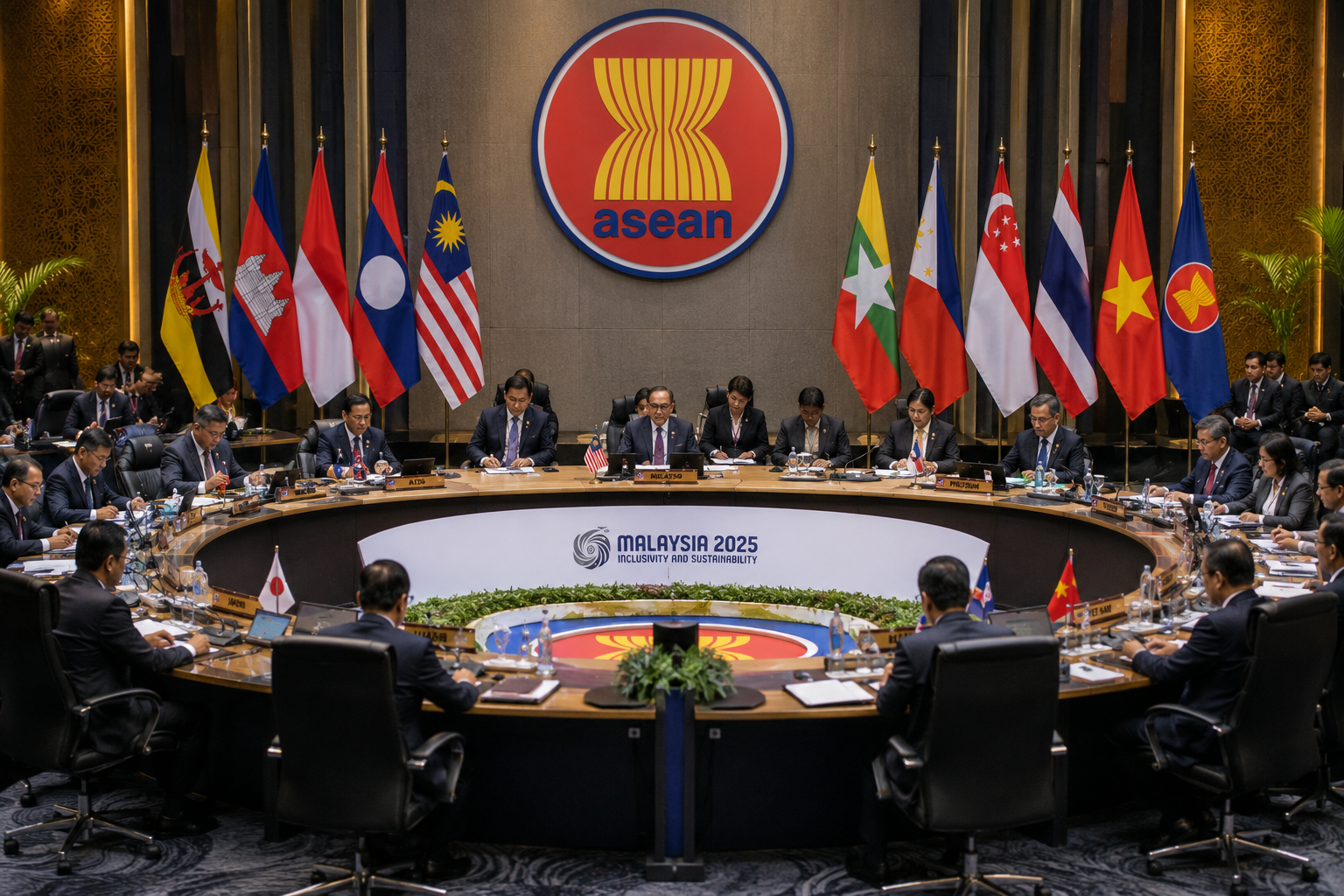
The Indo-Pacific is often described through the rivalry of great powers. Analysts speak of the United States and China, the Quad, Taiwan, the South China Sea, naval bases, chip supply chains and military deterrence. But at the centre of this entire strategic theatre sits a group of countries that does not behave like a military bloc, does not speak in the language of confrontation, and does not want to be forced into choosing one camp over another.
That group is ASEAN.
The Association of Southeast Asian Nations is not the loudest actor in the Indo-Pacific, but it is one of the most important. Its geography makes it unavoidable. Its markets make it attractive. Its sea lanes make it strategic. Its divisions make it vulnerable. Its diplomatic style makes it useful. And its centrality makes it a prize in the competition between major powers.
ASEAN sits between the Indian Ocean and the Pacific Ocean. It connects East Asia with South Asia, China with maritime trade routes, and the Pacific with the wider global economy. The South China Sea runs through its strategic heart. The Malacca Strait, one of the world’s most important maritime chokepoints, lies within its regional geography. From Singapore to Vietnam, from Indonesia to the Philippines, from Malaysia to Thailand, Southeast Asia is not merely a location on the map. It is the hinge of the Indo-Pacific order.
This is why the Indo-Pacific competition cannot be understood without ASEAN. The US and China may be the primary rivals, but Southeast Asia is one of the main arenas where their rivalry becomes visible. China offers trade, infrastructure, investment and proximity. The United States offers military partnerships, technology, markets and security reassurance. Japan offers infrastructure and quality investment. India offers civilisational links, maritime cooperation and Act East engagement. Australia offers defence cooperation and regional balancing. Europe offers trade, standards and diplomatic engagement.
ASEAN receives all of them, engages all of them, and avoids becoming the possession of any one of them.
That is the brilliance and burden of ASEAN centrality.
ASEAN’s official Indo-Pacific vision is called the ASEAN Outlook on the Indo-Pacific, or AOIP. It is built around principles such as ASEAN centrality, openness, transparency, inclusivity, rules-based cooperation, respect for sovereignty, non-intervention, mutual benefit and peaceful cooperation. Unlike many Western Indo-Pacific strategies, the ASEAN outlook avoids presenting the region as a battlefield between democracy and authoritarianism or as a direct containment strategy against China. It prefers the language of dialogue, cooperation and inclusive regionalism.
This is not accidental. ASEAN’s survival depends on avoiding hard polarisation. Its members have different threat perceptions, different economic dependencies, different political systems and different relations with China and the United States. Vietnam and the Philippines worry deeply about Chinese pressure in the South China Sea. Cambodia and Laos are more closely aligned with China economically and politically. Singapore is close to the United States in security terms but maintains strong economic relations with China. Indonesia wants strategic autonomy and regional leadership. Malaysia and Thailand often prefer quiet balancing.
ASEAN is therefore not a single strategic mind. It is a platform where different national interests are managed through consensus.
This consensus model is often criticised as slow and weak. That criticism is partly valid. ASEAN struggles to respond strongly when members disagree. It often produces careful statements instead of decisive action. It has found it difficult to manage the Myanmar crisis. It has failed to produce a binding and effective Code of Conduct for the South China Sea despite years of negotiations. Yet the same consensus model also explains ASEAN’s durability. It allows countries with very different systems and interests to remain inside one diplomatic tent.
In a divided world, that is not a small achievement.
ASEAN matters first because of geography. The South China Sea is one of the most important maritime spaces in the world. It is not only a sea of territorial disputes; it is a highway of trade, energy and military movement. China claims large parts of it, while several ASEAN members have competing claims. The Philippines, Vietnam, Malaysia and Brunei are directly affected. Indonesia is not a claimant in the same way, but it has concerns around the Natuna waters. The South China Sea is therefore both an ASEAN issue and a global issue.
Recent events show how dangerous this space remains. In May 2026, China conducted patrols around Scarborough Shoal after the Philippines warned of continuing threats from Beijing. The same Reuters report noted that Chinese claims in the South China Sea overlap with the exclusive economic zones of several Southeast Asian states, while the 2016 arbitral ruling rejected China’s sweeping claims under the nine-dash line, a ruling Beijing continues to reject.
This is the central dilemma for ASEAN. It wants peace and stability, but some of its members face direct maritime pressure. It wants economic cooperation with China, but it does not want Chinese dominance. It wants American engagement, but it does not want the region to become a US-China military chessboard. It wants international law, but it also wants to avoid open confrontation.
That is why the South China Sea Code of Conduct has become a test of ASEAN’s agency. ASEAN and China have been negotiating a Code of Conduct for years. ASEAN’s own documentation states that ASEAN member states and China are engaged in negotiations on the Code of Conduct, which began in March 2018. The Philippines, as ASEAN chair in 2026, has made the issue a priority, with analysts noting Manila’s ambition to push the process forward during its chairmanship.
But finalising a meaningful Code of Conduct is difficult because the core issues are not technical. They are political. What should be its geographic scope? Should it be legally binding? How will violations be handled? Will it restrict military activities? Will it affect third-party powers? Can it restrain coercive behaviour without becoming too weak to matter? These questions go to the heart of power in the South China Sea.
If the Code of Conduct is too vague, it will become a diplomatic ornament. If it is too strong, China may resist it. If ASEAN cannot agree internally, negotiations will remain stuck. This is why the Code of Conduct is not merely a legal document. It is a measure of whether ASEAN can protect its own regional space.
ASEAN matters second because of economics. Southeast Asia is one of the world’s most dynamic economic regions. ASEAN’s GDP stood at around US$3.9 trillion in 2024, and its population is around 683 million, according to HKTDC’s market profile. The region sits at the centre of manufacturing shifts, digital growth, consumer expansion and supply-chain diversification. Companies looking to reduce overdependence on China increasingly look toward Vietnam, Indonesia, Thailand, Malaysia and the Philippines.
This makes ASEAN a major economic prize. China remains deeply tied to ASEAN economically. ASEAN’s official economic relations page says two-way merchandise trade between ASEAN and China reached US$772.4 billion in 2024, accounting for 20.1% of ASEAN’s total trade. The United States is also deeply connected to the region. USTR data says US goods trade with ASEAN totalled an estimated US$580.1 billion in 2025.
These numbers explain ASEAN’s reluctance to choose sides. China may be a security concern for some members, but it is also a crucial trading partner. The United States may be a security guarantor for some, but its trade and industrial policies can also create uncertainty. ASEAN countries want Chinese markets, American technology, Japanese capital, Indian connectivity, Australian security cooperation and European standards. Their strategy is not alignment. Their strategy is diversification.
This is often misunderstood. Western analysts sometimes ask whether ASEAN will side with Washington or Beijing. But ASEAN’s answer is usually: neither fully, both partially, and ourselves first.
That is not weakness. It is strategic hedging.
ASEAN matters third because of supply chains. The global economy is shifting from pure efficiency to resilience. The pandemic, the US-China trade war, semiconductor shortages, Russia’s war in Ukraine, Red Sea disruption and technology controls have all forced countries and companies to rethink supply-chain dependence. Southeast Asia has benefited from this shift. Vietnam has become a manufacturing hub. Malaysia is important in electronics and semiconductors. Thailand remains central to automobiles. Indonesia is crucial for nickel and electric vehicle supply chains. Singapore is a logistics, finance and technology hub.
This gives ASEAN strategic leverage. It is no longer only a destination for low-cost production. It is becoming a region where economic security, technology competition and industrial strategy meet. The future of chips, batteries, electric vehicles, critical minerals, ports, data centres and digital trade will all pass through Southeast Asia in some form.
But this opportunity also creates risk. Great powers do not compete only with warships; they compete through investment rules, export controls, infrastructure finance, digital standards, energy corridors and industrial subsidies. ASEAN must manage this competition without allowing its domestic economies to become dependent on one power’s technology ecosystem.
ASEAN matters fourth because it is central to maritime security. The Indo-Pacific is fundamentally a maritime concept. It links the Indian and Pacific Oceans into one strategic space. Southeast Asia is the bridge between the two. Whoever influences Southeast Asia influences the flow between these oceans.
This is why military diplomacy around ASEAN has intensified. The United States strengthens ties with the Philippines and maintains partnerships with Singapore and others. China expands naval and coast guard activity. Japan increases security cooperation with Southeast Asian states. India deepens maritime engagement under Act East and SAGAR. Australia works with partners to keep the region open and stable.
The recent emphasis on air and maritime safety between US and Chinese military officials also shows how sensitive the regional environment has become. In late May 2026, Chinese and US military officials met in Hawaii for talks on air and maritime safety, with both sides stressing communication to reduce miscalculation. Such communication is essential because a crisis in the South China Sea or around Taiwan could quickly involve ASEAN states, even if they do not seek confrontation.
The region’s leaders understand this danger. At the 2026 Shangri-La Dialogue in Singapore, Vietnam’s leader To Lam warned that regional conflict could have global consequences and urged major powers to act responsibly, respect international law and avoid escalation. That warning captures ASEAN’s central fear: Southeast Asia wants to remain a zone of growth, not become the frontline of a great-power conflict.
ASEAN matters fifth because it is the diplomatic centre of the Indo-Pacific. ASEAN-led platforms such as the East Asia Summit, ASEAN Regional Forum and ASEAN Defence Ministers’ Meeting-Plus bring together powers that may otherwise not sit comfortably in the same room. These forums are not always decisive, but they provide habits of dialogue.
This is ASEAN’s quiet power. It does not command aircraft carriers or issue sanctions like a great power. It convenes. It absorbs tension. It gives rivals a common diplomatic platform. In a world where major powers increasingly talk past each other, ASEAN’s convening role is valuable.
However, ASEAN centrality faces a serious challenge from minilateral groupings. The Quad, AUKUS, trilateral US-Japan-Philippines cooperation, India-Australia-Japan dialogues and other smaller coalitions are growing because major powers often find ASEAN too slow. These minilaterals are more focused, more strategic and more willing to address hard security issues. But they also risk reducing ASEAN’s role if Southeast Asian concerns are treated as secondary.
This is why ASEAN insists on centrality. It does not want to be bypassed in decisions about its own region.
India understands this carefully. India’s Indo-Pacific vision repeatedly refers to ASEAN centrality. India and ASEAN issued a joint statement in 2021 on cooperation around the ASEAN Outlook on the Indo-Pacific for peace, stability and prosperity in the region. For India, ASEAN is not just an economic partner. It is the gateway to the eastern Indo-Pacific.
India’s Act East Policy depends on ASEAN. Without Southeast Asia, Act East becomes a slogan without geography. ASEAN connects India to the Pacific, to supply chains, to maritime security networks and to the wider Asian balance of power. India’s Northeast also depends on better connectivity with Southeast Asia. Projects like the India-Myanmar-Thailand Trilateral Highway, though delayed, reflect this larger ambition.
But India must also recognise its limitations. India’s trade with ASEAN has not reached the scale of China’s. Connectivity projects have often moved slowly. India’s economic engagement sometimes lacks the speed and depth Southeast Asian countries expect. If New Delhi wants to be taken seriously in ASEAN, it must move beyond diplomatic declarations and deliver infrastructure, investment, digital cooperation, education links, maritime capacity building and market access.
For India, ASEAN is not optional. It is essential.
ASEAN’s internal divisions are perhaps its greatest weakness. The bloc contains democracies, monarchies, communist states, military-influenced systems and authoritarian regimes. Its members do not always share the same strategic priorities. The Myanmar crisis has damaged ASEAN’s credibility. The South China Sea divides claimant and non-claimant states. Economic dependence on China creates caution. Domestic politics often limit regional ambition.
This fragmentation makes ASEAN vulnerable to external influence. Great powers can cultivate individual members and weaken collective positions. China has often benefited from ASEAN’s consensus rule because one or two friendly states can soften collective language. The United States sometimes strengthens bilateral ties outside ASEAN frameworks, which can also dilute the bloc’s centrality. Smaller ASEAN members may use great-power competition to extract benefits, but this can also deepen regional division.
Yet ASEAN’s diversity is also part of its realism. Southeast Asia has never been politically uniform. ASEAN’s genius lies in managing difference rather than eliminating it. It offers a minimum structure of regional order in a highly diverse neighbourhood. That structure may look weak, but without it, Southeast Asia would be far more exposed to rivalry.
The future of ASEAN will depend on whether it can move from centrality as a slogan to centrality as capacity. It must strengthen regional institutions, improve crisis response, build maritime cooperation, deepen economic integration, and speak more clearly when international law is violated. It cannot afford to become merely a meeting platform where great powers perform diplomacy while shaping the region elsewhere.
ASEAN also needs to protect its economic autonomy. The region must avoid becoming only a production base for external powers. It should build its own digital rules, green economy frameworks, regional supply-chain resilience, education networks and infrastructure standards. A stronger ASEAN Economic Community would make the bloc less vulnerable to pressure from any one partner.
For the United States, ASEAN is a test of whether Washington can offer more than military balancing. Southeast Asian states do not want only defence agreements; they want trade, investment, technology, climate finance, education and infrastructure. If the US talks only about China, it will not fully win ASEAN’s confidence.
For China, ASEAN is a test of whether Beijing can rise without intimidating its neighbours. China’s economic importance is undeniable, but coercive behaviour in the South China Sea creates strategic distrust. If China wants long-term influence in Southeast Asia, it must convince ASEAN that its power will not become domination.
For India, ASEAN is a test of seriousness. New Delhi has goodwill, history and strategic convergence, but it must improve execution. India cannot claim a major Indo-Pacific role while remaining economically underweight in Southeast Asia.
For Japan and Australia, ASEAN is a test of partnership without paternalism. Both can provide infrastructure, security cooperation and development support, but they must respect ASEAN’s preference for autonomy and inclusivity.
The central truth is this: ASEAN does not want to be the prize of Indo-Pacific competition. It wants to be the manager of it.
Whether it succeeds will shape the future regional order. If ASEAN remains cohesive, it can prevent Southeast Asia from becoming a battlefield of rival blocs. If ASEAN fragments, great powers will compete through individual states, turning the region into a zone of pressure, dependency and strategic anxiety.
The Indo-Pacific is not only about aircraft carriers and alliances. It is about who sets rules, who builds ports, who controls data, who finances roads, who protects sea lanes, who shapes standards and who earns trust. ASEAN sits at the heart of all these questions.
This is why ASEAN is central not because it is powerful in the traditional sense, but because no stable Indo-Pacific order can be built without it.
The future of Asia will not be decided only in Washington, Beijing, New Delhi or Tokyo. It will also be decided in Jakarta, Manila, Hanoi, Singapore, Kuala Lumpur and Bangkok. It will be decided in ASEAN meetings, coast guard encounters, trade negotiations, digital agreements, infrastructure projects and maritime disputes.
ASEAN’s challenge is to remain open without becoming vulnerable, neutral without becoming passive, central without becoming symbolic, and cooperative without surrendering its agency.
That is a difficult balancing act. But in the Indo-Pacific, balance itself has become power.