The return of messy maritime threats
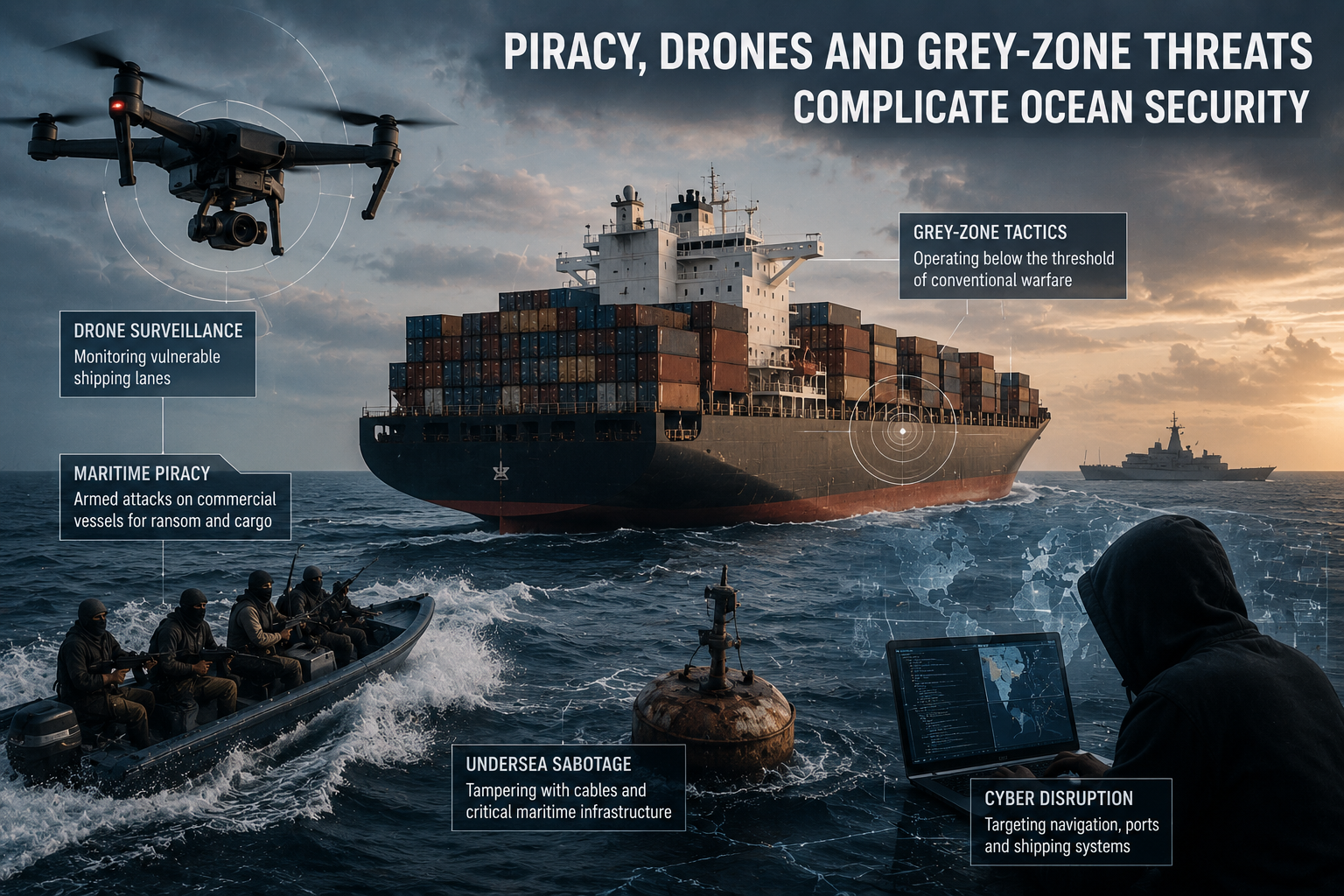
Ocean security used to be imagined as a contest among state navies. That picture is now too narrow. The modern maritime threat environment is messy, hybrid and often deniable. A commercial ship can be attacked by pirates seeking ransom, targeted by drones linked to a regional conflict, shadowed by a militia, jammed by electronic interference, inspected by a coast guard acting politically, or affected by cyber disruption in a port system. The line between crime, conflict and coercion is increasingly blurred.
This matters because the global economy still depends heavily on maritime trade. When ships avoid the Red Sea, reroute around the Cape of Good Hope, face higher insurance premiums or wait longer at ports, the cost is felt by consumers, exporters and energy-importing states. Ocean security is not a naval niche. It is an economic stability issue.
Piracy never fully disappeared
The decline of Somali piracy after its peak created a false sense of closure. Piracy was suppressed through naval patrols, armed guards, industry practices and international cooperation, but the underlying conditions—weak coastal governance, conflict, poverty, illegal fishing and criminal networks—did not vanish. When attention shifts and regional crises multiply, piracy can return.
India has a direct interest in preventing that return. Indian seafarers work on global merchant vessels. Indian trade moves through vulnerable waters. Indian naval credibility is strengthened when it responds quickly to distress calls. Anti-piracy operations therefore serve both humanitarian and strategic purposes. They protect lives and show that India can provide security beyond its coastline.
Drones change the cost equation
Drones have changed maritime security because they are relatively cheap, scalable and politically flexible. A non-state actor or militia can use drones to threaten ships in ways that force expensive defensive responses. A multi-million-dollar vessel may be endangered by a low-cost system. This asymmetry complicates naval planning. Traditional warships are powerful, but they are not always optimised for persistent, low-cost, swarm-like threats across wide maritime spaces.
The drone problem is not only kinetic. Unmanned systems can improve surveillance, track shipping, map vulnerabilities and create uncertainty. They can also be used by legitimate coast guards and navies for maritime-domain awareness. The same technology can secure or destabilise depending on who uses it and for what purpose. This dual-use character makes regulation and response difficult.
Grey-zone tactics at sea
Grey-zone operations exploit the space between peace and war. At sea, this may include maritime militia activity, coercive coast guard patrols, laser incidents, ramming, dangerous manoeuvres, survey activity in disputed waters, lawfare, illegal fishing fleets or infrastructure pressure. These tactics are designed to change facts gradually while avoiding a conventional military confrontation.
The South China Sea has demonstrated how grey-zone pressure can normalise new realities. The Indian Ocean could face similar pressures in different forms: research vessels near sensitive zones, dual-use port arrangements, fishing disputes, trafficking networks, maritime militia behaviour or political pressure around island infrastructure. India’s maritime strategy must therefore prepare not only for war, but for persistent competition below the threshold of war.
India’s response architecture
India needs layered maritime security. The Navy cannot be everywhere. The Coast Guard, customs, port authorities, fisheries agencies, intelligence services, satellite systems, drones, coastal radar networks and information-sharing platforms must work together. The Information Fusion Centre for the Indian Ocean Region is one example of how data can become security. But information must be timely, shared and actionable.
International cooperation is equally important. No country can secure the ocean alone. Joint patrols, white-shipping agreements, common operating pictures, shared legal frameworks and coordinated responses are essential. India’s advantage lies in being seen as a credible security partner that does not demand alliance loyalty as the price of cooperation.
Counter-view and next risks
The counter-view is that the language of grey-zone threats can become too elastic. If every unusual vessel movement is treated as strategic coercion, paranoia replaces analysis. Maritime security policy must distinguish between crime, commercial activity, scientific research, environmental concern and deliberate hostile behaviour. Overreaction can be as damaging as neglect.
The next risks will appear in chokepoints, undersea cables, port cyber systems, drone-enabled attacks, illegal fishing conflicts and legal disputes over maritime zones. India’s task is to build resilience before crisis arrives. The ocean is becoming harder to police because threats are cheaper, more distributed and more deniable. Security at sea now requires not only bigger ships, but sharper intelligence, faster coordination and political patience.
The commercial shipping vulnerability
Commercial shipping is built for efficiency, not combat. Large merchant vessels move slowly, follow predictable routes and depend on ports, insurers and digital systems. This makes them vulnerable to low-cost disruption. A single incident in a chokepoint can affect hundreds of sailings and contracts.
The strategic implication is severe: adversaries do not need to defeat a navy to hurt an economy. They can create uncertainty around shipping. Insurance costs, route changes and delays can act as economic pressure without formal war.
Legal ambiguity at sea
Grey-zone threats exploit legal ambiguity. Is a drone strike piracy, terrorism, war or proxy action? Is a suspicious fishing fleet commercial, criminal or state-directed? Is a coast guard manoeuvre law enforcement or coercion? These questions matter because response options depend on classification.
India and its partners need legal preparedness alongside operational readiness. Rules of engagement, evidence collection, prosecution mechanisms and information sharing must keep pace with new threats. Otherwise, hostile actors will continue to exploit the gap between law and action.
Technology for defence and disruption
Technology cuts both ways. Drones, satellites, automatic identification systems, machine learning and sensor networks can improve maritime security. The same tools can enable smuggling, spoofing, surveillance and targeting. The side that integrates data faster will gain advantage.
India should invest in indigenous maritime drones, coastal analytics, satellite fusion, cyber-secure port systems and rapid response protocols. The future of maritime security will belong to networks, not just platforms.
The human dimension
Behind every maritime security incident are seafarers, fishing communities and coastal families. Piracy and drone attacks are not only strategic events; they are human risks. Indian seafarers form a major part of the global maritime workforce, so instability at sea has direct social consequences for India.
A serious maritime policy must protect people as well as cargo. Training, distress communication, evacuation capability, welfare support and international legal action should be treated as part of national security.
Current trigger and why the issue matters now
The immediate trigger behind this article is piracy, drones and grey-zone maritime threats spreading below the threshold of conventional war. It matters now because the international system is no longer separating security, trade, technology and domestic politics into neat compartments. A shock in one domain quickly travels into another. That is why piracy drones grey zone should be read not as a specialised foreign-policy topic, but as a test of how power works in a more anxious world.
For a serious Indian reader, the importance of piracy, drones and grey-zone threats complicate ocean security lies in the fact that India is now exposed to global turbulence in multiple ways. Energy costs, shipping routes, diaspora safety, technology access, defence procurement, regional stability and diplomatic pressure all intersect. India can no longer watch these developments as an outside observer. It is large enough to be affected, but not yet powerful enough to control the system around it.
The article therefore needs to move beyond a news-event reading. The deeper question is not only what happened, but what pattern it reveals. The world is moving from optimism about open interdependence to guarded interdependence, where states still trade and cooperate, but constantly ask whether dependence can become vulnerability. That shift is visible across this topic.
Actors, incentives and pressure points
The main actors are navies, coast guards, pirates, militias, shipping firms, insurers, port authorities, fishing fleets and intelligence agencies. Each actor reads the same environment differently because each carries a different geography, domestic pressure and risk appetite. A great power may see room for manoeuvre where a smaller state sees exposure. A trading economy may fear disruption more than prestige loss. A military power may prioritise deterrence while a development-focused state seeks finance and stability.
The security pressure points include drone attacks, piracy resurgence, maritime militia tactics, spoofing, cyber disruption, illegal fishing and chokepoint coercion. These issues are not isolated. They create a chain of consequences. A maritime disruption can become an inflation problem. A technology restriction can become an industrial-policy challenge. A border dispute can change investment sentiment. A port deal can become a diplomatic signal. The modern strategic environment is connected precisely because systems are connected.
The economic pressure points include rerouting, insurance premiums, port delays, seafarer safety, fuel costs and supply-chain uncertainty. This is where traditional geopolitics meets ordinary life. A decision taken in a distant capital can affect freight rates, import bills, food prices, insurance costs, job creation and public finances. For Editors Outlook readers, this is the essential bridge: foreign policy is not remote. It enters the economy, the budget, the market and eventually the household.
India angle: choices, limits and leverage
India’s core task is building a layered maritime response through the Navy, Coast Guard, IFC-IOR, satellites, drones, legal preparedness and partnerships. This requires more than clever diplomacy. It requires material capacity: reliable infrastructure, credible defence production, institutional coordination, skilled negotiators, domestic consensus and the ability to deliver on promises. Strategic autonomy is meaningful only when backed by capability.
India also has to avoid two traps. The first is rhetorical overreach, where ambition is announced faster than institutions can execute. The second is defensive hesitation, where fear of taking sides prevents India from shaping outcomes. The better path is issue-based clarity: cooperate where interests align, resist coercion where necessary, and build domestic strength so that external pressure has less effect.
The Indian angle should also include the states and citizens most affected by these shifts. Coastal communities, exporters, students, seafarers, energy consumers, border populations, defence firms and technology workers all experience geopolitics differently. A mature editorial treatment should connect national strategy with these concrete constituencies.
Counter-view: what the dominant narrative may miss
The strongest counter-view is that the dominant narrative around piracy drones grey zone may exaggerate coherence. States are often less strategic than they appear. They make mistakes, react to domestic pressure, overpromise, underfund and improvise. What looks like a grand design may sometimes be a sequence of tactical moves under pressure.
Another complication is that cheap disruptive technologies may impose disproportionate costs on commercial shipping and naval escorts. This risk should not be treated as certainty, but it cannot be dismissed. Editorial credibility comes from acknowledging uncertainty. Good analysis does not pretend that one side has perfect strategy and the other side has none. It asks what each actor wants, what each actor can actually do, and where unintended consequences may appear.
There is also a moral danger in treating all issues only as power games. Smaller countries, local communities, migrants, soldiers, fishers and seafarers are not abstract variables. They bear the costs of strategic competition. An article that includes this human layer will feel more complete than one that speaks only in the language of capitals and corridors.
Future scenarios and editorial judgement
Three scenarios are worth watching. The first is managed competition: states continue to compete, but establish enough rules and communication channels to prevent crisis from becoming catastrophe. This is the best realistic outcome in many contemporary disputes because trust is low but interdependence remains high.
The second scenario is fragmented escalation: blocs harden, rules weaken, supply chains split further and smaller states are pressured to choose. This would increase costs for India and the Global South because development priorities would be repeatedly interrupted by strategic shocks. The third scenario is selective accommodation, where rivals compete in some areas but cooperate on climate, trade, health, maritime safety or crisis management. This is difficult, but not impossible.
The editorial judgement should be sharp: Piracy, Drones and Grey-Zone Threats Complicate Ocean Security is ultimately about the changing grammar of power. Influence is no longer exercised only through armies or treaties. It moves through shipping lanes, ports, credit, standards, legal claims, drones, institutions, public narratives and crisis response. India’s challenge is to read this grammar early and respond with capacity, not just commentary.
Policy choices and reporting angles for 2026
For Indian policymakers, the first requirement is institutional coordination. The issues around piracy drones grey zone do not belong to one ministry alone. They cut across external affairs, defence, commerce, finance, shipping, energy, technology, intelligence, environment and state governments. If policy remains fragmented, India will respond to symptoms while missing the system-level change. A coherent inter-ministerial approach is essential.
The second requirement is better public communication. Strategic debates in India often remain trapped between official optimism and social-media outrage. A serious democracy needs informed citizens who understand trade-offs. Not every compromise is weakness, and not every hard line is strategy. Explaining costs, risks and choices improves national resilience because citizens are less likely to be surprised by difficult decisions.
The third requirement is data discipline. Reporting on piracy, drones and grey-zone threats complicate ocean security should avoid vague claims and fashionable phrases unless they are supported by numbers, maps, timelines and documents. Readers should see trade volumes, defence budgets, shipping routes, project timelines, legal provisions, debt profiles or institutional statements wherever possible. Evidence gives strategic writing authority.
The fourth requirement is local reporting. Grand strategy becomes sharper when connected to ports, border towns, coastal villages, industrial clusters, seafarer families, students, exporters and small businesses. These are the places where geopolitics becomes lived experience. A strong article should therefore combine global analysis with Indian ground realities.
Finally, India should treat this subject as a capacity-building test. The question is not whether India understands the stakes of piracy drones grey zone; the question is whether it can build the institutions, infrastructure and partnerships needed to protect its interests. In a world where power is becoming more distributed and more coercive at the same time, strategic clarity must be matched by execution.
Reader takeaway
The reader should leave this article with one clear understanding: Piracy, Drones and Grey-Zone Threats Complicate Ocean Security is not an isolated diplomatic headline. It is part of a larger transition in which economics, security, law, technology and geography are converging. A country that studies only one layer will misunderstand the whole picture.
For India, the priority is to avoid emotional foreign policy. Outrage may produce applause, but it rarely produces leverage. India needs calm assessment, competitive capacity and long-term partnerships. It must know when to cooperate, when to resist, when to stay silent and when to lead.
For the wider Global South, the issue also carries a warning. Development choices are increasingly entangled with strategic pressure. Infrastructure, finance, technology and security cooperation can bring benefits, but they can also create dependence. Smaller states need options; larger states must offer them without coercion.
That is why the final frame of this article should be strategic maturity. piracy drones grey zone will test whether India can think in decades rather than news cycles. The countries that succeed in the coming order will not be those that react loudly to every event, but those that build the quiet capacity to absorb shocks and shape outcomes.
This also gives the article a strong editorial close. The subject should not be presented as a problem with a single clean solution. It is a moving strategic condition. Policies will need revision, partnerships will need repair, and assumptions will need testing against new facts. That is what makes the issue important for a serious publication rather than a passing news summary.
The final message for readers is that power today is cumulative. It is built through institutions, trust, production, maritime awareness, legal credibility, fiscal strength and public confidence. A state that neglects these foundations may win arguments but lose influence. A state that builds them patiently can turn uncertainty into advantage. This is why the issue must be tracked continuously, with fresh evidence, local reporting, institutional memory, editorial discipline, and strategic patience.
Sources Consulted / Verify Before Publishing
• UNCTAD Review of Maritime Transport 2024: https://unctad.org/publication/review-maritime-transport-2024
• PIB Sagar Sankalp 2026: https://www.pib.gov.in/PressReleasePage.aspx?PRID=2235847