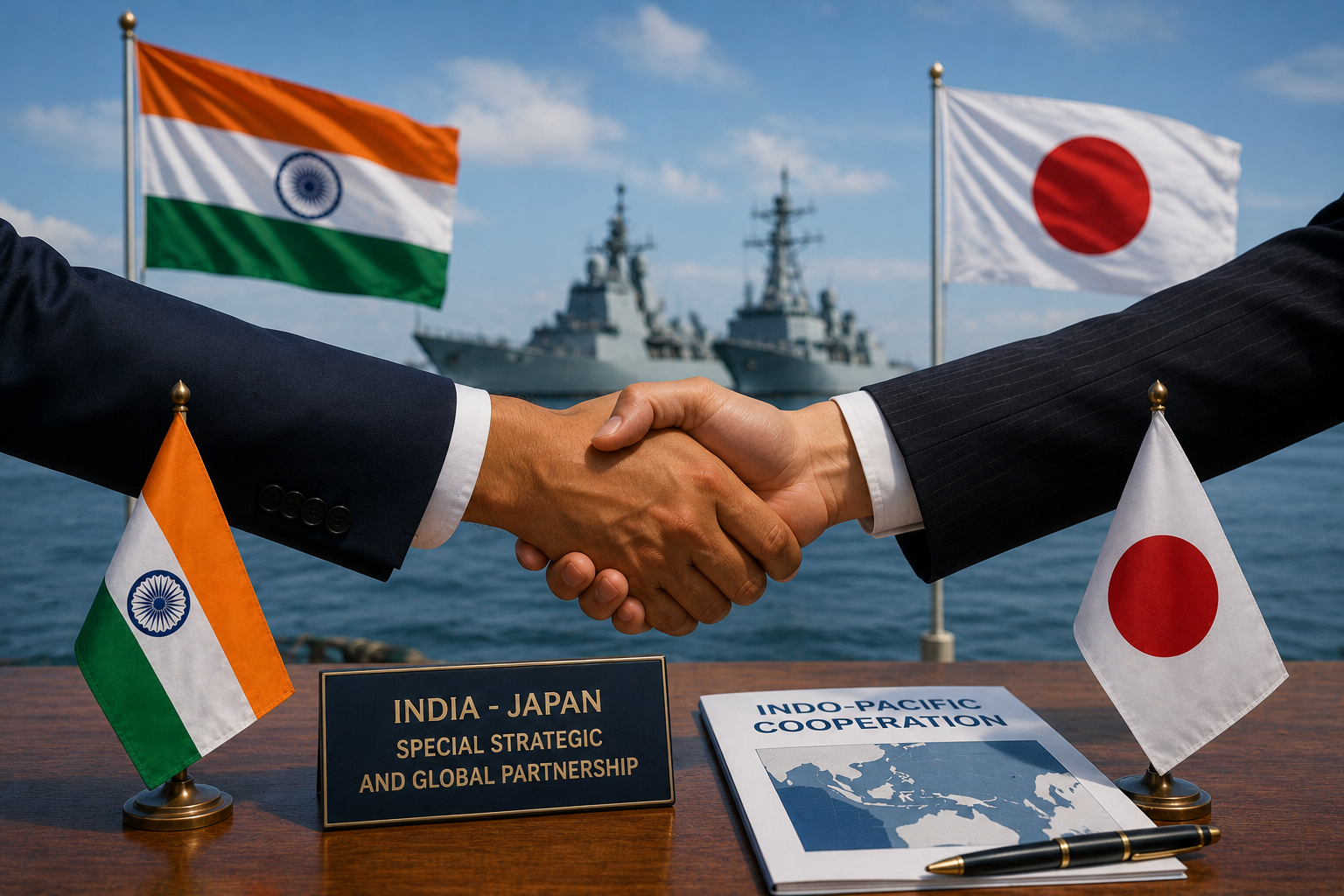
India and Japan are no longer just two Asian democracies with polite diplomatic ties and civilisational goodwill. Their relationship has acquired a sharper strategic purpose.
That purpose is the Indo-Pacific.
The Indo-Pacific is not merely a map. It is the space where the future of Asian power is being contested. It includes sea lanes, supply chains, islands, ports, naval deployments, digital networks, semiconductor ecosystems, energy routes, maritime chokepoints and the balance of power between China and other regional actors.
India and Japan sit at opposite ends of this strategic theatre. India looks east from the Indian Ocean. Japan looks west from the Pacific. Between them lies Southeast Asia, the South China Sea, critical shipping lanes, technology supply chains and the larger question of whether Asia will remain open, balanced and rules-based — or be shaped by coercion and dominance.
This is why India-Japan relations have found new meaning. The relationship is no longer based only on sentiment, Buddhism, economic aid or admiration for Japanese technology. It is now driven by hard strategic logic: China’s rise, maritime security, resilient supply chains, technology cooperation, infrastructure development, defence interoperability and the need for a stable Indo-Pacific order.
India needs Japan because Japan brings capital, technology, infrastructure quality, industrial discipline and strategic alignment. Japan needs India because India brings scale, geography, market depth, workforce potential and a strong position in the Indian Ocean.
This is no longer a relationship of convenience. It is becoming a partnership of necessity.
From Civilisational Warmth to Strategic Urgency
India and Japan have long enjoyed goodwill. Historical memory between the two countries is unusually positive compared with Japan’s relations with several other Asian states. India did not carry the same wartime bitterness toward Japan that China or Korea did. Cultural and spiritual links, especially through Buddhism, created a soft foundation.
But goodwill alone does not build strategic partnerships.
For many years, India-Japan ties remained underdeveloped. Japan focused heavily on its alliance with the United States and its economic presence in East Asia. India remained inward-looking, non-aligned and cautious about deep strategic partnerships. Trade was modest. Security cooperation was limited. Japan’s role in India was visible mainly through development assistance and infrastructure.
That older phase has changed.
Today, India and Japan see each other through a strategic lens. They are both concerned about the balance of power in Asia. They both support a free, open and rules-based Indo-Pacific. They both want stable sea lanes. They both worry about overdependence on China-centric supply chains. They both need trusted technology partnerships. They both see value in the Quad.
At the 2025 India-Japan Annual Summit, both countries adopted a “Joint Vision for the Next Decade,” describing India and Japan as two countries with a shared vision of a free, open, peaceful, prosperous and coercion-free Indo-Pacific based on the rule of law.
That phrase — “coercion-free Indo-Pacific” — is the strategic heart of the relationship.
China Is the Unspoken Driver
India-Japan relations are not anti-China in a simplistic sense. Both countries trade with China. Both engage China diplomatically. Neither wants uncontrolled conflict in Asia.
But China’s rise is the single most important strategic factor pushing India and Japan closer.
For India, China is a military rival on the Himalayan border, a major economic competitor, a presence in the Indian Ocean and a growing influence in South Asia. For Japan, China is a maritime and air-power challenge in the East China Sea, a major economic competitor, and a central concern in Japan’s national security planning.
The geography is different, but the anxiety is similar.
India faces China across land and sea. Japan faces China across sea and air. Both understand that the challenge is not only military. It is also economic, technological and infrastructural.
China’s scale has allowed it to dominate manufacturing supply chains, critical minerals processing, infrastructure financing, digital systems and regional influence. India and Japan cannot respond to this by rhetoric alone. They need practical cooperation: defence coordination, supply-chain resilience, trusted investment, infrastructure alternatives and technology partnerships.
This is where India-Japan ties become strategically valuable.
Japan cannot balance China in the Indo-Pacific without India’s geography and scale. India cannot build a strong Indo-Pacific posture without Japan’s technology, capital and maritime capabilities.
The Indo-Pacific Connects Their Strategic Maps
India’s strategic geography is centred on the Indian Ocean. Japan’s is centred on the Western Pacific. The Indo-Pacific concept connects these two spaces.
For India, the Indo-Pacific gives its Act East Policy a wider maritime and strategic frame. It expands India’s role beyond South Asia and the Indian Ocean into Southeast Asia and the Pacific. For Japan, the Indo-Pacific gives its Free and Open Indo-Pacific vision a western anchor in India.
This is why the India-Japan Act East Forum matters. Established in 2017, the forum was created to connect India’s Act East Policy with Japan’s Free and Open Indo-Pacific vision. It identifies projects for the economic modernisation of India’s North-East, including connectivity, development infrastructure, industrial linkages and people-to-people contacts.
This is not just regional development. It is strategic geography.
India’s North-East is the land bridge to Southeast Asia. Better infrastructure in this region strengthens India’s connectivity with ASEAN. For Japan, supporting development in India’s North-East helps build an alternative connectivity vision that is not dominated by China’s Belt and Road Initiative.
The North-East therefore becomes more than a domestic development region. It becomes part of the Indo-Pacific architecture.
The Quad Gives the Partnership a Wider Platform
India and Japan also work together through the Quad, along with the United States and Australia.
The Quad is often misunderstood as a military alliance. It is not. But it is clearly a strategic platform. It brings together four maritime democracies that want a stable, open and rules-based Indo-Pacific.
For India, the Quad provides strategic support without formal alliance obligations. For Japan, it strengthens regional coordination with India, Australia and the United States. For both, it creates a platform to discuss maritime security, technology, supply chains, cyber resilience, health security, disaster relief and infrastructure.
The 2025 India-Japan Joint Declaration on Security Cooperation explicitly referred to deeper cooperation within the Quad and advancing the Quad’s positive and practical agenda for peace and progress in the Indo-Pacific.
This shows that India-Japan ties are no longer only bilateral. They are part of a larger strategic network.
India’s caution is still visible. New Delhi does not want the Quad to become an Asian NATO. It values strategic autonomy and avoids treaty-based military obligations. Japan, as a US ally, has a different alliance structure. But both countries understand that the Quad gives them useful coordination without forcing India into formal alliance politics.
This flexibility is exactly why the Quad works for India-Japan relations.
Defence Cooperation Has Entered a New Stage
The most significant change in India-Japan ties is in defence and security cooperation.
For decades, Japan’s post-war security posture was restrained. India, too, was cautious about defence partnerships beyond traditional suppliers. That has changed as the regional security environment has become more difficult.
The 2025 Joint Declaration on Security Cooperation between India and Japan described the two countries as indispensable to a free, open, peaceful, prosperous and coercion-free Indo-Pacific. It committed both sides to promote interoperability and synergy between their defence forces, conduct more complex bilateral exercises, explore tri-service exercises for humanitarian assistance and disaster relief, increase logistics cooperation, and collaborate in areas such as counter-terrorism, peacekeeping and cyber defence.
This is a major shift.
India and Japan are no longer discussing security only as a diplomatic idea. They are building mechanisms: exercises, logistics, maritime domain awareness, coast guard cooperation, defence industry dialogue and joint staff-level coordination.
The declaration also referred to enhanced maritime security cooperation, including a common maritime picture through India’s Information Fusion Centre–Indian Ocean Region and the Indo-Pacific Partnership for Maritime Domain Awareness.
This matters because maritime awareness is the foundation of maritime power. A country cannot secure what it cannot see.
India and Japan both depend on open sea lanes. Japan’s energy and trade routes pass through the Indian Ocean. India’s economic and strategic future depends on secure access across the Indo-Pacific. Maritime cooperation is therefore not symbolic; it is practical.
Japan Helps India Build Infrastructure With Strategic Value
Japan has long been one of India’s most important development partners.
Japanese Official Development Assistance has supported infrastructure, transportation, power, environmental projects and basic human needs. According to India’s embassy in Tokyo, Japan has been extending bilateral loan and grant assistance to India since 1958 and remains India’s largest bilateral donor; Japanese ODA disbursement to India in 2024-25 stood at about JPY 440 billion.
This is important because Japan’s infrastructure approach is different from China’s Belt and Road model.
Japan emphasises quality infrastructure, transparency, long-term viability, local capacity and environmental standards. India values this because it does not want infrastructure financing that creates unsustainable debt or strategic dependency.
The Mumbai-Ahmedabad High Speed Rail project is the most visible symbol of Japanese infrastructure cooperation in India. The corridor is being implemented with Japanese technical and financial assistance and covers 508.17 km across Maharashtra, Gujarat and Dadra and Nagar Haveli.
The bullet train project is often debated domestically in terms of cost and priority. But strategically, it has a deeper meaning. It is about technology absorption, high-speed rail capacity, training, engineering standards and long-term infrastructure upgrading.
Japan’s infrastructure role in India is therefore both developmental and strategic.
Investment Is the Economic Spine of the Relationship
India-Japan relations cannot become truly strategic unless the economic pillar becomes stronger.
Japan is one of the world’s most advanced industrial economies. It has deep strengths in automobiles, robotics, precision machinery, electronics, materials science, manufacturing systems, high-speed rail, clean technology and infrastructure finance. India has a large market, young workforce, improving infrastructure and manufacturing ambitions.
The complementarity is clear.
During Prime Minister Modi’s 2025 visit to Tokyo, India and Japan set a new target of JPY 10 trillion — about USD 67 billion — in private investment from Japan into India. The 2025 summit statement also noted that the earlier target of JPY 5 trillion in public and private investment and financing from Japan to India since 2022 had made progress, and the new target was meant to deepen Japanese supply chains in India.
This is highly significant.
India wants to become a manufacturing hub. Japan wants to diversify supply chains and reduce excessive dependence on China. Japanese investment can support India’s manufacturing base, infrastructure, logistics, electronics, mobility, green energy and industrial ecosystems.
But India must also be honest: Japanese investors are demanding. They value policy stability, quality infrastructure, skilled labour, predictable taxation, contract enforcement and administrative efficiency.
If India wants more Japanese investment, it must provide Japanese-level reliability.
Trade Remains Below Potential
Despite strong political ties, India-Japan trade remains modest compared with the size of both economies.
Japan’s bilateral trade with India totalled USD 27.47 billion in FY 2025-26. Japanese exports to India were USD 21.43 billion, while India’s exports to Japan were only USD 6.04 billion. Japan ranked 10th in India’s total trade, while India accounted for only a small share of Japan’s total trade.
These numbers reveal the weakness in the relationship.
The political and strategic partnership is strong. The trade relationship is not yet strong enough.
India imports high-value machinery, electrical equipment, copper, iron and steel, chemicals and industrial products from Japan. India exports organic chemicals, vehicles, aluminium, fish and other products. But the scale is far below potential.
The India-Japan Comprehensive Economic Partnership Agreement came into effect in August 2011 and covers goods, services, movement of natural persons, investment, intellectual property, customs procedures and other trade-related issues. It envisaged tariff elimination over 94% of items traded over a ten-year period.
Yet the trade relationship has not expanded as dramatically as expected.
This is a warning. Strategic warmth does not automatically create commercial depth. Indian exporters need quality, scale, consistency, certification and market understanding. Japanese companies need confidence in India’s regulatory and operational environment.
The next phase of India-Japan ties must correct this imbalance.
Supply Chains Are the New Battlefield
The India-Japan relationship has gained urgency because supply chains have become geopolitical.
The pandemic exposed the danger of over-concentrated supply chains. The US-China technology conflict deepened concerns. The Ukraine war and Red Sea disruptions showed how geopolitical shocks can affect global commerce. Companies and governments now care not only about cost, but also reliability, trust and political risk.
This creates opportunity for India and Japan.
Japan wants supply-chain diversification. India wants manufacturing investment. Both want alternatives to excessive dependence on China.
But supply-chain relocation is not automatic. Global firms will not move production to India only because India is strategically important. They will move if India offers competitive costs, deep supplier ecosystems, good logistics, skilled labour, predictable rules and fast execution.
Japan can help India build industrial depth. India can help Japan diversify production. But the relationship must move from broad intention to specific sectors: semiconductors, batteries, electronics components, auto parts, green hydrogen equipment, medical devices, robotics, machine tools and advanced materials.
The real test is whether India-Japan cooperation can produce factories, jobs, exports and technology absorption — not just summit language.
Technology Cooperation Is Becoming Central
Technology is now one of the most important areas in India-Japan ties.
Japan has advanced capabilities in robotics, precision manufacturing, materials science, electronics, mobility, green technologies, space cooperation and high-end industrial processes. India has software talent, digital public infrastructure, a large startup ecosystem, engineering manpower and a fast-growing digital economy.
The two capabilities can complement each other.
The 2025 India-Japan outcomes included a Joint Vision for the Next Decade covering economic partnership, economic security, mobility, ecological sustainability, technology and innovation, health, people-to-people ties and state-prefecture engagement.
India’s embassy in Tokyo also notes that 2025-26 was declared the “India-Japan Year of Science, Technology & Innovation Exchanges,” with developments including a Joint Institute of Excellence by IIT Bombay and Tohoku University and continued advanced materials research cooperation.
This is important because India must move beyond being only a software services power. It needs hardware, manufacturing technology, materials research, semiconductor ecosystems, robotics and deep-tech capability.
Japan is one of the few partners that can help India build disciplined industrial technology capacity.
Human Mobility Can Solve Two Problems at Once
Japan has an ageing society and labour shortages. India has a young population and a need for global employment opportunities.
This creates a natural partnership in human mobility.
During the 2025 summit, India and Japan agreed on an Action Plan for Human Resource Exchange that targets two-way exchange of more than 500,000 people over five years, including 50,000 skilled and semi-skilled personnel from India to Japan.
This could become one of the most socially transformative parts of the relationship.
For Japan, Indian skilled workers can help address labour shortages in sectors such as healthcare, manufacturing, construction, services, technology and elderly care. For India, Japan offers higher wages, skill upgrading, discipline, exposure to advanced industry and a new destination beyond the traditional Gulf and Western routes.
But this will not be easy.
Language remains a major barrier. Japanese workplace culture is demanding. Certification systems must be aligned. Indian workers need training not only in skills, but also language, culture, contracts, rights and expectations.
If India handles this well, Japan can become a high-quality labour and skill destination. If handled poorly, the programme may remain underutilised.
Human mobility could become the hidden engine of India-Japan relations.
The North-East Is a Strategic Bridge
India’s North-East has a special place in India-Japan cooperation.
For India, the North-East is central to Act East. For Japan, it is a region where infrastructure and connectivity can support a wider Indo-Pacific vision. Together, the two countries can turn the region into a bridge between India and Southeast Asia.
The Act East Forum identifies projects for connectivity, developmental infrastructure, industrial linkages and people-to-people contacts in India’s North-East.
This is strategically important for several reasons.
First, it strengthens India’s domestic integration.Second, it improves access to Southeast Asia.Third, it offers an alternative connectivity model to China-led infrastructure.Fourth, it helps stabilise a sensitive region through development.Fifth, it makes India’s Indo-Pacific policy visible on land, not only at sea.
But challenges remain. Political instability in Myanmar, tensions in Bangladesh, difficult terrain, project delays and local concerns can slow connectivity.
India and Japan must therefore combine infrastructure with local development, skills, tourism, culture, environment and industry. The North-East should not become only a corridor. It must become a beneficiary.
Japan’s Strategic Evolution Helps India
Japan itself is changing.
For decades after World War II, Japan maintained a restrained security posture. But the regional environment has pushed Tokyo to rethink defence, economic security and strategic partnerships. North Korea’s missiles, China’s maritime assertiveness, Taiwan Strait tensions and supply-chain vulnerabilities have all influenced Japanese policy.
This evolution matters for India.
A more strategically active Japan can become a stronger partner in maritime security, defence industry, technology, infrastructure and regional stability. India benefits when Japan is willing to do more beyond economic diplomacy.
The 2025 Joint Declaration on Security Cooperation reflects this new stage. It includes plans for national security adviser-level dialogue, economic security dialogue, joint-staff cooperation, coast guard meetings, a reinvigorated defence industry forum and track 1.5 dialogue among think tanks.
This is not a minor bureaucratic development. It shows that the relationship is becoming institutionalised.
Strategic partnerships survive when they are built into systems, not just leader-level chemistry.
India Must Understand Japan’s Constraints
While Japan is becoming more active, India must understand Japan’s constraints.
Japan remains closely tied to the United States through its alliance system. Its security policy is shaped by domestic constitutional debates, public opinion and regional sensitivities. Japan also has a complicated economic relationship with China. China remains an important trade partner for Japan, even as Tokyo worries about Beijing’s power.
This means Japan will not behave like a reckless anti-China actor. It will balance competition with economic caution.
India should understand this because India does the same in its own way. New Delhi also competes with China but maintains channels. It also works with the United States without becoming an ally. It also wants supply-chain resilience without sudden economic rupture.
In that sense, India and Japan understand the logic of strategic caution.
Both countries are balancing China, but neither wants uncontrolled confrontation.
Japan Must Understand India’s Strategic Autonomy
Japan must also understand India’s constraints.
India is not a treaty ally of the United States. It values strategic autonomy. It maintains relations with Russia. It participates in BRICS and the SCO. It has a direct land border with China. It cannot adopt every position of US allies.
This sometimes creates discomfort among partners who want India to align more clearly. But India’s autonomy is also what makes India valuable. India is not a dependent state. It brings independent weight.
Japan should see India not as a country to be fitted into an alliance framework, but as a sovereign pole in the Indo-Pacific.
The more Japan respects India’s autonomy, the stronger the partnership will become.
The Relationship Needs More Business Depth
The biggest weakness in India-Japan ties remains business depth.
Japanese companies have invested in India, but not at the scale that the strategic relationship deserves. India is still not central enough to Japan’s global supply chains. Japanese small and medium enterprises often find India difficult. Indian exports to Japan remain limited.
To fix this, both sides need practical work.
India must improve ease of doing business for Japanese firms, especially outside a few established clusters. It must offer industrial parks, reliable logistics, skilled labour, faster approvals, stable tax treatment and dispute resolution. It must reduce the gap between policy announcement and ground execution.
Japan must encourage more SMEs to look at India, support technology transfer, local supplier development and long-term manufacturing partnerships.
India-Japan economic cooperation should not be limited to automobiles and infrastructure. It should expand into semiconductors, electronics, medical devices, clean energy, defence equipment, logistics, food processing, robotics and advanced manufacturing.
Without business depth, strategic partnership will remain incomplete.
Maritime Security Is the Natural Area of Convergence
Maritime security may become the strongest security pillar of India-Japan cooperation.
Japan depends heavily on sea lanes that pass through the Indian Ocean. India is the central power in the Indian Ocean. Both countries care about freedom of navigation, piracy, maritime domain awareness, law of the sea and disaster relief.
The 2025 security declaration emphasised naval and coast guard cooperation, port calls, maritime law enforcement cooperation, disaster risk reduction and coordination of assistance to third countries in the Indo-Pacific.
This is practical and important.
India’s maritime role is expanding from the western Indian Ocean to the wider Indo-Pacific. Japan’s maritime concerns extend from the Pacific to the Indian Ocean. Their interests meet across the sea lanes linking the Middle East, India, Southeast Asia and East Asia.
The sea is where India-Japan strategy becomes most natural.
India-Japan Cooperation Can Help ASEAN
ASEAN sits geographically between India and Japan. Any serious Indo-Pacific strategy must involve Southeast Asia.
Both India and Japan support ASEAN centrality. This is important because Southeast Asian countries do not want to be forced into a hard China-versus-US choice. They want options, infrastructure, markets and security without domination.
India and Japan can jointly support connectivity, maritime capacity, digital infrastructure, disaster resilience, health security and quality infrastructure in Southeast Asia.
This would strengthen the Indo-Pacific without making it look like a purely military project.
For India, working with Japan in ASEAN also helps give substance to Act East. For Japan, working with India reduces the impression that Indo-Pacific strategy is only a US-alliance project.
Together, India and Japan can offer ASEAN a more balanced model.
The Partnership Also Has a Global Governance Dimension
India and Japan are both aspirants for permanent membership in a reformed United Nations Security Council. Both have long argued that global institutions must reflect contemporary realities.
The 2025 India-Japan security declaration referred to promoting UNSC reform, including expansion in both permanent and non-permanent categories, and supporting each other’s candidature as permanent members in an expanded Security Council.
This creates another layer of strategic convergence.
India and Japan are both major economies and responsible stakeholders, but both remain outside the permanent membership structure created after World War II. Their cooperation on global governance reform reflects frustration with outdated institutions.
This also links India-Japan ties to the wider Global South and middle-power reform agenda.
Why This Matters for Ordinary Indians
India-Japan relations may appear distant, but they affect ordinary Indians in concrete ways.
Japanese investment can create manufacturing jobs.Japanese technology can improve infrastructure and industrial quality.Human mobility agreements can create overseas employment opportunities.High-speed rail and metro projects can improve transport capacity.Supply-chain cooperation can support Make in India.Defence cooperation can strengthen maritime security.Act East projects can support development in the North-East.Science and technology exchanges can benefit students and researchers.
This is why India-Japan relations should not be viewed only through diplomacy. They are linked to jobs, infrastructure, skills, technology and national security.
A strong Japan partnership can help India become more industrial, more connected and more strategically capable.
The Risks Ahead
The partnership has great promise, but it also faces risks.
First, trade remains weak. If trade does not grow, the economic base of the relationship will remain narrow.
Second, Japanese investment may fall short if India does not improve execution, regulatory predictability and industrial infrastructure.
Third, China-related tensions could create pressure, but both countries may respond differently depending on their own interests.
Fourth, India’s Russia ties and strategic autonomy may sometimes limit coordination with Japan, especially because Japan is closely aligned with the West on Ukraine.
Fifth, human mobility may underperform if language and skill barriers are not solved.
Sixth, connectivity projects in the North-East may be slowed by regional instability and implementation delays.
Seventh, the Quad may face expectations that India is not willing to meet if the platform becomes too militarised.
These risks do not weaken the partnership. They show what must be managed.
What India Must Do Next
India should approach Japan with a clear strategy.
First, deepen defence and maritime cooperation without compromising strategic autonomy.
Second, make India a serious destination for Japanese supply-chain diversification through regulatory stability, industrial clusters, logistics and skilled labour.
Third, expand cooperation in semiconductors, robotics, clean energy, medical devices, green hydrogen, batteries and advanced materials.
Fourth, convert the human-resource exchange plan into real worker and student mobility through Japanese language training, certification systems and employer linkages.
Fifth, strengthen the Act East Forum and ensure North-East projects benefit local communities, not just strategic maps.
Sixth, increase Indian exports to Japan through quality upgrading, food processing, pharmaceuticals, organic chemicals, engineering goods and services.
Seventh, use Japan as a partner in ASEAN, Africa and the wider Indo-Pacific through quality infrastructure and capacity-building initiatives.
The India-Japan relationship must now move from potential to performance.
Conclusion: The Indo-Pacific Has Given India-Japan Ties a Strategic Soul
India-Japan relations have entered a new phase because the Indo-Pacific has given the partnership a strategic soul.
Earlier, the relationship had goodwill.Then it gained economic depth through Japanese investment and infrastructure.Now it has acquired geopolitical purpose.
India and Japan need each other because Asia’s future is uncertain. China’s rise has changed the balance of power. Supply chains are being reorganised. Maritime security has become central. Technology has become strategic. Infrastructure has become geopolitical. The Indo-Pacific has become the main theatre of twenty-first-century competition.
In this environment, India and Japan are natural partners.
Japan brings capital, technology, industrial discipline and Pacific strategy. India brings scale, geography, workforce, market depth and Indian Ocean reach. Together, they can help build a more balanced Indo-Pacific.
But the partnership will succeed only if it becomes practical. The test is not how often leaders praise the relationship. The test is whether Japanese investment creates Indian manufacturing capacity, whether defence cooperation improves maritime security, whether human mobility creates real opportunities, whether North-East connectivity advances Act East, and whether both countries can coordinate without forcing India into alliance politics.
India-Japan ties now have purpose.
The next challenge is delivery.