The Story Behind the Headline
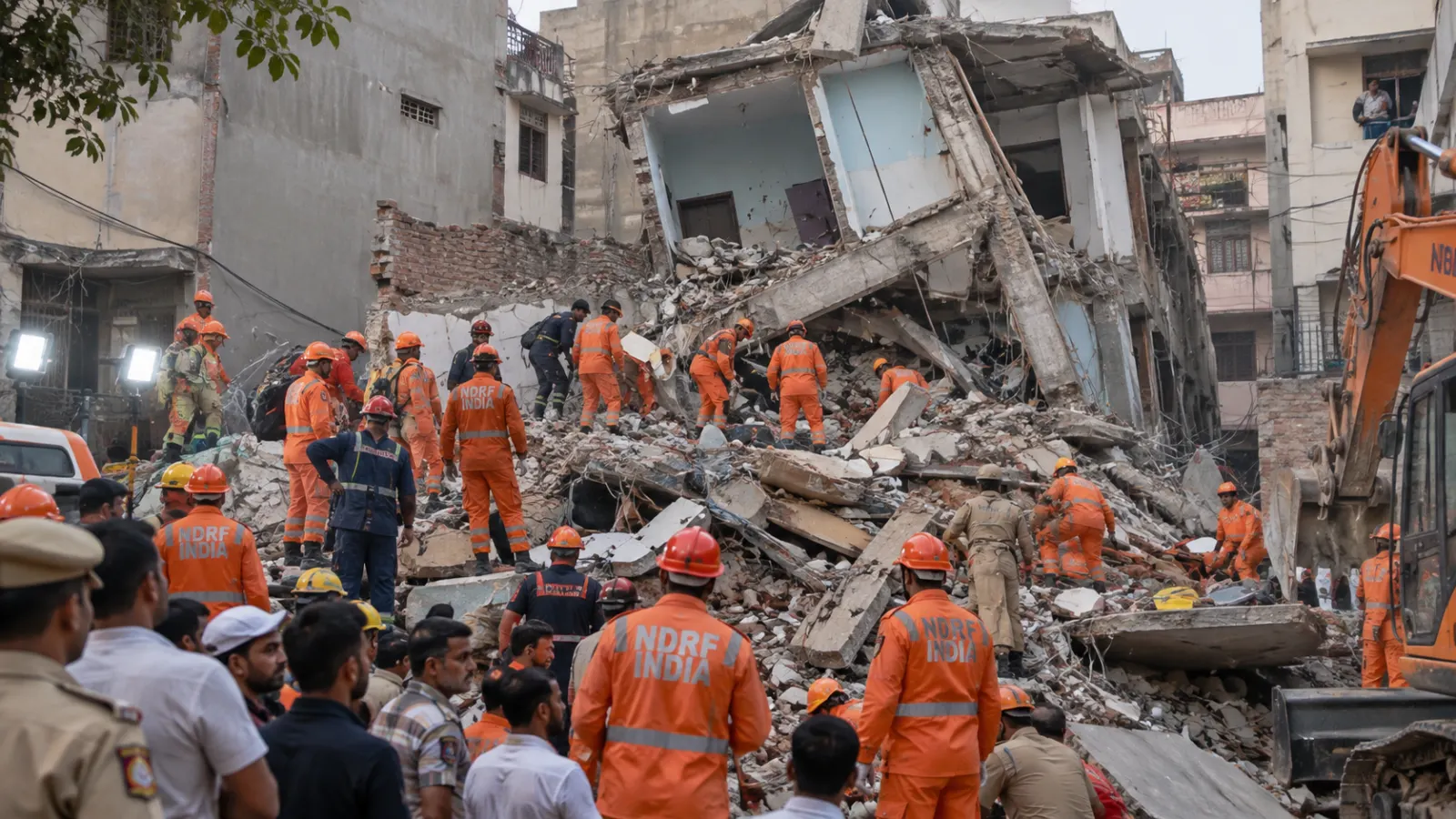
A city does not collapse in one evening. It collapses slowly - through ignored complaints, weak inspections, illegal floors, political protection, municipal fatigue and a public culture that treats safety documents as paperwork. The building collapse near Saket Metro Station in Delhi is therefore not merely a tragic accident. It is a brutal exposure of how urban India often places ambition inside unsafe structures and calls it development.
Reports say six people died after a multi-storey commercial building in the Saidulajab area near Saket collapsed. The structure reportedly housed coaching centres, cafes and offices. Construction work was said to be underway on an upper floor. Some of those caught in the disaster were connected to the student and coaching ecosystem. One account spoke of a research aspirant who had been celebrating an interview when tragedy struck. That detail gives the story its unbearable weight: a young person's future was interrupted not by personal failure, but by civic failure.
Delhi is a city of aspiration. Students arrive with borrowed money, parental sacrifice and compressed dreams. They sit in coaching rooms, rent small rooms, eat in cramped cafes and spend years trying to enter medical, administrative, research or professional careers. Around metro stations, a parallel economy grows around them: coaching institutes, food joints, hostels, photocopy shops, libraries and small offices. This ecosystem is energetic, but it is also vulnerable. Many of its spaces are not designed for the load they carry.
The Saket collapse sits inside this wider urban reality. Commercial buildings are adapted, extended, partitioned and modified. Floors appear where they should not. Basements become classrooms. Terraces become work zones. Staircases narrow. Structural audits are avoided or delayed. Tenants often do not know whether the building they occupy is safe. Students, workers and small entrepreneurs become end-users of risk they did not create.
Why It Matters Beyond the Immediate News
After the collapse, reports said an FIR was registered under provisions including culpable homicide, two MCD engineers were suspended and a magisterial inquiry was ordered. These steps are necessary, but the public must ask whether they are sufficient. Accountability after death is not the same as prevention before death. Suspensions may satisfy immediate outrage, but unless the inquiry identifies the full chain of responsibility - owner, contractor, engineer, municipal approval process, enforcement lapses and political pressure - the next collapse will simply wait its turn.
Urban governance in India often suffers from a dangerous division of responsibility. The builder says the tenant changed usage. The tenant says the owner assured safety. The owner says municipal permissions existed. Municipal staff say they were understaffed or unaware. Police say the matter belonged to civic authorities. Politicians promise strict action after visiting the site. The result is a circular economy of blame in which everyone had limited responsibility and victims had none.
The real test is documentary. Was the building sanctioned for its actual use? Were additional floors legal? Was construction underway with permission? Were structural drawings available? Were inspections conducted? Were notices issued? If notices were issued, were they enforced? If complaints were made, who received them? If engineers were suspended, what specific duty did they fail to perform? These are not technicalities. They are the difference between tragedy and accountability.
The Institutional Question
Delhi has repeatedly struggled with unauthorised construction and mixed-use pressure. As the city expands, land becomes expensive and compliance becomes negotiable. Small commercial clusters grow faster than enforcement capacity. Local economies depend on these buildings, so authorities often tolerate irregularities until something breaks. In that sense, unsafe construction is not merely a builder's crime. It is a governance ecosystem.
The class angle is important. The people most exposed to unsafe buildings are rarely the people who benefit most from cutting corners. Students, migrant workers, junior employees, small shopkeepers and service workers often spend their days in compromised structures because those are the spaces they can afford. Safety becomes a privilege. The rich can choose gated offices, certified complexes and better housing. The aspirational lower and middle classes are told to adjust.
This is why the Saket collapse must be written as more than a casualty report. It is a story about how cities consume dreams. Delhi attracts young people by promising access - to coaching, jobs, institutions, networks and mobility. But if that access is built on unsafe concrete, the promise becomes morally hollow. A city cannot call itself modern if its students study under ceilings that may fall.
The Wider Horizon
There is also a need to rethink how building safety is communicated to the public. Restaurants display menus and licences. Schools display boards. Hospitals display registrations. But ordinary citizens rarely see a clear, accessible building-safety certificate. Why should a student entering a coaching centre not be able to know whether the building has a valid occupancy certificate, fire clearance and structural safety compliance? Transparency should not be limited to government files.
Delhi needs a public-facing building safety registry for high-footfall commercial structures, especially coaching centres, hostels, cafes, libraries and offices near dense transit zones. It needs periodic structural audits for older and modified buildings. It needs whistleblower protection for residents who complain. It needs real penalties for officials who ignore illegal construction. Most importantly, it needs enforcement before elections, before disasters and before cameras arrive.
The language after every collapse is familiar: strict action, inquiry ordered, guilty will not be spared. The public has heard these lines too often. The more honest question is why the guilty are spared until people die. Why does the state become alert only after rubble appears? Why does a city wait for bodies before reading its own files?
What Should Change Now
The Saket collapse should haunt Delhi not only because six people died, but because their deaths were preventable if the system had treated safety as a living duty. Development is not the number of buildings a city raises. It is the confidence with which citizens can enter them. If students cannot sit in a classroom, workers cannot enter an office and friends cannot meet in a cafe without trusting the roof above them, then the city has failed at its most basic promise.
A young aspirant should be able to celebrate an interview without becoming a symbol of urban neglect. That is the minimum dignity a city owes its people. Delhi must now decide whether this collapse becomes another file in the archive of outrage or the moment it finally learns that concrete without accountability is not progress. It is danger with a paint coat.