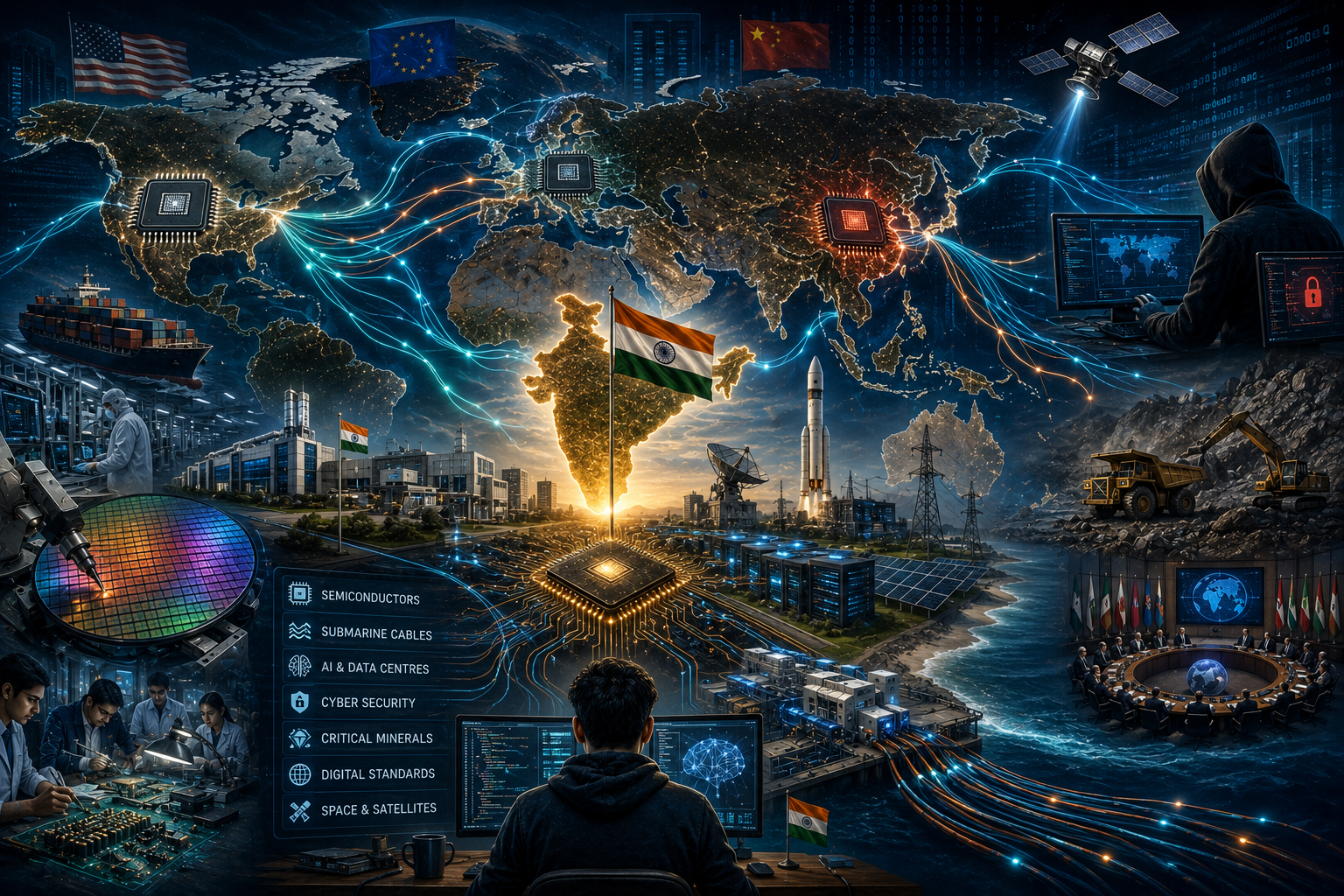
The New World Order Will Be Written in Chips, Cables and Code
For most of modern history, power was drawn on maps with borders, armies, ports, oilfields, sea lanes and alliances. That geography has not disappeared. Soldiers still stand at borders. Warships still matter. Energy routes still shape diplomacy. But a new layer has been placed over the old map: chips, cables, code, data centres, satellites, cyber tools, artificial intelligence models, rare earths and digital standards. The world order is no longer written only in treaties and troop movements. It is being written in supply chains and software architectures.
Technology has become the silent factor in international relations. It is silent because it often appears technical. It is decisive because it determines who can compute, communicate, surveil, sanction, manufacture, encrypt, predict and defend.
In the twentieth century, a country feared blockade of oil. In the twenty-first, it must fear blockade of semiconductors, cloud access, payment networks, submarine cables, GPS signals, advanced machinery, AI models and critical minerals. Sovereignty has moved from flags to infrastructure.
India must understand this clearly. Strategic autonomy cannot remain a diplomatic slogan. It must become technological capacity.
The old Non-Aligned Movement belonged to a world of ideological blocs. India could navigate between capitalism and communism, between Washington and Moscow, between postcolonial solidarity and national interest. Today's alignments are more complex. A country may buy oil from one partner, weapons from another, chips from a third, cloud services from a fourth, and face cyber threats from a fifth. Dependence is no longer always visible. It can sit inside a server, a software update, a payment gateway, a telecom network or a chip design tool.
This is why the phrase "chips, cables and code" matters. Chips are the brains of modern machines. Cables are the nervous system of the internet. Code is the language through which instructions become power. Whoever controls these layers has influence beyond territory.
Semiconductors are the most obvious example. Modern cars, smartphones, missiles, medical devices, power grids, banking systems and AI infrastructure depend on chips. The India Semiconductor Mission aims to build a strong semiconductor and display ecosystem and integrate India into global electronics value chains. Government communication around SEMICON India has framed chip capability as central to the next stage of electronics manufacturing and design. This is not simply industrial policy. It is strategic policy.
A country that cannot access advanced chips cannot fully
A country that cannot access advanced chips cannot fully control its defence, AI, telecom, manufacturing or energy transition. It may remain a market, but not become a power.
The global chip war has already shown how technology can become geopolitics. The United States has used export controls to limit China's access to advanced chips and manufacturing equipment. China has invested massively in self-reliance. Taiwan's semiconductor role has turned a small island into one of the most strategically sensitive points on earth. The Netherlands, Japan and South Korea matter because of specialised technology chains. This is a world in which a lithography machine can matter as much as a naval base.
India's opportunity is real, but the challenge is severe. Semiconductor ecosystems cannot be built by announcement. They require power reliability, water management, precision manufacturing, skilled engineers, supplier depth, design talent, long-term financing, intellectual property, global trust and policy stability. A fabrication unit is not a statue; it is a living industrial organism. If India wants chip sovereignty, it must build patient capability rather than headline capacity.
Cables matter just as much. The internet feels wireless because the last mile is often wireless. Globally, however, submarine cables carry the great bulk of international data traffic. TRAI, in its recommendations on submarine cable landing, described submarine cables and cable landing stations as critical assets and suggested that they be promoted, protected and prioritised. This is the right framing. Data routes are trade routes. Cable landing stations are ports of the digital age.
India's geography gives it natural importance in the Indian Ocean. But geography alone does not create power. Ports must be governed. Cables must be secured. Data centres must be built. Cyber resilience must be institutionalised. Legal frameworks must be trusted. If India becomes a reliable node in global data flows, its strategic relevance rises. If it remains dependent on infrastructure controlled elsewhere, its digital economy remains vulnerable.
Code is the third layer. Software has always been India's strength, but the old outsourcing model is insufficient for the new era. Writing code for global clients made India valuable. Owning platforms, protocols, AI models, cybersecurity tools and digital standards will make India powerful. There is a difference between being the world's back office and becoming a rule-maker in the digital order.
The IndiaAI Mission recognises the need to democratise AI benefits and strengthen technological self-reliance. But AI sovereignty is not only about talent. It is about compute, data governance, model development, language resources, cloud infrastructure, research depth and ethical legitimacy. India cannot become AI-powerful if it only consumes models built elsewhere.
Language is a strategic issue here
Language is a strategic issue here. Most global AI systems are stronger in English than in Indian languages. If India does not build high-quality datasets, speech systems and models for its linguistic diversity, the AI future will deepen language inequality. Citizens who think, work and argue in Indian languages may become second-class users of intelligent systems. A republic of many languages cannot outsource its linguistic future to companies with commercial priorities.
Cyber power is another crucial dimension. Traditional war announces itself. Cyber conflict often hides in networks before appearing in headlines. It can target power grids, hospitals, banks, ports, elections, military systems and citizen data. Sanctions can freeze assets. Platforms can de-amplify voices. Payment networks can restrict transactions. App ecosystems can shape access. The weaponisation of interdependence is one of the defining features of the current order.
This is where India's strategic autonomy must become more precise. It cannot mean equidistance from everyone. It must mean freedom of decision backed by domestic capability and diversified partnerships. India should cooperate with the United States, Europe, Japan, Australia, Israel, Taiwan, South Korea and others on technology where interests align. It should engage with the Global South on digital public infrastructure. It should maintain channels with rivals where necessary. But it must avoid dependence so deep that policy freedom becomes theoretical.
SIPRI's 2026 data showed that military expenditure in Asia and Oceania reached 681 billion dollars in 2025, 8.1 per cent higher than in 2024, with China's spending estimated at 336 billion dollars. The regional security environment is not becoming simpler. But the future military balance will not be decided only by tanks and aircraft. It will be decided by drones, satellites, AI-enabled surveillance, autonomous systems, electronic warfare, cyber tools and secure communications. Defence indigenisation must therefore include digital depth.
Border management is also changing. Roads, bridges and forward infrastructure matter in the Himalayas. So do satellite imagery, drones, sensors, encrypted networks, logistics software and weather intelligence. In the Indian Ocean, naval presence matters. So do maritime domain awareness, undersea cable protection, satellite tracking and port data systems. The frontier is now physical and digital at once.
Technology also affects diplomacy. Countries once exported ideology. They now export infrastructure stacks. China offers telecom equipment, digital surveillance tools, ports and platforms. The United States offers cloud, chips, software ecosystems and security alliances. Europe offers regulation and privacy frameworks. India has begun offering digital public infrastructure experience through Aadhaar-like identity lessons, UPI-style payments and governance platforms. This is a major opportunity. But India must ensure that its model is rights-respecting, secure and adaptable.
The Global South does not need another form of digital dependency. It needs technology that enhances state capacity without reducing citizen freedom.
Critical minerals complete the picture
Critical minerals complete the picture. Batteries, electronics, defence systems and clean-energy technologies depend on minerals whose supply chains are concentrated. Lithium, cobalt, nickel, rare earths and graphite have become strategic resources. A country that wants electric mobility, renewable storage, electronics manufacturing and defence technology must plan mineral security. This requires overseas partnerships, recycling, domestic exploration, material science and industrial policy.
The climate transition itself is technological geopolitics. Solar panels, wind turbines, batteries, green hydrogen, smart grids and carbon markets are not merely environmental tools. They are future industrial battlegrounds. If India imports the entire clean-tech stack, it may reduce emissions while creating new dependence. If it builds capability, the energy transition can become an industrial revolution.
The policy challenge is therefore integrated. Ministries cannot work in isolation. Defence, external affairs, electronics, telecom, commerce, power, education, science, finance and environment must see technology sovereignty as a shared project. A chip plant without skilled labour will struggle. AI without data governance will create distrust. Cables without maritime security will be vulnerable. Digital payments without cyber protection will expose citizens. Defence tech without manufacturing depth will remain dependent.
Private industry is crucial, but the market alone will not build strategic capacity. Deep technology requires patient capital, procurement support, research universities, testing facilities, standards bodies and risk-sharing. India's venture ecosystem is comfortable with apps and consumer platforms. It is less comfortable with long-gestation hardware, chips, advanced materials and frontier science. That must change. The next generation of Indian unicorns should not only deliver groceries faster. They should build sensors, chips, robotics, climate technology, cybersecurity systems and AI tools for public use.
Universities are the missing core. No great technological power has been built without strong research universities. India cannot become a chip, AI and deep-tech power if its universities remain underfunded, overregulated and disconnected from industry. Research must become a career of dignity. Doctoral students must not be treated as cheap labour. Laboratories must be modern. Industry must collaborate seriously. Public procurement must reward innovation.
There is also an ethical dimension. The world order written in code may become more unequal than the world order written in colonies. Colonies required armies. Digital dependence can be created through convenience. If a country's citizens rely on foreign platforms for communication, foreign clouds for data, foreign chips for computation, foreign models for intelligence and foreign standards for regulation, sovereignty becomes shallow.
At the same time, technological nationalism can become self-defeating if it turns inward. No country can build everything alone. Even the largest powers depend on global supply chains. India's goal should be strategic interdependence, not isolation. It should become indispensable in some areas, resilient in others, diversified everywhere and sovereign in critical layers.
The editorial judgement is this: the next world order
The editorial judgement is this: the next world order will not be announced at a summit. It will be embedded in infrastructure. The country that owns the chip, secures the cable, writes the code, protects the data, trains the talent and sets the standard will shape the choices of others. The country that merely consumes will remain vulnerable even if its market is large.
India has the population, talent, geography, democratic legitimacy and civilisational confidence to become a major technological power. But it must stop treating technology as a sector. Technology is now diplomacy, defence, economy, culture and sovereignty.
The old map showed mountains, rivers and borders. The new map shows fabs, cables, satellites, data centres, ports, rare earth routes and AI clusters. India must learn to read both maps at once.
Because in the coming decades, power will not only occupy territory. It will run silently through chips, cables and code.
India's technology diplomacy must also become more assertive in standards-setting. Standards sound boring, but they often decide markets. Charging protocols, data-transfer rules, cybersecurity norms, AI-risk frameworks, telecom specifications and digital identity models all shape commercial and political outcomes. Countries that help write standards gain invisible power. Countries that only adopt standards inherit someone else's assumptions. India should place more engineers, lawyers, diplomats and domain experts in global standards bodies and technology negotiations.
The diaspora can become a strategic bridge. Indians occupy important roles in global technology companies, universities, research labs and investment ecosystems. This is an advantage, but it must be organised intelligently. Diaspora pride alone will not transfer technology. India needs mechanisms for research collaboration, return fellowships, advanced manufacturing partnerships, defence innovation channels and startup bridges. The goal should be circulation of knowledge, not only celebration of Indian-origin CEOs.
Cybersecurity must be treated like public health. Just as one infected person can spread disease, one weak digital node can compromise larger systems. Small businesses, local governments, schools, hospitals and citizens are often the weakest links. National cyber resilience cannot be built only by elite agencies. It requires awareness, audits, secure procurement, incident reporting, insurance, training and rapid response.
Technology sovereignty also requires trust
Technology sovereignty also requires trust. If citizens fear surveillance, if businesses fear arbitrary policy, if global partners fear unpredictability, technological ambition weakens. A democratic technology power must show that it can build scale without eroding rights. India's advantage over authoritarian models should be precisely this: it can combine public digital infrastructure with rule of law, privacy, competition and citizen consent. But that advantage must be earned, not assumed.
The future map will reward countries that can connect hardware, software, finance, talent, diplomacy and ethics. India's risk is fragmentation: one ministry announces chips, another handles telecom, another speaks of AI, another negotiates trade, another regulates data, while universities and industry move separately. The world will not wait for bureaucratic coordination. Strategic technology needs a national architecture with clear priorities and measurable execution.
If India succeeds, it will not merely protect itself. It can offer an alternative model to many developing countries: affordable digital infrastructure, rights-aware governance, open innovation, language diversity and strategic autonomy without isolation. That would be a genuine contribution to the world order. But contribution requires capacity. In geopolitics, good intentions without capability become speeches.
India must also avoid the trap of assembly without mastery. It is tempting to celebrate every manufacturing unit as technological arrival. Manufacturing matters, and assembly can be an entry point, but the long-term goal must be design, process knowledge, materials capability, machinery expertise and intellectual property. Otherwise India risks becoming a large workshop for someone else's architecture. True technological power lies in understanding the system deeply enough to improve it, repair it, secure it and eventually redefine it.