
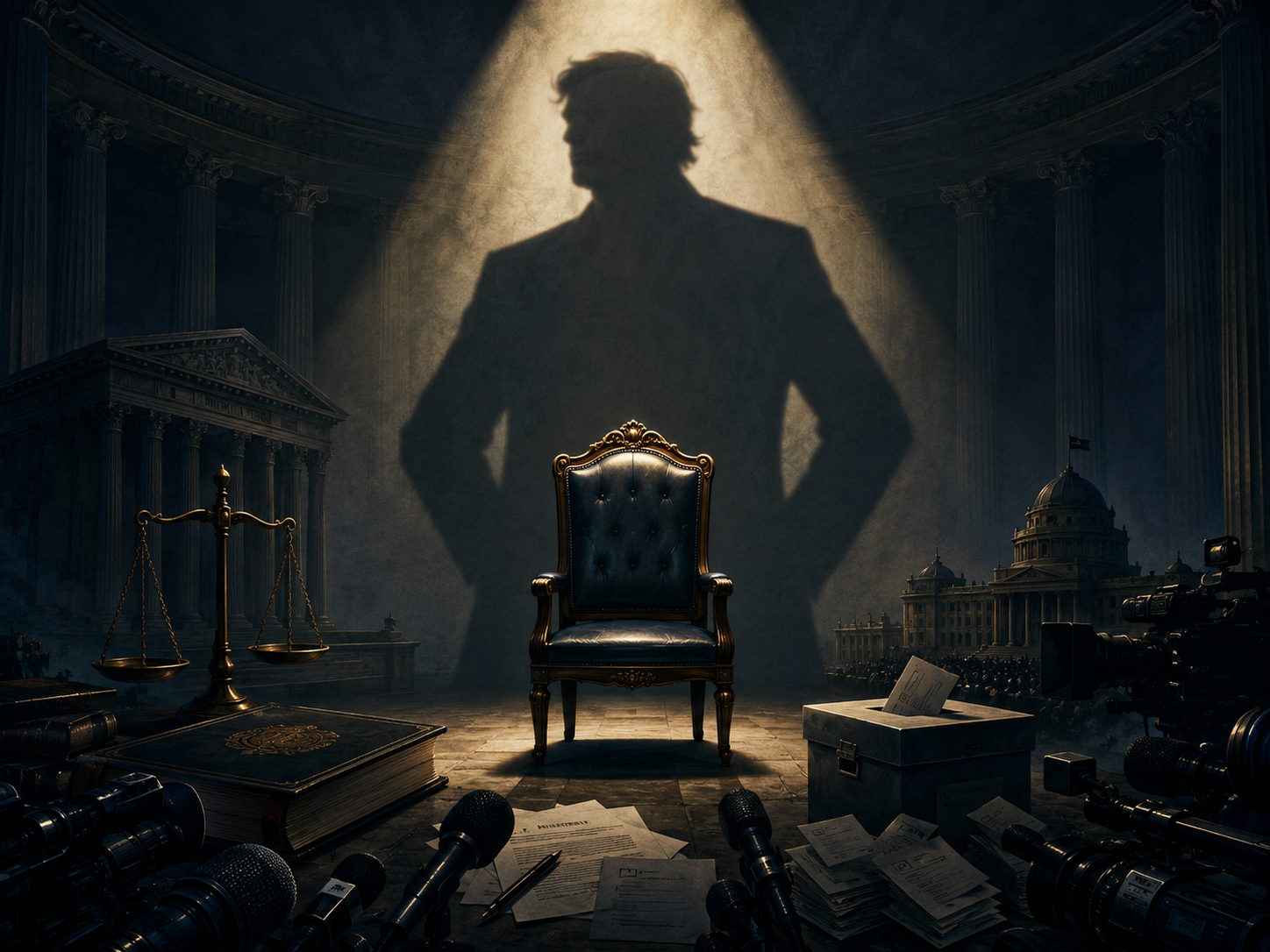
Power Does Not Corrupt Everyone; It Reveals Everyone
Adversity has a way of making people look noble. A leader out of office speaks of freedom. A party in opposition speaks of institutional dignity. A citizen without authority speaks of fairness. A bureaucrat outside the decision room speaks of transparency. But power is the real examination. It removes the excuse of helplessness and reveals what a person actually believes when restraint becomes optional.
The old saying that power corrupts is only half true. Power corrupts some people. More often, it reveals them. It reveals the leader who believed in accountability only when accountability weakened opponents. It reveals the officer who believed in rules only when rules protected him. It reveals the activist who loved free speech only until criticism came from the other side. It reveals the citizen who wants law for others and exception for himself.
This is why democratic societies must study power not only as a constitutional category but as a moral environment. Power changes the weather around a person. People laugh more easily at his jokes. Files move faster. Criticism becomes quieter. Old friends become careful. New flatterers appear. The powerful person begins to mistake compliance for respect and fear for consent.
India's republic was designed with this danger in mind. The Constitution divides power because human beings cannot be trusted with concentrated authority indefinitely. Parliament, courts, federalism, elections, media, civil society, audits, opposition, local governments and fundamental rights are not decorative features. They are methods of preventing human weakness from becoming public disaster.
The real test of constitutional morality is not how institutions behave when everyone agrees. It is how they behave when conflict is sharp. Centre-state tensions, disputes over governors' powers, election trust, judicial accountability, privacy and media credibility are all, at their core, arguments about power. Who decides? Who checks? Who explains? Who can be questioned? Who pays the price of delay?
The Supreme Court's 2025 judgment in the Tamil Nadu Governor matter, and the later constitutional discussion around assent to Bills, showed how questions that look procedural can become central to democracy. A Bill delayed is not only a file delayed. It can become an elected government's mandate suspended in constitutional uncertainty. Whatever one's view of the legal details, the larger lesson is clear: public power must not hide behind silence.
Similarly, election trust depends not only on polling-day efficiency but on the ordinary credibility of the entire process: voter lists, candidate disclosures, funding transparency, campaign conduct, counting, grievances and public communication. The Election Commission's work is therefore not a technical service alone. It is a trust institution. In a polarised country, the perception of fairness matters almost as much as fairness itself, because democracy runs on consent.
Civil society groups such as the Association for Democratic
Civil society groups such as the Association for Democratic Reforms have repeatedly used candidate affidavits to draw public attention to criminal cases and wealth disclosures in elections. Such data must be interpreted carefully because declarations are not convictions. Yet the fact that voters need these disclosures at all tells us something important: democracy cannot rely on moral claims by candidates. It needs information.
Power also reveals citizens. Indians often complain about corrupt leaders while celebrating "jugaad" when it benefits them personally. We condemn VIP culture until someone offers us access. We criticise traffic violations until we are late. We demand merit until our own child needs influence. A republic cannot be cleaner than the moral habits of its citizens. Political corruption grows in the soil of social acceptance.
This does not mean blaming citizens for institutional failure. Those with greater power carry greater responsibility. But public ethics is a chain. If the voter rewards intimidation, the party will select intimidation. If the businessman rewards regulatory manipulation, the officer will price it. If the media rewards outrage, the politician will supply it. If the citizen rewards spectacle, serious governance will look boring.
The media's relationship with power deserves special scrutiny. A free press is supposed to question authority. But media institutions themselves can become power centres, dependent on owners, advertisers, political access and audience emotion. The Reuters Institute's Digital News Report 2025 noted that traditional news media globally are struggling with declining engagement and trust. In India's noisy information ecosystem, the danger is not only censorship. It is also capture, polarisation and entertainment replacing scrutiny.
Power reveals the journalist who still asks difficult questions when access is threatened. It reveals the anchor who discovers courage only against weak targets. It reveals the editor who protects facts when ideology becomes profitable. It reveals the platform that claims neutrality while amplifying anger for revenue. In democracy, media power must also be accountable to truth.
The judiciary too is tested by power. Courts command moral authority because citizens believe they stand above ordinary political pressure. When questions of judicial conduct arise, the system must respond with transparency consistent with institutional integrity. Trust cannot be demanded; it must be maintained. Judicial independence is not a shield against accountability. It is the condition under which accountability can be credible.
Bureaucracy faces another test. The civil servant's oath is to the Constitution, but the daily pressures come from ministers, transfers, local power networks and career incentives. Some officers resist unlawful pressure. Some rationalise compliance as pragmatism. Some become enthusiastic instruments of power. The file, in India, is often a moral document. It records not only decisions but courage, cowardice, delay and evasion.
Federalism is also a test of character
Federalism is also a test of character. A party that demands state rights while out of power may centralise aggressively when it controls the Centre. A regional leader who attacks central overreach may dominate local bodies within his own state. Federal morality cannot be selective. It requires respecting autonomy even when the other side governs.
Privacy is the modern test of power. Digital governance creates efficiency but also temptation. Data can deliver welfare, prevent fraud and improve planning. It can also enable surveillance, profiling and exclusion if checks are weak. The Digital Personal Data Protection framework and rules are therefore not technical paperwork. They are part of the moral architecture of power in a digital state.
A mature democracy does not assume that those in power are evil. It assumes that all power requires rules because even good people are vulnerable to temptation, arrogance and fear. The point of checks and balances is not cynicism. It is realism. Institutions are built because virtue alone cannot carry a republic.
Leadership must therefore be judged less by speeches about sacrifice and more by behaviour under authority. Does a leader tolerate dissent? Does he appoint competent people or loyal flatterers? Does he disclose information? Does he respect courts when they disagree? Does he allow independent media questions? Does he decentralise? Does he leave office gracefully? Does he protect minorities of opinion? These are the true tests.
Power also reveals insecurity. The insecure powerful person cannot laugh at criticism. He sees questions as betrayal, satire as conspiracy and disagreement as disrespect. He confuses the chair with the self. Such leaders may appear strong, but their strength is brittle. A confident leader does not need to crush every voice. He can govern amid noise.
Institutions must be designed to survive both good and bad personalities. India cannot depend on finding saints for every office. It must build systems where even ambitious, vain or partisan people are constrained by law, transparency and consequences. That is the genius of constitutional government: it does not require perfect humans, only enforceable limits.
Yet law alone is insufficient. Political parties must develop internal democracy. Candidate selection must become cleaner. Campaign finance must become more transparent. Citizens must stop treating elections as community warfare. Schools must teach constitutional ethics not as textbook ritual but as civic habit. Public honour must attach to restraint, not only victory.
The most dangerous phrase in public life is "our
The most dangerous phrase in public life is "our side is different." Every side believes that. Every side thinks its use of power is historically justified. Every side believes that its opponents are so dangerous that normal restraint can be relaxed. This is how democracies decay: not always through open dictatorship, but through repeated exceptions made in the name of noble objectives.
The editorial judgement is this: power should not be trusted when it praises itself. It should be observed when it is criticised. The character of a leader, party, institution or citizen is revealed not by how they treat supporters but by how they treat those who can embarrass them.
India's republic has survived because it contains deep democratic instincts. People vote, argue, litigate, protest, organise and criticise. But survival is not the same as health. A democracy can continue to hold elections while becoming morally thinner. It can keep institutions while draining them of courage. It can speak constitutional language while practising domination.
Power does not corrupt everyone. Some people grow larger under responsibility. They become more careful, more humble, more aware of consequences. They understand that authority is borrowed from the public, not owned personally. Such people are rare, but democracies depend on making their conduct normal.
The final test of power is restraint. Anyone can use authority to reward friends and punish enemies. It takes character to use authority to strengthen rules that may one day limit oneself. That is the difference between a ruler and a constitutional leader.
India must judge power by that standard. Not by charisma. Not by slogans. Not by victimhood. Not by inherited status. By restraint, transparency, accountability and willingness to be questioned.
Adversity may make a person sympathetic. Power makes him visible. What it reveals is what democracy must never stop examining.
The lesson applies beyond elected politics
The lesson applies beyond elected politics. In corporations, power reveals itself in how management treats junior employees when targets are missed. In universities, it appears in how administrators treat dissenting students and independent faculty. In families, it appears in how elders treat daughters-in-law, domestic workers and younger members with less economic power. In residential societies, it appears in how committees treat guards, tenants and service staff. Democracy is not only a form of government; it is a habit of power at every level.
This is uncomfortable because many people who speak beautifully about national democracy practise private authoritarianism. They want rights from the state and obedience at home. They want transparency from politicians and secrecy in their own institutions. They want accountability for opponents and loyalty from subordinates. Public ethics collapses when private conduct contradicts public vocabulary.
The Indian workplace is a daily classroom of power. A manager who takes credit for a junior's work, demands late-night availability without necessity, humiliates employees in meetings or rewards flattery over competence is practising the same moral failure that citizens condemn in politics. The scale differs; the structure is familiar. Power reveals whether a person sees others as human beings or instruments.
Gender relations expose power with particular clarity. Patriarchy is not sustained only by law; it is sustained by everyday permissions. Who can go out? Who eats first? Who controls money? Whose career matters? Whose anger is feared? Whose dreams are negotiable? A society cannot claim democratic maturity while half its population must negotiate freedom inside the household.
Caste too is a power system, not merely a social identity. It reveals itself in marriage, housing, temple access, school seating, manual labour, local politics and informal networks. Modern India may speak the language of equality, but power often travels through old channels. Constitutional morality requires not only state action but social courage: the willingness to challenge inherited privilege when it benefits one's own group.
The digital age has created new forms of power. Platforms decide visibility. Algorithms shape attention. Data brokers profile citizens. Influencers mobilise mobs. Anonymous accounts destroy reputations. A person with a large following may not hold office, but he holds power over public perception. The ethics of power must therefore expand beyond government. Digital power also needs restraint.
This is why the idea of character is not old-fashioned. Institutions matter because character is unreliable; character matters because institutions are run by people. A perfect law can be weakened by cowardly implementation. A flawed rule can be softened by humane discretion. Public life is never purely structural or purely personal. It is the meeting point of systems and souls.
India's civic education should teach this more honestly
India's civic education should teach this more honestly. Students memorise fundamental rights, directive principles and constitutional articles, but often do not learn how power behaves psychologically. They should study why flattery is dangerous, why dissent is useful, why transparency prevents arrogance, why conflict of interest matters, why due process protects everyone and why ends do not automatically justify means. Democracy is a moral technology that must be learned.
The opposition also has a duty. Criticism of power is credible only when it is principled. If a party condemns centralisation only when excluded from power, citizens notice. If it defends free speech only for its supporters, the principle weakens. Democracies need opposition that defends rules even when the immediate beneficiary is an opponent. That is rare, but without it constitutionalism becomes tactical.
The same applies to supporters. Blind loyalty is not political commitment; it is civic surrender. A citizen can support a leader and still ask questions. In fact, honest supporters are more valuable than flatterers because they prevent leaders from drifting into delusion. The most dangerous court around power is the circle that never says no.
Accountability must be designed before scandal. Asset disclosures, transparent appointments, independent regulators, strong parliamentary committees, reasoned orders, open data, protected whistleblowers and time-bound grievance systems are not anti-government devices. They protect legitimate authority from suspicion. Clean power should welcome sunlight because sunlight distinguishes authority from manipulation.
India must also stop mistaking decisiveness for virtue. A decision can be quick and wrong, slow and wise, quick and wise, or slow and cowardly. The moral question is not speed alone. It is whether power listened, reasoned, disclosed, respected rights and accepted review. Strong leadership is not the absence of consultation. It is the capacity to consult without becoming paralysed.
Finally, citizens must remember that power is temporary. Every office is rented from time. The chair remains; the occupant leaves. The damage done to institutions in moments of triumph may later harm the same side when fortune changes. Constitutional restraint is therefore not generosity to opponents. It is long-term self-protection for the republic.
The healthiest democracies are not those without conflict. They are those where conflict does not destroy the rules of coexistence. India will remain noisy, argumentative and politically intense. That is not a weakness. The weakness begins when power treats noise as illegitimacy and opposition as enemyhood.
Power reveals everyone
Power reveals everyone. It reveals the ruler, the critic, the voter, the judge, the editor, the officer, the employer, the parent and the citizen. The question is whether we are willing to look honestly at what it reveals.
This is why personal humility is not merely a private virtue for those in authority. It is a public safeguard. A humble leader asks for evidence before certainty. A humble judge recognises the limits of doctrine before lived suffering. A humble officer listens to the citizen at the counter. A humble editor corrects an error. A humble voter admits that his preferred side can also misuse power. Humility does not weaken authority; it makes authority less dangerous.
The republic must also distinguish loyalty to office from loyalty to the Constitution. A civil servant who refuses an unlawful order is not disloyal. A judge who rules against the government is not anti-national. A journalist who asks a difficult question is not an enemy. An opposition leader who accepts a fair result while criticising policy strengthens democracy. A supporter who corrects his own side protects it from moral decay. These distinctions are the grammar of constitutional life.
In the end, power is a mirror held too close to the face. It magnifies vanity, courage, pettiness, generosity, insecurity and discipline. India should not fear powerful people; every society needs authority. But it should fear unchecked power, worshipped power and power surrounded by applause. Character is revealed most clearly when no one can easily say no. That is precisely when democracy must speak.
