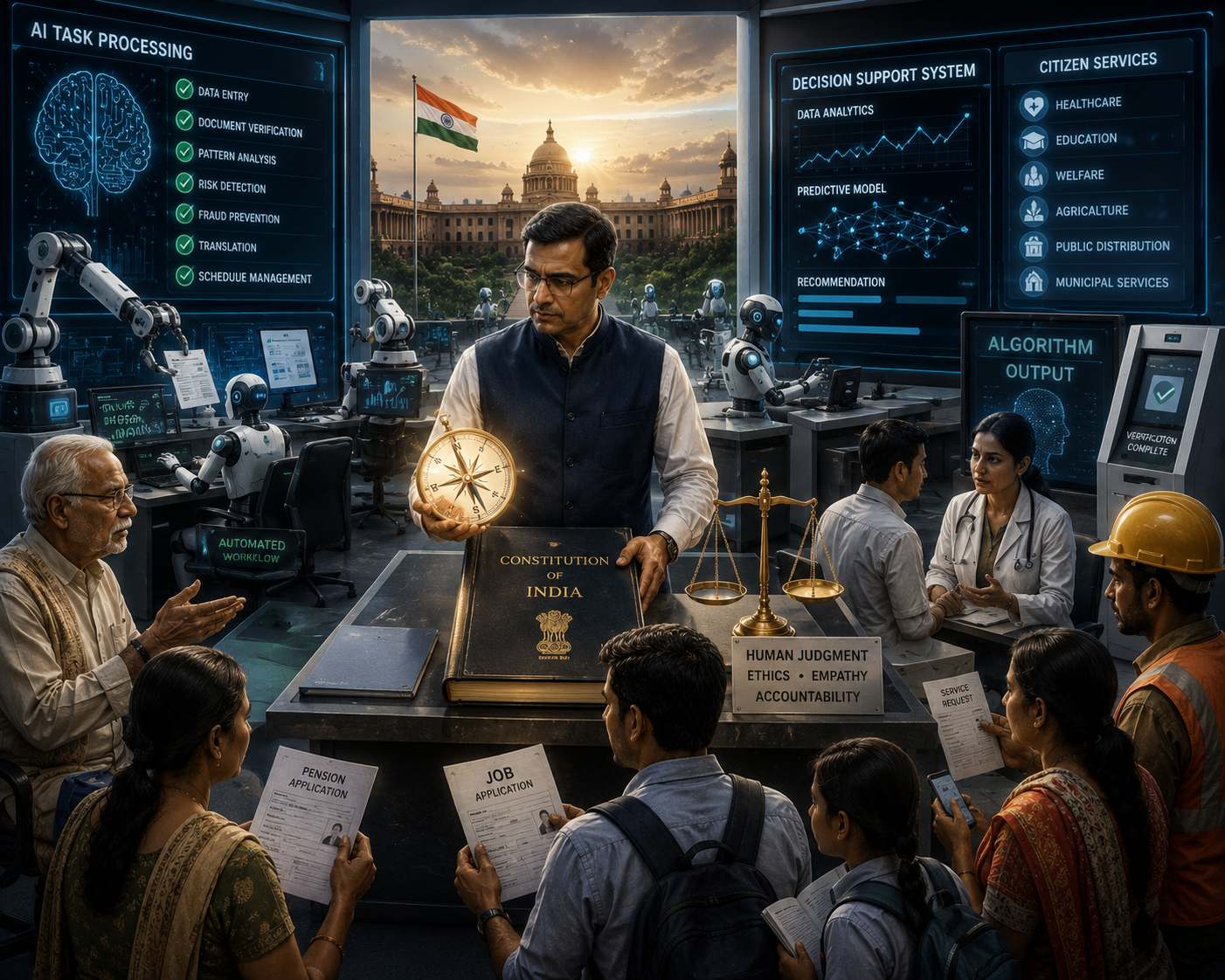
Technology Can Replace Tasks, Not Human Judgment
Every generation has its favourite machine. The steam engine promised strength. The railway promised speed. The computer promised calculation. The internet promised connection. Artificial intelligence now promises intelligence itself. Each time, humanity is tempted by the same fantasy: that tools will free us not only from labour, but from responsibility.
The latest version of this fantasy is visible everywhere. AI will write, decide, detect, translate, police, teach, recruit, diagnose, govern and predict. Offices are told they can do more with fewer people. Governments are told dashboards can improve delivery. Media houses are told automation can produce content. Courts are told technology can reduce pendency. Schools are told apps can personalise learning. Citizens are told digital systems will remove corruption. Companies are told algorithms will know the customer better than employees ever did.
Some of this is true. Technology can remove drudgery. It can reduce paperwork, speed up service delivery, expose leakages, analyse data and perform routine tasks with impressive efficiency. A file that once moved through dusty corridors can be tracked digitally. A payment that once required a visit can be completed instantly. A medical image can be screened faster. A language barrier can be reduced. A farmer can receive weather information. A welfare beneficiary can avoid a middleman.
But the central mistake is to confuse task replacement with judgment replacement. Technology can execute instructions, identify patterns and optimise processes. It cannot carry moral responsibility. It cannot understand dignity in the way a human institution must. It cannot ask whether the rule itself is fair. It cannot feel the democratic weight of a wrong denial, a false accusation, an exclusion, a misclassification or a life reduced to a data field.
This distinction matters because India is not merely digitising convenience. It is digitising governance, markets, welfare, policing, media and identity. In such a society, technology is not a neutral back-office tool. It becomes part of power. When a system decides eligibility, ranks visibility, flags risk, recommends content, processes complaints or verifies identity, it shapes the citizen's relationship with institutions.
The IndiaAI Mission and India's expanding digital public infrastructure show the scale of the opportunity. Official material in 2025 described major investment in AI capacity, including large compute ambitions under the IndiaAI ecosystem. That capacity can help agriculture, healthcare, education, translation, disaster response and public administration. For a country with vast scale and uneven administrative capacity, technology is not optional. It is necessary.
Yet necessity is not worship. A serious country must use technology without surrendering judgment to it. The first principle of democratic technology should be simple: machines may assist decisions, but accountable humans must own them.
Consider welfare delivery
Consider welfare delivery. Digital systems can reduce ghost beneficiaries and speed payments. But when an eligible person is excluded because of authentication failure, data mismatch, connectivity problems or lack of documentation, the issue is not technical. It is moral. A poor citizen cannot be told that the system has no field for their complexity. The state cannot hide behind software. The more automated a system becomes, the stronger its human grievance redressal must be.
Consider hiring. Algorithms can screen thousands of applications. But if past data reflects social bias, the algorithm may reproduce discrimination with a modern face. It may learn that certain colleges, locations, surnames, career breaks or employment gaps predict "risk", when in reality they reflect inequality. A human recruiter can also be biased, but human bias can at least be questioned through accountability. Algorithmic bias often hides inside the prestige of objectivity.
Consider policing and security. Data analytics can help detect patterns of fraud or crime. But predictive systems can also over-target communities already over-policed. Facial recognition can help identify suspects, but false matches can destroy lives. The issue is not whether technology should be used. The issue is whether law, audit, proportionality and human review are strong enough to prevent power from becoming invisible.
Consider media. Automated content production can summarise information quickly. But journalism is not only assembling words. It is verification, judgment, context, courage and restraint. An AI system can generate a headline; it cannot bear the responsibility of defaming a citizen, inflaming a riot, misleading voters or flattening a human tragedy into clickbait. A newsroom that replaces editorial judgment with automated output may increase volume and lose credibility.
The Reuters Institute's Digital News Report 2025 documented rising concerns around AI in news and misinformation. This is not a distant concern. In India, where short video, WhatsApp forwards and partisan commentary already strain public trust, synthetic media can deepen confusion. A society in which citizens no longer know what to believe cannot be saved by faster fact-checking alone. It needs institutions trusted enough to interpret reality.
Technology is also reshaping employment. The lazy debate asks whether AI will "take all jobs". The better question is: which tasks will be automated, which workers will be weakened, which skills will gain value and who will capture productivity gains? Technology rarely eliminates labour evenly. It reorganises bargaining power. Routine cognitive work becomes vulnerable. Average skills lose comfort. High-trust, high-judgment, high-creativity and high-human-contact roles gain importance. Workers without reskilling support are asked to compete with machines while corporations enjoy the productivity benefit.
India must be particularly careful because it has a young labour force and a jobs challenge. The Periodic Labour Force Survey 2025 showed that youth unemployment remains a significant concern, especially in urban areas, despite improvement. If technology adoption becomes only a cost-cutting exercise, India may deepen the contradiction of high growth and anxious employment. The goal should not be to resist automation, but to ensure that automation is matched by skill formation, new industries, labour protections and social mobility.
Education is central
Education is central. A school system built around memorisation cannot prepare citizens for an AI world. If machines can retrieve facts, human beings must be trained to ask better questions. If AI can produce text, students must learn reasoning, ethics, evidence, imagination and communication. If software can solve routine problems, education must cultivate judgment in ambiguous situations. India's classroom must move from answer-production to mind-formation.
This is where the phrase "technology cannot replace manpower" needs refinement. Technology can replace manpower in tasks. It should. No society should force people to perform repetitive, unsafe or meaningless work merely to preserve employment statistics. The real point is that technology cannot replace human purpose. It cannot decide what kind of society work should serve. It cannot define justice, dignity, beauty, trust or responsibility. It can help implement values, but it cannot generate them.
The danger is greatest when technology is treated as a substitute for institutional reform. A corrupt office with a portal may remain corrupt. A weak school with tablets may remain weak. A biased police system with software may remain biased. A hospital without doctors cannot be saved by an app. A judiciary with procedural complexity cannot be transformed by digitisation alone. Technology can improve institutions; it cannot compensate for the absence of institutional character.
India has often loved technological fixes because they appear cleaner than political reform. A dashboard is easier than accountability. A portal is easier than staffing. A biometric system is easier than local trust. An app is easier than public health capacity. But citizens do not live inside PowerPoint presentations. They live at ration shops, police stations, courts, schools, hospitals, banks, municipal offices and bus stops. If the human interface remains humiliating, the digital layer cannot produce dignity.
This is also true in business. Companies that replace customer service with bots often discover that efficiency without empathy damages trust. A chatbot can answer common questions, but it cannot calm an elderly customer whose money is stuck, a patient whose report is delayed, or a small vendor whose payment is blocked. Human judgment is not inefficiency. It is often the price of trust.
The legal framework must catch up. India's DPDP Rules in 2025 strengthened personal data rights, according to PIB. That matters because AI systems require data, and data without rights becomes extraction. But the next frontier is algorithmic accountability. Citizens should know when automated systems materially affect them. There should be auditability, appeal, explanation where feasible and liability for harm. The state must not allow the phrase "algorithmic decision" to become a shield against justice.
At the same time, India must avoid fear-based regulation that kills innovation. AI startups, researchers and public-interest technologists need room to build. The answer is not to license every experiment. It is to regulate according to risk: stricter rules for high-impact domains such as healthcare, credit, policing, employment, education and elections; lighter rules for low-risk innovation; strong penalties for deception, fraud and harmful deepfakes; and public investment in open datasets and safety research.
The workplace needs a new social contract
The workplace needs a new social contract. If technology raises productivity, workers must share in the gains through better wages, training, reduced drudgery and upward mobility. Otherwise automation becomes a machine for concentrating wealth. India cannot build a stable society if the educated middle class fears redundancy, gig workers remain unprotected and young graduates feel that the economy values tools more than people.
A human-centred technology policy must therefore rest on five principles. First, inclusion: no essential service should become inaccessible because a citizen lacks device, literacy or connectivity. Second, accountability: every automated system affecting rights must have a responsible human authority. Third, transparency: citizens should understand the logic of major digital systems at least in practical terms. Fourth, dignity: technology must reduce humiliation, not merely paperwork. Fifth, capability: citizens must be trained to use, question and shape technology.
The philosophical issue is older than AI. Tools enlarge human power, and enlarged power exposes human character. A hammer can build a home or break a skull. A camera can expose corruption or violate privacy. A database can deliver welfare or enable surveillance. An algorithm can improve diagnosis or automate discrimination. The moral quality of technology depends on the institutions and values that guide it.
This is why scientific temper is essential. Scientific temper does not mean blind faith in gadgets. It means disciplined inquiry. It means asking what works, for whom, at what cost, with what evidence and under whose control. The unscientific person may reject technology out of fear. But the equally unscientific person may worship technology out of insecurity. A mature society does neither. It tests, audits, improves and governs.
India's advantage is that it has lived with human complexity at scale. No country that understands Indian administration, languages, caste, gender, poverty, migration, informal labour and federal diversity should believe that software alone can solve governance. Our complexity is not an obstacle to technology; it is a warning against simplistic technology.
The editor's judgement is this: technology will replace tasks, and India should welcome that where it reduces drudgery and expands capacity. But technology must not replace judgment, responsibility or empathy. A machine can process a form. It cannot know what it means for a widow to be denied a pension. A model can rank a candidate. It cannot know the full story behind a career break. A platform can moderate content. It cannot understand the constitutional culture required for free speech. A system can flag risk. It cannot carry the burden of a wrongful life outcome.
The future will not belong to countries that automate everything blindly. It will belong to countries that combine technological capacity with institutional wisdom. India must become such a country.
The great question is not whether machines will become intelligent
The great question is not whether machines will become intelligent. The great question is whether humans will remain responsible after machines become useful. If we fail that test, the problem will not be artificial intelligence. It will be natural irresponsibility.
There is a further danger in elite language. Many decision-makers speak of automation as if the displaced worker is an abstraction. They say "efficiency", "optimisation", "lean teams" and "AI-led transformation". But for the person affected, the issue is rent, school fees, parents' medicines, marriage plans, loan EMIs and social dignity. A country with India's demographic profile cannot allow technology strategy to be written only in boardrooms and policy conferences. It must be written with the worker in mind.
This does not mean protecting every existing job forever. Such protection would be dishonest and economically harmful. Some tasks should disappear. Manual scavenging should not be preserved as employment. Dangerous industrial work should be automated where possible. Mindless clerical repetition should be reduced. But when tasks disappear, pathways must appear. The test of a humane economy is not whether it prevents change; it is whether it helps people cross from old work to new capability.
The state can lead by example. Every major government automation project should include an exclusion audit, a grievance audit and a human-contact audit. Who is being left out? How quickly are errors corrected? Can a citizen reach a responsible official? Are frontline workers trained or merely blamed? Are local languages supported? Are women, elderly citizens, disabled persons and migrants able to use the system? Without such audits, digitisation becomes administrative self-congratulation.
In the private sector, boards should treat AI governance as seriously as financial governance. A company using automated systems for hiring, lending, insurance, content, pricing or customer service should know where the risks lie. Who approved the model? What data trained it? How are errors monitored? Can affected people appeal? What happens when the system discriminates? "The algorithm did it" must never become an acceptable corporate defence.
The Indian newsroom also needs this discipline. AI tools can help transcribe, translate, summarise, research and design. Used properly, they can free journalists for deeper work. Used carelessly, they can flood the public sphere with polished emptiness. Editors must not confuse production speed with editorial value. In a misinformation age, the premium product is not more content. It is trusted judgment.
The philosophical centre is responsibility. Modern systems often diffuse responsibility until no one feels guilty. The programmer says he only built the tool. The manager says she only followed policy. The official says the portal made the decision. The minister says the data shows success. The citizen is left facing a machine with no conscience and an institution with no owner. This diffusion is unacceptable in a republic.
Therefore, every technological system must have a named chain
Therefore, every technological system must have a named chain of accountability. If a welfare payment fails, someone must answer. If an automated credit denial is wrong, someone must review. If a deepfake spreads, someone must respond. If a recruitment system discriminates, someone must be liable. Human judgment is not only about making wise decisions; it is about being answerable for decisions.
India's technology ambition is justified. But the country must not become so dazzled by tools that it forgets the human being tools are meant to serve. The truly advanced society is not the one with the most automation. It is the one where automation expands justice, capability and dignity. Anything less is not progress. It is only machinery moving faster than conscience.
The deepest reform is cultural: India must stop treating human beings as obstacles in systems designed for reports. The teacher, nurse, constable, clerk, field officer, journalist, judge, technician and customer-support worker are not leftovers from a pre-digital age. They are the human surface of institutions. If they are poorly trained, badly paid, overworked or humiliated by management, no technology layer will produce trust. Capacity building must therefore accompany automation at every level.
A society that values judgment will invest in people even while investing in machines. It will train civil servants in data ethics, doctors in digital tools, teachers in AI-assisted learning, workers in reskilling and citizens in digital rights. It will ask not only what can be automated, but what must remain human because it involves care, discretion, accountability or democratic legitimacy. That distinction will decide whether technology deepens civilisation or merely accelerates administration.