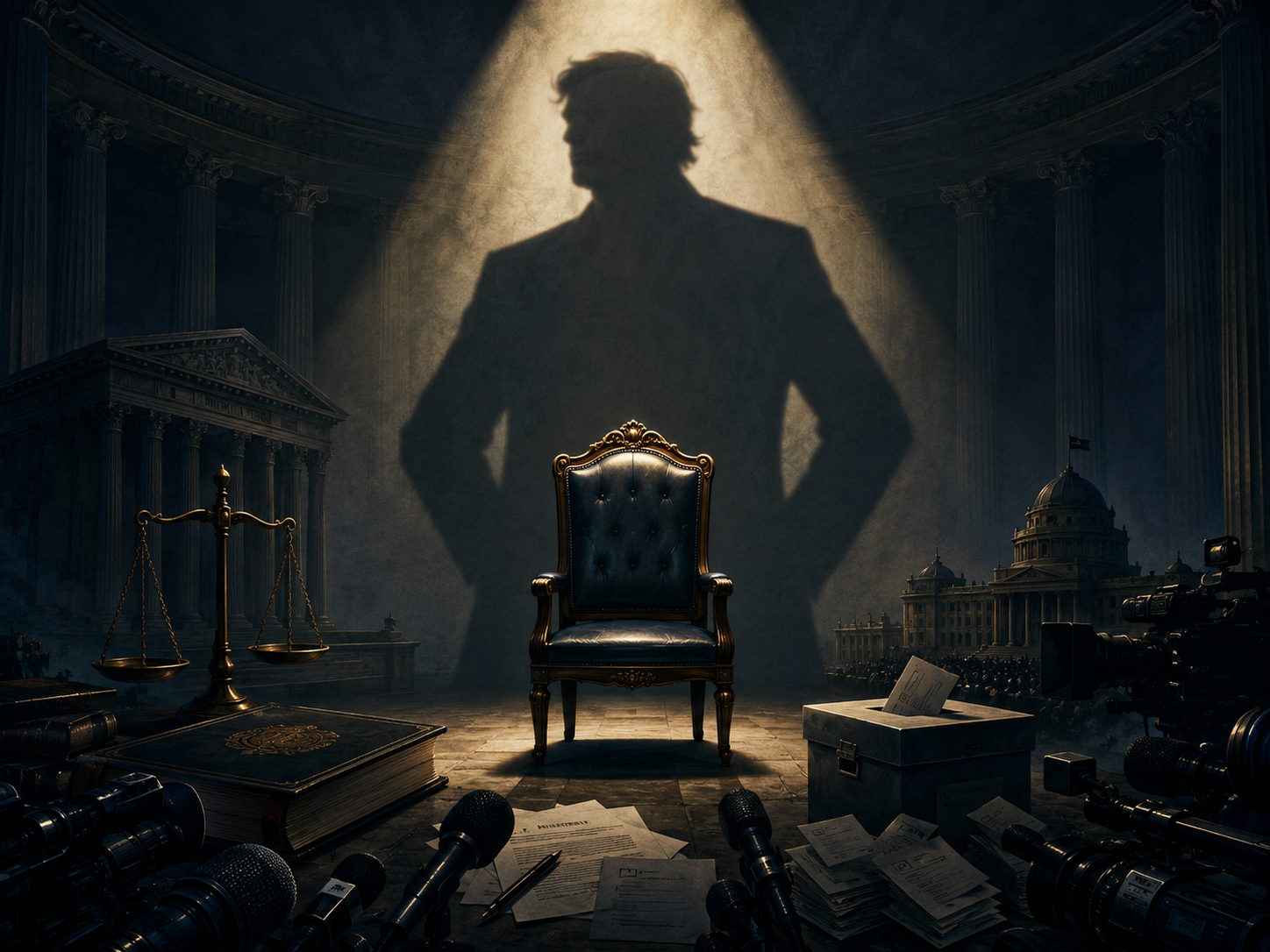
A Democracy Without Disagreement Stops Thinking
Democracy is often praised as the rule of the people, but that is only its surface. At its best, democracy is the discipline of disagreement. It is the arrangement by which a society accepts that no one person, party, caste, class, region, religion, ideology or institution has a permanent monopoly over wisdom. It forces power to listen, opposition to argue, citizens to choose, courts to review, media to question and governments to justify.
When disagreement weakens, democracy does not become more efficient. It becomes less intelligent. Thinking itself requires opposition. A mind that never meets resistance becomes lazy.
A party that never hears criticism becomes arrogant. A movement that never faces scrutiny becomes dogma. A government that never has to explain itself begins to mistake authority for truth. A citizen who only consumes agreeable news gradually loses the capacity to reason.
This is why the philosophical line is profound: thinking is like a game; it does not begin unless there is an opposite team. India understands this in theory but often resents it in practice. We celebrate parliamentary democracy, but frequently treat opposition as obstruction. We praise free speech, but dislike uncomfortable speech.
We want strong governments, but not always strong scrutiny. We invoke national interest, but too often define it as agreement with our side. This is dangerous because a democracy without disagreement does not become united; it becomes brittle. There is, of course, bad disagreement.
Noise is not argument. Disruption is not scrutiny by itself. Abuse is not dissent. Permanent outrage is not democratic vigilance.
A Parliament that cannot function is not a sign of healthy opposition. A television debate where everyone shouts is not pluralism. A social-media trend that threatens people into silence is not public opinion. Democracies need disagreement, but they need disciplined disagreement.
The distinction matters because India's institutions are under pressure
The distinction matters because India's institutions are under pressure from both sides: excessive obedience and excessive theatre. Obedience tells citizens not to question because questioning helps enemies. Theatre tells citizens that every disagreement must become a moral emergency. Both harm democracy.
One kills scrutiny; the other kills seriousness. Parliament is the first theatre of this tension. PRS Legislative Research reported that during the Monsoon Session of 2025, both Houses sat for the scheduled 21 days, but two-thirds of planned time was lost to disruptions, with Question Hour particularly affected. This is not a partisan point; it is an institutional warning.
Question Hour is one of the instruments through which elected representatives demand accountability from the executive. When it collapses, citizens lose information, not merely parliamentary decorum. At the same time, governments must not use disruption as an excuse to avoid debate. Bills passed without adequate discussion may be technically lawful, but they weaken democratic legitimacy.
Legislation is not paperwork. It is the conversion of public power into rules that affect citizens. The process matters because the process is where errors are caught, minorities are heard, federal concerns are raised and unintended consequences are exposed. The 18th Lok Sabha reflects a more competitive political field than the previous single-party majority era.
PRS's profile of the 18th Lok Sabha noted that the BJP remained the largest party with 240 seats, followed by the Congress with 99, after results were declared for all 543 constituencies. Such a House demands negotiation, debate and committee seriousness. A coalition-era or competitive-era Parliament should not be treated as a nuisance. It is an opportunity to restore deliberation.
Disagreement also matters in federalism. India is not a unitary society waiting to be administered from one point. It is a union of languages, regions, economies, histories and political mandates. Centre-state disputes over funds, governors, law-and-order issues, welfare design, taxation and institutional jurisdiction are not necessarily signs of national weakness.
They are often the natural friction of a diverse federation. The question is whether the friction is handled constitutionally or converted into permanent suspicion. A mature federation treats disagreement as negotiation within the family of the Constitution. An immature federation treats every state objection as defiance and every central action as domination.
India cannot afford either simplification
India cannot afford either simplification. It needs strong national capacity and meaningful state autonomy. That balance cannot be discovered without argument. Elections are another site where disagreement must remain disciplined.
The Election Commission's release of detailed statistical reports for the 2024 Lok Sabha election is important because electoral trust depends not only on voting but also on transparent information. Opposition parties must have the right to question processes. Institutions must respond with clarity, not irritation. Citizens must distinguish between legitimate scrutiny and baseless delegitimisation.
Trust grows when questions are answered well, not when questions are treated as insults. The judiciary plays a critical role in this ecosystem. Courts are not meant to govern the country, but they are meant to protect constitutional boundaries. When courts examine electoral finance, civil liberties, federal disputes, privacy, administrative power or free speech, they are participating in democracy's thinking process.
People may disagree with judgments. They should. But attacking the legitimacy of judicial review itself weakens the constitutional conversation. The Supreme Court's electoral bonds judgment, widely reported and analysed by legal observers, held the scheme unconstitutional on the ground that it violated voters' right to information.
Whatever one's political preference, the case showed why institutional disagreement matters. Political finance is not merely a technical issue. It shapes equality, transparency and public trust. Without challenge, disclosure and judicial scrutiny, power tends to protect its own opacity.
Media is supposed to host disagreement for society. Unfortunately, much of modern media now monetises polarisation rather than clarifying conflict. The Reuters Institute's Digital News Report 2025 observed that traditional news media in many markets are struggling with trust and engagement. One reason is that citizens increasingly sense performance where they expected explanation.
Debate has become content. Outrage has become format. The anchor often behaves less like a moderator and more like a prosecutor for a chosen tribe. This damages public intelligence.
When every issue is reduced to loyalty, citizens stop
When every issue is reduced to loyalty, citizens stop asking better questions. A policy is good because our side proposed it. A court order is good because it hurts the other side. A journalist is credible if he attacks those we dislike.
A protest is patriotic or anti-national depending on who attends. This is not democracy. It is team sport without rules. Social media intensifies this by allowing people to live inside agreement machines.
The algorithm learns what angers or flatters a user and gives more of it. Over time, disagreement appears not as a normal democratic condition but as moral contamination. People become shocked that intelligent citizens can disagree with them. This is the death of public thinking.
Universities should be the antidote, but they too often become either silent or performative. A university that cannot host ideological disagreement has failed. Students must learn how to argue without dehumanising, how to read opponents charitably, how to revise positions, how to separate evidence from identity and how to lose an argument without feeling annihilated. Democracy requires such citizens.
Families also matter. Many Indians first learn authoritarianism at home. Children are told not to argue. Women are told not to question.
Younger people are told elders know best. Caste, class and gender hierarchies train people to treat disagreement as disrespect. Then we wonder why public debate becomes either submissive or explosive. Democratic culture begins before the polling booth.
It begins at the dining table, in the classroom, in the workplace and in the neighbourhood meeting. This does not mean all views deserve equal respect. A democracy need not respect hate, lies or calls for violence as merely another opinion. Constitutional disagreement has boundaries: dignity, equality, liberty, public order and truthfulness.
The right to disagree does not include the right
The right to disagree does not include the right to fabricate. The right to criticise does not include the right to threaten. The right to protest does not include the right to destroy democratic institutions. But these boundaries should be applied through law and reason, not partisan convenience.
The policy implications are clear. Parliament must strengthen committee scrutiny and protect Question Hour. Parties must train spokespersons and legislators in argument, not only messaging. Media organisations must reward evidence-based debate over performative shouting.
Schools must teach constitutional values through discussion, not moral slogans. Universities must protect academic freedom while enforcing standards of evidence. Platforms must reduce coordinated abuse and manipulated virality, but citizens must also develop the courage to hear discomfort. The editor's judgment is this: India does not need less disagreement.
It needs better disagreement. The problem is not that Indians argue too much. It is that we often argue badly. We argue to defeat, not to understand.
We argue from identity, not evidence. We confuse volume with conviction and loyalty with truth. A democracy without disagreement stops thinking because it stops testing itself. It forgets that policy improves through criticism, that institutions strengthen through scrutiny, that power behaves better when watched, and that citizens mature when exposed to arguments they cannot easily dismiss.
The opposite team is not always the enemy. Sometimes it is the instrument through which a nation discovers its own errors. India's democratic greatness will not be measured by how completely one side silences the other. It will be measured by whether disagreement can remain fierce, factual, constitutional and humane.
A republic that cannot disagree cannot govern itself. It can only obey, shout or break. India deserves better than all three. The quality of disagreement also determines the quality of nationalism.
A fearful nationalism demands applause
A fearful nationalism demands applause. A confident nationalism allows correction. If a bridge collapses, the patriot asks why. If a policy excludes people, the patriot asks how to fix it.
If a military veteran questions a decision, the patriot listens before labelling. If a student raises a constitutional concern, the patriot responds with argument. Love of country is not proved by silence; it is proved by responsibility. India's freedom movement understood this better than many modern commentators.
It contained moderates, extremists, constitutionalists, revolutionaries, socialists, liberals, religious reformers, labour organisers, peasant leaders and regional voices. They disagreed fiercely. The movement's moral force came not from uniformity but from the ability to hold conflict inside a larger anti-colonial purpose. Independent India should not develop a smaller imagination than the movement that created it.
The opposition also has duties. It cannot reduce every issue to obstruction and then claim democratic virtue. It must produce alternative policy, respect facts, avoid reckless delegitimisation and use parliamentary tools seriously. A lazy opposition helps authoritarian habits because it allows power to portray all criticism as noise.
Democracy needs opposition that is sharp enough to hurt bad policy and responsible enough to be trusted with power. The ruling side has a greater duty because it controls the instruments of state. It must not confuse electoral victory with unlimited moral permission. A mandate authorises government; it does not cancel scrutiny.
The majority gets to govern, but not to define truth alone. Constitutionalism exists precisely to remind winners that democracy is more than arithmetic. Citizens are not spectators in this game. We reward bad disagreement when we click only on insults, share unverified attacks, treat corrections as betrayal and demand that our side never concede.
We punish good disagreement when we ignore serious speeches, long reports and careful journalism. Public taste shapes public behaviour. If citizens reward theatre, politics will perform theatre. There is a need to rebuild the middle ground of argument.
This does not mean ideological emptiness
This does not mean ideological emptiness. A person can be deeply conservative, liberal, socialist, nationalist, feminist, religious, secular, regional or market-oriented and still argue honestly. The middle ground is not the absence of conviction. It is the presence of standards.
It says: I will not lie for my side. I will not defend what I would condemn if the other side did it. I will not dehumanise opponents. I will change my mind when evidence demands it.
This standard is difficult, which is why democracies decline without noticing. They do not always collapse through coups. Sometimes they decay through habits: the habit of mocking institutions, the habit of forwarding lies, the habit of treating every critic as enemy, the habit of accepting bad behaviour because it benefits one's tribe. By the time citizens notice, public trust has already been damaged.
India still has enormous democratic energy. People vote in large numbers, argue intensely, follow politics closely and hold strong views. The task is not to create interest; it is to civilise energy into deliberation. The country's diversity guarantees disagreement.
The choice is whether disagreement becomes constitutional argument or social poison. The answer lies partly in institutional reform and partly in civic character. Parliament must work. Courts must remain independent.
Media must rebuild trust. Election bodies must communicate transparently. Parties must respect internal democracy. Schools must teach debate.
Families must allow questions. Citizens must develop intellectual self-respect: the willingness to say, "My side may be wrong here." A democracy that can say that sentence remains alive. A democracy that cannot say it has stopped thinking. The most worrying sign in any democracy is not anger.
Democracies can survive anger if institutions remain trusted
Democracies can survive anger if institutions remain trusted and arguments remain factual. The worrying sign is contempt. Contempt says opponents are not merely wrong but illegitimate. It says courts are valid only when convenient, media is credible only when friendly, elections are fair only when won, and citizens are patriotic only when obedient.
Once contempt becomes normal, disagreement no longer corrects democracy. It corrodes it. India must resist that descent with deliberate civic habits. Read the best argument from the other side.
Demand evidence from your own side. Separate criticism of government from hatred of country. Separate faith from coercion. Separate protest from vandalism.
Separate majority rule from majoritarian arrogance. Separate dissent from permanent obstruction. These distinctions may sound modest, but democracies are preserved by such modest disciplines. Without them, constitutional language remains, but constitutional culture thins out.
The republic will always contain arguments because India itself is an argument: between languages, histories, regions, castes, classes, faiths, ambitions and memories. The genius of the Constitution was not to erase these disagreements. It was to give them a house in which they could fight without burning the country down. That house needs repair, not abandonment.
This is why institutions should protect not only the right to speak but the conditions under which speech can become argument. Time in Parliament, independence in media, safety in universities, transparency in elections, reasoned orders from public authorities and civic education in schools are not procedural luxuries. They are the lungs through which disagreement breathes. If they weaken, the republic may still speak loudly, but it will no longer think clearly.
Disagreement, properly practiced, is not a threat to order. It is the method by which a free society prevents order from becoming obedience. India's scale, diversity and ambition make this discipline difficult. They also make it non-negotiable.
A quiet democracy may look peaceful for a while,
A quiet democracy may look peaceful for a while, but if silence replaces argument, the peace is only administrative. The democratic mind lives by disagreement. That is the difference between a managed population and a thinking republic.