South China Sea Becomes a Test Case for Maritime Power
The South China Sea is no longer just a disputed body of water.
It has become a test case for maritime power.
Here, power is not measured only by who has the largest navy. It is measured by who can control reefs, patrol waters, pressure fishermen, build artificial islands, deploy coast guards, shape legal narratives, intimidate smaller states, keep trade moving, and make military presence appear normal without triggering open war.
This is what makes the South China Sea one of the most important strategic theatres of the twenty-first century.
The conflict is not simply about rocks and reefs. It is about sea lanes, sovereignty, energy resources, fisheries, military access, alliance credibility, international law and the future balance of power in the Indo-Pacific. It is where China’s rise meets Southeast Asian resistance. It is where the United States tests its ability to defend freedom of navigation. It is where ASEAN’s unity is repeatedly tested. It is where law meets coercion.
The South China Sea has become the place where the world will learn whether maritime order is governed by rules or by raw power.
Why the South China Sea Matters
The South China Sea matters because geography has made it valuable.
It sits between China, Vietnam, the Philippines, Malaysia, Brunei, Indonesia and Taiwan. It connects the Pacific and Indian Ocean systems. It links East Asian manufacturing centres with global markets. It is used by shipping routes that connect China, Japan, South Korea and Taiwan with the Strait of Malacca and the wider Indian Ocean. CSIS estimates that the South China Sea carries about one-third of global shipping, making it one of the most commercially important maritime spaces in the world.
This is why the dispute cannot be treated as a local quarrel. A crisis in the South China Sea would affect global trade, insurance costs, supply-chain confidence, naval movement and regional economic security.
The sea also has natural resources. CFR notes that China’s sweeping claims overlap with claims by Brunei, Indonesia, Malaysia, the Philippines, Taiwan and Vietnam, and that the area contains estimated untapped oil and natural gas resources as well as rich fishing grounds.
But the true value of the South China Sea is strategic. Whoever dominates it can influence one of the world’s most important maritime corridors. That is why every patrol, barrier, artificial island and naval exercise matters.
China’s Maritime Strategy Is About Control Without War
China’s approach in the South China Sea has not usually been based on sudden military conquest. It has relied on gradual control.
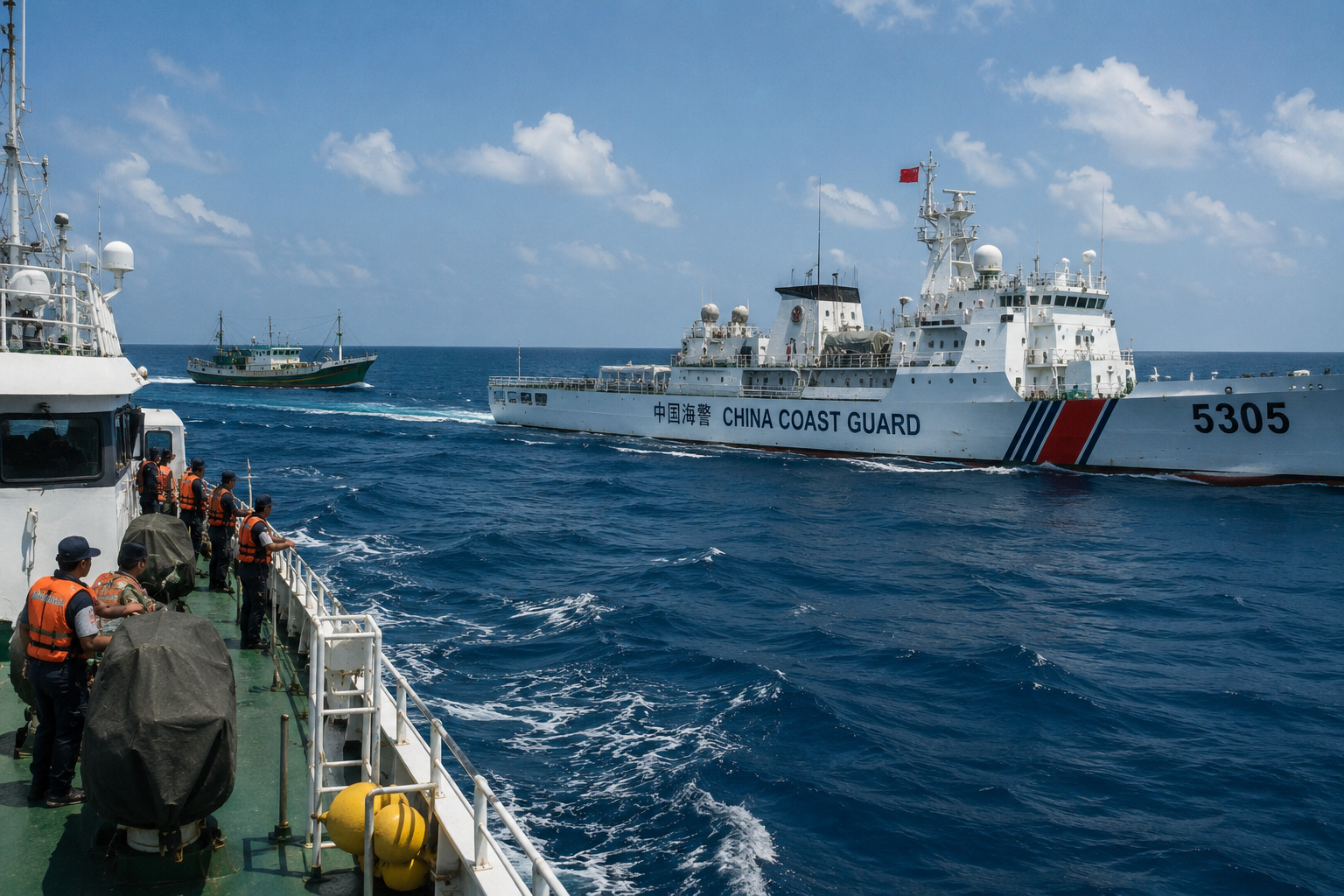
This is often called grey-zone strategy. It operates below the threshold of formal war but above normal diplomacy. Coast guard vessels, maritime militia, fishing fleets, artificial islands, water cannons, ramming incidents, floating barriers, legal claims and regular patrols are used to change facts at sea.
The goal is to make Chinese presence permanent and resistance costly.
China does not need to fire the first shot to achieve strategic gains. If it can prevent Philippine vessels from resupplying a ship, stop fishermen from entering traditional grounds, build facilities on reefs, or make other states hesitate before operating in their own exclusive economic zones, it has already changed the balance of power.
CSIS’s Asia Maritime Transparency Initiative states that China has 20 outposts in the Paracel Islands and seven in the Spratlys, controls Scarborough Shoal through a constant coast guard presence, and has created about 3,200 acres of new land through dredging and artificial island-building in the Spratlys since 2013.
This is maritime power in slow motion.
It does not always look like war. But it changes the map.
Scarborough Shoal Shows the Pattern
Scarborough Shoal has become one of the most important flashpoints.
It is a traditional fishing ground and is claimed by both China and the Philippines. It lies within the Philippines’ exclusive economic zone, but China has effectively controlled access since the 2012 standoff. Reuters reported in April 2026 that satellite images showed China deploying vessels and a floating barrier at the entrance to Scarborough Shoal, tightening control over one of Asia’s most disputed maritime sites.
In late May 2026, China again conducted patrols near Scarborough Shoal after the Philippines warned of threats from Beijing. Reuters reported that the patrols coincided with Philippine-U.S. maritime exercises and that Manila’s defence secretary described China’s posture as a severe threat.
This shows the tactical logic of the dispute.
China uses regular patrols and physical barriers to normalise control. The Philippines uses alliances, publicity and international law to resist. The United States and partners conduct exercises to signal deterrence. Each side tries to avoid open conflict, but the risk of collision grows.
The South China Sea is therefore not only a legal dispute. It is a daily contest of presence.
Second Thomas Shoal Is a Symbol of Resistance
Second Thomas Shoal is another major flashpoint.
The Philippines grounded the BRP Sierra Madre there in 1999 to reinforce its claim. Filipino personnel remain stationed on the ageing ship, and Manila conducts resupply missions. China has tried to interfere with those missions, arguing that the area is Chinese territory.
CFR notes that Chinese Coast Guard vessels have used dangerous tactics against Philippine resupply missions, including water cannons, lasers and collisions, while the shoal lies within the Philippines’ 200-mile exclusive economic zone.
The symbolism is powerful. A rusting ship has become a frontline of maritime resistance.
For the Philippines, the Sierra Madre is proof of presence. For China, it is an obstacle to control. For the United States, it is a possible treaty trigger. For ASEAN, it is a reminder that legal claims mean little without enforcement.
This is why Second Thomas Shoal matters beyond its size. It shows how small maritime features can carry huge strategic weight.
The 2016 Arbitration Still Matters
International law is central to the South China Sea dispute.
In 2016, an arbitral tribunal constituted under UNCLOS ruled in favour of the Philippines on major issues. The Permanent Court of Arbitration’s press release stated that the tribunal concluded there was no legal basis for China to claim historic rights to resources within sea areas falling inside the “nine-dash line” beyond rights allowed under UNCLOS.
China rejected the ruling and refused to participate in the proceedings. The ruling did not settle sovereignty over every feature, but it severely weakened the legal basis of China’s expansive maritime claims.
That is why the ruling remains politically important even if China ignores it.
The dispute is now a test of whether law can restrain power. If a major state can reject an adverse legal ruling and still impose control through coast guard pressure, smaller states will draw a dangerous lesson: law protects only those strong enough to enforce it.
This is why the South China Sea is not merely about China and the Philippines. It is about the credibility of UNCLOS itself.
Coast Guards Have Become Strategic Forces
One of the defining features of the South China Sea dispute is the central role of coast guards.
In earlier eras, great-power competition at sea was associated with battleships, aircraft carriers and submarines. In the South China Sea, the coast guard has become one of the most important instruments of coercion.
This is deliberate.
A navy creates immediate military escalation risk. A coast guard vessel creates ambiguity. It appears civilian or law-enforcement oriented, even when it is used for strategic pressure. It can block, shadow, ram, spray water cannons, inspect, surround or intimidate without formally starting a war.
This creates a dilemma for smaller states. If they respond with navy vessels, China can accuse them of militarising the issue. If they respond only with coast guard vessels, they may be physically outmatched. If they do not respond, China’s control expands.
This is the logic of grey-zone maritime power: win without triggering the legal and political consequences of war.
Maritime Militia Adds Another Layer
China’s maritime militia makes the picture even more complex.
Fishing vessels can operate as ordinary commercial actors, but some also function as instruments of state power. They can swarm disputed areas, block access, gather information, and support coast guard presence while preserving plausible deniability.
This makes attribution and escalation harder.
If a fishing vessel blocks a foreign ship, is it a civilian incident or a state-directed action? If maritime militia vessels surround a reef, is it commercial fishing or coercive occupation? If a coast guard vessel protects them, does the incident become state action?
The South China Sea shows how maritime power is no longer limited to navies. It now includes coast guards, militias, survey ships, dredgers, fishing fleets, satellites, legal maps and information campaigns.
Artificial Islands Changed the Military Geography
China’s artificial island-building changed the military balance.
Land reclamation turned reefs and low-tide elevations into platforms for runways, ports, radar systems and military facilities. These outposts extend China’s ability to monitor, patrol and project power across the sea.
The strategic effect is not only physical. It is psychological.
Once a feature has a runway, harbour, radar facility or missile system, other countries must plan around it. Patrol routes change. Surveillance changes. Crisis calculations change. The sea becomes more militarised even if no shots are fired.
Artificial islands are therefore not just construction projects. They are tools of strategic permanence.
ASEAN’s Limits Are Exposed
The South China Sea is also a test of ASEAN.
ASEAN wants regional stability, economic cooperation and peaceful dispute resolution. But its members do not share identical interests. Vietnam and the Philippines are more exposed to Chinese maritime pressure. Cambodia and Laos have different relationships with China. Malaysia and Brunei often prefer quieter diplomacy. Indonesia is not a claimant in the same way, but it has faced Chinese activity near the Natuna waters.
This diversity weakens ASEAN’s collective response.
ASEAN and China pledged in 2002 to create a South China Sea Code of Conduct, but progress has been slow. Reuters reported that the Philippines, as ASEAN chair, wanted the long-delayed Code of Conduct to explicitly reference UNCLOS and aimed to complete the document in 2026.
The problem is that a weak code would be worse than no code. If the document avoids binding obligations, excludes key features, weakens outside partnerships, or fails to reference UNCLOS clearly, it could legitimise ambiguity rather than reduce tension.
A meaningful code must restrain coercion. A symbolic code will only decorate the status quo.
The Philippines Has Changed the Regional Equation
Under President Ferdinand Marcos Jr., the Philippines has taken a more assertive stance than during the later Duterte years.
Manila has publicised Chinese actions, deepened defence ties with the United States, expanded cooperation with Japan, Australia, France and others, and tried to internationalise the issue. Reuters reported in May 2026 that Philippine Defence Secretary Gilberto Teodoro said the Philippines remained under threat from China and emphasised alliance-building and accelerated defence upgrades.
This is a major shift.
The Philippines is no longer trying to manage the issue quietly through bilateral accommodation. It is making the dispute visible. That visibility raises diplomatic costs for China. It also increases the risk that local incidents become alliance crises.
Manila’s strategy is clear: a middle power cannot match China alone, so it must build networks.
The U.S. Alliance System Is Being Tested
The South China Sea is also a test of American credibility.
The United States is not a claimant, but it has a direct interest in freedom of navigation, treaty commitments and the regional balance of power. It also has a Mutual Defense Treaty with the Philippines.
A February 2026 U.S.-Philippines joint statement reiterated that the Mutual Defense Treaty applies to armed attacks against either country’s armed forces, aircraft and public vessels, including those of the coast guard, anywhere in the South China Sea.
This raises the stakes.
If China injures or kills Philippine personnel in a serious incident, Washington may face pressure to respond. If the United States does not respond credibly, allies across the Indo-Pacific may question American guarantees. If it responds too forcefully, escalation with China becomes possible.
This is why the South China Sea is dangerous. It combines local friction with great-power commitments.
Military Exercises Are Signalling Tools
Military exercises have become a major part of the regional contest.
In April 2026, the Philippines and the United States, along with allies including Australia, Canada, France, New Zealand and Japan, began their largest-ever Balikatan exercises. Reuters reported that more than 17,000 troops participated, and the drills focused on maritime strike, air and missile defence, multinational operations and live-fire scenarios.
China sees such exercises as hostile encirclement. The Philippines and its partners see them as deterrence.
Both interpretations matter.
Exercises are not war, but they prepare for war. They reassure allies, signal capability and complicate Chinese calculations. But they also increase Chinese suspicion and can provoke counter-drills.
This is the security dilemma at sea: one side’s deterrence becomes the other side’s provocation.
China’s Navy Is Moving Beyond the Near Seas
The South China Sea also reveals China’s broader maritime ambition.
China is no longer simply a continental power with coastal interests. It is becoming a blue-water naval power. Its aircraft carriers, submarines, destroyers, coast guard fleet and island bases are part of a larger transformation.
Reuters reported in June 2026 that China’s aircraft carrier Liaoning conducted drills east of the Philippines, with Japan’s defence ministry recording around 170 aircraft and helicopter take-offs and landings.
This matters because China’s maritime power is expanding beyond disputed reefs. It is entering the wider western Pacific. The South China Sea is therefore part of a larger Chinese effort to shape the Indo-Pacific maritime order.
For Beijing, maritime power protects trade, secures resources, prevents foreign military pressure, and supports its great-power status. For its neighbours, the same expansion appears coercive.
Vietnam’s Position Is Important
Vietnam is one of the most serious South China Sea actors.
It has its own disputes with China, especially around the Paracel and Spratly Islands. It has fought China before. It also depends heavily on trade with China and therefore cannot afford uncontrolled confrontation.
This creates a balancing strategy.
Vietnam strengthens defence ties, supports international law, deepens partnerships, and avoids becoming a formal U.S. ally. Its diplomacy is cautious but firm.
In June 2026, the Philippines and Vietnam upgraded ties to an enhanced strategic partnership, with Philippine President Ferdinand Marcos Jr. saying peace, stability and a rules-based order in the South China Sea were “non-negotiable.”
This is significant. Southeast Asian states are not forming an anti-China alliance, but they are building issue-based partnerships to protect maritime interests.
India Has a Stake in the South China Sea
India is not a claimant in the South China Sea, but it has clear interests there.
India’s trade, energy security, Indo-Pacific strategy and Act East policy all depend on stable sea lanes. The South China Sea is part of the maritime route connecting India to East Asia. India also has strategic partnerships with Vietnam, the Philippines, Japan, Australia and the United States.
India’s official position has long emphasised freedom of navigation, overflight and unimpeded commerce based on international law, especially UNCLOS. The Ministry of External Affairs stated after the 2016 arbitral ruling that India supports freedom of navigation and overflight, unimpeded commerce, and respect for international law as reflected in UNCLOS.
For India, the issue is not only China’s behaviour in Southeast Asia. It is the principle that maritime claims must not be imposed through coercion. If China can dominate the South China Sea by pressure, it strengthens a model of maritime behaviour that could affect the wider Indo-Pacific.
India therefore has reason to support a rules-based maritime order without becoming unnecessarily provocative.
The Quad’s Relevance Is Growing
The Quad — India, the United States, Japan and Australia — is not a military alliance, but South China Sea tensions give it strategic relevance.
The Quad’s focus on freedom of navigation, maritime domain awareness, resilient supply chains and Indo-Pacific stability directly overlaps with South China Sea concerns. Even when the Quad avoids naming China directly, its strategic purpose is clear: prevent any one power from dominating the Indo-Pacific maritime order.
For India, the Quad is useful because it supports a multipolar maritime balance without requiring formal alliance commitments. For the United States, Japan and Australia, India’s participation gives the grouping wider Indo-Pacific legitimacy.
The South China Sea is where Quad language about a “free and open Indo-Pacific” is tested in practice.
The Dispute Is Also About Fisheries
The South China Sea is often discussed in terms of navies and trade, but fisheries are central.
Millions of people across Southeast Asia depend on fishing for livelihoods and food security. When fishing access is restricted, the dispute affects ordinary households, not just diplomats.
This is why Scarborough Shoal matters so deeply to Filipino fishermen. For them, the issue is not abstract sovereignty. It is livelihood. If they are blocked by foreign coast guard vessels from traditional fishing grounds, their economic survival is affected.
Fisheries also create escalation risk because fishing boats are often the first vessels to encounter foreign patrols. A confrontation between fishermen and coast guards can quickly become diplomatic and military.
Maritime power is therefore not only about warships. It is also about who controls daily economic life at sea.
The Energy Question Adds Pressure
Oil and gas resources also intensify the dispute.
States want access to offshore energy resources within their exclusive economic zones. But exploration becomes difficult when Chinese vessels or legal threats create risk. Energy companies may hesitate to invest in disputed waters. Smaller states may avoid drilling to prevent confrontation.
This gives China strategic leverage. Even without extracting the resources itself, it can make others afraid to do so.
If a country cannot explore resources within its own maritime zones because another power objects, sovereignty becomes hollow. This is why energy is part of maritime power.
Lawfare Is Part of the Contest
The South China Sea dispute is fought through legal language as much as through ships.
China uses maps, historical narratives, domestic laws, coast guard regulations and administrative declarations to support its claims. The Philippines uses UNCLOS, the 2016 ruling, diplomatic notes and public documentation. Vietnam, Malaysia and Indonesia also rely on legal frameworks to defend their maritime rights.
This is lawfare: the use of law as an instrument of strategic competition.
But lawfare works only when backed by political will. A legal ruling that is ignored by a powerful state still matters, but it does not enforce itself. Smaller states need partnerships, publicity, coast guard capacity and diplomatic coalitions to turn law into resistance.
The South China Sea shows that law and power are not opposites. Effective maritime strategy requires both.
The Risk of Accidental Escalation Is Growing
The greatest danger may not be a deliberate Chinese decision to start a war.
It may be an accident.
A collision, injury, water-cannon incident, boarding attempt, blocked resupply mission, aircraft intercept or misread patrol could spiral. Nationalist sentiment could limit diplomatic flexibility. Military commanders could overreact. Treaty commitments could pull in outside powers.
The South China Sea is full of vessels operating in close proximity. The more often ships and aircraft meet under hostile conditions, the greater the chance of miscalculation.
This is why confidence-building measures are essential. Hotlines, incident-at-sea protocols, clear rules of engagement and crisis communication channels matter. But they cannot substitute for restraint.
Smaller States Are Learning to Network
One major lesson from the South China Sea is that smaller states cannot face maritime coercion alone.
The Philippines is deepening defence cooperation with the United States, Japan, Australia, France, Canada and others. Vietnam is upgrading partnerships while preserving strategic autonomy. Malaysia and Indonesia are strengthening maritime enforcement capabilities. Japan is providing equipment and training to Southeast Asian partners.
This is not a formal alliance bloc. It is a networked balancing strategy.
Smaller states do not necessarily want war with China. They want enough external support to prevent China from converting size into dominance.
This is the new maritime politics of Southeast Asia: no one wants to choose total confrontation, but no one wants to surrender maritime rights either.
China’s Dilemma
China faces its own dilemma.
If it pushes too aggressively, it drives Southeast Asian states closer to the United States and Japan. If it pulls back, it may appear weak domestically and lose momentum in asserting its claims. If it relies on coast guard pressure, it may gain tactical control but lose regional trust. If it militarises further, it strengthens the argument for external balancing.
This is the paradox of coercive power.
China may win control over specific features while losing influence over regional opinion. It may dominate reefs but create an anti-coercion coalition. It may claim to defend sovereignty while convincing neighbours that China’s rise threatens theirs.
The South China Sea is therefore also a test of China’s statecraft. A truly great power does not only command fear. It builds legitimacy.
The United States’ Dilemma
The United States also faces a dilemma.
It wants to deter China without triggering a war. It wants to reassure allies without giving them a blank cheque for risky behaviour. It wants to defend freedom of navigation without appearing to militarise every dispute. It wants to remain the Indo-Pacific security guarantor while managing crises in Europe and West Asia.
This is difficult.
If Washington appears weak, China may press harder. If Washington appears reckless, regional states may fear being dragged into a great-power war. The U.S. must therefore calibrate deterrence carefully.
The South China Sea is a test of American power, but also of American judgement.
ASEAN Must Avoid Strategic Irrelevance
ASEAN’s biggest risk is not that it will disappear. It is that it will become strategically bypassed.
If ASEAN cannot manage the South China Sea diplomatically, claimant states will increasingly turn to outside powers. The Philippines will rely more on the United States and Japan. Vietnam will deepen external partnerships. Australia, France, India and others will expand maritime roles. China may prefer bilateral negotiations because it can pressure individual states more easily.
ASEAN centrality will survive only if ASEAN can defend principles, not merely host meetings.
A serious Code of Conduct must be consistent with UNCLOS, protect the rights of coastal states, avoid legitimising coercive control, and not restrict lawful cooperation with external partners. Anything weaker may reduce ASEAN to a diplomatic stage while real power is exercised elsewhere.
What Maritime Power Means Now
The South China Sea teaches that maritime power today has many layers.
It is naval power: warships, submarines, aircraft and missiles.It is coast guard power: law enforcement vessels that can pressure without formal war.It is economic power: trade routes, ports, energy resources and fisheries.It is legal power: UNCLOS, arbitration, claims and diplomatic notes.It is informational power: satellite imagery, public diplomacy and narrative control.It is alliance power: treaty commitments, exercises and security partnerships.It is industrial power: shipbuilding, surveillance systems and maritime technology.
A state that understands all these layers can shape the sea without always fighting. That is why the South China Sea has become such an important case study.
It is not just about who can win a naval battle. It is about who can control behaviour at sea.
What India Should Do
India should approach the South China Sea with strategic clarity.
First, India should continue supporting freedom of navigation, overflight and unimpeded commerce under international law.
Second, India should deepen defence and maritime cooperation with Vietnam, the Philippines, Indonesia, Singapore, Japan and Australia.
Third, India should improve maritime domain awareness across the Indo-Pacific, including white-shipping information, satellite monitoring and coast guard cooperation.
Fourth, India should avoid unnecessary rhetorical escalation while remaining firm on principles.
Fifth, India should connect South China Sea stability with its own trade, energy and Indo-Pacific interests.
India does not need to become a direct party to the dispute. But it cannot be indifferent to the outcome. The rules established in the South China Sea will shape the wider maritime order in which India must operate.
Conclusion: The Sea Is Testing the World Order
The South China Sea has become a test case for maritime power because it concentrates the central questions of the modern international order.
Can a powerful state convert historical claims into control despite legal rulings? Can smaller states defend maritime rights without triggering war? Can international law restrain coercion? Can alliances deter without escalating? Can ASEAN remain central? Can trade routes remain open? Can the Indo-Pacific remain free, open and multipolar?
These questions are not theoretical. They are being tested every day by coast guard patrols, resupply missions, barriers, military exercises, legal statements and diplomatic alignments.
The South China Sea is not only about China. It is about the future of the sea itself.
If rules hold there, smaller states gain confidence. If coercion succeeds there, the message spreads far beyond Southeast Asia. Every maritime power will learn that patient pressure can defeat law. Every smaller coastal state will learn that legal rights require external support. Every shipping nation will learn that trade routes are only as secure as the balance of power around them.
The world cannot afford to treat the South China Sea as a distant regional dispute.
It is a mirror of the emerging order.
In that mirror, the future looks uncertain: part legal contest, part military competition, part trade-route vulnerability, part great-power rivalry.
The sea is asking a simple question.
Will maritime order be governed by law, or by the strongest fleet near the reef?
The answer may define the Indo-Pacific century.