
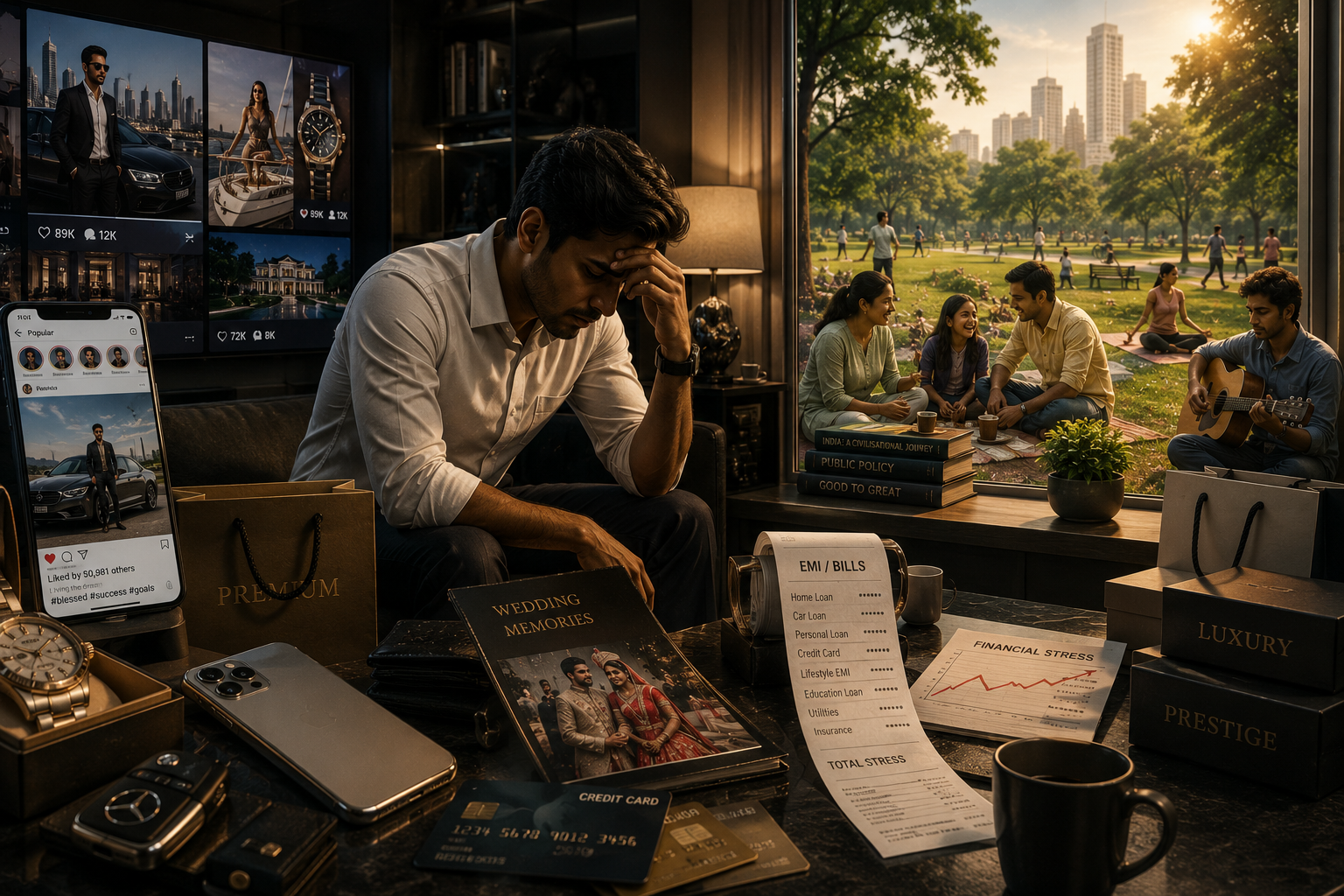
Luxury Has Become the New Poverty of the Mind
There was a time when poverty meant not having enough. Today, a new poverty has entered the lives of people who have more than any generation before them: the poverty of never feeling enough. A phone is bought, and the next model begins to whisper. A wedding is celebrated, and comparison spoils the memory. A holiday is taken, and the photographs matter more than rest. A child is admitted to school, and the brand of the school becomes family identity. The wardrobe grows, the wallet strains, the house fills, and yet the mind remains hungry. Luxury has become the new poverty of the mind.
The old saying that contentment is natural wealth and luxury is artificial poverty was never an argument against comfort. Human beings deserve beauty, rest, good food, travel, technology and celebration. Poverty is not morally superior. There is no virtue in deprivation. The problem begins when luxury stops being enjoyment and becomes proof of existence. When consumption becomes identity, the person is never rich enough because identity must be constantly displayed, defended and upgraded.
India is living through a major transformation in aspiration. Liberalisation, digital media, credit access, malls, e-commerce, influencers, premium housing, destination weddings, luxury cars, branded education, fitness culture and global travel have changed the imagination of the middle class. Many of these changes are welcome. A society emerging from scarcity should not be shamed for wanting quality. The danger is different: aspiration has become performative faster than it has become secure.
MoSPI's Household Consumption Expenditure Survey 2023-24 estimated average monthly per capita consumption expenditure at Rs 4,122 in rural India and Rs 6,996 in urban India, without imputing free welfare benefits. These numbers remind us of the distance between elite consumption narratives and the average Indian household. Much of India is not debating which luxury brand to buy. It is balancing food, rent, education, healthcare, transport, debt and ceremonies. Yet the visual culture of aspiration makes even modest households feel behind.
The status economy works by manufacturing inadequacy. It does not merely sell products; it sells comparison. A phone is not a device, but a signal. A car is not transport, but rank. A house is not shelter, but proof. A wedding is not union, but spectacle. A school is not learning, but parental status. Even spirituality is packaged as premium retreat. The market has learned an old human weakness: people will pay heavily not only for comfort, but to escape the shame of appearing ordinary.
Social media has intensified this artificial poverty. Earlier, comparison had geography. Now comparison has no boundary. A small-town professional compares his life with a Mumbai influencer, a Dubai trader, a Bengaluru founder, a cousin in Canada and a classmate posting from Europe. The platform does not show balance sheets, loneliness, EMIs, family conflict or anxiety. It shows surfaces. The viewer compares his whole life with another person's edited display. That is not inspiration. It is psychological debt.
The WHO Commission on Social Connection found in 2025 that one in six people worldwide experience loneliness, with adolescents and young adults among the most affected groups. This matters because consumption often fills the space left by weak connection. When people lack meaningful belonging, they may buy visibility. When friendship becomes fragile, display becomes community currency. When self-worth is uncertain, luxury becomes armour. But armour is heavy. The person protected by status is also imprisoned by it.
India's consumer culture is not simply individual weakness
India's consumer culture is not simply individual weakness. It is shaped by economic insecurity. In a country where social mobility is uncertain, visible consumption becomes evidence that one has arrived. Families that were once excluded from elite spaces may use luxury to claim dignity. A first-generation professional may buy a car not because of vanity alone, but because the car symbolises escape from humiliation. A lavish wedding may express social legitimacy. A branded school may be seen as protection against inherited disadvantage. Therefore, moral lectures against consumption can be arrogant if they ignore history.
Yet empathy should not prevent judgement. Some consumption is liberation. Some is theatre. Some is self-respect. Some is surrender. The line is crossed when people begin spending not to live better, but to be seen as living better. The middle class then becomes financially stretched and emotionally restless. Savings are postponed, insurance neglected, health ignored, parents burdened, and young people pushed into careers not for meaning but for the consumption ladder they must climb.
RBI-linked data placed before Parliament in 2025 noted that household net financial savings stood at 6.0 percent of GDP in 2024-25, according to RBI Monthly Bulletin figures. Financial savings are only one indicator, and households also save through physical assets. But the broader concern remains visible in everyday life: easy credit, buy-now-pay-later habits, personal loans, credit cards, and peer pressure can convert aspiration into fragility. A society that teaches spending before financial literacy is preparing many families for silent stress.
Luxury also changes politics. Citizens who are trained to think of life primarily as consumption may become less sensitive to public goods. They may demand private schools, private hospitals, private cars, private security, private clubs and gated life, while public systems decay. This creates a divided republic: those who can buy exit and those forced to endure failure. The wealthy then complain about poor public culture after withdrawing from the public institutions that create culture.
The moral poverty of luxury is that it narrows attention. A person obsessed with status has little room for wonder, service, friendship or citizenship. He asks what something signals before asking what it means. She asks how it will appear before asking whether it is needed. Families begin planning ceremonies for spectators rather than relationships. Children learn brands before values. Cities build malls faster than libraries. The market expands, but the inner life shrinks.
This does not mean India should romanticise simplicity in a hypocritical way. Many who preach minimalism do so from positions of comfort. It is easy to praise simplicity after securing wealth. The poor do not need sermons on contentment; they need income, dignity and opportunity. The critique of luxury must be directed primarily at the psychology of endless comparison among those who have enough but are trained to feel poor.
Contentment is often misunderstood as lack of ambition. In truth, contentment is the only stable foundation for healthy ambition. A content person can still work hard, create wealth, build companies, travel, buy good things and enjoy success. The difference is that he does not need every possession to repair his self-worth. She can desire without being dominated by desire. Contentment is not the absence of movement. It is the absence of enslavement.
Indian philosophical traditions understood this well, though modern India
Indian philosophical traditions understood this well, though modern India often quotes them more than living them. The idea of aparigraha, or non-possessiveness, does not demand that everyone become ascetic. It asks whether possession has begun to possess the person. The Bhagavad Gita's emphasis on disciplined desire, Buddhist reflections on craving, Jain ethics of restraint, Sikh teachings on honest work and sharing, and Gandhian simplicity all point toward a truth that consumer capitalism prefers to hide: desire without limit becomes suffering.
The modern economy, however, runs on stimulating desire. Advertising does not merely identify needs; it manufactures dissatisfaction. Influencer culture personalises advertising by making envy intimate. E-commerce removes friction from purchase. Credit reduces the pain of payment. Algorithms learn insecurity and serve products accordingly. A person browsing in loneliness may be shown beauty products, courses, gadgets, luxury travel, investment fantasies and self-improvement packages. The market knows when the mind is weak.
Policy cannot and should not police desire. A free society allows people to spend. But policy can create conditions for healthier economic culture. Financial literacy must begin early. Schools should teach budgeting, debt, insurance, savings, digital fraud and the psychology of consumption. Advertising aimed at children should face stricter scrutiny. Digital platforms must be more transparent about targeted persuasion. Public campaigns should make responsible credit and mental well-being part of mainstream conversation.
Workplaces also need correction. Corporate culture often rewards visible lifestyle as proof of success. Young professionals feel pressure to live above their financial maturity because networking, dating, housing and social media all carry status expectations. Companies speak of wellness while quietly celebrating overwork and consumption as aspiration. A healthier workplace would respect savings, rest, family time and modesty as much as hustle.
Families can do even more. Parents should stop converting ceremonies into competitive projects. A wedding that creates debt is not honour. A school chosen for status rather than fit is not parenting. A festival celebrated to impress neighbours is not devotion. Children watch carefully. They learn whether money is a tool, a god or a mask. The most valuable inheritance may not be property, but a sane relationship with desire.
Media too must reassess its role. Lifestyle journalism often sells aspiration without consequences. It celebrates luxury homes, celebrity weddings, premium gadgets and elite consumption, while rarely asking who feels inadequate after watching. Newsrooms cannot ignore consumer culture; it is part of modern life. But they can cover it with intelligence: debt stress, environmental cost, labour behind luxury, mental health, class anxiety, and the difference between taste and display.
There is also an ecological cost. Luxury consumption consumes more energy, water, material, packaging and land. A society where the affluent constantly upgrade while the poor are asked to adapt to climate stress is morally unstable. Climate responsibility cannot be placed only on farmers, poor households or future technology. The upper-consuming classes must examine lifestyle emissions, waste and excess. Restraint is not anti-growth. It is intelligent civilisation.
India's growth story needs consumption
India's growth story needs consumption. Demand drives jobs, investment and production. The answer is not anti-market puritanism. The answer is a better hierarchy of desire. Spend on health, learning, safety, tools, experiences, art, local enterprise, quality goods and genuine joy. Be cautious of spending designed only to defeat another person's image. An economy can grow around dignity rather than insecurity.
The editor's judgement is this: the new poverty of India is not only material deprivation. It is comparative deprivation among the comfortable. It is the anxiety of being seen as less. It is the inability to sit with one's own life without measuring it against a feed. It is the sadness of people who have bought many things but lost the capacity to feel rich.
Contentment is natural wealth because it cannot be repossessed, outdated or compared into extinction. Luxury is artificial poverty when it makes every possession temporary and every achievement insufficient. India must become prosperous, but it must not become psychologically bankrupt in the process.
A developed country is not one where everyone can imitate the consumption of the richest. It is one where citizens have enough security to stop performing wealth and enough wisdom to know what wealth is for. The truly rich society is not the one with the largest malls. It is the one where people can live with dignity, desire with restraint, celebrate without debt, succeed without display, and rest without feeling defeated.
The antidote to artificial poverty is not anti-modern guilt. It is conscious abundance. A family can celebrate without competing. A professional can buy quality without turning life into display. A young person can enjoy fashion, technology and travel without letting them become a personality. A society can build markets while also building libraries, parks, public transport, sports grounds and cultural spaces where worth is not measured by billing capacity.
India's older idea of wealth was never only money. It included knowledge, reputation, generosity, family stability, community trust, health, land, skill, restraint and spiritual balance. Modern India need not return nostalgically to the past, but it should recover the wider imagination of prosperity. A person who has high income but no rest, many contacts but no friendship, many possessions but no security, and constant display but no inner quiet is not living wealth. He is managing a premium form of anxiety.
Businesses also have a choice. They can profit by deepening insecurity, or they can build brands around quality, durability, repair, transparency and genuine usefulness. The second path may appear slower, but it creates healthier consumers and more durable trust. Policy can encourage this through consumer protection, right-to-repair thinking, financial literacy and scrutiny of predatory credit. Culture can encourage it by admiring wisdom as much as display.
The central question is not whether Indians should consume more
The central question is not whether Indians should consume more. Many should, because deprivation remains real. The question is whether consumption will serve life or replace it. When money buys education, health, safety, tools, art and meaningful experience, it can expand freedom. When money buys only comparison, it shrinks the mind. Luxury becomes poverty precisely when it teaches people to feel poor in the presence of their own abundance.
The harder editorial responsibility is to connect private behaviour with public consequence. India often treats values as ceremonial words and policy as a separate technical field. In reality, the two are inseparable. A corrupt file, an anxious classroom, a reckless construction, a performative social-media debate, a debt-funded display of status and a neglected public institution all grow from choices that were first normalised culturally. Policy can correct some damage, but culture decides how much damage is produced in the first place.
That is why the argument is not merely moral advice. It is a governance argument. A country that wants better outcomes must cultivate citizens capable of better judgement. Laws matter, budgets matter, technology matters, but none of them can replace a public temperament that respects evidence, restraint, dignity and long-term thinking. The mature citizen is not passive. He acts, but not blindly. She questions, but not destructively. They demand change, but also accept responsibility.
For Editors Outlook, the point is to hold that middle ground firmly: neither cynical nor naive, neither sentimental nor mechanical. India deserves analysis that respects its pain without exploiting it, respects its ambition without flattering it, and respects its readers enough to offer complexity instead of easy anger. The subject may begin as philosophy, economy, society or environment, but the final question is always the same: what kind of republic are we becoming through our everyday choices?
A mature editorial must finally resist two temptations: the comfort of preaching and the laziness of despair. Preaching tells readers what to think without respecting what they endure. Despair tells them nothing can change, which is merely another form of surrender. The better path is harder. It asks readers to see the machinery behind daily life and then identify the point at which personal agency, institutional reform and public pressure can meet. That meeting point is where change begins.
India will not be improved by one perfect law, one heroic leader, one viral campaign or one angry season. It will be improved by repeated acts of correction that become habits. A habit of asking for evidence. A habit of measuring policy by outcomes. A habit of respecting human dignity even during disagreement. A habit of choosing substance over spectacle. These habits are quiet, but republics are ultimately made of quiet habits. They decide whether public debate becomes a passing emotion or a durable civic force capable of changing institutions without losing humanity in practice. That is the minimum standard of serious public life, and it is also the difference between a nation that merely reacts to events and a nation that learns to govern its own future with patience, courage and institutional memory. The reader should finish not only informed, but steadier, more alert, and more capable of refusing the easy emotional shortcut that weakens democratic judgement.