India's Climate Future Will Depend on Technologies We Scale Before Crisis Hits
Climate change will not arrive in India as a single dramatic event. It will arrive as a bad monsoon, a failed borewell, a hotter classroom, a damaged road, a flooded underpass, a farmer's second loan, a power grid under stress, a heat-exhausted worker, a city hospital crowded after a heatwave, a coastal family moving inland, a food-price spike and a village where young people quietly decide agriculture is no longer worth inheriting.
That is why India's climate future will depend not only on promises made at summits, but on technologies scaled before crisis hits.
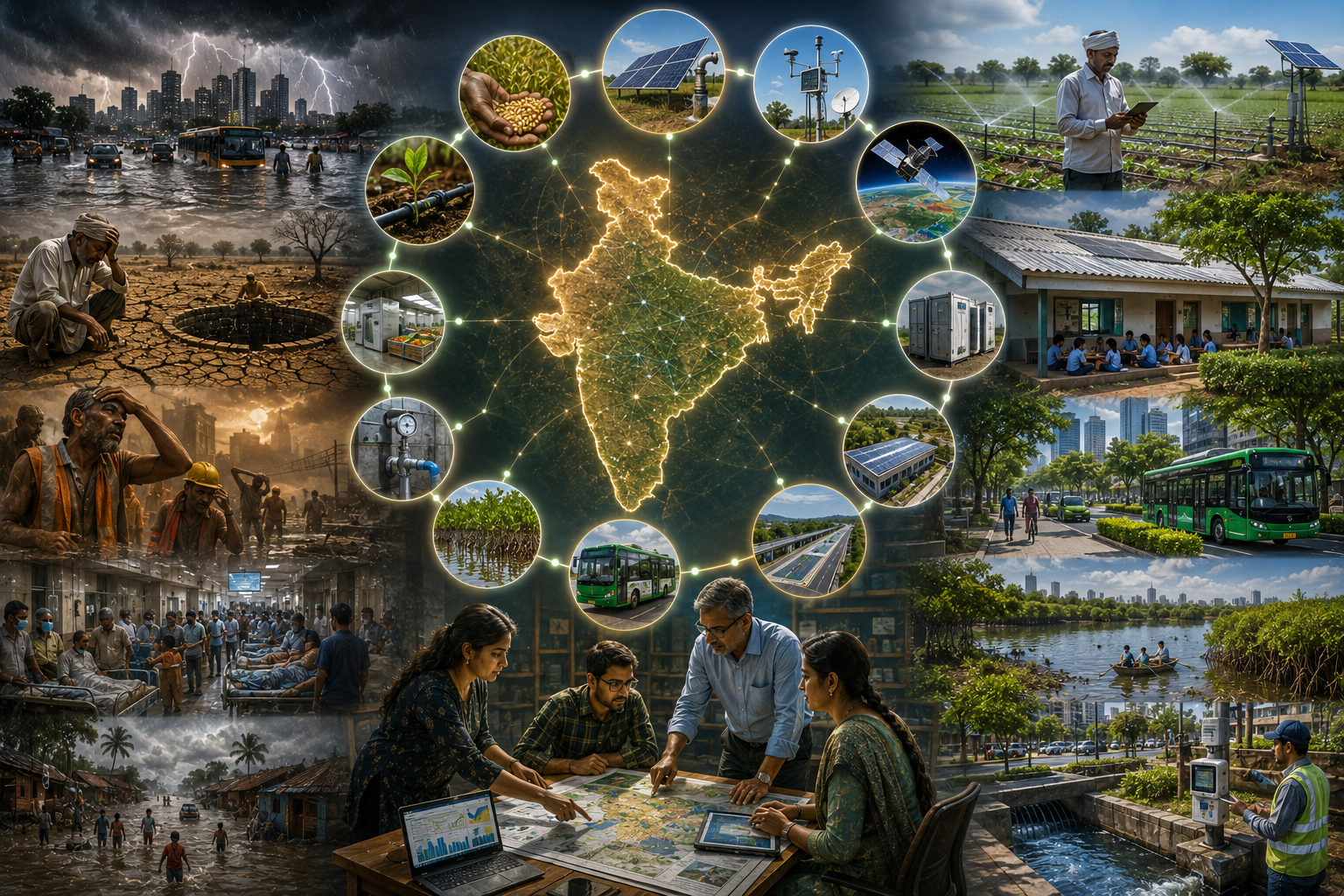
The word "technology" must be understood broadly. It does not mean only expensive machines or imported climate gadgets. It includes drought-resistant seeds, flood-tolerant crops, micro-irrigation, heat-resilient building materials, early-warning systems, solar pumps, battery storage, decentralised cold chains, water accounting, climate insurance, satellite mapping, urban drainage sensors, green public transport, clean cooking, precision agriculture, waste-to-energy systems, mangrove restoration, community seed banks and data systems that help local officials act before disaster becomes tragedy.
India cannot adapt to climate change through speeches after disasters. It must build resilience before the shock.
The urgency is no longer theoretical. The World Meteorological Organization's 2026 global annual to decadal update said there is a 91 per cent chance that at least one year between 2026 and 2030 will temporarily exceed 1.5 degrees Celsius above the pre-industrial average, and a 75 per cent chance that the five-year mean for 2026-2030 will exceed that threshold. WMO's State of the Global Climate 2025 also confirmed that 2015-2025 were the hottest eleven years on record. These global numbers translate into local stress: heat, rainfall volatility, crop risk, water conflict and infrastructure damage.
India's climate story is especially complex because its development needs are still enormous. It must grow, build, employ, urbanise, industrialise and provide energy to millions. A poor country cannot be asked to freeze development in the name of planetary virtue. But a climate-vulnerable country cannot pursue development as if weather patterns are stable. The choice is not development versus climate. The choice is climate-smart development versus repeated crisis.
Agriculture is the first battlefield. The monsoon remains central to India's food security and rural livelihoods. IMD's 2026 long-range forecast indicated below-normal southwest monsoon rainfall, estimated around 92 per cent of the long-period average with a model error. Even when seasonal totals look manageable, distribution can be erratic: too much rain in one district, too little in another, long dry spells, sudden downpours, crop damage at the wrong stage. Farmers do not live by annual averages. They live by timing.
This is why climate-resilient agriculture is not an optional reform
This is why climate-resilient agriculture is not an optional reform. It is survival policy.
The government has stated that ICAR develops and promotes climate-resilient technologies for regions prone to droughts, floods, frost and heat waves, and that during the last ten years till October 2024, 2,593 crop varieties were released, of which 2,177 were tolerant to one or more biotic or abiotic stresses. These numbers matter, but the real test lies in adoption. A seed variety in a research system does not automatically protect a farmer. It must reach the village, be trusted, be affordable, match local food habits, suit market demand and be supported by extension services.
The gap between laboratory and field is where resilience often fails.
Water technology is equally urgent. India's groundwater dependence is one of the most serious structural vulnerabilities in the rural economy. A borewell is often treated as private infrastructure, but aquifers are shared ecological systems. When every farmer drills deeper, the community moves closer to collective risk. Micro-irrigation, crop diversification, water budgeting, groundwater recharge, wastewater reuse and community-level aquifer management are not glamorous reforms. They are the difference between adaptation and collapse.
The Pradhan Mantri Krishi Sinchayee Yojana's per drop more crop component supports drip and sprinkler systems, with higher financial assistance for small and marginal farmers. Such schemes show the right direction. But micro-irrigation must be integrated with cropping decisions. Drip irrigation cannot solve water stress if water-intensive crops continue expanding in unsuitable regions. Technology without ecological judgement becomes a subsidy machine.
Climate resilience requires not only better tools, but better incentives.
Heat is the second battlefield. India's cities and work sites are already feeling the pressure. Heat affects labour productivity, electricity demand, public health, school attendance and urban inequality. A wealthy household can buy air conditioning. An informal worker cannot air-condition a construction site. A child in a poorly ventilated classroom cannot learn properly during extreme heat. A street vendor cannot move business indoors. Heat is not just weather. It is class.
Heat-action plans must therefore become enforceable urban policy,
Heat-action plans must therefore become enforceable urban policy, not annual paperwork. Cities need cool roofs, shaded streets, water points, public cooling centres, early warnings, changed work hours, emergency health protocols, green cover and building codes suited to local climate. The technology is often simple. The problem is governance. A reflective roof may save lives, but no ribbon-cutting ceremony celebrates it. Urban drainage may prevent flooding, but it remains invisible until it fails.
Climate adaptation is full of unglamorous work. That is why serious states must do it.
Infrastructure must be redesigned for new climate realities. Roads, bridges, railways, power lines, airports, ports and housing are often planned using past weather assumptions. But the past is becoming a weaker guide. Floods are more intense. Heat is more severe. Coastal risks are rising. If infrastructure is built cheaply today and repeatedly repaired tomorrow, the nation pays more. Climate-resilient infrastructure may cost more upfront, but it is fiscally prudent over time.
India's public finance must recognise this. Budgeting should include climate-risk screening for major projects. Urban local bodies should receive technical support for adaptation planning. Insurance markets should be strengthened, but not in ways that abandon the poor. Disaster-relief spending must shift gradually toward risk reduction. Every rupee spent before a disaster is more humane than a rupee spent after lives are damaged.
Energy technology forms the third battlefield. India's renewable energy expansion is essential, but renewable capacity alone is not enough. The grid must handle variability. Storage must scale. Distribution companies must become financially healthier. Rooftop solar must become easier for households and small businesses. Green hydrogen must be pursued where it makes economic and industrial sense, not as slogan. Electric mobility must be supported by charging infrastructure, battery recycling and public transport integration.
The climate transition will fail if it is seen only as replacing fuels. It is about redesigning systems.
There is also a rural energy opportunity. Solar pumps, decentralised cold storage, biomass systems and mini-grids can reduce costs and improve resilience. But poorly designed subsidies can create new groundwater extraction. Again, technology must be governed intelligently. The question is never simply "solar or diesel?" The question is how energy, water, crops and income interact.
Food systems need cold-chain and logistics technology
Food systems need cold-chain and logistics technology. Heat and erratic rainfall can increase post-harvest losses. Farmers lose value when produce cannot be stored, processed or transported efficiently. Climate-resilient cold chains powered by clean energy can reduce waste, stabilise farmer income and improve food security. This is not only an agricultural issue. It is an inflation issue. A climate shock that damages food supply becomes a kitchen-budget shock for urban families.
Forests and ecosystems are living technology. India's State of Forest Report 2023 recorded total forest and tree cover of 8,27,357 square kilometres, or 25.17 per cent of the country's geographical area. Forests store carbon, regulate water, reduce heat, protect biodiversity and support livelihoods. Yet public debate often treats them as land banks. A mature climate strategy must treat ecosystems as infrastructure. Mangroves can protect coasts. Wetlands can absorb floods. Urban trees can reduce heat. Healthy soils can store carbon and water.
Nature-based solutions are not anti-development. They are cheaper than engineering arrogance.
However, ecological technology must not become a new excuse for excluding communities. Forest dwellers, tribal communities, small farmers and fishers must be partners in resilience, not obstacles. Conservation without justice creates conflict. Climate policy that burdens the poor while allowing the rich to continue wasteful consumption will lose legitimacy. A just transition is not a moral add-on. It is a condition for political durability.
Data will be the nervous system of climate resilience. Satellite imagery, weather forecasts, soil data, crop mapping, hydrological models, disease surveillance and local sensors can help governments act earlier. But data must reach decision-makers in usable form. A district official does not need a complex climate model alone; she needs actionable alerts, resources, trained staff and authority to act. A farmer does not need a generic advisory; he needs location-specific, language-accessible guidance that he trusts.
India's digital public infrastructure can help here if adapted carefully. Weather advisories, crop insurance, credit, market information and disaster warnings can be integrated. But digital systems must not exclude those with poor connectivity, low literacy or limited trust. Climate technology must be last-mile technology.
The private sector has a role, but climate resilience cannot be left to startup enthusiasm alone. Many adaptation technologies serve people with low ability to pay. Markets undersupply them. The state must create demand through procurement, standards, subsidies, concessional finance and public research. Climate-tech startups should be encouraged, but their success should be measured by field impact, not only valuations.
Universities and agricultural extension systems must be revived
Universities and agricultural extension systems must be revived. India cannot import every climate solution. Agroecology varies by region. Himalayan risks differ from coastal risks. Punjab's water crisis differs from Bundelkhand's drought vulnerability. Assam's floods differ from Chennai's urban flooding. Local knowledge must meet modern science. Farmers often know micro-conditions that models miss. Scientists can identify patterns that local memory cannot see. Resilience emerges when both work together.
The climate conversation must also become politically honest. Citizens are repeatedly told to change behaviour: use less plastic, save water, plant trees, shift to public transport. These are useful messages, but they are insufficient. Large-scale resilience requires planning, infrastructure, regulation and finance. A citizen cannot personally redesign a city's drainage. A farmer cannot alone repair a distorted procurement system. A household cannot individually solve heat-island effects. Behaviour matters, but governance matters more.
India's climate politics must move from guilt to systems.
There is a danger that climate technology becomes elite language. Words such as net zero, carbon markets, green hydrogen and ESG may circulate in conferences while the rural household worries about drinking water and the urban worker worries about heat. The bridge between these worlds is adaptation. Climate action must be explained in terms people understand: fewer crop losses, lower electricity bills, safer homes, cooler schools, less flooding, better water, more stable food prices, healthier air and more reliable livelihoods.
The editorial judgement is clear: India's future will be decided by whether it scales resilience before disaster forces reaction. A country of India's size cannot improvise its way through climate volatility. Relief after floods, compensation after crop loss, advisories after heat deaths and repairs after infrastructure collapse are necessary, but they are signs of late action. The serious work is boring, technical, local and continuous.
Build the early-warning system before the cyclone. Promote the resilient seed before the drought. Redesign drainage before the flood. Cool the classroom before the heatwave. Protect the wetland before the city drowns. Price water sensibly before the aquifer collapses. Train the health worker before heatstroke cases rise. Finance adaptation before debt replaces livelihood.
Climate change punishes delay. Technology can buy time, but only if deployed before panic.
India does not lack intelligence
India does not lack intelligence. It lacks urgency at scale. The tools exist in pieces: scientific institutions, digital capacity, agricultural research, renewable energy, local governance networks, community knowledge and entrepreneurial talent. The task now is integration.
The crisis will not wait for perfect policy. The monsoon will not wait for committees. Heat will not wait for budget cycles. Groundwater will not wait for election manifestos.
India's climate future will belong to those technologies, institutions and communities that are ready before the headline arrives.
The financing question is decisive. Adaptation is often less attractive to investors than mitigation because its returns are local, dispersed and preventive. A solar park produces measurable electricity revenue. A restored wetland prevents future flood damage that may never be fully priced. India needs climate finance mechanisms that value avoided loss, not only visible profit. Green bonds, resilience bonds, blended finance, district adaptation funds and insurance-linked incentives should be designed for local realities.
Local governments must be empowered. Climate change is national in cause but local in impact. A municipal engineer, panchayat official, district collector, school principal, health officer and agricultural extension worker often form the front line of adaptation. Yet local bodies frequently lack money, staff and technical expertise. National missions will remain incomplete if implementation capacity is weak at the bottom. Climate resilience must become part of municipal budgeting, panchayat planning and district administration training.
The insurance sector also needs reform. Crop insurance, health insurance, disaster insurance and asset insurance will all be tested by climate volatility. Insurance can spread risk, but it cannot become a substitute for prevention. If premiums rise beyond affordability, the vulnerable are abandoned. If claims are delayed, trust collapses. Technology can help with satellite-based assessment and faster settlement, but grievance redressal must remain humane.
India should also build a climate workforce. This means trained people for solar installation, battery maintenance, water auditing, climate-resilient construction, ecological restoration, disaster response, heat-health planning, climate data analysis and sustainable agriculture. Climate action can create jobs if designed as an employment strategy. The young person who might otherwise seek uncertain clerical work can become part of the resilience economy.
The deepest shift, however, is psychological
The deepest shift, however, is psychological. India must stop treating climate as tomorrow's issue. The evidence is already present in crop choices, insurance claims, electricity peaks, hospital admissions, urban flooding, migration and food prices. Climate change is not only about glaciers and polar bears. It is about the price of tomatoes, the timing of sowing, the durability of roads, the safety of outdoor workers and the survival of small farmers.
Technology gives India a chance to act with foresight. But foresight must become governance before the next crisis makes it obvious.
Cities deserve a special warning. India's urbanisation is still incomplete, which means it still has a chance to avoid some mistakes. If cities expand through concrete, glass, weak drainage, shrinking wetlands and car-dependent layouts, they will lock in heat and flood vulnerability for decades. Climate technology in cities should include permeable surfaces, lake restoration, urban forests, public transport, cool materials, decentralised waste management and building codes that recognise heat stress. A city that ignores climate while building fast is not modern. It is creating future disaster assets.
Climate data must be public enough to create accountability. Citizens should know which wards flood repeatedly, where heat islands are worst, which lakes are encroached, where groundwater is falling, which schools lack cooling and which hospitals are vulnerable during extreme weather. When climate risk is mapped publicly, politics changes. It becomes harder to hide behind vague promises.
India's civilisational memory also offers a lesson. Traditional water systems, stepwells, tanks, sacred groves, vernacular architecture and crop diversity were not backward simply because they were old. Many carried ecological intelligence. The future will not be built by romanticising the past, but by combining that intelligence with modern science. Climate resilience will require both satellite data and local memory, both AI models and farmer observation, both engineering and humility.