India Is Building Civilisation Faster Than It Is Preserving Culture
India is building at a speed that would astonish many earlier generations. Airports rise where towns once waited for rail connectivity. Expressways cut journey times that families once planned around. Metro lines change the daily geography of cities. Digital systems move money, documents and welfare with an efficiency that would have seemed impossible not long ago. New museums, new corridors, new convention centres, new urban districts and new tourist circuits announce a country impatient with delay.
This is not a small achievement. A poor country cannot romanticise inconvenience. A young population cannot be asked to live in decaying infrastructure so that older elites can praise "authentic India" from air-conditioned rooms. Modern roads, reliable transport, better airports, cleaner public spaces, digital access and efficient services are part of dignity. Development is not the enemy of civilisation.
But something else is also happening. India is building civilisation faster than it is preserving culture.
The sentence may sound paradoxical because we usually use civilisation and culture as if they are the same. They are not. Civilisation is the visible apparatus: cities, institutions, infrastructure, law, administrative systems, monuments, technologies, trade routes, public architecture. Culture is the inner weather: language, memory, food, craft, music, manners, rituals, humour, family codes, ethical instincts, ways of mourning, ways of celebrating, ways of disagreeing. Civilisation can be constructed quickly. Culture is accumulated slowly.
A country may build a grand cultural complex and still weaken culture if the artisans cannot survive, the local language is declining, the community is displaced, the ritual becomes spectacle, and the young know the monument only as a backdrop. A government may beautify a heritage zone and still damage the heritage if the old neighbourhood loses its social ecology. A city may conserve a facade and destroy the life behind it.
This is the challenge before India. We are right to modernise. But are we modernising with memory?
The scale of India's heritage obligation is vast. Government information has stated that the Archaeological Survey of India oversees 3,686 centrally protected monuments and sites. These are not just tourist assets. They are material evidence of political power, faith, trade, craftsmanship, violence, coexistence, ambition, decline and creativity. They stand in deserts, forests, megacities, pilgrimage towns, villages and contested landscapes. Some are famous. Many are not. Some are loved. Many are neglected until they become useful to a debate.
A country serious about culture would not measure heritage
A country serious about culture would not measure heritage only by visibility. It would ask how many sites have proper documentation, trained conservation staff, visitor interpretation, climate-sensitive maintenance and local community involvement. It would ask whether schoolchildren understand nearby heritage. It would ask whether municipal planning protects view corridors, drainage, access and the settlement around a site. It would ask whether the artisan knowledge needed for restoration is being transmitted.
The Maratha Military Landscapes of India entering UNESCO's World Heritage List in 2025, officially celebrated as India's 44th World Heritage property, is a powerful example. It recognises not only forts but a landscape of military imagination, geography, mobility and regional statecraft. Yet recognition also brings risk. Once a site becomes globally visible, tourism, branding and commercial pressure intensify. The question is whether India can convert recognition into conservation rather than consumption.
Tourism is both opportunity and danger. The Ministry of Tourism's annual reporting shows that foreign tourist arrivals and foreign exchange earnings form a meaningful part of the economy, while domestic tourism in India is massive and culturally significant. If managed well, heritage tourism can support local guides, hotels, transport workers, craftspeople, restaurants, performers and small entrepreneurs. It can create pride where neglect existed. It can make local history economically relevant.
But tourism can also flatten culture into entertainment. A pilgrimage town can become a crowd-management nightmare. A fort can become a drone-shot commodity. A bazaar can become a themed marketplace where locals can no longer afford to live. A ritual can be scheduled for visitors rather than communities. A craft can be simplified until it becomes souvenir design. The market is a useful servant and a terrible custodian.
This is why cultural policy must be more sophisticated than promotion. Carrying capacity, waste management, crowd control, conservation protocols, interpretation quality, local consent and revenue sharing are not secondary issues. They decide whether tourism sustains culture or eats it.
The problem is visible in urban redevelopment. Indian cities need renewal. Many old areas suffer from poor sanitation, unsafe buildings, fire risks, congestion and lack of services. No editor should romanticise collapsing houses and narrow drains as "heritage". Residents deserve safety and dignity. But redevelopment becomes destructive when it sees only land value and not cultural value. Old neighbourhoods are knowledge systems. Their lanes encode climate adaptation, caste histories, occupational clusters, religious coexistence, street economies, food cultures and social memory.
When a city replaces a living neighbourhood with a clean but generic development, it may gain floor space and lose a vocabulary. The loss is not always visible immediately. First the old shop signs disappear. Then the repair crafts vanish. Then the local food changes. Then the festival route is altered. Then the language on the street shifts. Then the memory remains only in coffee-table books. By the time the city realises what it lost, the community that carried the memory is gone.
This is why India needs conservation urbanism
This is why India needs conservation urbanism. Not museum urbanism. Not freeze-the-city nostalgia. Conservation urbanism means improving infrastructure while protecting social texture. It means allowing old buildings to adapt without erasing their character. It means giving residents incentives to maintain heritage rather than forcing them into illegal repairs. It means integrating drainage, mobility, fire safety and public services with historic form. It means treating local people as custodians, not obstacles.
The culture question also appears in language. India often speaks proudly about its linguistic diversity, and rightly so. A language is not just a medium. It is a philosophy of everyday life. It carries jokes, agricultural knowledge, kinship structures, devotional forms, caste markers, songs, insults, lullabies and political instincts. When a language weakens, a civilisation does not merely lose words. It loses a way of arranging reality.
Yet language policy often becomes symbolic rather than institutional. The real question is not only which language receives pride of place in a speech. The real question is whether children receive high-quality education in languages they understand, whether courts and hospitals communicate accessibly, whether scientific and legal knowledge is available in Indian languages, whether translation across Indian languages is funded seriously, and whether publishing markets can sustain intellectual production beyond English.
If India wants cultural confidence, it must not only praise languages. It must make them capable of carrying modern knowledge. Otherwise English will remain the ladder of mobility, Indian languages will remain the language of emotion, and the gap between cultural pride and economic power will widen.
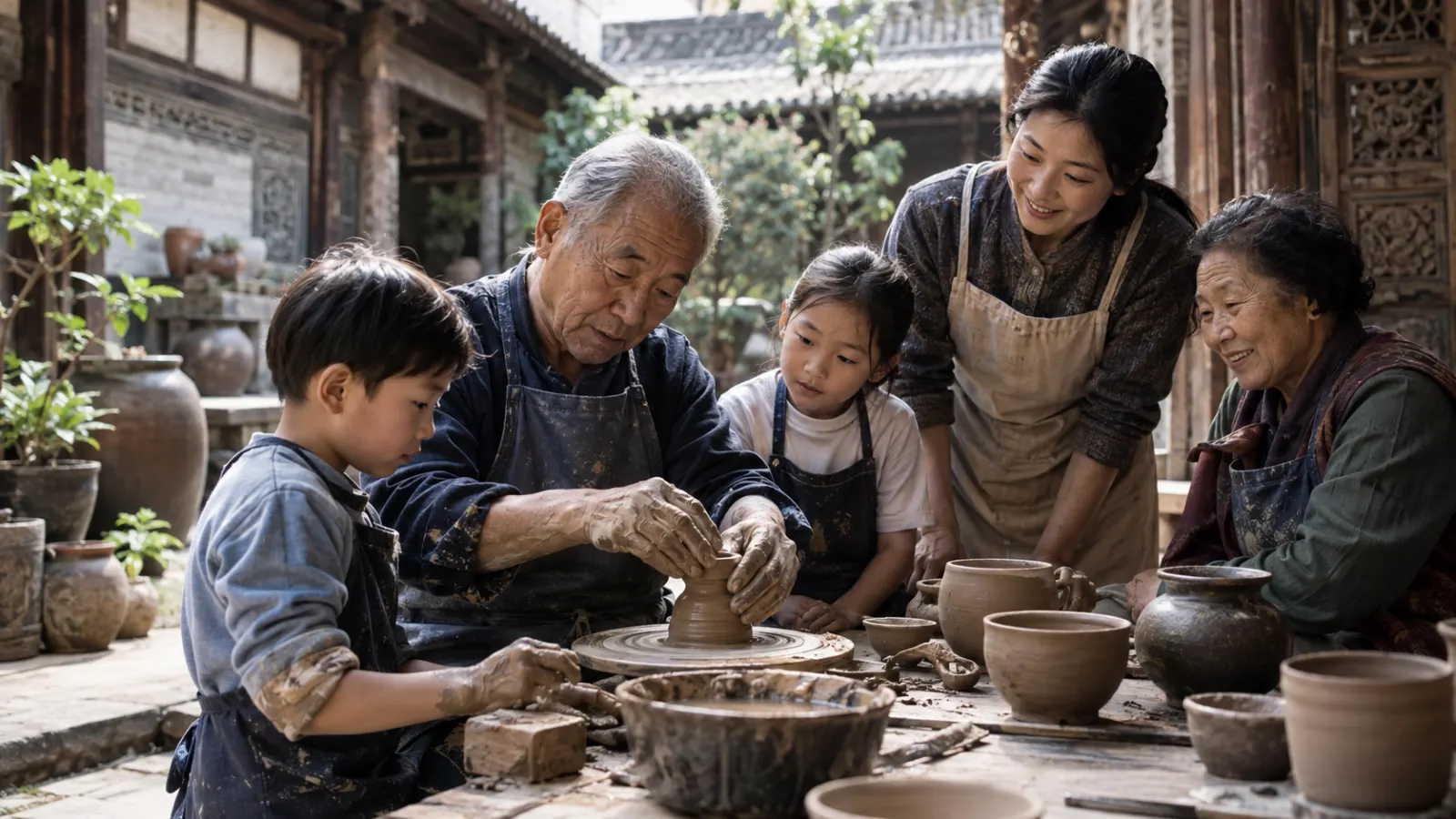
The craft economy reveals an even sharper contradiction. India loves the image of the artisan: the weaver at the loom, the potter at the wheel, the stone carver with inherited skill, the metalworker, the embroiderer, the woodworker, the musician, the performer. But admiration does not pay school fees. Tradition cannot survive if it is economically irrational for the next generation to inherit it. Official schemes such as PM Vishwakarma recognise the need to support traditional artisans and craftspeople through skill, recognition and market-related support. The underlying principle is correct: culture survives through livelihoods.
A civilisation that praises craft but buys only cheap machine-made substitutes is not preserving culture. A state that showcases artisans on national days but does not help them access design, credit, logistics, digital markets and fair pricing is performing respect. A middle class that wants handmade beauty without paying for labour is part of the problem.
The preservation of culture must therefore move from sentiment to value chains. Crafts need design schools, e-commerce support, export intelligence, GI protection where relevant, apprenticeships, public procurement and serious documentation. But they also need creative freedom. If every craft is fossilised as "traditional", artisans become museum employees. Living culture must be allowed to innovate without being accused of betrayal.
Cinema and OTT platforms have become another factory of culture
Cinema and OTT platforms have become another factory of culture. They can revive historical curiosity, regional memory and forgotten stories. They can also reduce culture to spectacle. A generation may learn more about a historical figure from a series than from a book. That is not automatically bad; popular culture has always shaped memory. But it requires a public capable of distinguishing artistic interpretation from historical conclusion.
India's problem is not that films take liberties. Art must have space. The problem is when audiences treat entertainment as evidence and when creators exploit historical wounds for easy emotional profit. If a society's historical education is weak, cinema becomes its textbook. That is too much power for any industry.
The same applies to postcolonial confidence. India is right to question colonial categories and recover indigenous frames of knowledge. But decolonisation cannot mean replacing one insecurity with another. A decolonised mind is not one that rejects everything Western. It is one that is no longer dependent on Western approval. It can learn from Europe, Japan, Africa, Latin America and Southeast Asia without imitation. It can criticise colonial violence without becoming intellectually provincial. It can present Indian knowledge to the world through evidence rather than exaggeration.
Here, again, science protects culture. Manuscripts must be preserved, translated and critically edited. Archaeological claims must be tested. Traditional medicine must be researched carefully. Architectural knowledge must be documented. Oral histories must be recorded. Music and performance traditions must be archived in high quality. None of this is anti-tradition. It is how tradition enters the future.
The family is the smallest cultural institution and perhaps the most neglected. We often speak of Indian culture in terms of monuments, festivals and civilisation. But culture is also how families treat daughters, sons, elders, workers, widows, inter-caste couples, disabled members and domestic labour. A society cannot claim cultural greatness only through temples and textiles while tolerating cruelty inside homes. Culture is not merely what we inherit. It is what we normalise.
This is why the debate on culture must include gender. MoSPI's Time Use Survey has shown the unequal burden of unpaid domestic and care work on women. That unpaid labour is not outside culture; it is culture in daily operation. If women carry the house invisibly while men inherit authority visibly, then culture has become a structure of inequality. Preserving culture cannot mean preserving unfairness. Article 51A's pairing of heritage with scientific temper and reform becomes important here. The Constitution asks us to preserve richness, not injustice.
Culture also needs institutions. Museums, libraries, archives, universities, local history centres, translation boards, conservation schools, craft clusters and municipal heritage cells are not luxuries. They are the infrastructure of memory. India has invested heavily in physical infrastructure. It must now invest as seriously in memory infrastructure. Otherwise we will have smoother roads to poorer cultural destinations.
The digital opportunity is enormous
The digital opportunity is enormous. India can create open heritage databases, virtual museum access, local language archives, 3D documentation of monuments, oral history repositories, craft process libraries and school-level heritage maps. PIB has noted wider adoption of scientific and digital tools in heritage documentation and conservation. Such tools can democratise access if they are built well. But digitisation must not become a substitute for physical preservation. A scanned manuscript does not save the library from neglect. A 3D model does not repair the wall.
The editorial judgement is this: India is not suffering from lack of cultural pride. It is suffering from under-institutionalised cultural responsibility. We have pride in abundance, but pride is cheap if it does not pay for conservation, translation, research, training and fair livelihoods. We have civilisational vocabulary, but vocabulary cannot replace governance.
To build civilisation faster than culture can be preserved is to risk becoming impressive and hollow at the same time. The airport will function, the corridor will shine, the skyline will rise, but the language of the street, the skill of the hand, the memory of the neighbourhood and the complexity of the past may quietly thin out.
India must modernise. But it must not become culturally amnesiac in the process. The aim is not to slow progress. The aim is to deepen it. A country that builds roads to heritage sites must also build the capacity to protect them. A country that promotes tourism must also protect residents. A country that celebrates artisans must also secure their incomes. A country that praises languages must also produce knowledge in them. A country that invokes civilisation must also reform the injustices hidden inside culture.
Civilisation is what we build. Culture is what builds us. India can afford to lose neither. But if it keeps confusing the two, it may one day discover that it has constructed a grand house while forgetting the music, memory and moral discipline that made it a home.
The policy implication is that every major development project should have a cultural impact lens, just as it has financial, environmental and technical assessments. This does not mean every old structure must be preserved at any cost. It means decision-makers should ask what cultural ecosystem is being altered. Who lives there? What skills are practised? What languages dominate the street? What ritual routes exist? What informal economies depend on the location? What will be lost if relocation is purely physical and not social?
Museums also need reinvention. A museum cannot remain a hall of objects behind glass. It must become a space of interpretation. India needs museums that tell stories of labour, migration, science, textiles, food, oceans, rivers, political ideas, constitutional change, cinema, music, caste reform, women's movements and regional worlds. A child should leave a museum feeling that history was lived by people, not only ruled by kings. Modern museum design, digital tools and local language interpretation can make heritage democratic rather than elite.
The same applies to schools
The same applies to schools. Every district should have a local history curriculum module. Children should know the river, fort, craft, market, shrine, industrial history, migration story and ecological memory of their own region. National history without local anchoring becomes abstract. Local history without national perspective becomes narrow. A good education connects both. It tells a child: your lane is part of civilisation, but civilisation is larger than your lane.
Cultural preservation also requires market honesty. If the state wants artisans to survive, procurement policies should buy from them fairly. If urban consumers want handmade products, they must accept that dignity has a price. If designers collaborate with craft communities, credit and revenue must be shared. If tourism departments use folk performers for branding, those performers need contracts, insurance, training and continuity, not one-day visibility.
Finally, cultural confidence must include reform. Not everything inherited deserves preservation. Practices that humiliate, exclude or exploit cannot hide behind tradition. The test is not whether a practice is old, but whether it carries human dignity. A living culture has the courage to edit itself. India must preserve memory, not injustice. It must carry forward beauty, skill, language and wisdom while refusing cruelty, hierarchy and superstition.
That is the only sustainable way to be both ancient and modern. Not by choosing between the expressway and the old road, but by ensuring that the expressway does not erase the memory of where the old road led.